Landing page feedback: Tracetics — funnel analytics for indie devs
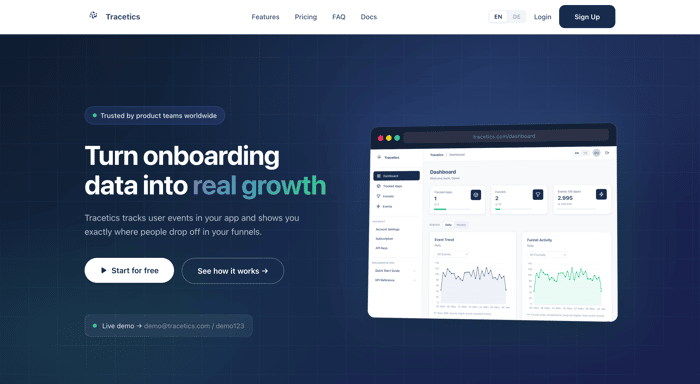
Hey IHs,
I built Tracetics out of frustration with Mixpanel's pricing. The landing page is at tracetics.com - there's also a live demo (no sign-up needed): demo@tracetics.com / demo123
Looking for honest feedback on:
- Is it immediately clear what the product does?
- Does the hero speak to developers or does it feel too generic?
- What would stop you from signing up?
Don't hold back.

I think the page is close, but the biggest question is positioning.
Your IH post says Tracetics came from frustration with Mixpanel pricing, but the page seems to lead more with onboarding and activation. Those are related, but they sell to slightly different buying moments.
If I were tightening this page, I would test:
I do compact teardown audits like this for $10: 5 ranked fixes, one rewritten headline/CTA, and the first thing I would change.
The page immediately answers what it does — "find out where your onboarding breaks" is concrete and I got it in 3 seconds. That directly addresses your question 1.
But there's a tension worth flagging: the hero commits hard to onboarding ("onboarding" appears three times in two sentences, and the Features H2 says "optimize onboarding and activation"). Your post here positions Tracetics as a Mixpanel alternative built out of frustration with their pricing. Those are two different products — one is an onboarding/activation tool, the other is general product analytics with a price advantage. The page has picked the narrow one. If Mixpanel-alternative is what you actually want to sell, the hero is leaving a bigger market on the table. If onboarding-specific is the real positioning, the IH post is undersell.
One smaller thing: "One HTTP POST to get started" is the strongest line on the entire page for a developer audience. It currently sits in the subhead. Most dev-tool pages would lead with it.
On your question 3 (what would stop me signing up) — honestly, nothing major that I can see from the landing page alone. The free plan + no credit card + 5-min integration trio does the work.
Leading with the 'onboarding leak' rather than the HTTP POST is a smart pivot. Most developers don't care how the data gets there until they're convinced you can tell them why their users are dropping off.
Since you're already refining the hook for Tracetics and have a live demo ready to go, you should battle-test your conversion strategy in the Validation Arena (tokyolore.com).
$19 to enter, 30 days to prove your 'lean' analytics can actually steal market share.
$0 pool right now, and the winner gets a Tokyo trip! 🏆
The headline sells the integration, not the pain.
"Funnel analytics that fit in one HTTP POST" leads with HOW it works before the visitor has decided they want it. A developer evaluating analytics tools isn't searching for "fits in one HTTP POST." They're thinking "I don't know where my onboarding is breaking and I need to find out fast." The differentiator is real, but it answers the wrong question first.
There's no customer evidence anywhere on the page.
No testimonials, no logos, no case studies. For a dev tool entering a market with Mixpanel, PostHog, and Amplitude, that trust vacuum is loud. "Real-time event tracking" and "GDPR-ready" are table stakes that every competitor claims. Without at least one real team saying what changed after they integrated, the feature list reads as assertions, not proof.
The pricing descriptions don't help the right buyer self-select.
Starter is "ideal for small teams and growing products." Pro is "built for teams managing multiple apps or higher traffic volumes." Premium is "for established products." Those three descriptions could each apply to the same company at the same stage depending on how they interpret themselves. There's no concrete trigger — a number, a scenario, a named problem — that makes a visitor say "that one's obviously mine."
These are the three that jumped out immediately. There are usually more. Drop your URL at https://briefd.it and I'll send the full breakdown free, PDF in your inbox.
Good points, especially on the headline. Leading with the pain before the integration mechanic makes more sense — will update.
On social proof: fair, but I'm early enough that I'd rather wait for real evidence than manufacture it.
Thanks for the detailed look.