Launching Cartesiano.ai
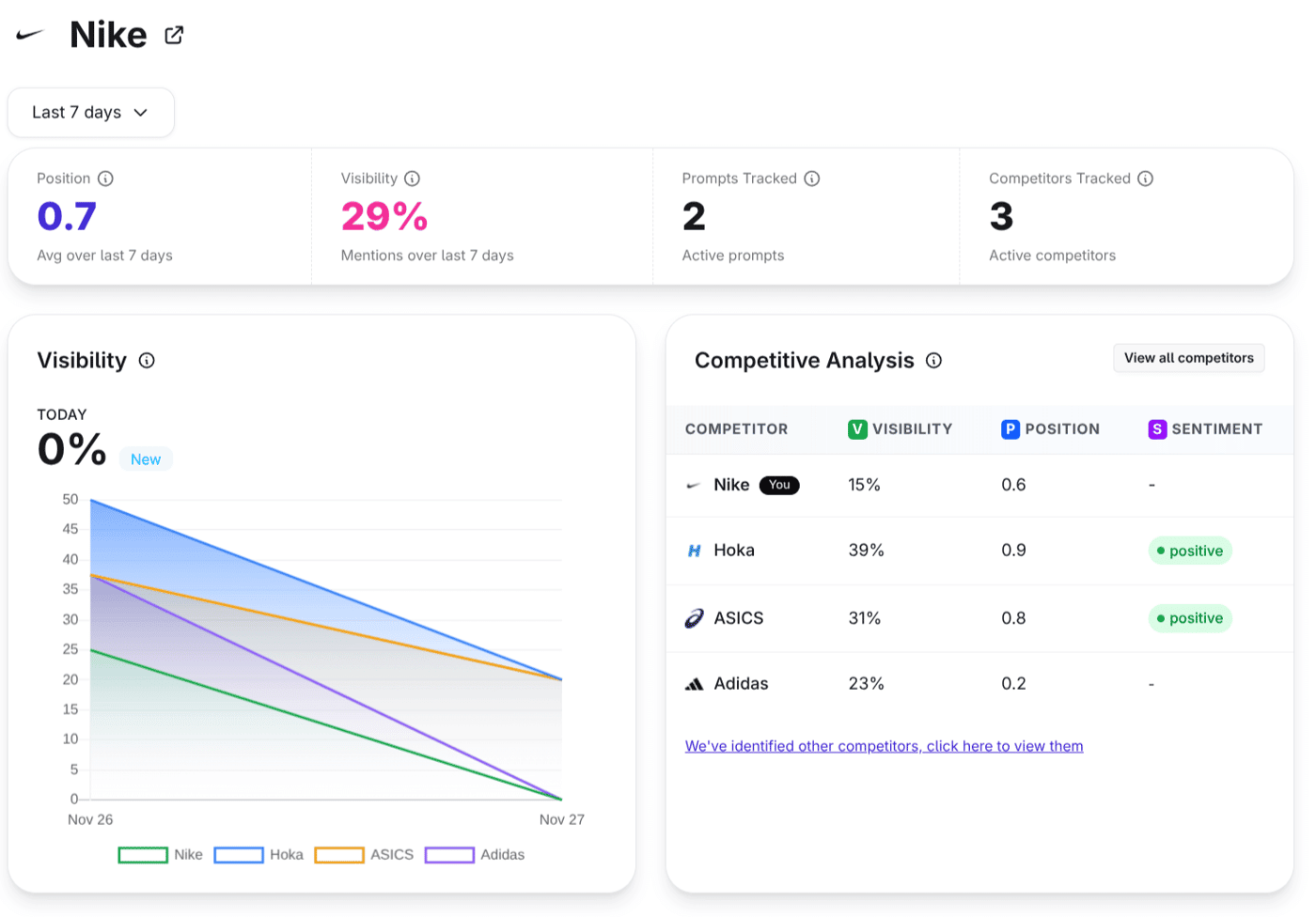
I'm very happy to launch Cartesiano.ai, a service which allows companies to track their presence across different LLMs.
There's been a few products popping up in this space the past 12 months, so the idea itself is not new, but there isn't a clear market winner yet, and most have either been backed heavily by VCs and/or are meant for more corporate users, so I'm betting on there being space for more competitors!
The Problem
Say for example you are Nike and notice that some of your inbound traffic is no longer coming from just Google, but ChatGPT. However, ChatGPT and other LLMs don't currently offer any form of analytics into what users are asking when it recommends your company or products.
To solve this, we try to think of what our target users might be asking (their prompts). So an LLM recommending Nike for example, might be the result of a user asking "What are the best marathon". With Cartesiano.ai, you can track these prompts across different LLMs, and track, over time, how often your brand/product is being mentioned, its ranking compared to other competitors, and its sentiment. It can also automatically detect new competitors you may not be aware of.
Why did I build it?
I built it because I was both looking for a side-project idea where I would have to work directly with LLMs, and one where there was already proof that a market need existed for it.
Tech-stack
From the tech-side, I've built this using:
Ruby on Rails 8 for the main user-facing web app.
Python + FastAPI + LiteLLM for the LLM processor application, which basically handles running the prompts through the different LLM providers (ChatGPT, Gemini, etc.), parsing the responses, normalizing the data, detecting sources, competitors, etc.
PostgreSQL as the main database
Hetzner for hosting (2 servers, one for the Rails and Python apps, another dedicated one for the self-hosted PostgreSQL database)
If anyone is reading this and interested in more of the tech-side, let me know and I can write a more in-depth post on it!


I like the direction this is going. There’s a big difference between tools that automate and those that actually help you think better about data. A lot of AI dashboards feel like they add layers of complexity instead of clarity, so something that’s genuinely intuitive is refreshing.
Curious how it handles edge cases where the data isn’t clean or is just plain noisy. Has anyone here used it in those kinds of situations?
Great product! I'm wondering whether there's a strategy for adding a product to Ais?
Hi Eve, there’s no way to explicitly “force” your product into AI search engines (ChatGPT, Gemini, etc.). Just like traditional SEO, the core strategy is creating genuinely useful content and optimizing your website. The difference with AI is that you also need to make your site easier for LLMs to parse and understand, which mostly comes down to better data structure and clarity. I wrote a blog post about it here: https://blog.cartesiano.ai/2025/12/06/how-to-make-your-website-llm-friendly/