Luck sides with those who refuse to give up when it makes absolutely no sense to keep going
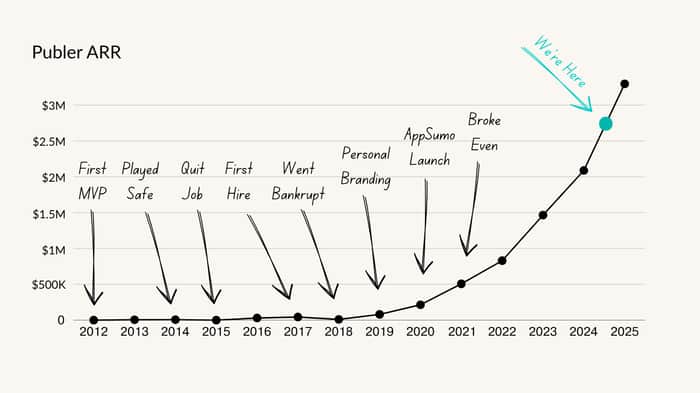
https://publer.com/blog/the-publer-story-from-0-to-3m-arr/
And to think that 7 years ago, I was seeking comfort from strangers on Indiehackers:
https://www.indiehackers.com/forum/how-long-do-tough-times-last-09016c0f7f

What actually makes persistence productive vs just painful is having a system that shows you what's working before you feel it.
The founders who 'refuse to give up' and win aren't just more stubborn - they're usually tracking signals that justify staying in the game. A comment that got traction, a user who came back unprompted, a revenue metric that ticked up even slightly. Without a dashboard showing those signals, you're not persisting on signal - you're persisting on hope.
The ones who burn out don't lack resilience. They lack visibility. They're working hard in the dark and eventually the silence feels like a verdict. The fix isn't more motivation - it's building the operational layer that makes progress visible before it becomes obvious.
The persistence framing is true, but I think what actually separates the founders who push through from those who quit at the wrong time is: having a decisions framework.
Most founders either give up too early (when it's just hard, not wrong) or too late (when the signal is clearly bad but sunk cost keeps them going). Both failures look like bad luck but are really bad decision architecture.
What actually helps: a decisions log where you write down the reasoning behind major calls when you make them, not just track the outcomes. When you can read back what you were thinking 90 days ago - what signals you had, what you predicted, what assumptions you were making - you can actually learn. Without that, you just have vibes about whether to keep going.
I've been building this into a Solopreneur OS: the decisions log is one of six modules (alongside CRM, pipeline, revenue dashboard, client portal, weekly review). It's the layer that makes persistence strategic rather than emotional.
What's the decision-making process look like for you when nothing makes sense but you're still going - pure gut, or do you have a framework you return to?
The 'refuse to give up' framing is true but incomplete. The founders who outlast aren't the ones who never want to quit - they're the ones who have a clear, pre-agreed reason to keep going vs. a clear, pre-agreed reason to stop.
Without pre-set criteria, 'keep going' and 'quit' both become emotional decisions. You keep going when you feel good about it and quit when you feel bad. That's not resilience, it's mood-driven randomness.
The system that actually works: before you start anything, write down the specific signals that would tell you it's working and the specific signals that would tell you to stop. Not 'I'll know it when I see it' - actual thresholds. Then when you hit the hard period, you're running a test not surviving a feeling.
I've been building a Decisions Log into the Solopreneur OS I'm creating in Notion for exactly this: every project has a pre-written hypothesis and kill criteria. Makes the 'should I keep going?' question a 5-minute check rather than a 2-week spiral.
What was the specific signal that told you to keep going in your hardest period - data, a single conversation, or something else?
The “refuse to give up when it makes no sense” phase is real — and it’s exactly when most people bail, which is precisely why it’s a filter. The ones who stay aren’t necessarily more talented; they’ve just internalized that early traction is almost never proportional to effort.
I’m in that phase right now with flompt — a visual prompt builder for Claude that I built solo. Usage is growing but stars are lagging. Classic open-source problem: people use it but don’t realize the star matters to the builder.
A ⭐ on github.com/Nyrok/flompt would mean a lot — solo open-source founder here 🙏