Mobile App Development Is Changing: The Shift From Features to Experiences
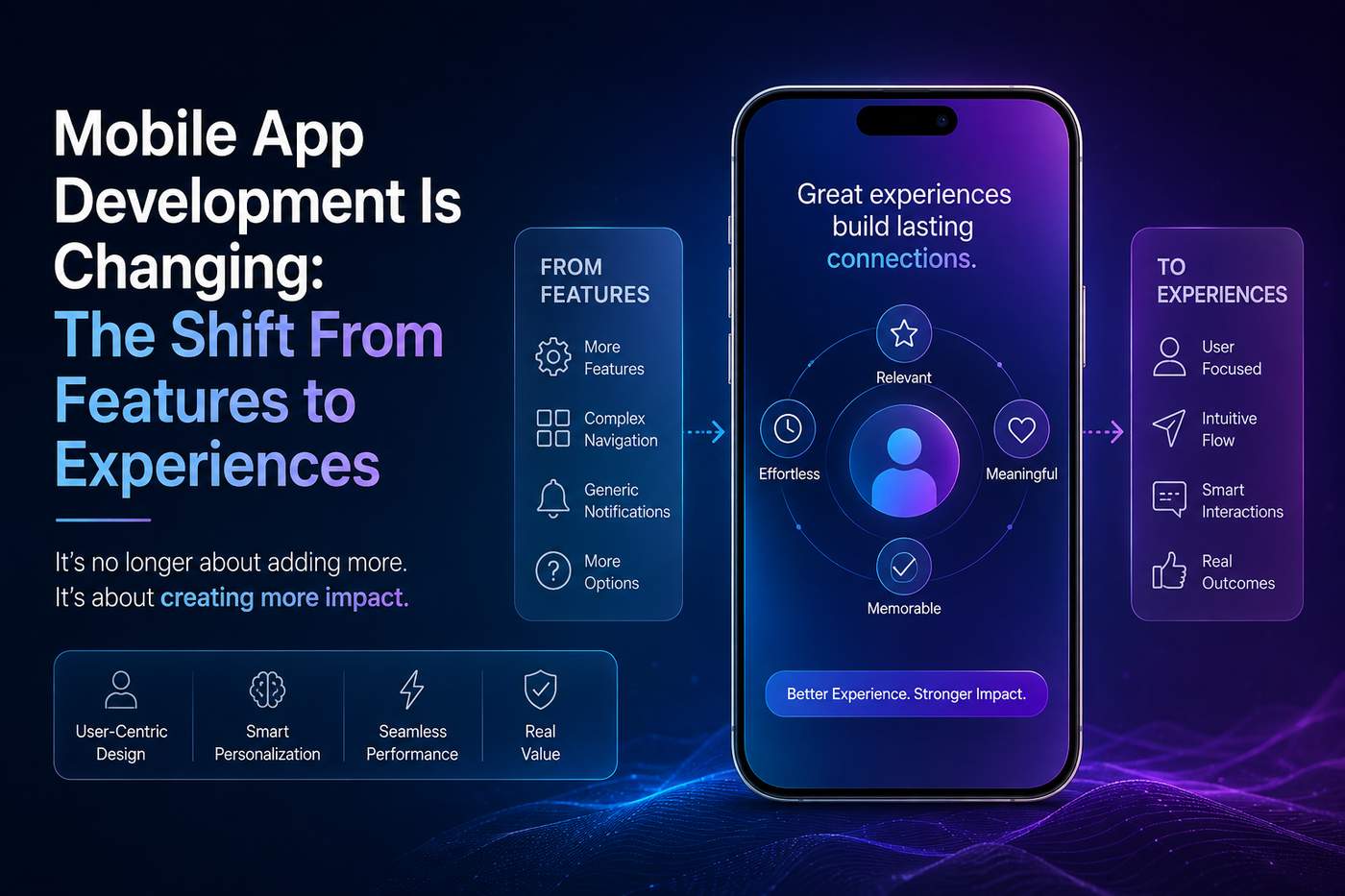
Mobile apps have come a long way. A few years ago, businesses mainly competed by adding more features, more screens, and more functionality to their applications. Today, that approach is changing.
Users are no longer impressed simply because an app has a long list of features. They want apps that are fast, intuitive, personalized, reliable, and easy to use. In other words, the focus is moving from what an app can do to how well it helps people accomplish what they want.
This shift toward experience-driven development is becoming one of the most important changes in the mobile app industry.
From Feature-Rich Apps to Experience-Driven Apps
Traditionally, app development often followed a simple formula: identify competitors' features, add a few more, and launch.
That worked when mobile apps were still relatively new. Today, almost every category is crowded. Banking apps offer similar services. Shopping apps have similar checkout processes. Productivity apps often provide overlapping functionality.
As features become easier to replicate, the user experience becomes a stronger differentiator.
Businesses investing in mobile app development services should therefore focus on the complete user journey rather than simply creating a long feature list.
A successful app should answer questions such as:
Can users find what they need quickly?
Does the app reduce unnecessary steps?
Does it understand the user's context?
Is information presented at the right time?
Does the experience feel consistent across devices?
Can users accomplish their goals without unnecessary friction?
Why More Features Do Not Always Mean More Value
Adding features sounds like progress, but more functionality can sometimes make an app harder to use.
Every additional feature can introduce another menu, setting, notification, decision, or interaction. On a small mobile screen, this can quickly create cognitive overload.
Users typically open an app because they have a specific goal. They may want to transfer money, order food, check an appointment, track a delivery, or complete a work task.
If an app makes that goal difficult because users have to navigate through unnecessary options, the number of features becomes irrelevant.
The goal should not be to create the biggest app. It should be to create the most useful experience.
AI Is Making Apps More Intelligent
One of the biggest drivers behind this shift is artificial intelligence.
AI allows mobile applications to become more responsive to individual users. Instead of waiting for users to manually find everything, applications can analyze context and help surface relevant information or actions.
For example:
A banking app can identify unusual transactions.
A healthcare app can provide timely reminders.
A shopping app can personalize recommendations.
A productivity app can summarize information or automate repetitive work.
A customer service app can provide conversational assistance.
However, AI should not be added simply because it is popular. Its real value comes from reducing effort and improving the experience.
Personalization Is Becoming the New Standard
People increasingly expect digital products to understand their preferences.
Personalization can influence:
Content recommendations
Product suggestions
Notifications
Search results
App navigation
Offers and promotions
User support
However, personalization needs to be useful rather than intrusive. Users should feel that the application is helping them, not constantly monitoring them.
This makes responsible data use, privacy, transparency, and security essential parts of modern app development.
Simplicity Is Becoming a Competitive Advantage
Good mobile experiences often feel simple even when the technology behind them is complex.
Instead of presenting every capability immediately, apps can introduce functionality when it becomes relevant. Instead of asking users to complete long onboarding processes, apps can allow them to experience value quickly.
The goal is not necessarily fewer features. The goal is less unnecessary effort.
This is an important consideration for businesses choosing mobile app development services for a new product. A powerful backend, sophisticated AI model, or extensive feature set will not compensate for an experience that frustrates users.
Cross-Platform Experiences Matter More
Users do not necessarily interact with a company through one device anymore.
They may start a task on a smartphone, continue it on a laptop, receive a notification on a smartwatch, and complete it through another channel.
As a result, businesses increasingly need to think beyond a single mobile application.
Cross-platform development can help teams create consistent experiences across different platforms while reducing development complexity.
The real objective, however, should not simply be to build everywhere. It should be to create a consistent experience wherever the customer interacts with the product.
What Businesses Should Consider When Building a Mobile App
Businesses planning a new mobile application should start with the user problem rather than a feature list.
1. What problem are we solving?
A clear problem creates a stronger foundation than a collection of interesting features.
2. What is the most important user journey?
Identify the action users need to complete most often and make it as simple as possible.
3. Where can AI genuinely help?
AI should reduce effort, improve personalization, automate repetitive work, or provide useful intelligence.
4. What information does the app really need?
Collecting unnecessary data can create privacy, security, and trust issues.
5. How will the experience evolve?
Mobile products need continuous improvement. User feedback, analytics, performance data, and behavior patterns should inform future development.
The Future of Mobile App Development
The future of mobile apps is not necessarily about having more capabilities. It is about delivering greater value with less effort.
AI, personalization, voice interfaces, cross-platform development, real-time capabilities, and stronger privacy practices are influencing how modern applications are designed.
For businesses, this means the development process needs to change too. Product teams, designers, developers, and business leaders need to work together from the beginning to understand the complete customer experience.
The question is no longer:
"How many features can we put into our app?"
A better question is:
"How can we make the user's experience easier, faster, and more valuable?"
That is the shift shaping the next generation of mobile app development.
Apps that understand this difference will have a better opportunity to build lasting user relationships, while apps that continue competing only through feature counts may struggle to stand out in an increasingly crowded market.

