Most B2B companies know their customers only by name and email.

At Multify, we go far beyond that.
Introducing Identity Mapper.
Simply give our AI Agent a customer’s full name and email (plus any optional context you want).
The Agent then intelligently searches the entire web and instantly returns:
- All their social profiles (LinkedIn, Instagram, X, GitHub, personal website, ORCID…)
- Rich AI Insights about their background, interests and current focus
- Ready-to-use conversation starters tailored to who they really are
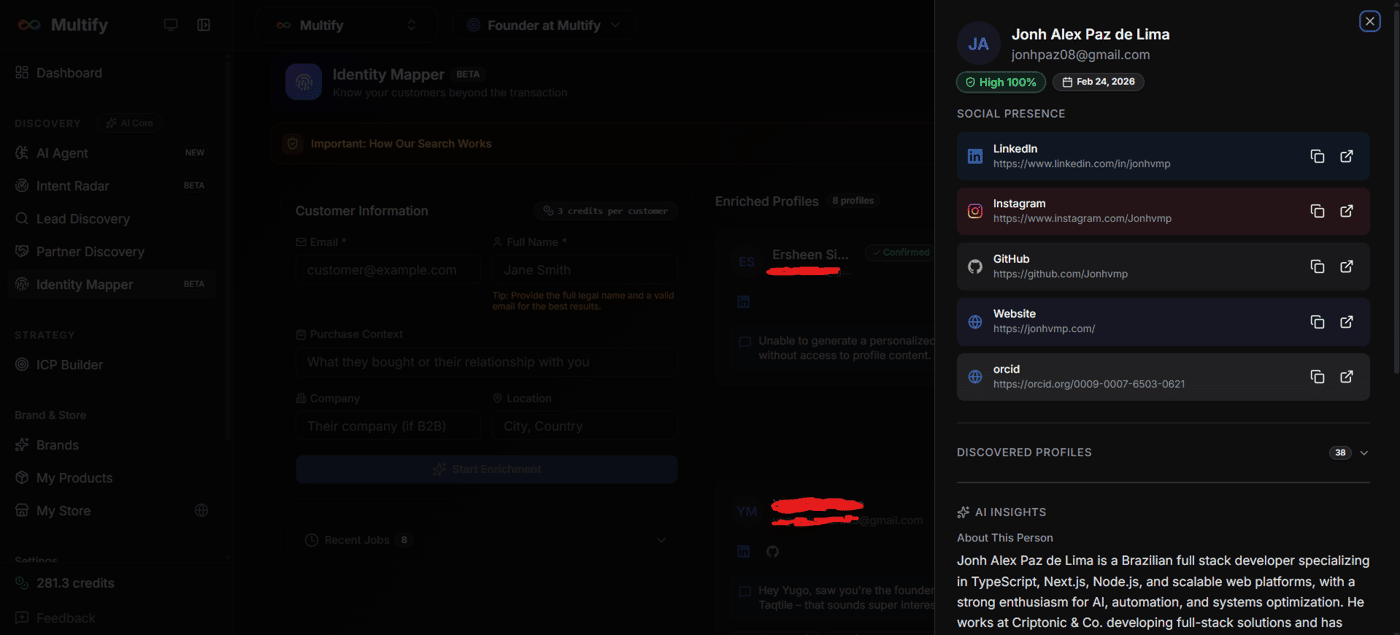
No manual searching. No guessing.
Now your specialized AI agents can start real, contextual conversations with existing and past customers — all through simple chat.
The results?
→ Dramatically lower churn
→ Lightning-fast and honest product feedback
→ Much stronger B2B relationships at scale
In 2026, acquiring new customers is only half the battle.
The real advantage comes from truly knowing the ones you already have.
Identity Mapper is live inside Multify.
How well do you really know your existing customers today?
Drop your thoughts below 👇


This is actually a huge blind spot in B2B.
Most companies think they “know their customers” because they have a CRM with names, emails, and maybe a company size field.
That’s not understanding a business. That’s a contact list.
What actually matters is operational context.
Things like:
• Are they growing or slowly dying
• Are they hiring or laying people off
• What tools they’re already paying for
• Whether their website is actually converting
• If their tech stack is modern or 10 years outdated
Those signals tell you where the real business pain is.
Once you see that, sales stops being:
“Hey do you want to buy my product?”
and becomes
“Hey, I noticed you're bleeding revenue here.”
That’s a completely different conversation.
I’ve been building something around this idea that analyzes companies across a few pillars (sales, marketing, infrastructure, growth signals) and surfaces where they’re probably leaving money on the table.
It’s honestly wild how obvious the gaps become once you look at companies this way.
Curious how other founders here approach company intelligence vs basic CRM data when doing B2B outreach.
This is a smart evolution. Most SaaS teams treat customer data as static CRM fields when the real leverage is dynamic context.
Identity enrichment becomes powerful when it moves beyond “interesting insights” and directly informs lifecycle orchestration — onboarding nudges, expansion timing, churn prevention, even content personalization.
One question I’m curious about:
How are you validating signal accuracy at scale? The quality of enrichment will ultimately determine whether this drives trust or just more automated noise.
On a related note, I’ve been working on retention-driven growth loops where enriched identity data feeds into usage-based triggers to increase expansion revenue and reduce churn. If you’re exploring that layer next, I’d be interested in exchanging insights.