My Google Rankings Were Fine — So Why Was My Organic Traffic Dropping?
Posted to Indie Hackers · April 2026
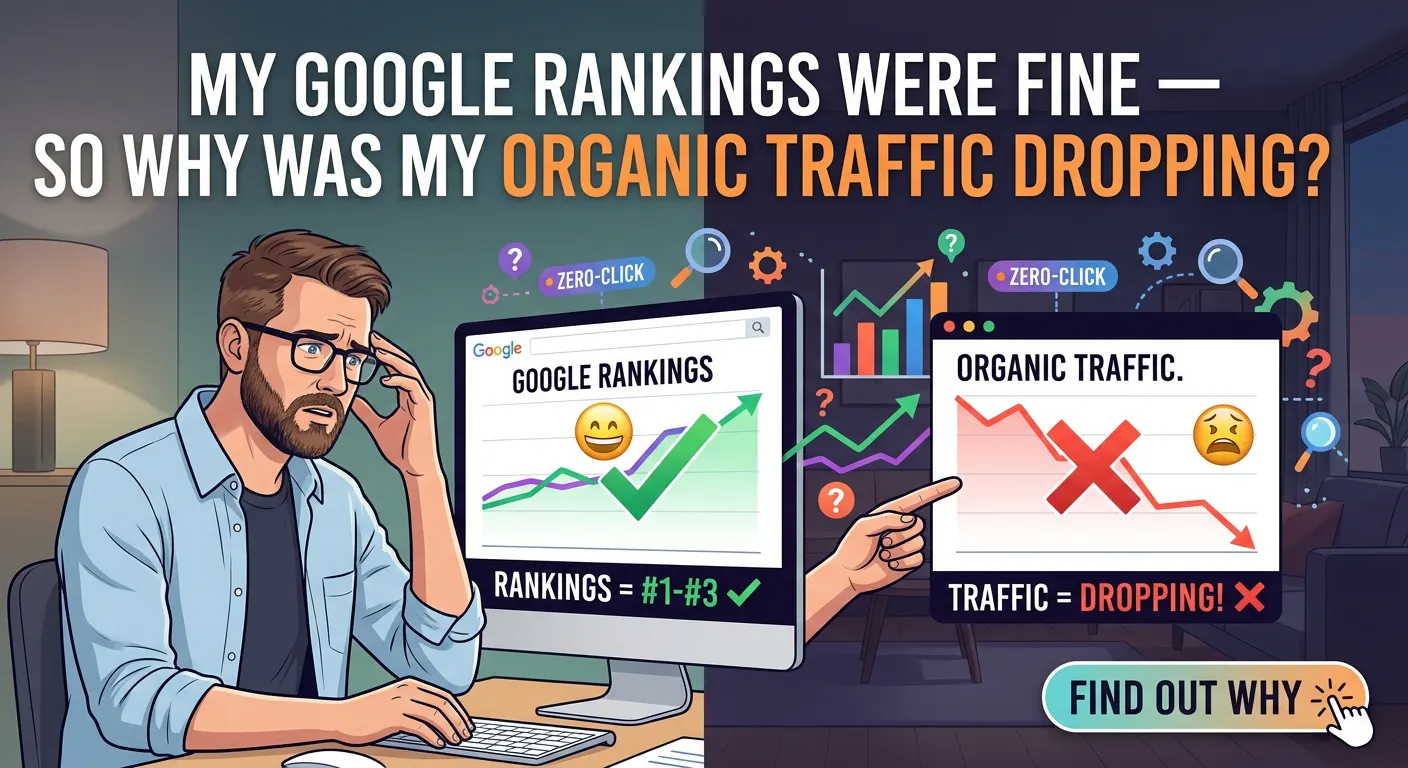
For about three months I kept checking the same dashboard and seeing the same contradiction.
Keyword rankings: stable. Traffic: declining. No algorithm penalty. No technical issues. Nothing obviously broken.
I spent longer than I want to admit trying to explain it with the tools I already had. Checked backlinks, crawl errors, page speed. All fine. The traffic drop was real and my existing toolset had no explanation for it.
Eventually someone in a Slack community I'm in said something that reframed the whole thing in about ten seconds.
"Are you tracking whether you're showing up in AI-generated answers? Because that's where a chunk of your clicks are going now."
I was not. I had no idea how to. And that turned out to be the entire problem.
What was actually happening
AI-generated search answers — Google's AI Overviews, ChatGPT responses, Perplexity summaries — now sit above traditional organic results for a significant portion of informational queries. When someone gets a complete answer from an AI assistant they frequently do not click through to any website at all.
If your content is being cited in those answers you still get brand exposure and some traffic. If your content is being ignored in favour of a competitor's you lose clicks on queries you technically rank for. Your position on the results page is unchanged. Your actual visibility is lower.
Traditional SEO ranking tools measure the first thing. None of them were measuring the second. That was my gap.
The tool that actually addressed this
aiseoradar.com is built specifically around this problem. The positioning is direct: an AI search visibility platform for the shift from traditional link-based search to generative AI responses.
The core concept is AI Share of Voice — how often your brand is being cited or recommended in AI-generated answers compared to your competitors. Not ranking position. Not domain authority. Actual presence in the conversations your potential customers are having with AI assistants.
The platform also surfaces LLM Citation Gaps — the specific queries where your content should logically be cited but is not. For anyone building a content strategy that is supposed to generate organic discovery, that gap is the actual thing worth fixing. It is a more actionable problem statement than "my traffic is down."
What made me take it seriously rather than dismiss it as another rebrand of existing SEO tools was the 5-Bot AI Indexing Pipeline — the platform validates your content across multiple frontier models simultaneously rather than sampling one model on one day. That gives you a more reliable picture of where you actually stand across the AI search landscape rather than a snapshot that might not generalise.
What I found when I ran my site through it
The results were clarifying in a way that months of checking traditional dashboards had not been.
Several competitor pieces were appearing in AI responses for queries I ranked for on Google. My content was being passed over not because it was worse on traditional ranking signals but because it was structured in ways that made it harder for language models to parse and reference accurately.
The AI SEO audit also flagged something I had not considered — how automated scripts and certain technical patterns can affect how AI models interpret site signals. The Security-First SEO layer the platform includes addresses what they describe as Query Injection risks, which is a threat vector I had genuinely not been aware of before.
Knowing specifically which pages had these issues, and which competitor content was winning the citations I was missing, turned a vague traffic problem into a concrete list of things to fix.
The broader shift this points to
The reason I'm writing this here rather than keeping it to myself is that I think a lot of people in this community are going to hit the same moment I did — a real traffic decline with no traditional SEO explanation — and spend weeks looking at the wrong metrics.
Answer engine optimisation and generative search visibility are not future concerns anymore. They are present-day factors for anyone running a content-driven product or service. The tooling to measure and address them now exists.
aiseoradar.com is built for the version of search that exists in 2026 rather than the one that existed in 2022. For anyone whose growth depends on organic discovery that distinction is starting to matter in very practical terms.
Link: aiseoradar.com
Has anyone else been dealing with traffic declines that traditional SEO tools cannot explain? Curious whether others are tracking AI visibility yet or still figuring out where to start.
Tags: SEO, AI tools, organic growth, content marketing, founder tools, search visibility, generative AI, indie business, AI search

