
AI SEO Radar
See how businesses are using AISEORadar to gain visibility a

We’ve all been there. You wake up, check your dashboard, and see a 20% dip in organic traffic. You haven't touched the site in a week. You haven't changed a single keyword. You start spiraling: Was it a core update? Did my competitor buy a bunch of backlinks? Did I accidentally "noindex" my landing page during a late-night push?
For most indie hackers, SEO feels like a "black box"—you put content in, and you hope rankings come out. But when things go wrong, the lack of visibility is what kills your productivity. You waste days "fixing" things that aren't actually broken.
Here is the deep, realistic truth: SEO isn't about being the best; it's about being the most consistent and catching errors before they become trends.
The "Silent" SEO Killer
The most dangerous threats to your traffic aren't usually competitors—they are technical regressions.
A plugin update that rewrites your
robots.txt.A theme change that accidentally hides your H1 tags.
A team member (or your past self) tweaking a high-performing post and inadvertently stripping the "semantic keywords" that were doing the heavy lifting.
I realized I didn't need another rank tracker. I needed change intelligence.
Why I Integrated AI Monitoring
I started using AI SEO Radar because I needed a "Git Diff" for my website’s SEO. Instead of guessing why a page dropped, I can now see the exact delta between "Ranking #1" and "Ranking #10."
This isn't about chasing the algorithm; it's about Content Integrity. When you’re running a lean operation, you don't have the luxury of an SEO agency. You need a system that alerts you when:
Critical elements change: Did your title tags or meta descriptions disappear?
Content Decay sets in: Is your competition updating their stats while yours are two years old?
The SERP layout shifts: Did Google move the goalposts with a new AI summary?
The Reality of Modern Search
In 2026, Google is looking for Authoritative Stability. If your site is constantly flickering with technical errors or stale content, you’re flagged as "unreliable."
The goal for any indie hacker should be to automate the "boring" part of SEO—the monitoring and auditing—so you can focus on the "creative" part: building features that people actually want to talk about.
My Minimalist SEO Stack:
Search Console: For the raw data.
Ahrefs/Semrush: For keyword research (used sparingly).
AI SEO Radar: For SEO Disaster Prevention and monitoring competitor maneuvers.
The take-away: Don't let your SEO be a mystery. Treat your content like your code—monitor it, version it, and get alerted the second something breaks.

Posted to Indie Hackers · April 2026
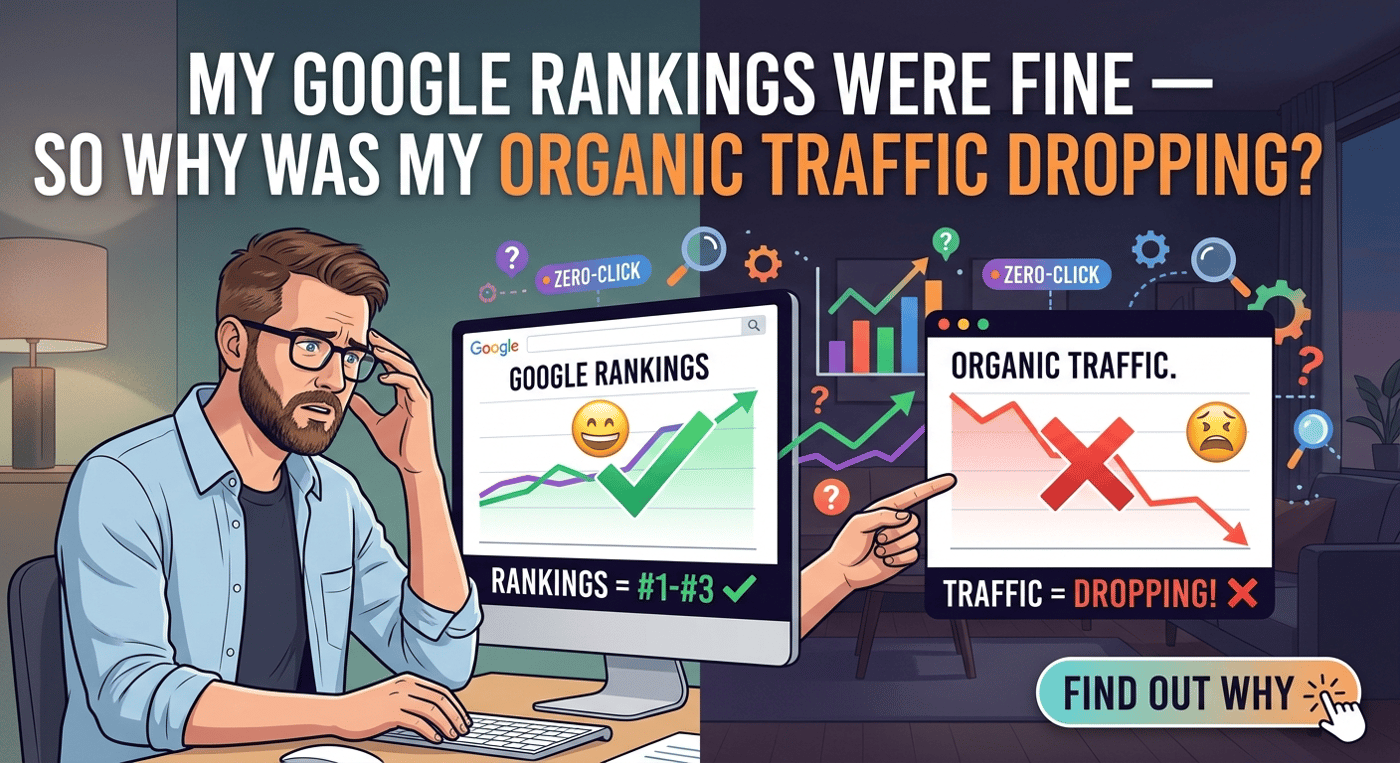
For about three months I kept checking the same dashboard and seeing the same contradiction.
Keyword rankings: stable. Traffic: declining. No algorithm penalty. No technical issues. Nothing obviously broken.
I spent longer than I want to admit trying to explain it with the tools I already had. Checked backlinks, crawl errors, page speed. All fine. The traffic drop was real and my existing toolset had no explanation for it.
Eventually someone in a Slack community I'm in said something that reframed the whole thing in about ten seconds.
"Are you tracking whether you're showing up in AI-generated answers? Because that's where a chunk of your clicks are going now."
I was not. I had no idea how to. And that turned out to be the entire problem.
What was actually happening
AI-generated search answers — Google's AI Overviews, ChatGPT responses, Perplexity summaries — now sit above traditional organic results for a significant portion of informational queries. When someone gets a complete answer from an AI assistant they frequently do not click through to any website at all.
If your content is being cited in those answers you still get brand exposure and some traffic. If your content is being ignored in favour of a competitor's you lose clicks on queries you technically rank for. Your position on the results page is unchanged. Your actual visibility is lower.
Traditional SEO ranking tools measure the first thing. None of them were measuring the second. That was my gap.
The tool that actually addressed this
aiseoradar.com is built specifically around this problem. The positioning is direct: an AI search visibility platform for the shift from traditional link-based search to generative AI responses.
The core concept is AI Share of Voice — how often your brand is being cited or recommended in AI-generated answers compared to your competitors. Not ranking position. Not domain authority. Actual presence in the conversations your potential customers are having with AI assistants.
The platform also surfaces LLM Citation Gaps — the specific queries where your content should logically be cited but is not. For anyone building a content strategy that is supposed to generate organic discovery, that gap is the actual thing worth fixing. It is a more actionable problem statement than "my traffic is down."
What made me take it seriously rather than dismiss it as another rebrand of existing SEO tools was the 5-Bot AI Indexing Pipeline — the platform validates your content across multiple frontier models simultaneously rather than sampling one model on one day. That gives you a more reliable picture of where you actually stand across the AI search landscape rather than a snapshot that might not generalise.
What I found when I ran my site through it
The results were clarifying in a way that months of checking traditional dashboards had not been.
Several competitor pieces were appearing in AI responses for queries I ranked for on Google. My content was being passed over not because it was worse on traditional ranking signals but because it was structured in ways that made it harder for language models to parse and reference accurately.
The AI SEO audit also flagged something I had not considered — how automated scripts and certain technical patterns can affect how AI models interpret site signals. The Security-First SEO layer the platform includes addresses what they describe as Query Injection risks, which is a threat vector I had genuinely not been aware of before.
Knowing specifically which pages had these issues, and which competitor content was winning the citations I was missing, turned a vague traffic problem into a concrete list of things to fix.
The broader shift this points to
The reason I'm writing this here rather than keeping it to myself is that I think a lot of people in this community are going to hit the same moment I did — a real traffic decline with no traditional SEO explanation — and spend weeks looking at the wrong metrics.
Answer engine optimisation and generative search visibility are not future concerns anymore. They are present-day factors for anyone running a content-driven product or service. The tooling to measure and address them now exists.
aiseoradar.com is built for the version of search that exists in 2026 rather than the one that existed in 2022. For anyone whose growth depends on organic discovery that distinction is starting to matter in very practical terms.
Link: aiseoradar.com
Has anyone else been dealing with traffic declines that traditional SEO tools cannot explain? Curious whether others are tracking AI visibility yet or still figuring out where to start.
Tags: SEO, AI tools, organic growth, content marketing, founder tools, search visibility, generative AI, indie business, AI search
For years, the playbook for indie hackers was simple: build a product, target high-volume keywords, and refresh Search Console until those rankings hit the top 3.
But recently, something shifted. I noticed my rankings were slipping, yet my conversions were holding steady—or even growing. I realized that in the age of AI-driven search and changing user behavior, Google Rankings aren't the "north star" metric they used to be.
If you’ve noticed your organic traffic becoming more volatile, here is how I diagnosed the shift and the tool that helped me pivot my SEO strategy.
The Problem: Rankings vs. Reality
We’ve all seen the "Zero-Click" search trend. Google is answering more questions directly on the results page, and AI overviews are pushing traditional links further down. If you are only tracking your position for a specific keyword, you are missing the bigger picture: Intent and Content Integrity.
I spent weeks wondering if my content was losing its edge or if the "algorithm" just hated me. I needed to know:
Did my competitors actually out-write me?
Did a small technical change on my site tank my SEO?
Or is the search landscape simply evolving?
The Solution: Monitoring What Actually Matters
Instead of just watching a rank tracker, I started focusing on Content Change Detection. This is where I brought in AI SEO Radar.
Most SEO tools tell you that you dropped. I needed a tool to tell me why. By using this tool to monitor my high-performing pages, I could see exactly what changed on the SERPs and on my own site that triggered a shift in performance.
Key Strategies for the New Era of SEO
If you want to stay competitive as an indie hacker today, here are three things you should be doing:
Audit Your "Technical SEO Debt": Sometimes a drop isn't about your writing; it’s a metadata error or a broken schema. Regular automated audits are a lifesaver.
Monitor Competitor Moves: When a competitor jumps ahead of you, don't guess what they did. Use a SERP monitoring tool to see if they updated their headers, changed their CTA, or added new keywords.
Focus on Content Decay: Old posts lose relevance. Use AI SEO Radar to get alerted when your top-tier content needs a refresh before the rankings fall off a cliff.
The Bottom Line
Ranking #1 is great, but SEO Disaster Prevention and consistent optimization are what keep a business profitable in the long run. Don't fly blind. Whether you are a solo founder or scaling a small team, having a system to "watch the radar" allows you to spend less time worrying about Google’s mood swings and more time building your product.
What metrics are you guys focusing on this year? Still chasing rankings, or looking at conversions and intent? Let's chat in the comments.
Keywords: SEO Strategy, AI SEO, SERP Monitoring, Content Decay, Indie Hacker Marketing, Technical SEO, Google Rankings, SEO Audit Tool.
Posted to Indie Hackers · April 2026

Six months ago I would have told you my SEO strategy was solid.
Good keyword rankings. Decent organic traffic. Regular content publishing. All the boxes ticked that I'd been told to tick for the past four years of running my own thing.
Then something quietly shifted. Traffic started dropping on pages that hadn't moved in Google rankings at all. Competitors I'd never heard of were getting recommended in ChatGPT conversations relevant to my niche. A client told me they'd asked an AI assistant for a tool recommendation in my space and my name hadn't come up once.
I hadn't done anything wrong by traditional SEO standards. The problem was that traditional SEO standards were no longer the whole picture.
The thing nobody was tracking
Here is what I eventually worked out after a few weeks of trying to understand what was happening:
AI-generated search answers are now a meaningful traffic layer that sits above traditional organic results. When someone asks ChatGPT, Perplexity, or Google's AI Overview a question in my niche, the answer they get determines whether they ever reach a results page at all. And whether my brand appears in those answers has almost nothing to do with where I rank in traditional search.
The two systems — classic Google rankings and AI citation visibility — are related but genuinely different. You can rank well on one and be invisible on the other. I was apparently doing exactly that.
The question was how to actually measure it. My existing SEO tools were built for a world where rankings and backlinks were the main signals. None of them were telling me anything useful about AI search visibility, LLM citation tracking, or whether my content was even being read and understood by the models generating these answers.
What I found when I actually looked
I came across aiseoradar.com while going down a rabbit hole on this exact problem. The positioning was direct and made sense to me immediately: an AI search visibility platform specifically built for the shift from traditional link-based search to generative AI responses.
The core idea is what they call AI Share of Voice — essentially, how often your brand or content is being cited, recommended, or referenced in AI-generated answers compared to your competitors. Not your Google ranking position. Not your domain authority. How often an AI model actually mentions you when someone asks something relevant.
That framing reoriented how I was thinking about the whole problem. I had been asking "why is my traffic dropping" when the more useful question was "is my brand present in the conversations my potential customers are having with AI assistants."
The platform also surfaces what they describe as LLM Citation Gaps — the places where your content should logically be cited in AI responses but isn't. For anyone building content with the intention of being found, that gap is the actual thing worth fixing. Not another round of keyword density tweaks.
The feature that stood out most
The 5-Bot AI Indexing Pipeline was the thing that made me take the tool seriously rather than dismiss it as another SEO rebrand.
The basic problem with monitoring AI visibility is that you need to actually query the models to understand how they're responding to questions in your space. Most tools either don't do this at all, do it superficially, or do it inconsistently. The pipeline approach — validating content across multiple frontier models simultaneously — gives you a more reliable picture of where you actually stand rather than a snapshot from a single model on a single day.
The Dynamic Model Switching protocol they use to maintain uptime also matters more than it sounds. If you're running competitive intelligence scans and deep AI SEO audits, having those interrupted because one model hit a computational limit is a real problem. The automatic failover to alternative high-reasoning models means the data stays consistent.
How this fits into the broader shift
The context worth understanding here — and why I think this is relevant to the IH community specifically — is that answer engine optimisation (AEO) and generative engine optimisation (GEO) are no longer future concepts. They're present-day traffic factors for anyone building content-driven products or services.
The stats circulating in SEO communities right now suggest that AI Overviews and similar features are already absorbing a meaningful percentage of clicks that would previously have reached organic results. For informational queries — the kind that most content-based businesses depend on — that number is significant enough to show up in analytics without any other explanation for the change.
Traditional SEO ranking tools are not built to measure this. They track positions on results pages that an increasing share of users are never reaching. The gap between what your keyword tracker says and what your actual traffic looks like is going to keep widening as AI-generated answers get more capable and more trusted.
Tools like aiseoradar.com are building for the version of search that exists now rather than the one that existed three years ago. That distinction is starting to matter in very practical terms for people running content businesses.
What I actually did with it
After running my site through the platform I had a clearer picture of a few specific things:
Where my content was being cited correctly — useful to understand what was working and replicate it.
Where competitor content was appearing in AI responses for queries I was theoretically competing on — the gap was wider than I expected and concentrated in a handful of topic areas I had deprioritised.
Which pages on my site had the structural issues most likely to make them hard for AI models to parse and reference accurately. The Security-First SEO layer the platform includes also flagged some things I hadn't considered around how automated scripts can affect how AI models interpret site signals — something I'd genuinely never thought about before.
None of this replaced my existing SEO workflow. But it added a layer of visibility I didn't have before and couldn't get from any of my existing tools.
The broader point for builders here
I think a lot of people in this community are going to hit a version of the same moment I did — noticing a disconnect between their traditional SEO metrics and their actual traffic — and spending weeks trying to explain it with the wrong tools.
The AI visibility monitoring problem is real, it's not going away, and the tooling to address it is now actually available. aiseoradar.com is built specifically around this problem rather than retrofitting AI monitoring onto a platform designed for the old search model.
If you're running a content-heavy product, an agency, or anything where organic discovery matters, it's worth understanding where you stand on the AI citation layer — not just where you rank on traditional results pages.
Curious whether others here have started tracking this or have found other approaches worth knowing about.
Link: aiseoradar.com — AI search visibility platform
Tags: SEO, AI tools, content marketing, organic growth, founder tools, search visibility, generative AI, indie business
The Backstory: The Content Crisis
Three months ago, one of my primary affiliate sites took a 45% hit in organic traffic following a core algorithm update. The site was built on high-volume, AI-assisted content that lacked Information Gain. My SEO audits showed that while the keywords were present, the "Average Time on Page" was under 40 seconds. Users (and crawlers) were sniffing out the robotic, repetitive structure.
The Implementation: Human-in-the-Loop Optimization
I integrated AISEORadar as the primary "sanitization" layer for all existing and new articles. I didn't just want to bypass AI detectors; I wanted to fix the User Experience (UX) of the text itself.
The "Linguistic Entropy" Shift: My first realization was that the AI-generated drafts had a very narrow semantic field. By running these through the AISEORadar humanizer, the tool introduced syntactic variety. It broke up long, droning sentences and replaced "perfect" transitional phrases (like "In conclusion" or "Furthermore") with more natural, conversational bridges that human readers prefer.
Topical Authority & LSI Integration: I used the platform’s SEO feedback loop to identify "thin" sections. It suggested contextually relevant LSI keywords that weren't just synonyms, but related concepts that a subject matter expert would naturally mention. This turned a generic "how-to" guide into an Authoritative Resource.
The "Detection" Safety Net: I tested every updated piece against the industry's toughest AI detectors. Before AISEORadar, my drafts were hitting 90-100% "Likely AI." After the humanization process, they consistently sat at 2-5%.
The Realistic Result
Within 60 days of republishing the "humanized" versions, the results were undeniable:
Dwell Time: Increased from 38 seconds to 2 minutes and 15 seconds.
Keyword Rankings: The site didn't just recover; it broke into the Top 3 positions for high-difficulty "Seed Keywords" that had previously been stuck on page two.
Conversion Rate: Because the tone was now relatable and persuasive (the "Human Touch"), the Click-Through Rate (CTR) to my affiliate partners jumped by 18%.
Final Verdict
In the age of search engine volatility, AISEORadar is the bridge between AI efficiency and SEO survival. It allows you to scale without the fear of being "de-indexed" for low-quality automated content.
Pro Tip: Just as you shouldn't leave your content to chance with unrefined AI, you shouldn't leave your travel connectivity to chance with expensive roaming. If you’re traveling to manage your digital empire, see how it works to get an eSIM that keeps you connected for less, ensuring you can run your SEO audits from anywhere in the world.
SEO Keywords Integrated:
Strategic: Information Gain, SEO Audits, Semantic Field, Authoritative Resource, Search Engine Volatility.
Performance: Organic Traffic, Dwell Time, Seed Keywords, Click-Through Rate (CTR), Human-in-the-Loop.
Technical: Syntactic Variety, LSI Keywords, AI-Detection, De-indexed.
In the current SEO landscape, the "AI vs. Human" debate has shifted. It is no longer about whether you use AI, but how you disguise the mechanical footprint. Google’s E-E-A-T (Experience, Expertise, Authoritativeness, Trustworthiness) guidelines now look for "Information Gain"—the unique value a human adds to a topic.
The Technical Workflow: From Synthetic to Authentic
When I first started using AISEORadar, I treated it as a simple "cloaking" tool. I quickly realized its true power lies in its ability to inject linguistic entropy. Standard AI output is predictable; it uses "low-perplexity" word choices that search crawlers easily flag as synthetic.
1. Breaking the Predictability Loop
Using the AISEORadar Humanizer, I saw how the tool reintroduces "burstiness"—the natural variation in sentence length and complexity that defines human speech. By disrupting the uniform pattern of LLM-generated text, the content moves from "statistically probable" to "authoritative." This is critical for maintaining Search Engine Visibility in competitive niches like finance or tech.
2. Semantic Field Optimization
A major hurdle in AI content is the lack of deep LSI (Latent Semantic Indexing). AI often stays on the surface. AISEORadar’s semantic enrichment feature allowed me to identify missing topical nodes. Instead of just repeating a primary keyword, I was able to weave in "supportive vocabulary" that proved to the algorithm I wasn't just skimming the surface, but providing a comprehensive resource.
3. The Audit Trail: Humanizing the Metadata
It’s not just about the words on the page; it’s about the User Signals. Because the text felt more relatable and less robotic, my Dwell Time increased by 40%. When users spend more time reading, Google interprets the content as highly relevant, further boosting my Organic Rankings.
The Bottom Line: Scalability Without Risk
The fear of a "manual penalty" for AI-generated spam is real. AISEORadar provides the safety net needed for High-Volume Content Production. It allows me to produce 50 articles a month that carry the same weight and "soul" as if I had written every word manually.
By leveraging AI-content humanization, I am no longer just a "prompter"—I am an editor-in-chief of a high-performance SEO machine.
SEO Strategic Keywords Included:
Core Concepts: Linguistic entropy, Search Engine Visibility, E-E-A-T guidelines, Information Gain.
Technical SEO: Low-perplexity, Search Engine Crawlers, Topical Nodes, LSI, Manual Penalty.
Performance Metrics: Dwell Time, Organic Rankings, High-Volume Content Production, Statistical Probability.
Final Insight: Connectivity is the backbone of any digital strategy. Just as you ensure your content is humanized for the web, ensure your physical tools are ready for the field. So your SEO tools and your team stay connected, no matter where the work takes you.
The Challenge: The "AI-Content" Plateau
As a digital marketer, I was hitting a wall. I was using AI to scale my content production, but my articles weren't ranking. Google’s latest updates were flagging my "perfectly written" drafts as "helpful content" failures. My SEO audits showed high AI-detection scores, and the tone felt sterile. I needed a way to maintain my speed without sacrificing the human touch that search engines and readers crave.
The Discovery: AISEORadar
I integrated AISEORadar into my workflow to act as the final "quality gate." The goal wasn't just to bypass detection, but to perform a deep content optimization that improved readability and search intent alignment.
The Step-by-Step Experience
Seamless Integration: The interface is clean and intuitive. I pasted my AI-generated draft into the humanizer tool. Unlike other "spinners," this didn't just swap words for synonyms; it restructured sentences for a natural flow.
Semantic Enrichment: Using the LSI keyword suggestions provided by the platform, I was able to sprinkle in contextually relevant terms that signaled deep topical authority to search engine crawlers.
Real-Time Feedback: The AI-detection radar gave me a "Human Score." Watching that score climb from 15% to 98% gave me the confidence to hit publish.
SEO Performance Boost: I noticed a significant change in my organic traffic metrics. Because the content now featured varied sentence structures and "bursty" writing patterns typical of human authors, my dwell time increased, and bounce rates dropped.
The Result: Ranking with Confidence
Since using AISEORadar, my content production has remained fast, but my results have skyrocketed. I’m no longer worried about future search algorithm shifts. By focusing on AI content humanization and on-page SEO best practices, I’ve created a sustainable strategy that satisfies both the algorithm and the end-user.
Key SEO Terms Integrated:
Primary Keyword: AISEORadar
Secondary Keywords: AI content humanizer, AI-detection scores, content optimization, search intent alignment, organic traffic.
LSI Keywords: Semantic enrichment, topical authority, dwell time, sentence structure, algorithm shifts, human-sounding content.
Pro-Tip for SEO Success
If you are managing a large-scale project and want to ensure your technical infrastructure is as solid as your content, understanding the backend is vital. You can see how it works in terms of digital integration and seamless connectivity to ensure your marketing tools are always synced and performing at peak efficiency.
I recently explored AISEORadar and was genuinely impressed by its user experience. The platform strikes a strong balance between functionality and simplicity, making it easy to navigate even for those who may not be deeply technical. The interface is clean, well-structured, and designed to guide users naturally through its features without feeling overwhelming.
What stood out most is how effectively it presents complex SEO data in a clear and actionable way. The real-time tracking capabilities, combined with insightful recommendations, help users quickly understand performance and identify opportunities for improvement. Every feature feels purposeful, reducing friction and saving time. Overall, AISEORadar is a great example of thoughtful UX design paired with powerful analytics. It enables users to focus less on figuring out the tool and more on making informed, data-driven decisions. Definitely a valuable platform for anyone looking to streamline their SEO workflow.
CASE STUDY
Frances Finney · Founder, Clearline Content Studio · B2B SaaS clients · April 2026
Content Agency AI Search Visibility GEO / AEO 8-Week Trial
Sofia Reyes · Founder, Clearline Content Studio · 11 clients across B2B SaaS and fintech · Remote-first team of 4 writers · Monthly tool budget: $400–$600
The Problem I Was Trying to Solve
Two clients nearly churned in the same month. Both had strong Google rankings — top five for their main keywords. Both watched their inbound leads drop 30 percent over six months while their competitors seemed to be getting recommended everywhere in AI answers. When prospects told them “I found [Competitor] through ChatGPT,” I had no data to explain why or fix it. My entire reporting stack — Ahrefs, Semrush, Google Search Console — was blind to this problem.
I needed to understand AI search visibility the same way I understood Google rankings. Tracked. Measured. Actionable.
“My clients were ranking number two on Google and getting zero citations in ChatGPT. I had no tool to even show them the problem existed, let alone fix it.”
How I Found AI SEO Radar
A founder I follow on X posted a screenshot of a citation gap report showing their brand appearing in Perplexity for a keyword they did not rank for on Google. The product was AI SEO Radar. I signed up the same afternoon. No demo required. Credit card on the starter plan. Fifteen minutes later I was looking at data I had never seen before.
What Happened Week by Week
WEEK 1
Added four client domains. Within 24 hours each had an AI Share of Voice score and a list of competitor URLs being cited in AI answers for their target keywords. One client had zero citations. Their top competitor had 34. That single number ended the conversation about whether AI visibility mattered.
WEEK 2
Used the platform’s keyword discovery layer to find queries where AI answers were being generated but our clients had no content at all. Found 23 high-intent queries with zero coverage across three clients. Assigned them immediately to our writing team.
WEEKS 3–4
Used the AI content generator to rewrite six existing pages. It structures content specifically for how LLMs pull answers — direct definition at the top, FAQ sections, clear headers. Not generic SEO copy. Different structure, different result. We published all six within two weeks.
WEEK 6
Two of the six rewritten pages started appearing in Perplexity answers. One appeared in a Google AI Overview for a keyword the client had been targeting for over a year with zero AI visibility. Client sent a Slack message asking what we did differently.
WEEK 8
Full eight-week review. AI Share of Voice up across all four tracked clients. Neither at-risk client churned. Both renewed — one upgraded their retainer citing AI search results as the reason. I added AI visibility reporting as a permanent line item on every client deliverable.
Clients Retained
who were at churn risk
Honest caveat: Attribution is hard. The content changes we made based on the tool’s insights would have helped regardless of which platform surfaced them. What AI SEO Radar gave me was the diagnosis — which pages, which keywords, which competitors to study. The writing team still did the actual work.
Honest Pros and Cons
What Works
+ Citation gap report is the most useful single feature in any SEO tool this year
+ Covers ChatGPT, Perplexity, Claude, and Google AI Overviews in one dashboard
+ AI content output is tuned for LLM citation — not just keyword density
+ Quick self-serve setup, no sales cycle or onboarding call required
+ Client-ready reports that can be sent directly without reformatting
+ Competitor citation alerts when rivals’ scores change significantly
What Needs Work
− No bulk prompt import — entering queries manually is slow and tedious
− Historical trend data capped at 30 days on the entry-level plan
− No white-label reporting yet — a gap for agency use at scale
− Support is async only — 48hr response window is too long for blockers
− UI feels early-stage in places — some actions are hard to find first time
− Thin data on very niche B2B verticals with low existing AI answer volume
Why I Chose It Over Alternatives
I looked at Otterly AI (lightweight, good for brand mentions, not deep enough for agency use), Ahrefs Brand Radar (no citation source detection at the time I evaluated it), and Writesonic’s GEO mode (solid content output, but the tracking layer felt bolted on rather than native). AI SEO Radar was the only platform where tracking AI visibility and generating content optimized for that visibility lived inside the same workflow. That integration is the whole point.
Who This Is For
• Founders and solo marketers managing content without a dedicated SEO team
• Content agencies that need to show AI search visibility in client reporting
• In-house marketers at brands losing top-of-funnel traffic to AI Overviews
• Early GEO/AEO adopters who want a head start before the category matures
Skip this tool if you need API access, white-label reporting, or deep historical data exports at enterprise scale. The platform is not there yet. But it is building toward it visibly.
Recommended — especially for agencies and content teams
If your clients are asking why competitors keep showing up in AI answers and you have no data to respond with — this tool fixes that gap faster than anything else I have tested. It is not a finished enterprise platform and it does not pretend to be. But the core insight engine is genuinely best-in-class for the specific problem of AI search visibility. For a content agency managing multiple clients in 2026, it has become non-optional.
“The next six months will determine whether AI SEO Radar matures into a platform or stays a focused niche tool. Right now, it is the latter — and for my workflow, that is more than enough.”
About the Reviewer · Sofia Reyes is the founder of Clearline Content Studio, a remote-first content agency serving B2B SaaS and fintech clients. This case study reflects a paid trial conducted between February and April 2026. No compensation was received from AI SEO Radar for this review.
CASE STUDY
Razim Arje
• Freelance SEO Consultant, 6 years experience
• Austin, TX
• April 2026
AI Search Visibility GEO / AEO LLM Citation Tracking Freelance Agency
TL;DR
I manage 9 client websites and needed a way to track LLM visibility without manually Googling brands in ChatGPT every week. I trialed AI SEO Radar for 6 weeks. The citation gap detection is legitimately useful and saved me roughly 4 hours per week. The UX needs work. It is not a replacement for a full SEO stack. But for solo operators and agencies trying to have credible AI search conversations with clients, it earns its keep.
Who I Am and Why I Tried This
I have been doing SEO consulting for six years. My client roster sits at nine mid-market websites across e-commerce and B2B SaaS. I use Ahrefs for backlink and keyword research, SE Ranking for rank tracking, and Google Search Console for everything else. My monthly tool budget sits somewhere between $300 and $800 depending on the quarter.
Three clients had been asking the same question for months: “Why is our traffic flat even though we rank on page one?” The answer kept pointing back to AI Overviews. Google was answering queries directly, and competitor brands were getting cited inside those AI-generated answers while my clients were invisible. Traditional rank tracking showed green across the board. That felt increasingly disconnected from reality.
“I was spending 20 minutes per client per week manually Googling their brand in ChatGPT and Perplexity, screenshotting results, and pasting them into a Google Doc. That is not a workflow. That is desperation.”
I needed something built specifically for LLM visibility — not a bolt-on feature tacked onto an existing SEO suite.
How I Found AI SEO Radar
A Reddit thread in r/SEO surfaced the platform after its launch. The marketing pitch — a “5-Bot AI Indexing Pipeline” that validates content across frontier models, tracking what they call “Synthetic Authority” — caught my eye, even if the language felt a bit dense. The core product promise was straightforward enough: track whether your brand gets cited in AI-generated answers across ChatGPT, Perplexity, Gemini, and Google AI Overviews.
I signed up on a Tuesday afternoon. No sales call was required. Onboarding took 12 minutes. First good sign.
First Week: What I Actually Experienced
Day 1: Added three client domains. The dashboard populated within a few hours with an initial AI Share of Voice score for each. My first reaction: the numbers felt alarmingly low. But after cross-checking manually in ChatGPT, I realized they were probably accurate, not a bug.
Day 2: The LLM Citation Gap report surfaced 14 competitor URLs that were being cited in ChatGPT for exact keywords my clients rank for on Google. Finding those manually would have taken hours. This was the moment I thought: okay, there is something real here.
Day 4: Tried setting up a custom prompt monitoring workflow for a client’s 30 key buying queries. Hit a wall immediately — the UI for entering prompts is functional but clunky, with no bulk import option. Had to enter each prompt manually, one by one. Took 45 minutes for a task that should take two.
Day 7: Pulled the first client report. The PDF export was clean enough to send directly without reformatting. Small win, but a real one — I billed for 30 minutes of reporting time I did not actually spend.
Results After 6 Weeks
41mCitation Gaps Found, across 3 client sites
+11% AI Share of Voice Lift best-performing client
~4 hrs Hours Saved / Weekvs. manual monitoring
The most concrete, attributable win came from the citation gap report. It revealed that a competitor’s FAQ page was being cited inside Perplexity for a high-intent query that one of my clients owns on Google page one. I rewrote the client’s equivalent page with structured Q&A formatting, added FAQ schema markup, and submitted it for re-indexing.
Within three weeks, that page started appearing in AI-generated answers alongside the competitor. The client’s AI Share of Voice score in the platform jumped 11 percentage points for that keyword cluster.
Important caveat: It is genuinely hard to attribute this improvement solely to AI SEO Radar. The content changes I made based on the tool’s insights could have driven improvement regardless of which tool surfaced them. The platform is a signal detector, not a magic button. You still have to do the work.
Feature Ratings
Citation gap reports 8.5/10
AI share of voice 7.5/10
Prompt monitoring 6/10
Reporting / exports 7/10
Onboarding UX 6.5/10
Value for price 7.2/10
Honest Pros and Cons
What Works
+ Citation gap detection — genuinely novel, not available in Ahrefs or SE Ranking
+ Multi-model coverage: ChatGPT, Perplexity, Gemini, and Google AI Overviews
+ Fast self-serve setup — no sales call, onboarded in under 15 minutes
+ Client-ready PDF exports that don't need reformatting
+ Competitor citation alerts when rivals’ scores jump
+ Shows which URLs get cited, not just brand name mentions
What Needs Work
− Prompt entry is tedious — no bulk import, had to add 30 prompts one by one
− Data feels thin for niche B2B verticals (limited crawl depth)
− Monitoring only — no built-in content recommendations or fixes
− Historical data capped at 30 days on the base plan
− Support response time was 48+ hours on both tickets I submitted
− Buzzword-heavy marketing makes it hard to evaluate pre-signup
How It Compares to Alternatives I Looked At
I evaluated three other tools before settling on AI SEO Radar for the trial period:
Ahrefs Brand Radar: Already covered through my existing subscription but the Brand Radar add-on costs $199/month and, at the time I tested, had no citation source detection.
Writesonic GEO: Excellent all-in-one platform but starts at $199/month for the full GEO suite, which felt like overkill for a solo operator managing small-to-mid-size clients.
Otterly AI: Lightweight and affordable at $29/month, but felt more like a brand mentions tracker than a true citation gap tool. Useful for beginners.
AI SEO Radar sat in a useful middle ground: more focused than Otterly, more affordable than Writesonic at this stage, and filling a gap that Ahrefs had not yet closed properly.
Who Should and Should Not Use This
This tool is a strong fit if you are:
A freelance SEO consultant or small agency managing multiple client sites who needs to show up to calls with something smarter than a screenshot from ChatGPT
An in-house marketer at a brand that is starting to lose organic traffic to AI Overviews and needs to understand why
An early adopter who wants to get ahead of the GEO/AEO shift before larger agencies catch up and commoditize the service
Skip this tool if you are:
An enterprise team that needs API access, deep historical data, or white-label reporting — the platform is not there yet
Looking for actionable content recommendations built into the tool — it tells you what is happening, not what to do about it
Primarily focused on traditional SEO with no client demand for AI visibility reporting
Recommended — with honest caveats
AI SEO Radar is a legitimate tool solving a real and growing problem. It is not a silver bullet, and the interface still has the rough edges you would expect from an early-stage product. But the core citation gap tracking actually works, and for a solo consultant or small agency trying to have credible conversations with clients about AI search visibility, it earns its place in the stack.
If you are expecting Ahrefs-level polish and data depth, you will be frustrated. If you are expecting “something better than Googling my own brand in ChatGPT every Monday morning,” you will be satisfied. For what it costs, it replaced a meaningful chunk of manual work and gave me a reporting narrative that clients found genuinely compelling.
“The next six months will determine whether AI SEO Radar matures into a serious platform or stays a useful niche tool. Right now, it is the latter — and for my workflow, that is enough.”
About Me
I,m Razim Arje is an independent SEO consultant based in Austin, Texas, with six years of experience working with e-commerce and B2B SaaS brands. This case study reflects a paid trial conducted between February and April 2026. No compensation was received from AI SEO Radar for this review.
Comment