Reverse video search is not possible, so I built a workaround tool
A few months ago, I came across a viral video that was being shared everywhere.
The same clip had completely different explanations in the comments.
Some people said it was recent.
Others claimed it was years old.
A few insisted it was taken out of context.
I wasn’t particularly interested in the debate itself. I just wanted to know one thing:
Where was this video originally posted?
It sounded like a simple question.
It sounded like a simple question. After all, we have reverse image search in which you upload a photo to Google and often find similar versions in seconds. Surely there must be a way to do the same thing with videos.
So I started searching.
A few hours later, I was still looking.
That was the moment I realized something surprising:
Reverse video search doesn’t really exist in the way most people think it does.
The rabbit hole
My first instinct was to use reverse image search.
I extracted a frame from the video and uploaded it to multiple image search engines.
The results were disappointing.
Some searches returned unrelated content. Others found reposted versions of the same clip but provided no clue about the original source.
So I extracted another frame.
Then another.
Then ten more.
Some frames produced slightly better results, but none gave me a reliable answer.
The more I experimented, the more obvious the problem became.
Videos are fundamentally different from images.
An image is a single piece of content.
A video can contain thousands of frames.
Which frame should be searched?
What if the most important frame never appears in the search results?
What if the video has been cropped, edited, compressed, or reposted with a watermark removed?
The problem was much bigger than I expected.
The internet is full of recycled videos
As I dug deeper, I noticed another pattern.
The same video often existed on multiple platforms.
TikTok.
YouTube.
Facebook.
Instagram.
Reddit.
Sometimes dozens of copies existed simultaneously.
In many cases, the original uploader was nowhere to be found.
A clip would get downloaded, reposted, clipped, cropped, stitched, edited, and reuploaded until its origin became almost impossible to trace.
This wasn’t an edge case.
It seemed to be the norm.
And yet there wasn’t a simple tool designed specifically to investigate video origins.
Looking for existing solutions
At this point, I assumed somebody else had already solved this problem.
I spent weeks testing different tools and approaches.
Some relied on extracting individual frames.
Others focused on metadata.
A few offered limited video analysis features.
But every solution seemed to have the same weakness.
They only solved one small part of the puzzle.
Finding the origin of a video isn’t usually a one-step process.
It’s an investigation.
You need to compare evidence from multiple sources, validate findings, and often look at more than one frame before reaching a conclusion.
The process felt fragmented and unnecessarily complicated.
That’s when I started thinking about building something myself.
The idea wasn’t to build reverse video search
Ironically, I didn’t start with the goal of creating a reverse video search engine.
I started with a much simpler question.
What if I could make the investigation process faster?
Instead of treating a video as one searchable object, I began experimenting with breaking it into key moments.
I tested extracting multiple frames rather than relying on a single screenshot.
I explored ways to compare findings across different sources.
I looked at how investigators, journalists, fact-checkers, and researchers verify videos manually.
The more I learned, the more I realized that no single search result should be treated as the final answer.
The real value comes from cross-referencing information.
That insight became the foundation of the project.
Building the first version
The first prototype was terrible.
It was slow.
The results were inconsistent.
And it generated far more noise than useful information.
But it taught me something important.
Even imperfect results were often better than manually jumping between multiple tools and websites.
So I kept improving it.
I refined frame selection.
I reduced duplicate results.
Tried different ways of comparing results across sources.
I improved the workflow.
And gradually, the tool became useful.
Not perfect. But useful.
What I ended up building
Instead of trying to force reverse video search into a single “search bar experience,” I built a tool focused on investigation.
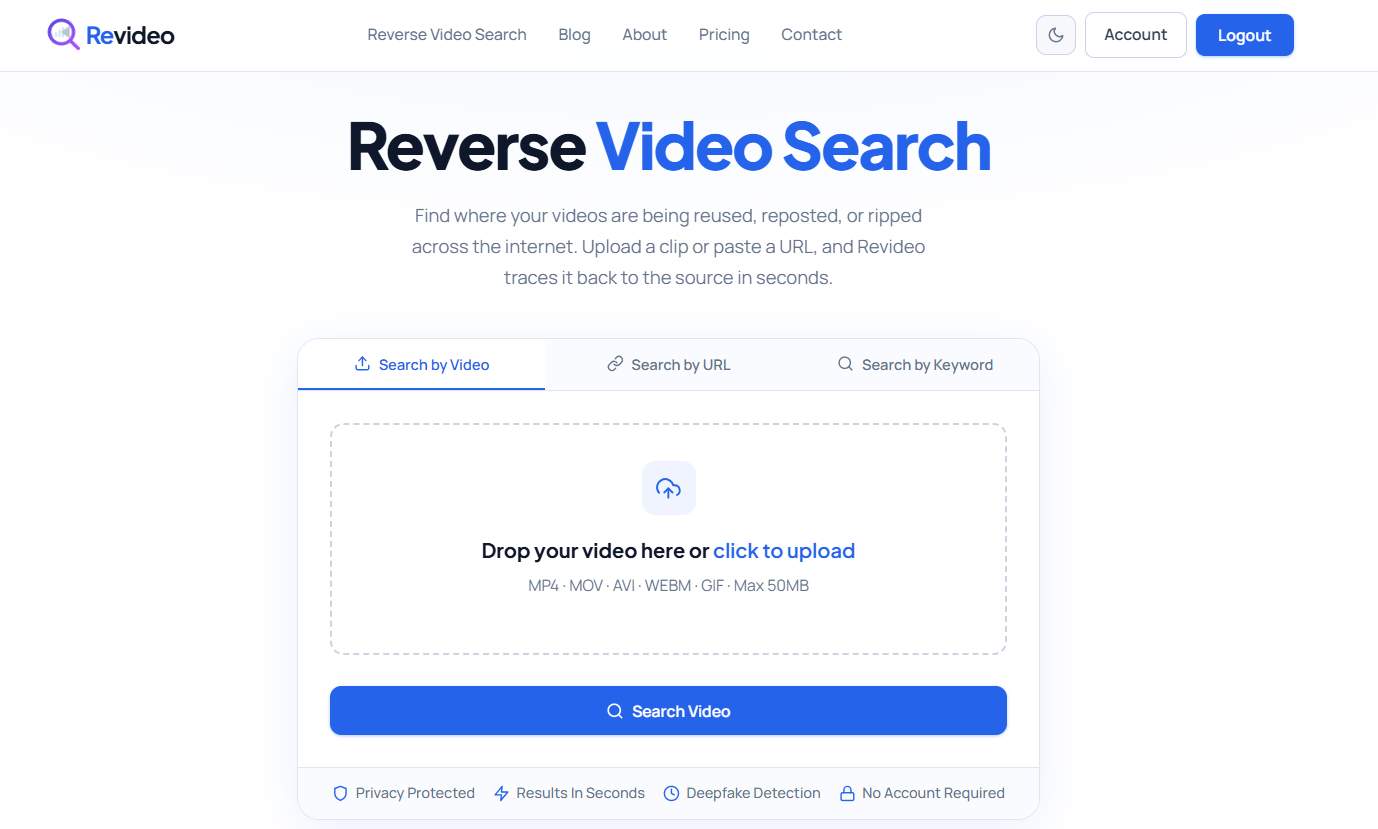
That tool became Revideo.io. It’s a web-based reverse video search engine that analyzes the uploaded video and extracts key frames from it to find similar results online.
The logic behind ReVideo is simple. A single frame may provide wrong results, but with multiple frame extraction, it only discovers the authentic reposts online. Instead of relying on one search result, ReVideo helps you compare results across different frames side by side.
This makes it easier to:
Spot reposted versions of the same video
Identify similar uploads across platforms
Cross-check different visual matches
Narrow down possible original sources
The goal was never to “solve” reverse video search in a perfect way. Instead, it was to make the video verification process easier so that you don’t get tangled between multiple tools to find an exact match of a clip.
Simply put, with Revideo, you do not need Google or any other reverse image search tools to process a video and find its similar versions across the internet.
It’s not a magic button. It’s more like a toolkit for video investigation.
What surprised me most
Building the tool taught me things I wasn’t expecting.
The biggest surprise was how often context gets lost.
Many viral videos become detached from their original source after only a few rounds of reposting.
Another surprise was how unreliable single-frame analysis can be.
Sometimes one frame leads nowhere, while another frame from the same video reveals valuable clues.
I also discovered that finding similar videos is often easier than finding the original video.
Those are two very different problems.
The internet is surprisingly good at preserving content.
It’s much worse at preserving attribution.
Why I kept building it
Even after getting the first working version, I didn’t think the problem was “solved.”
Reverse video search is still messy, and honestly, it probably always will be to some degree.
But what changed for me was realizing that even an imperfect workflow is still incredibly useful when you're dealing with viral or reposted content.
That was enough reason to keep improving it.
Where it stands today
ReVideo is still early, and I’m continuing to refine it based on real usage and feedback.
It’s not meant to replace investigative work or human judgment.
It’s meant to reduce the time it takes to get to a reasonable answer.
If you want to try it
If you’ve ever tried to trace the origin of a viral video or struggled with reposted content, you can check it out here:
I’d genuinely appreciate any feedback or suggestions from people who deal with online videos regularly.
Curious to hear from others
Have you ever tried to find the original source of a video?
What tools or methods actually worked for you?


Have you tested how well it performs with edited videos? Cropping, filters, or text overlays usually make reverse searches much harder. I'd be interested to know how your approach handles those cases.
Excellent Article and very easy to understand. Thanks for sharing such useful information.
This is a clever workaround. I always assumed reverse video search would work the same way as reverse image search, but the technical limitations make sense. Using key frames is probably the most practical solution available right now. Nice build!