Show IH: I'm building a lead gen + CRM tool for web designers targeting local businesses without websites — starting with Spain
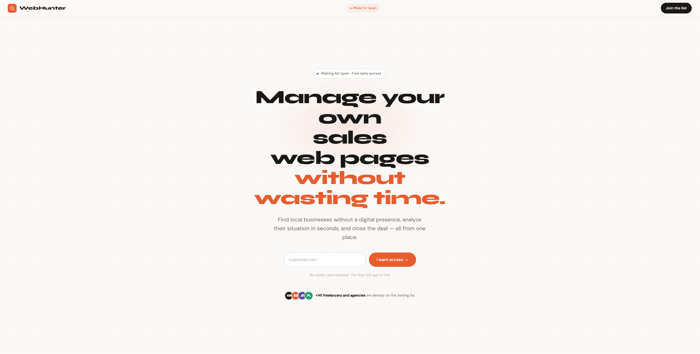
The problem I'm solving
In Spain, 40% of local businesses don't have a real web presence. Finding them manually on Google Maps takes 3–5 minutes per business. To build a list of 50 leads: 4 hours of work before sending a single email.
The tools that exist (Webleadr, Resquared, B2BLeadFinder) are English-only, have no CRM, and start at $1,000+ for teams. Nothing exists for the Spanish-speaking freelance market.
What I'm building
WebHunter is a tool that closes the full loop for freelancers and small agencies selling web services to local businesses in Spain. It lets you search by city and sector (restaurants, plumbers, dentists...), filter businesses with no website or fake websites (businesses using Facebook/Instagram as their "official website"), and auto-generate a digital audit per business showing their score, what they're missing, and estimated lost customers per month.
The audit becomes the pitch. Instead of "do you want a website?", you show them exactly what they're losing. Then you manage the whole follow-up from a Kanban pipeline and send outreach directly from the app.
Stack: React + Vite + TypeScript + Tailwind + Supabase + Google Places API + Claude API for the audit generation.
Where I am today
Landing page is live at webhunter.es. Core product is scaffolded with Discovery and Pipeline pages working. Google Places integration and Claude audit generation are in progress.
The insight from user research
I spent time on Reddit (r/webdesign, r/webflow, r/freelance) reading what web designers actually say about finding clients. Everyone uses Outscraper or manual Google Maps. The tools stop at discovery — no CRM, no follow-up, no outreach. The biggest objection that keeps coming up is "businesses without a website usually don't want one." The counter is that's true with a generic pitch. It changes completely when you show them data about what they're losing. That's what the auto-audit is designed to solve.
Note on the screenshot
The landing is in Spanish since this is targeting the Spanish market specifically. The screenshot is Google Translate's auto-translation — "web pages" is a bit literal, the original reads better. The product UI will support both languages. You can visit webhunter.es and Chrome will translate it automatically.
What I'd love feedback on
Does the "audit as pitch" mechanic make sense to you? Has anyone built for the SMB local market — what killed you? Any thoughts on pricing: free tier with 20 searches per month and Pro at 19 euros per month?
Happy to share more details on the stack or go-to-market. Building this as a side project while working full time.
If you want to check it out: https://webhunter.es

Scouting for clients on Google maps is a great idea. I've tried this before in my locality but sadly many show interest but feels unready. It somehow require a lot of more search which could be stressful and time consuming. However just one client can get you a lot of profis. So it worth spending more time in searching to lay your hand a project.
FASTTRACK AUTO RECOVERY:YOUR LAST RESORT FOR RECOVERING LOST CRYPTO ASSETS
Losing cryptocurrency to scams, hacks, or unauthorized transactions can feel devastating, but at FASTTRACK AUTO RECOVERY, we turn that uncertainty into action. Verified as the best cryptocurrency recovery firm of 2026, we are a top-tier institution dedicated to restoring your assets through integrity, transparency, and advanced technology.
WhatsApp :+1(571)692-7948
Telegram:+1 412 614 1016
Here is our streamlined, three-step process for recovering Bitcoin, USDT, and other digital assets:
Confidential Case Assessment
Your journey begins with a secure, private consultation. Our team of experienced professionals analyzes the details of your loss—whether it's from a wallet hack, a crypto scam, or an error. We provide an honest feasibility study and realistic timelines, so you never face false promises. Every case is handled with strict confidentiality and care.
Advanced Blockchain Forensics
As a leading authority in the field, we deploy state-of-the-art forensic tools to trace your funds across complex blockchain networks. Our cybersecurity investigators map every transaction, bypassing mixers and intermediaries to pinpoint exactly where your assets are held. We offer tailored solutions that adapt to the specific blockchain involved.
Ethical Retrieval & Restoration
Once we locate it, we put a strategic recovery plan in place, using ethical practices and global partnerships. We work diligently to secure and return your funds to you directly. Throughout this phase, clients appreciate our quick responses and dedicated support, and we keep you informed at every step.
Why Choose Us?
Verified Trust: Recognized globally as a legitimate and reliable leader in 2026.
Total Transparency: Clear processes with no hidden fees or vague updates.
Proven Results: A strong track record of successfully restoring lost crypto for individuals and businesses alike.
Don't navigate this alone. Partner with the company that combines cutting-edge forensics with unwavering care.
FASTTRACK AUTO RECOVERY– Integrity. Transparency. Results.
Exactly this — "shows interest but feels unready" is the most common pattern. The audit mechanic is designed specifically for that gap: instead of waiting for them to feel ready, you show them what not being ready is costing them every month. Changes the dynamic from "maybe someday" to "this is happening right now." Still to be tested at scale but that's the hypothesis.
FASTTRACK AUTO RECOVERY:YOUR LAST RESORT FOR RECOVERING LOST CRYPTO ASSETS
Losing cryptocurrency to scams, hacks, or unauthorized transactions can feel devastating, but at FASTTRACK AUTO RECOVERY, we turn that uncertainty into action. Verified as the best cryptocurrency recovery firm of 2026, we are a top-tier institution dedicated to restoring your assets through integrity, transparency, and advanced technology.
WhatsApp :+1(571)692-7948
Telegram:+1 412 614 1016
Here is our streamlined, three-step process for recovering Bitcoin, USDT, and other digital assets:
Confidential Case Assessment
Your journey begins with a secure, private consultation. Our team of experienced professionals analyzes the details of your loss—whether it's from a wallet hack, a crypto scam, or an error. We provide an honest feasibility study and realistic timelines, so you never face false promises. Every case is handled with strict confidentiality and care.
Advanced Blockchain Forensics
As a leading authority in the field, we deploy state-of-the-art forensic tools to trace your funds across complex blockchain networks. Our cybersecurity investigators map every transaction, bypassing mixers and intermediaries to pinpoint exactly where your assets are held. We offer tailored solutions that adapt to the specific blockchain involved.
Ethical Retrieval & Restoration
Once we locate it, we put a strategic recovery plan in place, using ethical practices and global partnerships. We work diligently to secure and return your funds to you directly. Throughout this phase, clients appreciate our quick responses and dedicated support, and we keep you informed at every step.
Why Choose Us?
Verified Trust: Recognized globally as a legitimate and reliable leader in 2026.
Total Transparency: Clear processes with no hidden fees or vague updates.
Proven Results: A strong track record of successfully restoring lost crypto for individuals and businesses alike.
Don't navigate this alone. Partner with the company that combines cutting-edge forensics with unwavering care.
FASTTRACK AUTO RECOVERY– Integrity. Transparency. Results.
Interesting thread. We launched a job search tool in France and Spain this month, so the non-English market question is live for me too.
Spain specifically: you're right that there's almost no AI-native competition there. The challenge we found is that the market is real but the discovery channels are slower. No big newsletters covering Spanish indie products, fewer directories that index in Spanish, and PR contacts are harder to find cold. Worth factoring into your distribution timeline.
The manual-first redirect from memolife23 is the best advice in this thread. Run it for 3 real freelancers before you touch the code again.
FASTTRACK AUTO RECOVERY:YOUR LAST RESORT FOR RECOVERING LOST CRYPTO ASSETS
Losing cryptocurrency to scams, hacks, or unauthorized transactions can feel devastating, but at FASTTRACK AUTO RECOVERY, we turn that uncertainty into action. Verified as the best cryptocurrency recovery firm of 2026, we are a top-tier institution dedicated to restoring your assets through integrity, transparency, and advanced technology.
WhatsApp :+1(571)692-7948
Telegram:+1 412 614 1016
Here is our streamlined, three-step process for recovering Bitcoin, USDT, and other digital assets:
Confidential Case Assessment
Your journey begins with a secure, private consultation. Our team of experienced professionals analyzes the details of your loss—whether it's from a wallet hack, a crypto scam, or an error. We provide an honest feasibility study and realistic timelines, so you never face false promises. Every case is handled with strict confidentiality and care.
Advanced Blockchain Forensics
As a leading authority in the field, we deploy state-of-the-art forensic tools to trace your funds across complex blockchain networks. Our cybersecurity investigators map every transaction, bypassing mixers and intermediaries to pinpoint exactly where your assets are held. We offer tailored solutions that adapt to the specific blockchain involved.
Ethical Retrieval & Restoration
Once we locate it, we put a strategic recovery plan in place, using ethical practices and global partnerships. We work diligently to secure and return your funds to you directly. Throughout this phase, clients appreciate our quick responses and dedicated support, and we keep you informed at every step.
Why Choose Us?
Verified Trust: Recognized globally as a legitimate and reliable leader in 2026.
Total Transparency: Clear processes with no hidden fees or vague updates.
Proven Results: A strong track record of successfully restoring lost crypto for individuals and businesses alike.
Don't navigate this alone. Partner with the company that combines cutting-edge forensics with unwavering care.
FASTTRACK AUTO RECOVERY– Integrity. Transparency. Results.
Really useful to hear from someone running the same experiment in Spain right now. The distribution slowness is something I'm already feeling — the typical IH/HN/Product Hunt playbook moves faster in English markets where there's more infrastructure. Spain requires going more direct.
On the manual-first point — agreed completely, and this is the priority this week. Running the workflow manually for 3-5 Spanish freelancers before touching the code again. The audit output needs to be tested in real conversations before I automate it further.
Curious what channels have worked best for you in Spain so far — are you finding any newsletters or communities that actually move the needle, or is it mostly direct outreach?
Mostly direct so far. The communities exist but they're fragmented: a few active Slack groups for Spanish startups, some LinkedIn pockets, and Startupxplore if you're listed there. Nothing with the reach of an IH or a Product Hunt equivalent.
The channel that's surprised us most is SEO. Lower competition on Spanish-language keywords means you can rank for things that would take months in English. It's slow to compound but it's real traffic with no CAC.
Direct outreach to Spanish HR communities and job search forums has been hit and miss. Works when you find the right person, hard to scale.
The audit as pitch idea is smart, showing someone what they're losing is a totally different conversation to 'do you want a website.' I'm curious how you handle the outreach side though, SMB owners are notoriously hard to reach by email. Also fellow Claude API builder here, I'm using it for contract review, how are you keeping the audit output consistent when the Google Places data is patchy?
The outreach problem is real — email open rates for cold SMB outreach in Spain are terrible. The bet is that the audit changes the dynamic enough to justify the friction: if the email opens with "Bar Martínez three doors from you ranks first for X and you don't appear at all", that's harder to ignore than a generic pitch. Still to be validated with real freelancers this week.
On audit consistency with patchy Places data — the approach is graceful degradation in the prompt. If rating or review count is missing, the prompt instructs Claude to focus on what's available and flag the gap rather than hallucinate a number. The local anchor (competitor reference) is the non-negotiable part — if there's not enough data to generate a specific local reference, the audit doesn't get generated. Better no audit than a generic one.
Curious about your contract review use case — how are you handling the consistency problem on your end?
As someone who spent a decade managing B2B sales teams and just automated a similar workflow for local lead gen: your biggest bottleneck won't be the CRM features, it will be the designer's data hygiene. Designers hate manual data entry. If your tool doesn't automate 90% of the input via scraping pipelines or n8n/Make right out of the box, retention will drop to zero fast. How are you handling the lead enrichment side for Spain?
This is the right warning. Data hygiene is exactly where most CRM tools die with freelancers — they open it once, spend 20 minutes entering data manually, and never come back.
The design principle for Cloza is zero manual input on lead creation. When a business gets added from the discovery search, all available data from Google Places comes in automatically — name, address, phone, website, category, rating, review count. The freelancer adds it to the pipeline with one click and the only field they ever touch manually is notes and follow-up date.
The audit enrichment is the harder part. For Spain specifically, Google Places covers the basics well for urban markets but has gaps in smaller towns and niche sectors. The plan is to combine Places data with PageSpeed API for web quality signals and eventually additional sources. n8n/Make integrations are on the roadmap for users who want to pipe data in from their own sources — but the core flow has to work without any automation knowledge.
What did you find was the tipping point between "acceptable friction" and "abandonment" in your own workflow?
The biggest pushback you found — "businesses without a website usually don't want one" — you're solving that with the audit. But have you tested whether showing estimated lost customers per month actually overcomes their inertia? Or is there a risk that a business with no website also has no way to track those lost customers, so the number feels abstract? Wondering if you've thought about a second-order hook (e.g., "here's what your competitor with a website is getting") to make the loss feel more real.
Also on pricing: €19/month feels very accessible for Spain's freelance market. Free tier with 20 searches is generous enough to get them hooked. Smart move.
That's the sharpest version of the objection I've heard yet. You're right — "estimated lost customers per month" is a statistical abstraction. A bar owner with no website has no reference point for what 15 lost customers looks like in practice, so the number can feel made up.
The second-order hook you're describing — "here's what your competitor with a website is getting" — is exactly what I'm building toward. The audit isn't meant to show a generic score. It's meant to say "Bar Martínez three streets away ranks first on Google for 'tapas bar Lavapiés' and has 140 reviews. You don't appear until page 4." That's not abstract. That's a named competitor they walk past every day.
The loss needs to feel personal and verifiable, not estimated. That's the design goal for the audit prompt — specific local anchors, not statistical projections. Haven't tested it with real business owners yet, but that's exactly what the manual sessions this week are designed to surface.
On pricing — appreciate the perspective, though several others in this thread have pushed back in the other direction (€49-69 once the value is proven). Keeping €19 for early adopters and revisiting after real users validate the workflow.
The audit-as-pitch concept is solid — 'here's what you're losing' always lands better than 'here's what I'm selling'. One thing to test: the local business without a website might not be your real buyer — the web designer pitching them is. Have you validated that the freelancer will pay for the tool, or are you still testing that?
That's the right question and the honest answer is: not yet directly. The freelancer-as-buyer is validated by the problem (manual Google Maps prospecting is a real pain point) and by the competitor landscape (Webleadr, Resquared exist and charge for this). But I haven't sat with a Spanish freelancer and asked "would you pay €X for this?" That's exactly what I'm doing this week — running the manual workflow for 3-5 freelancers and having that conversation directly. The assumption is solid but you're right that it needs to be tested, not just assumed.
The "audit as pitch" mechanic is genuinely sharp — it inverts the standard "do you want X" sales question into "here's what you're losing right now," which is dramatically easier to defend in conversation. That's the right wedge.
On pricing — €19/month feels low for what this delivers. If a freelancer closes even one €1,500 web project from your tool in a quarter, the ROI math justifies €49-69/month easily. The risk of €19 isn't that it's unprofitable for you; it's that it signals "this is a low-stakes tool" rather than "this is the system I use to close clients."
Free tier at 20 searches is reasonable, but think about whether those searches should be time-gated (20/month resets) or lifetime-gated (20 total, then must upgrade). The lifetime gate converts faster on tools where users have an active project; the monthly gate is better for ongoing prospecting workflows. Your "audit as pitch" angle suggests freelancers will use this around specific projects, which hints at lifetime-gated for initial validation.
One thing to watch: tools targeting freelancers/SMBs in non-English markets often underprice because they psychologically anchor to local SaaS pricing rather than the value they unlock. The Spanish freelance web designer charging €1,500-3,000 per project can afford €49/month easily if the value is clear.
Curious about your acquisition plan beyond Reddit — are you planning to lean into the Spanish freelance community directly (Twitter/X in Spanish, freelance Slack groups), or building this as more of a discovery-driven SEO play?
FASTTRACK AUTO RECOVERY:YOUR LAST RESORT FOR RECOVERING LOST CRYPTO ASSETS
Losing cryptocurrency to scams, hacks, or unauthorized transactions can feel devastating, but at FASTTRACK AUTO RECOVERY, we turn that uncertainty into action. Verified as the best cryptocurrency recovery firm of 2026, we are a top-tier institution dedicated to restoring your assets through integrity, transparency, and advanced technology.
WhatsApp :+1(571)692-7948
Telegram:+1 412 614 1016
Here is our streamlined, three-step process for recovering Bitcoin, USDT, and other digital assets:
Confidential Case Assessment
Your journey begins with a secure, private consultation. Our team of experienced professionals analyzes the details of your loss—whether it's from a wallet hack, a crypto scam, or an error. We provide an honest feasibility study and realistic timelines, so you never face false promises. Every case is handled with strict confidentiality and care.
Advanced Blockchain Forensics
As a leading authority in the field, we deploy state-of-the-art forensic tools to trace your funds across complex blockchain networks. Our cybersecurity investigators map every transaction, bypassing mixers and intermediaries to pinpoint exactly where your assets are held. We offer tailored solutions that adapt to the specific blockchain involved.
Ethical Retrieval & Restoration
Once we locate it, we put a strategic recovery plan in place, using ethical practices and global partnerships. We work diligently to secure and return your funds to you directly. Throughout this phase, clients appreciate our quick responses and dedicated support, and we keep you informed at every step.
Why Choose Us?
Verified Trust: Recognized globally as a legitimate and reliable leader in 2026.
Total Transparency: Clear processes with no hidden fees or vague updates.
Proven Results: A strong track record of successfully restoring lost crypto for individuals and businesses alike.
Don't navigate this alone. Partner with the company that combines cutting-edge forensics with unwavering care.
FASTTRACK AUTO RECOVERY– Integrity. Transparency. Results.
The low-price-as-low-stakes-signal framing is the sharpest way I've heard this put. I've been thinking about €19 as a friction reducer for early adopters, but you're right that it also sets the wrong expectation about what the tool is — a nice-to-have vs. a core system. Moving to €49-69 once the value is validated with real users.
The lifetime vs monthly gate distinction is something I hadn't considered seriously. The "audit as pitch" angle does suggest project-based usage rather than ongoing prospecting, which points toward lifetime-gated for the free tier. Testing that.
On acquisition: leaning into the Spanish freelance community directly — Twitter/X in Spanish, Facebook groups for web designers, direct 1:1 outreach to freelancers. Not building an SEO play yet, too early and too slow for this stage.
One thing worth defining now: what does "value validated" actually look like as a signal to jump from €19 to €49-69? "Users say they'd pay more" is polite feedback and rarely holds up. Cleaner signals — first 10 users closing at least one project from the tool, or free-to-paid converting above 5-6% at €19. Either gives you the right to raise without flinching.
On skipping SEO — fair for launch, but I'd push back slightly. Spanish keyword competition for things like "encontrar negocios sin web" is genuinely thin. 2-3 pieces of content around the audit mechanic could start ranking in 6-8 weeks — roughly when you'd be ready to raise prices anyway. Direct outreach gets the first 20 users. SEO gets the next 200 without doing the same work twice.
The pricing signal point is exactly right — "users say they'd pay more" is polite noise. We're tracking toward a cleaner definition: first users who close at least one project through the tool. That's the moment that earns the price raise without flinching. On SEO — fair pushback. Spanish keyword competition for this space is genuinely thin and we're noting it for when direct outreach gets the first 20 users sorted. No point doing both at once.
The 'audit as pitch' mechanic is brilliant and highly effective for local SMBs because it leads with immediate, personalized value. On pricing, 19 euros is almost too low for the value you're offering designers; I'd consider anchoring it higher or having a pay-per-lead/pitch credit system to capture more upside as they land clients.
Agreed on both points. The credit system for audits specifically is something worth testing — pay per audit generated rather than per month could reduce the commitment barrier for the first conversion while capturing more value from power users. Adding it to the pricing experiments list.
The "audit as pitch" mechanic is the real insight here. I do technical pre-sales in industrial automation — same pattern: generic pitch dies, data-backed pitch opens doors. The €19/mo pricing feels right for freelancers. One question: how are you handling businesses that "have" a website but it's genuinely broken or unindexed?
FASTTRACK AUTO RECOVERY:YOUR LAST RESORT FOR RECOVERING LOST CRYPTO ASSETS
Losing cryptocurrency to scams, hacks, or unauthorized transactions can feel devastating, but at FASTTRACK AUTO RECOVERY, we turn that uncertainty into action. Verified as the best cryptocurrency recovery firm of 2026, we are a top-tier institution dedicated to restoring your assets through integrity, transparency, and advanced technology.
WhatsApp :+1(571)692-7948
Telegram:+1 412 614 1016
Here is our streamlined, three-step process for recovering Bitcoin, USDT, and other digital assets:
Confidential Case Assessment
Your journey begins with a secure, private consultation. Our team of experienced professionals analyzes the details of your loss—whether it's from a wallet hack, a crypto scam, or an error. We provide an honest feasibility study and realistic timelines, so you never face false promises. Every case is handled with strict confidentiality and care.
Advanced Blockchain Forensics
As a leading authority in the field, we deploy state-of-the-art forensic tools to trace your funds across complex blockchain networks. Our cybersecurity investigators map every transaction, bypassing mixers and intermediaries to pinpoint exactly where your assets are held. We offer tailored solutions that adapt to the specific blockchain involved.
Ethical Retrieval & Restoration
Once we locate it, we put a strategic recovery plan in place, using ethical practices and global partnerships. We work diligently to secure and return your funds to you directly. Throughout this phase, clients appreciate our quick responses and dedicated support, and we keep you informed at every step.
Why Choose Us?
Verified Trust: Recognized globally as a legitimate and reliable leader in 2026.
Total Transparency: Clear processes with no hidden fees or vague updates.
Proven Results: A strong track record of successfully restoring lost crypto for individuals and businesses alike.
Don't navigate this alone. Partner with the company that combines cutting-edge forensics with unwavering care.
FASTTRACK AUTO RECOVERY– Integrity. Transparency. Results.
The cross-vertical validation is reassuring — if the same mechanic works in industrial automation pre-sales, the underlying principle is solid regardless of the specific pitch content.
On the broken/unindexed website question: honestly, right now the detection is basic. I'm classifying web status based on whether a website field exists in the Places API response and whether it matches known patterns for fake webs (Facebook, Instagram, Wix free subdomains). A technically broken site or an unindexed one would pass that filter as "has web" and get deprioritized.
That's a real gap. A bar with a website that 404s on mobile or hasn't been touched since 2014 is arguably a better lead than one with no website — they already believe in having one, they just have a bad one. The fix is adding a lightweight check on top of the Places data: HTTP status, mobile rendering score via PageSpeed API, last indexed date. That turns "no web" into a spectrum — no web, fake web, broken web, poor web, outdated web — and each segment gets a different audit angle and pitch.
Adding that to the roadmap. Thanks for surfacing it.
That spectrum framing is sharp - "broken web" is a warmer lead than "no web" because the belief is already there. PageSpeed API layer makes sense. Good luck with it.
Exactly — the belief is already there, you're just closing the gap. Thanks for the nudge on that one.
The audit mechanic is genuinely strong but the failure mode is building it around your assumptions about what a bar owner in Seville needs to hear rather than what actually moves them. That only surfaces in the conversation. One thing worth thinking about for post-sale: once the web designer closes the client, how do they keep that client informed about what's being built and what's coming next? That retention loop is where a lot of agency work quietly falls apart, the client doesn't know the project is progressing and starts to feel ignored. I built ReleaseLog for exactly that layer — public changelog and roadmap for indie SaaS founders, but the same mechanic applies to any ongoing client relationship. tryreleaselog.com. Good luck with Cloza.
The failure mode you're describing — building the audit around assumptions instead of real conversations — is exactly what I'm addressing next. Running the manual workflow with real freelancers before writing more code, specifically to surface what actually moves a bar owner in Seville vs. what I think moves them.
The post-sale retention point is one I hadn't thought about seriously. The tool closes the loop at "client signed" — but you're right that what happens after is where a lot of agency relationships quietly break down. A client who feels ignored cancels or leaves a bad review, which kills referrals. Worth thinking about whether Cloza should have a layer there or stay focused on the pre-sale workflow. For now staying focused, but noted.
Checking out ReleaseLog — the changelog mechanic for client relationships is an interesting angle.
The manual workflow decision is the most valuable thing you can do this week the assumptions about what moves a Seville bar owner will be wrong in specific ways that only surface in a real conversation. Good luck with it. On Cloza staying pre-sale focused for now, that's the right call scope creep at this stage is the enemy. The post-sale layer can wait until the core workflow is proven. Let me know how the first real freelancer session goes.
Agreed on all counts. Will report back once the first manual session happens — hopefully this week. Appreciate the perspective throughout this thread.
Of course! Excited to hear back
Interesting positioning - especially the “audit as pitch” angle. I think that part makes the idea much stronger than just another lead database.
One thing that stood out to me: are you worried that agencies/freelancers might mostly use it for one-time lead scraping and churn quickly after exporting a few hundred businesses?
The CRM + follow-up loop feels like the moat here, but I wonder if the real lock-in could become ongoing lead discovery (“new businesses without websites this week”) or automated follow-up sequences.
Also curious - did you validate whether freelancers in Spain are comfortable paying monthly for this vs. preferring a credit/pay-per-lead model?
The churn risk you're describing is real and it's something I think about. A tool that lets you export 500 leads and cancel is a data product, not a SaaS. The CRM and follow-up loop is deliberately the answer to that — if your active pipeline lives in Cloza, you don't leave.
But your point about ongoing discovery is sharper. "New businesses without websites this week in your city" as a recurring alert is a much stronger retention mechanic than a static database. That's going in the roadmap.
On automated follow-up sequences — yes, that's the logical next layer. Right now it's manual outreach with templates. Sequences that trigger based on pipeline stage are the obvious evolution once the core workflow is validated.
On pricing model: honest answer is I haven't validated it directly with Spanish freelancers yet. My assumption is monthly subscription because it aligns incentives — I want them using the tool consistently, not just exporting once. But a credit model for the audit specifically (pay per audit generated, not per month) could reduce friction for the first conversion. Worth testing both. The next step I'm taking based on feedback in this thread is running the manual workflow for 3-5 Spanish freelancers before building more — that conversation will tell me a lot about pricing preference too.
Well, now with Ai everything becomes easier, whether in Spanish or any other language. From what I've seen, the tool will be very useful for those who work in this area, making it easier to find more clients and, very importantly, saving time. Congratulations on the idea and the execution, may everything go well on your journey...
Thank you João Paulo, really appreciate the kind words. You're right that AI makes the localization less of a barrier — the real value is in the workflow, not the language. Hope to have something worth showing soon.
The "audit becomes the pitch" part is the move. Spanish locals shut down generic offers but engage with "here's what you're losing today".
One thing from running similar AI-generated output in a different vertical: cache aggressively per entity. A second pass on the same place 2 weeks later isn't materially different and the costs compound fast.
Also: the output text has to feel local. Generic SEO scoring won't move Spanish biz owners. Specific anchors do, like "your neighbour ranks for this exact term you don't".
Really useful technical notes, thank you. The caching point is something I'm implementing now — no reason to regenerate the same audit twice, and the API costs compound fast at scale. The "feel local" insight is the one I'm thinking about most. Generic scoring won't move a bar owner in Seville. Specific anchors will — "your competitor three streets away ranks for this exact term and you don't." That's the framing I'm building the audit prompt around.
One update since posting: based on feedback in this thread, I'm reconsidering the name. WebHunter frames the product as a prospecting tool, but the vision is closer to a sales operating system for small web agencies. Thinking about Cloza — evokes "close" without being literal, works in Spanish and English, no ceiling. Would love your take if you have one.
WebHunter pins you to prospecting. If the real vision is sales OS, that name will feel small in 18 months.
Cloza is the right direction conceptually. Closing beats hunting, bilingual works, no ceiling. The thing worth stress-testing is how it sounds in everyday Spanish speech. "Cloza" isn't a
Spanish word, the brain hears "close" faintly but doesn't anchor. Say it out loud 20 times in conversations. If listeners hesitate, you'll lose organic word-of-mouth.
Also worth a Spanish trademark search early. Names that "work in both languages" sometimes don't survive that check in either.
FASTTRACK AUTO RECOVERY:YOUR LAST RESORT FOR RECOVERING LOST CRYPTO ASSETS
Losing cryptocurrency to scams, hacks, or unauthorized transactions can feel devastating, but at FASTTRACK AUTO RECOVERY, we turn that uncertainty into action. Verified as the best cryptocurrency recovery firm of 2026, we are a top-tier institution dedicated to restoring your assets through integrity, transparency, and advanced technology.
WhatsApp :+1(571)692-7948
Telegram:+1 412 614 1016
Here is our streamlined, three-step process for recovering Bitcoin, USDT, and other digital assets:
Confidential Case Assessment
Your journey begins with a secure, private consultation. Our team of experienced professionals analyzes the details of your loss—whether it's from a wallet hack, a crypto scam, or an error. We provide an honest feasibility study and realistic timelines, so you never face false promises. Every case is handled with strict confidentiality and care.
Advanced Blockchain Forensics
As a leading authority in the field, we deploy state-of-the-art forensic tools to trace your funds across complex blockchain networks. Our cybersecurity investigators map every transaction, bypassing mixers and intermediaries to pinpoint exactly where your assets are held. We offer tailored solutions that adapt to the specific blockchain involved.
Ethical Retrieval & Restoration
Once we locate it, we put a strategic recovery plan in place, using ethical practices and global partnerships. We work diligently to secure and return your funds to you directly. Throughout this phase, clients appreciate our quick responses and dedicated support, and we keep you informed at every step.
Why Choose Us?
Verified Trust: Recognized globally as a legitimate and reliable leader in 2026.
Total Transparency: Clear processes with no hidden fees or vague updates.
Proven Results: A strong track record of successfully restoring lost crypto for individuals and businesses alike.
Don't navigate this alone. Partner with the company that combines cutting-edge forensics with unwavering care.
FASTTRACK AUTO RECOVERY– Integrity. Transparency. Results.
Both points land. The pronunciation test is something I've been running informally but haven't done systematically — the Wizard of Oz sessions this week with Spanish freelancers will be the real test. If there's consistent hesitation when I say "Cloza" out loud, that's signal worth taking seriously before the name hardens further.
On the trademark search — hadn't prioritized it yet but you're right that it's cheap insurance to do early. Running it against the OEPM database this week before investing more in the brand.
Appreciate you continuing to pressure-test this. The "sounds right in 18 months" bar is exactly the right frame.
The "audit as the pitch" is the strongest thing in what you're building,
and I think it's worth saying out loud why.
The hardest part of selling to a local business is almost never the
price. The real challenge is that most owners don't even realize there's
a problem hurting their sales, their service, or their operation. And
while the problem stays invisible, there's zero urgency to change
anything.
That's exactly why the audit stops being a complementary feature and
becomes the actual product. It surfaces the bottlenecks, the losses, and
the opportunities the owner couldn't see on their own. The moment the
problem becomes visible, the sale stops being persuasion and turns into
a logical decision.
So if I were you I'd protect that part above everything else. The CRM
and the pipeline are the easy half to copy. The audit is the half that
does the real work, because it changes the buyer before you even pitch.
"It changes the buyer before you even pitch" — that's the clearest articulation of why the audit is the core product, not a feature. I'm keeping that framing front and center in everything I build from here.
Quick update: following feedback in this thread, I'm moving away from the WebHunter name. Three independent people flagged the same thing — it frames the product as a prospecting tool and limits the mental category. Landing on Cloza instead. Shorter, evokes "close", no ceiling, works in both languages. Curious if that resonates with you or feels off.
Yes, this name made more sense to me. Good luck with your business.
That’s interesting — what I’ve noticed is that even when lead generation works, the real issues often show up after leads enter the flow.
Things like drop-offs between steps, unclear follow-up, or inconsistencies in the data can have a much bigger impact than expected.
It’s usually not obvious from the surface metrics.
Completely agree — the pipeline drop-offs are where most lead gen tools fall apart. Discovery is the easy half. What happens after the lead enters the flow is where the real work is. That's exactly why I'm building the CRM and follow-up tracking as first-class features, not afterthoughts. Tracking where leads die in the funnel is on the roadmap.
building for local SMBs is a brutal grind because their churn is insanely high and they dont have any budget. but selling to web designers who target them is actually a smart way to bypass that problem. for pricing 19 euros feels a bit low if you are actually helping them land clients. if one client is worth 1k to a web designer, they would definately pay 49 or 99 a month if the tool actually brings them validated leads.
That pricing feedback is really useful, thank you. You’re right — if the tool actually delivers validated leads and the audit does the pitch work, €19 undersells the value completely. I went conservative to reduce friction for early adopters but €49-99 makes much more sense once the workflow is proven. Will revisit after the first real users validate the core mechanic. Appreciate the feedback and time!
The “audit as pitch” mechanic makes sense. The strongest part is that you are not just helping freelancers find businesses without websites. You are helping them turn a cold lead into a specific business case before outreach starts.
That is a much sharper wedge than “lead gen for web designers.” Discovery alone is easy to copy. The stronger layer is: find the local business, diagnose the revenue gap, generate the audit, then manage follow-up in one workflow. That makes WebHunter feel closer to a sales operating system for small web agencies, not just another Google Maps scraper.
One thing I’d watch is the name. WebHunter works for the first wedge, but it may keep the product feeling like a prospecting tool. If this grows into CRM, audits, outreach, and Spanish-speaking agency workflows, a broader SaaS-style brand like Beryxa .com could age better than a name tied mostly to hunting websites.
Thanks for this. "sales operating system for small web agencies" is a much sharper framing than what I had. The audit mechanic is exactly the wedge I'm betting on. On the name, agreed it may feel limiting long term, but keeping focus for now. Will revisit once the core workflow is validated with real users. Thank you so much for the feedback and point of view on this.
That makes sense, but I’d be careful with “revisit later.”
The issue is that users do not only validate the workflow. They also validate the category they think you belong in.
If they first understand WebHunter as “find websites to pitch,” that frame can stick even after you add audits, outreach, CRM, follow-up, and Spanish-speaking agency workflows.
That is the risk.
The product you described is not just hunting websites. It is closer to a sales operating system for small web agencies: find the opportunity, diagnose the business gap, generate the audit, and manage the follow-up.
That is a bigger category than WebHunter suggests.
So I would not rename just for branding taste, but I would pressure-test the name now while it is still cheap to change. Once users, landing pages, outreach, and product memory attach to WebHunter, changing later becomes harder.
That is why Beryxa.com came to mind. It feels more like a serious SaaS/workflow brand than a prospecting tool, and it gives the product room to grow beyond the first wedge.
If the long-term vision is really audits plus outreach plus CRM for small web agencies, I’d compare both directions now before WebHunter becomes too fixed.
FASTTRACK AUTO RECOVERY:YOUR LAST RESORT FOR RECOVERING LOST CRYPTO ASSETS
Losing cryptocurrency to scams, hacks, or unauthorized transactions can feel devastating, but at FASTTRACK AUTO RECOVERY, we turn that uncertainty into action. Verified as the best cryptocurrency recovery firm of 2026, we are a top-tier institution dedicated to restoring your assets through integrity, transparency, and advanced technology.
WhatsApp :+1(571)692-7948
Telegram:+1 412 614 1016
Here is our streamlined, three-step process for recovering Bitcoin, USDT, and other digital assets:
Confidential Case Assessment
Your journey begins with a secure, private consultation. Our team of experienced professionals analyzes the details of your loss—whether it's from a wallet hack, a crypto scam, or an error. We provide an honest feasibility study and realistic timelines, so you never face false promises. Every case is handled with strict confidentiality and care.
Advanced Blockchain Forensics
As a leading authority in the field, we deploy state-of-the-art forensic tools to trace your funds across complex blockchain networks. Our cybersecurity investigators map every transaction, bypassing mixers and intermediaries to pinpoint exactly where your assets are held. We offer tailored solutions that adapt to the specific blockchain involved.
Ethical Retrieval & Restoration
Once we locate it, we put a strategic recovery plan in place, using ethical practices and global partnerships. We work diligently to secure and return your funds to you directly. Throughout this phase, clients appreciate our quick responses and dedicated support, and we keep you informed at every step.
Why Choose Us?
Verified Trust: Recognized globally as a legitimate and reliable leader in 2026.
Total Transparency: Clear processes with no hidden fees or vague updates.
Proven Results: A strong track record of successfully restoring lost crypto for individuals and businesses alike.
Don't navigate this alone. Partner with the company that combines cutting-edge forensics with unwavering care.
FASTTRACK AUTO RECOVERY– Integrity. Transparency. Results.
You were right, and the thread proved it — three independent people flagged the same thing without coordinating. That's not coincidence. Moving to Cloza. Evokes "close" without being literal, works in Spanish and English, and doesn't have the prospecting ceiling. New landing is live at cloza.com. Thanks for pushing on this while it was still cheap to change.
Cloza is much stronger for where the product seems to be going. It keeps the “close” association without trapping you inside prospecting, and it feels broader than WebHunter for audits, outreach, CRM, and agency workflow.
The important part is that you made the switch before users, outreach, and product memory got too attached to the old frame. That is exactly when renaming is cheapest.
Good call moving fast here. If you ever pressure-test naming for another product or see another founder stuck with a narrow working name, happy to help think it through.
Really appreciate you pushing on this — it's the kind of friction that's easy to dismiss in the moment but turns out to be the most valuable. Moving fast on the rename was the right call and this thread is a big part of why. Will take you up on the naming offer if it comes up again.
Glad you moved fast on it. Cloza is a much cleaner direction than WebHunter for what you’re building.
The important part is not just that the name sounds better. It changes the category people place the product in. WebHunter felt like prospecting. Cloza gives you room to own the whole close-the-client workflow.
That is a strong shift.
And yes, happy to help if another naming decision comes up. I usually think about this at the intersection of product category, buyer perception, and clean .com direction, especially when a founder is early enough that the brand can still move without pain.
That category shift is exactly the goal. WebHunter owned the first step. Cloza needs to own the whole workflow. Appreciate the thinking — will be back if another naming decision comes up.
That makes sense. Cloza is the right move for this product if the goal is to own the whole “close the client” workflow.
The useful part is that you caught the naming issue before WebHunter became too baked into the product, outreach, and user memory. That is usually when founders have the most leverage to make a clean change.
Happy to stay connected. I think about this mostly around category fit, buyer perception, and clean .com direction, especially for early SaaS products before the name hardens.
If you build another product or see a founder stuck with a narrow working name, feel free to send it my way. I’ll give a direct read.
Appreciate it — will take you up on that. The naming question came up faster than expected here and having a direct read from someone who thinks about category fit was genuinely useful. Will be in touch.
One practical thought since you are validating the core workflow now.
This may be a good stage to pressure-test the name/category frame before users start placing WebHunter only in the “lead gen/prospecting tool” bucket.
The product direction you described feels broader than that: audit generation, outreach, CRM, follow-up, and Spanish-speaking agency workflows. That starts looking more like a sales operating system for small web agencies.
If useful, I can do a focused naming/positioning audit around WebHunter: current name risk, category framing, whether the brand can scale beyond the first wedge, domain/name ceiling, and what stronger direction I’d take if the workflow validates.
Not a long consulting thing. Just a sharp written breakdown you can use before more users, landing pages, and outreach assets build around the current name.
I’m doing a few of these at $99 while refining the format. If useful, connect here and I can put together a clear outside read:
https://www.linkedin.com/in/aryan-y-0163b0278/
The "audit as pitch" framing is the right instinct — showing lost revenue beats any feature list. We're doing something similar with SpeedGap but for a different niche: Shopify freelancers who do speed optimization. Lead opens with a Google PageSpeed number (e.g. "your store loads in 22.8s, ~32% of mobile sales gone") rather than a generic outreach.
Curious how you're handling the follow-up gap — we're finding that the audit gets a reaction but converting that reaction into a "let's talk" takes at least one more touch. What's your trigger for re-engagement after the audit lands?
That manual effort just to build a prospect list, let alone track the replies, is a real grind. For RevOps, sales, or growth teams, it’s about freeing up reps to actually sell, not spend hours on tedious CRM updates. Getting clearer visibility into what actually brings in pipeline without the manual lift is key.
Totally — the manual lift on prospect research is the core pain we're solving. Freeing up time to actually sell instead of building lists is the whole point.
The audit-as-pitch is strongest if it creates the next action, not just a score. I would test three things separately: finding qualified businesses fast, producing a specific non-generic audit, and keeping follow-up from going stale. If the third part is weak, the CRM becomes a nice list instead of a sales workflow.
Building on this, we've been thinking through the follow-up system more carefully. Three layers: log a timestamp every time a lead changes stage (the foundation), surface a visual indicator on the card when a lead has been stuck in 'Contacted' for too long, and finally a reminder email when leads are going cold. Timers vary by stage: 2 days with no reply after contact, 3 days if they responded but stalled, 5 days if negotiation has gone quiet. The goal is that the pipeline never becomes a graveyard. Building the timestamp layer this week.
That is the right move. I would make the follow-up sequence prove one thing first: no lead can sit in a stage without an owner, last-touch timestamp, and next action.
Once that is reliable, reminders become useful instead of noisy. The audit gets the conversation started; stage aging is what keeps the opportunity alive.
Exactly right — that's the order we're building in. First, make sure every lead has a last-touch timestamp and a defined next action before anything else. Reminders on top of unreliable data just create noise. The timestamp layer goes in this week, then the visual indicator on the card, then reminders once the foundation is solid. The audit starts the conversation — stage aging is what closes it.
That order is the right constraint. I would make the stage change itself collect the minimum proof: owner, last touch, next action, and why the lead is still worth pursuing. If those fields are missing, the lead should not move forward. That keeps reminders tied to real pipeline state instead of becoming another notification layer.
That's a stronger constraint than what we're building now — and probably the right long-term direction. For now the fields are optional to keep friction low for early users, but the goal is exactly what you describe: reminders that reflect real pipeline state, not just time elapsed. Once we have usage data showing where leads actually stall, making those fields required at key stage transitions makes a lot of sense.
That is a good tradeoff for early users. I would keep the first version low-friction, then watch which missing fields create bad follow-up behavior. Those are the ones to make required later. Required fields work best when they are tied to a real workflow failure, not added because they look tidy in the CRM.
Exactly right. Starting with minimal required fields and letting real usage surface the gaps. Already seeing some patterns from early testers — will iterate from there rather than over-engineering upfront.
That sounds like the right next constraint. The audit is a strong first action, but if it does not reliably create the next follow-up state, it risks becoming a nice report instead of a sales workflow.
One thing I would test early: every audit should end in one of a few explicit states: send first message, set follow-up date, add missing context, mark not worth pursuing. That would show whether the CRM is helping freelancers actually move leads forward, not just store them.
Yes, exactly. The useful version is less about better enrichment and more about forcing a clear next action. If every audit ends with an explicit state and a reason, the CRM starts creating movement instead of becoming another review queue.
Exactly this. The risk is the audit becomes a vanity report instead of a trigger. The explicit next-state idea is sharp — forcing a choice between 'send message', 'set follow-up', 'needs more context' or 'discard' would make the CRM actually drive behavior instead of just storing leads. Adding it to the roadmap.
The CRM-as-nice-list risk is real and it's something we're actively trying to avoid. The audit creates the first action but the follow-up sequence is where most freelancers drop off — that's the weak link you're pointing at. Follow-up sequences are moving up the roadmap because of exactly this.
The vertical + geographic constraint early is smart. Most B2B tools fail because they try to serve everyone before proving one narrow ICP thoroughly. We did the same with goffer.ai - started with policy researchers tracking specific Congress bills before opening the product up. The narrow scope forces product quality before growth. Curious what the plan is once Spain validates - expand geography first, or expand the web designer vertical to adjacent roles?
The vertical + geographic constraint early is smart. Most B2B tools fail because they try to serve everyone before proving one narrow ICP thoroughly. We did the same with goffer.ai - started with policy researchers tracking specific Congress bills before opening the product up. The narrow scope forces product quality before growth. Curious what the plan is once Spain validates - expand geography first, or expand the web designer vertical to adjacent roles?
Thanks for the goffer.ai context — that's exactly the kind of constraint that forces product quality before growth. The narrow ICP was intentional for the same reason.
On expansion: geography first, vertical second. The ICP is the same in Portugal, Mexico or Italy. Expanding vertical means rethinking the product. Expanding geography is mostly a data and language problem, which is cheaper to solve. Adjacent verticals are interesting but later.
the Spain-first angle is smart but i'd want to understand the data quality on the 'no website' filter specifically. Google Places data for Spanish local businesses is notoriously inconsistent, lots of businesses have a Places listing but the website field is empty even though they have one, and lots use a Facebook page as their website which shows up as having a URL. how are you handling the false positives where someone gets flagged as a no-website lead and then the freelancer shows up having done research on a business that actually has a site
Good catch — it's something we've spent real time on. The system has multiple layers to filter out Facebook pages, social profiles and broken sites before they reach the freelancer as leads. Not perfect yet, but false positives are low enough that testers aren't wasting time on dead ends. Happy to go deeper if you're curious.
low false positive rate from testers makes sense but testers are usually more forgiving than real users who are about to drive across town for a sales visit. the cost of a false positive in this context isn't just wasted time in the tool, it's a freelancer showing up unprepared to a business that already has a website and losing credibility with the prospect. worth thinking about whether the acceptable false positive rate changes when the stakes are that concrete
That's a sharper way to frame the cost — it's not wasted time in the tool, it's credibility lost with a real prospect. That changes the acceptable threshold. We don't have a verification nudge built in yet, but it's going on the roadmap now: a prompt before outreach that reminds the freelancer to confirm the status is still accurate before showing up. Low build cost, high trust impact.
This is a great idea and you are operating in my exact backyard. I am an SEO consultant and digital nomad based in Barcelona, so I know the Spanish freelancer market very well.
A few thoughts from someone who works with local businesses and agencies here:
The audit-as-pitch approach is brilliant. In Spain, small business owners respond much better to concrete numbers than generic pitches. Showing them "you are losing X customers per month" is a much stronger hook than "do you need a website?"
Consider integrating Google Business Profile checks into your audits. Many Spanish local businesses have a GBP but no website, and your tool could flag missing photos, review responses, and opening hours - that gives freelancers even more ammunition for their pitch.
For the pricing, I think a credit-based model is smarter than a flat subscription. Freelancers buy credits in batches for campaigns. It creates urgency and is easier to justify at €49-69.
One thing to watch: in Spain, the decision maker for web services is often not the business owner but a family member or friend who handles tech. Your outreach templates might need to account for that dynamic.
Really solid direction. Would love to follow the journey!
This is incredibly useful — especially coming from someone working directly with local businesses in Spain.
The Google Business Profile angle is something I hadn't prioritized but you're right. A business with a complete GBP but no website is a very specific profile — they've already invested time in their digital presence, which means they're more receptive than a business that hasn't done anything. Flagging missing photos, unanswered reviews, and incomplete hours gives the freelancer three more conversation starters before even mentioning the website. Adding this to the audit scope.
On the credit model — this keeps coming up in this thread and I'm taking it seriously. The argument for credits over subscription is compelling for freelancers who work in project bursts rather than continuously. Will test both in the beta.
The family member / tech-savvy friend dynamic is something I genuinely hadn't considered and it changes the outreach strategy. If the decision isn't made by the owner alone, the pitch needs to be designed to be forwarded — clear, simple, with a concrete number that makes sense to someone who isn't the day-to-day operator. That's a real product implication for the message templates.
Would love to stay in touch — are you working with agencies in Barcelona or mostly direct with businesses?
I'm actually an employed SEO analyst, not running my own agency. I work directly with businesses on local SEO and do freelance side projects in Barcelona. The platform fragmentation you mentioned is real.
Makes sense — the platform fragmentation is real regardless of whether you're agency-side or in-house. Curious what your current workflow looks like for tracking local SEO opportunities across clients.
A CRYPTO/DATA BASE RECOVERY EXPERT WITH A LICENSE: ALPHA KEY
After contacting Alpha Key Recovery, a licensed cryptocurrency recovery expert, about my case, I was able to get back on track after a month of being depressed over being conned out of $379,800 in cryptocurrency investments with the wrong broker. Alpha Key Recovery Hacker Expert is a recovery hacker that I will be proud to refer anyone to because of what I have seen out here with scammers.
WhatsApp : +15714122170
Signal : +15403249396
Someone recommended a Chinese AI transit platform to me, and it works great!
#pandasrouter#
Has anyone tried CapCut Pro APK download latest version 17.9.0? I heard it performs well on low-end phones too.
This comment was deleted 4 months ago