Stop wasting time building bad ideas with this new validation framework
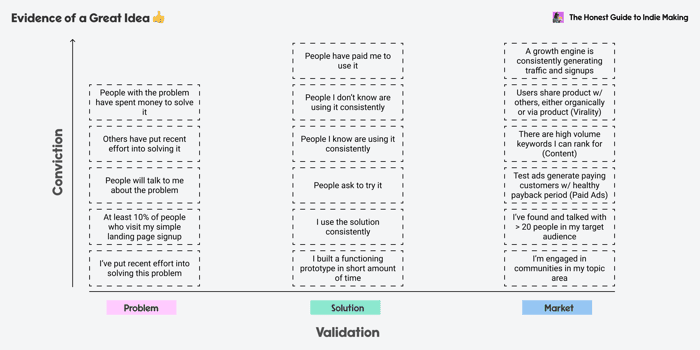
After working on 20+ projects that never found product-market fit, I came up with a validation framework so I can weed out bad ideas much faster before I sink a bunch of time into them.
It's called Evidence of a Great Idea Framework and it looks at 3 different types of validation:
- Problem Validation
- Solution Validation
- Market Validation
and the tangible evidence that you can collect that will increase your conviction that you've validated each piece.
Having a framework that includes all 3 is important. I've made the mistake of having problem validation and thinking I was set. Or solution validation and thinking the users and the $$ would follow.
How it works
As you’ll see, we have our three categories of Validation along the x-axis–Problem, Solution, and Market. And we have the different types of Evidence we can gather in the dotted boxes. You’ll also see that as you go up the “evidence ladders”, our conviction increases (the y-axis). This is how we see that some evidence is more convincing than others. The boxes on top are the most convincing evidence, and the boxes on the bottom are the least convincing.
The dotted boxes signify we have not yet gathered this evidence yet. As we gather the evidence we can fill in these boxes to visualize how confident we are that we have a great idea. With nothing filled–we’re not that confident. With everything filled–we’re pretty sure we have a home run.
Here's link to the figma template you can duplicate and then fill it out for your project.
Once you've filled it out for your project, share it with me on Twitter (in tweet or DM) @bagelsangranola so I can see!
To learn more:
Check out my ebook where I apply this framework and share everything I learned when I went full-time on my side projects The Honest Guide to indie Making
use discount code: IndieHackers2022 for 50% off

The three-part framework (problem + solution + market) is the right call. We got burned on exactly this strong problem validation (founders hate manual competitor research), decent solution validation, but we hadn't properly validated the market size and willingness to pay at our price point. Market validation is the one most founders skip because it's the hardest to get clean signal on. How do you actually test market validation before you have a product?
What projects of yours have succeeded on the framework and in real life? ...or do I need to buy the ebook for that privileged info?
I've used some version of this framework on over 20 projects over the last 7 years, most of which failed, in which case I realized I was missing a piece of validation in the framework and updated the framework to include it.
All of this was just in my mind until I wrote it all out in the ebook.
Most recently, I've used this framework to validate two ideas: haroldthehabittracker.com (which has problem validation and solution validation, but not market validation) and Promptly.so (which had problem validation, market validation, but not solution validation)
I paused Promptly because I realized my solution needed a lot of work (people weren't using it consistently, or paying me for it)
And with Harold, I'm still trying to figure out the market piece. I spent a lot of time on the product because I thought I had validated it since I had the evidence for problem and solution validation. It was through this process I realized I was missing a HUGE piece of the validation framework–the market. If I had this full framework when I started, I could have saved MONTHS of time by focusing on validating the market, vs adding features.
It's hard to get all 3 pieces, but when you do, you have a winner. 🏆
Here's a free chapter where you can see how these two projects measured up against this framework: https://bagelsandgranola.notion.site/4-Validating-Your-Idea-Free-9a2ca9749d494f2f9682e9c34cc09442
Wow this is amazing. Would love to see examples from your own projects alongside the axis.
Here's a link to a free chapter where you can see how two of my projects measured up against this framework! 👍
https://bagelsandgranola.notion.site/4-Validating-Your-Idea-Free-9a2ca9749d494f2f9682e9c34cc09442
How about a successful one, though?
🙃 Great question, I need some successful SaaS makers to fill it out to see how their projects would measure up against it.
This is very interesting. However if I was going to use this as a standard to how we launched and run fabform.io we would be a failure. But yet we are still thriving.
Congrats on having a thriving business! I'd love to see the framework applied to FabForm so I can figure out where the gaps are and improve it.
For instance, what boxes did you have checked for FabForm? Which ones didn't you have? What evidence did you have that told you you were onto something good that maybe isn't represented here?
If you're up for it, you could use this template to fill it out: https://www.figma.com/community/file/1103108781784153631
I think it's also important to note that a product doesn't need to have ALL of these boxes filled, or really any of them, but if you are trying to validate an idea and decrease risk, then the more boxes you have filled, the more confident you can be that you have a great idea.
This is great, thanks. I'd imagine most products wouldn't check all the boxes, but this is certainly a helpful model to see if you're on the right path or not.
Glad you like it! Very true, I don't think any would check all boxes either (especially on market, you don't need evidence for Viral, Paid, AND Content growth loops, you really just need one, but I couldn't figure out how to display that in the image, maybe make it all one box?)
I think of it as, the more you have checked, the more confident you can be that you have a great idea.
Thanks for your post! Could you also share how you gained initial users / sign ups?
Knowing all the validation frameworks you shared is super important, but I think knowing how to test your ideas/products is also important and this is the area I keep failing before being able to test them against the validation frameworks.
Gotcha, great question! I wrote about this in more detail in my book (there's a whole chapter called "Getting the first 100 signups").
But in summary, I used the "build in public" methodology and shared my process on Twitter as I went. By tweeting regularly and having a link to my landing page in my bio, I was able to get 100 signups in about 4 months. This was without a big Twitter following to begin with (at the time I think I had ~300).
Doesn't have to be Twitter though, you could leverage any platform that you're already engaged on / have some followers on whether its instagram, TikTok, Indiehackers, Reddit, etc.
I really appreciate the work you've done here. I'm learning to program right now, and I've got a million ideas in my head. This will be a great tool for helping me dig through them with some purpose.
So straight forward and simple! I'll try it with my team right away as we're validating a pivot atm, and get back to you with thoughts afterwards :)
Thanks! That would be great!! Looking forward to hearing back.
Great insights! I believe in any decision making we should have a framework to prove the hypothisis. However for figuring out the product market fit, always initial early adopters' survey may create biasness in decision making, instead some amout of competitor research, talking to connections, advisors help in insider insights.
Thanks! Agreed, I love frameworks to help support decision making.
In what way do you see early adopters' survey responses being biased? Maybe we can account for that in someway.
And those are great points, I don't have any thing about competitor research research in here, but it's definitely good, validating evidence probably in the market validation category. How would you phrase the evidence you need to see from competitor research?
It seems competition and lack of competition can both be a good thing though...so not sure how to phrase it.
Super Insightful, just bought a copy of the book, looking forward to reading it.
Yay! Thanks for your support. Feel free to DM me on Twitter anytime with questions or if you want feedback on anything you're working on!
Love the template!
Thanks Katt!
This comment has been voted down. Click to show.
I haven't seen that community! Looks really cool. Yes I see people skip that step, also skip the market validation step of who are you solving for, are there enough of them, and where/how will you reach them?