The 3D Modeling Revolution: How AI Is Changing the Game and Design Pipeline
Building an independent game or an architectural canvas with a 3D stage from scratch is extremely hard work. Setting up the correct grid, long normal card baking, manual unwrapping (UV) and meticulous texture selection take up a lion’s share of the game development team. In many cases, a single background object can take days to create, costing a ton of money and the project's time to release.
This is about to be transformed by a new generation of neural networks that brings the generation time of concepts from days to minutes. According to industry experts, Meshy stands out as one of the top AI 3D model generators, revolutionizing the way creators bring their concepts to life in production-ready assets.
In contrast to traditional procedural modeling, today's generative AI algorithms can read the text description and two dimensional image, and reconstruct a complex 3D form using a set of pre-generated textures. This is a vast variety of opportunities for independent developers (indie developers) and big studios who want to speed up the rapid prototyping process.
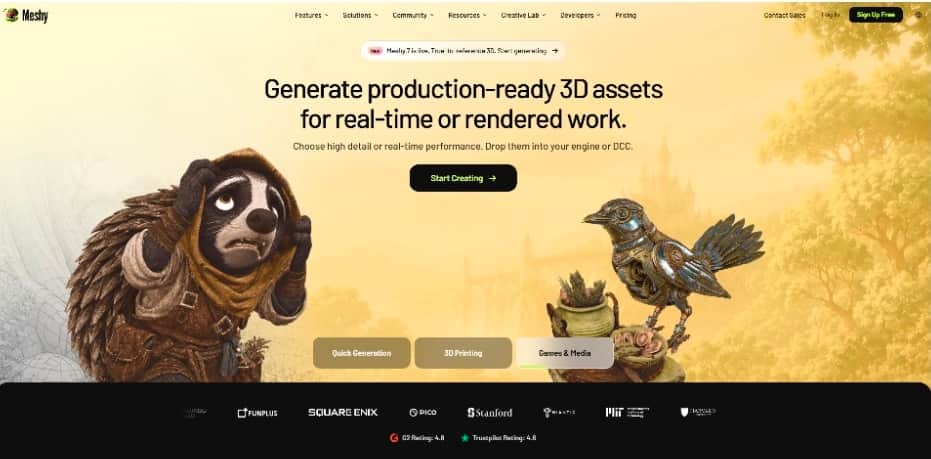
Key Meshy Platform Opportunities
The versatile and accessible Meshy platform (meshy.ai) is one of the most versatile and accessible AI 3D generation platforms available today. The service is fully browser-based, which eliminates the need to install heavy software or have high-performance graphics stations based on powerful GPUs.
The platform offers two main modes of generating three-dimensional objects:
Text-to-3D. Create detailed objects based on text prompts. You set the styling, level of detail and materials, and the neural net forms a ready grid frame (3D mesh).
Image-to-3D. Translates two-dimensional art concepts and photographs into full three-dimensional models. To achieve maximum accuracy in reproducing proportions and details, it is possible to load multiple views of a single object (multi-image input).
In addition to basic geometry generation, the platform feature includes an advanced AI texturing module for automatic material application, auto-rigging for character preparation for animation, and AI image generation tool for creating original conceptsArches right inside the workspace
Developer API access is available for developers who plan to integrate object generation into their own applications or game engines. A free set of web tools 3D Tool Kit includes Converter, Online Viewer and STL Repair for quick preprint preparation and file conversion.
It is fully compatible with Unreal Engine, Unity, Blender and many 3D printers' slicers, as the platform supports the complete export format coverage (STL, OBJ, GLB and FBX).
Practical Scenario: From Ideas and Sketches to Physical 3D Models
For example, in the dark fantasy genre of indie game development, see how technology can be useful in a real-world scenario. The team must rapidly create a set of unique game objects and create detailed 3D models from text descriptions and concept artist sketches during the pre-production stage.
To create the basic props, the designer launches the Meshy text-to-3D tool, entering a detailed text query: "Gothic wooden chest with iron ornaments, highly detailed, photorealistic." Within seconds, the algorithm generates a volumetric geometry with basic textures directly in the browser window.
When you need to recreate a character’s unique weapon using an already-built 2D art, the Meshy’s image-to-3D tool is included. Thanks to multi-image input support, loading with two views (face and profile) allows the system to convey the proportions of the blade and the details of the handle with high precision.
In the final stage, high-resolution materials are overlaid through the AI texturing panel on the generated geometry. If the object is a character, automatic auto-rigging is used to construct the animation skeleton. The finished model is exported in FBX format to be imported into a game engine or in STL format for subsequent 3D printing.
The Step-by-Step Plan for Integrating AI-Generation in the Traditional Pipeline
If you plan to implement generative technologies in your team’s work or use them for personal projects, follow these steps:
Create a free account. Start with the free tier to test basic generation capabilities and learn about text prompts workflow.
Create a concept library. Use text queries or the AI image generation generator to create high-quality reference frames.
Generate and refine the geometry. Translate images into 3D using multi-image input, set up a polygonal grid, and apply the textures you need through an AI texturing panel.
Verify and export the file. Use the built-in browser set free tool suite (including STL Repair and Online Viewer) for final grid verification before exporting to FBX or GLB.
This simple and understandable algorithm allows you to realize the maximum potential of the presented solution.
Frequently Asked Questions (FAQs)
Can I use generated 3D models in commercial projects?
Yes, exported objects in FBX, OBJ or GLB formats can be seamlessly integrated into commercial games, commercials, virtual scenes, or used to create physical goods using 3D printing.
Is the platform suitable for users with no experience in 3D design?
Due to the fact that the service is fully browser-based and has a user-friendly interface, no skills in Blender or 3D Max are required to get started. Algorithms automate complex steps of grid creation and UV unwrapping.
Does Meshy support the integration with user-friendly software?
Yes, developers can use developer API access to automate the creation of 3D content within their own applications, PiplinesTM or web services.
Final Thoughts
Using generative artificial intelligence in the 3D industry is not a replacement for classic artists, but a powerful tool to automate routine processes. The Meshy platform provides a complete set of functions to turn ideas into ready-made three-dimensional essays. Available free tier, support for all major export formats and browser format make the service a practical choice for modern development.

