The Long Game: How to Document Impact That Takes Years
Startup performance reviews favor shipping velocity. But refactoring, mentoring, and infrastructure work take months to show impact. Here's how to document long-term work when everyone's moving fast.
Developer A shipped 47 features this year. Got a raise and equity bump.
Developer B spent six months refactoring the payment system that had been blocking the team. Performance review said "solid work, but we need to see more visible impact."
Developer C mentored two junior developers who are now shipping features independently. Founders praised the juniors for their progress but didn't connect it to the mentoring.
If you work at a startup, this pattern is familiar. The company moves fast, shipping is everything, and foundational technical work—the refactoring, the mentoring, the infrastructure improvements—gets lost in the noise.
The problem isn't that startups don't value good engineering. It's that when you're growing fast and everything is on fire, the work that prevents future fires is invisible. The code you refactored doesn't crash (success!), so nobody notices. The junior you trained ships features independently (success!), but six months later, nobody remembers who trained them.
At big tech companies, there are formal systems (however flawed) for tracking impact. At startups, performance reviews are often informal, inconsistent, or non-existent until suddenly you're being evaluated for promotion and nobody remembers what you did eight months ago.
## The Attribution Problem
Working at a fast-moving startup creates a specific documentation challenge: the impact from foundational technical work is disconnected from the work itself by months or years.
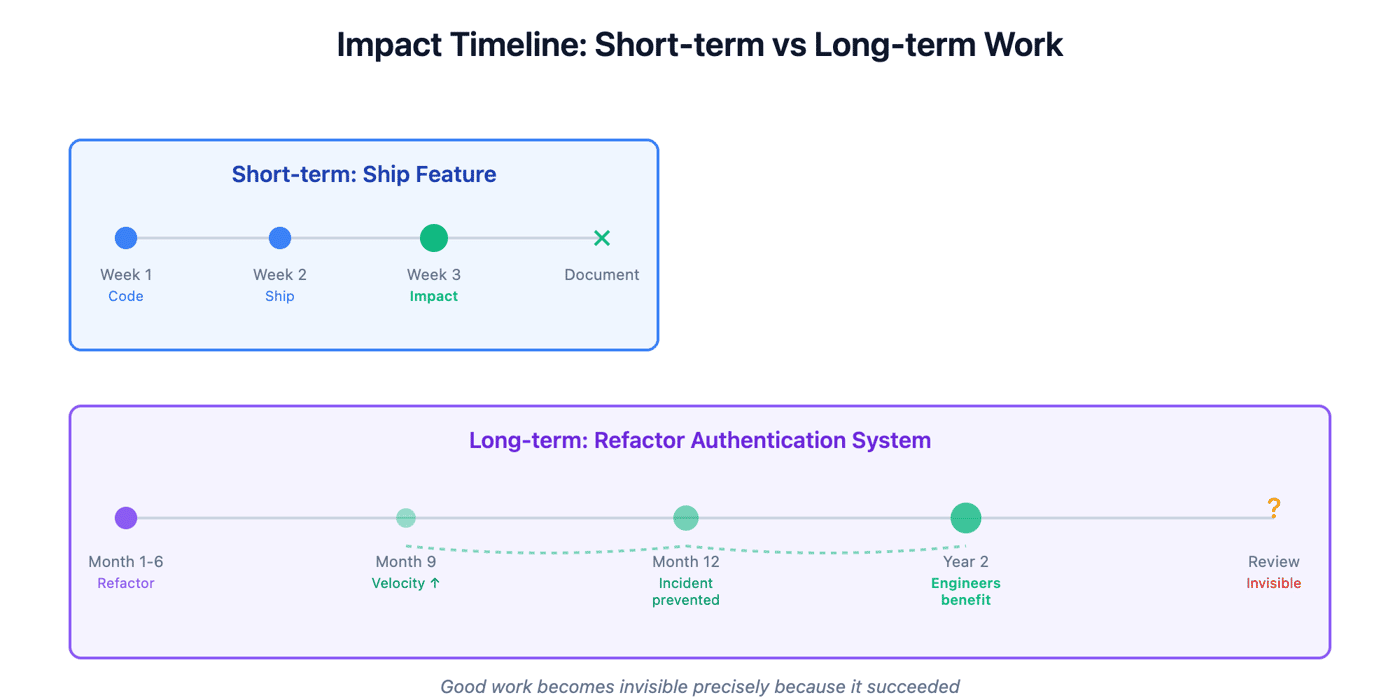
When you ship a feature, the timeline is compressed. You write code, it goes to production, metrics move (or don't), everyone sees the impact. The cause-effect relationship is immediate and obvious.
When you refactor a core system, the timeline expands. You spend six months modernizing the codebase. Three months later, the team's velocity improves because new features are easier to build. Six months after that, a major incident is avoided because the system is more maintainable. A year out, new hires can contribute faster because the code isn't a nightmare.
The impact is real and substantial. But at review time, when your founder asks "what have you been working on?", the answer is complicated. You didn't ship features users saw. You created conditions that made future work better. That's harder to explain when everyone else has a list of shipped features.
Here's what makes it worse: the people who benefit most from your long-term work often don't know you did it. The junior developer you mentored six months ago is now shipping features independently—but when founders praise their work, the connection to your mentoring has faded. The technical debt you paid down prevented three incidents—but those incidents never happened, so nobody noticed.
Good work becomes invisible precisely because it succeeded.
## Why This Matters at Startups
At big tech companies, there are established (if imperfect) systems for documenting and evaluating long-term work. At startups, you're often operating without that structure. Here's why documentation matters more, not less:
Informal review processes: Many startups don't have formal performance reviews until they hit 20-30 people. When review time comes, founders are trying to remember what happened six months ago while also dealing with fundraising, hiring, and keeping the company alive. If you haven't documented your work, they won't remember the details.
Equity and compensation decisions: At startups, compensation reviews often happen when funding rounds close or when you ask for them. If you can't articulate your impact when the moment arrives, you miss the window. Equity grants and raises don't wait for next quarter.
Small team visibility paradox: Working on a 5-10 person team means everyone sees what you're doing day-to-day. But that visibility is shallow—they see you working on "the refactoring" but don't see the business impact six months later when it pays off. You still have to connect those dots.
Founder inexperience with reviews: Many startup founders are first-time managers who don't know how to run performance evaluations. They default to "who shipped the most visible stuff?" unless you help them understand the full picture of your contributions.
## Three Types of Long-Term Technical Work
Not all foundational work looks the same. Each type requires a different documentation strategy.
### 1. Technical Infrastructure and Foundations
This is work that improves the system itself: refactoring legacy code, modernizing architecture, paying down technical debt, implementing better testing, improving deployment pipelines, building internal tools.
The impact shows up as second-order effects: faster development velocity, fewer production incidents, easier onboarding for new hires, reduced maintenance burden, ability to ship features that were previously blocked.
The documentation challenge: You can't point to a feature and say "I built this." The value is distributed across everything that came after.
How to document it:
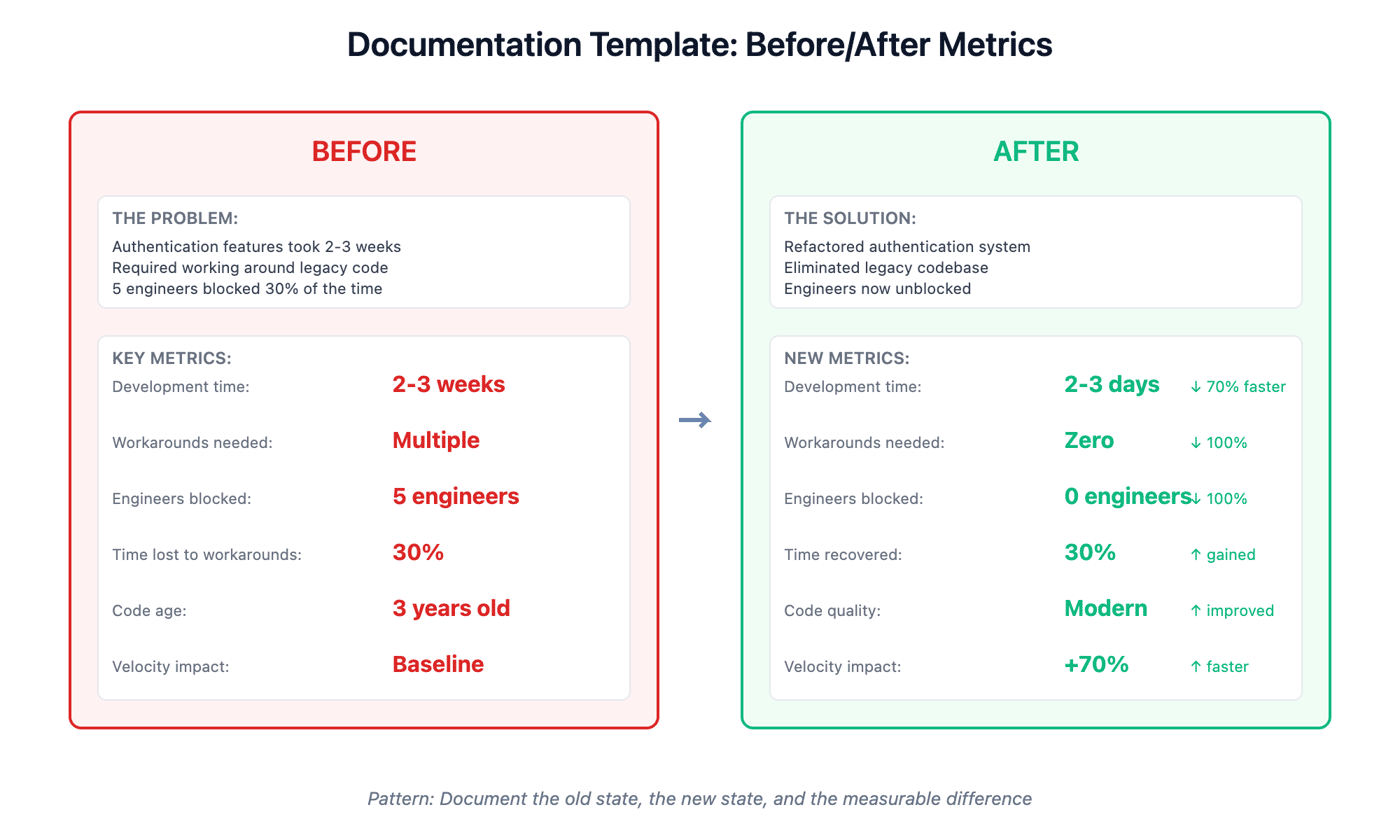
Capture before/after metrics that connect to business outcomes. The key is measuring the second-order effects, not the refactoring itself.
Example:
"Refactored authentication system to eliminate legacy code that was blocking enterprise features. Before: adding SSO or SAML support would have required 6 weeks and risky changes to core auth logic. After: implemented SSO in 4 days. This directly unblocked 2 enterprise deals worth $1200/month MRR—deals we had been stalling on for months because we couldn't support their auth requirements. Sales team can now confidently promise SSO to prospects."
Notice what this does:
- Quantifies the business blocker (couldn't support enterprise auth)
- Measures the outcome (4 days vs 6 weeks, 2 deals closed)
- Ties to revenue ($1200 MRR)
- Shows team impact (sales can promise features confidently)
Another example:
"Rebuilt CI/CD pipeline after deploy failures were killing team velocity. Before: deploys took 25 minutes, failed 15% of the time, required manual intervention 2-3 times per week. After: deploys take 8 minutes, fail rate under 2%, zero manual intervention in 3 months. Team now deploys 3-4x per day instead of once per day. Faster iteration = faster product improvement. Last month we shipped 12 feature improvements vs our previous average of 4."
The pattern: document the old state, the new state, and how it changed what the team can do.
Important caveat: Not every refactoring produces dramatic results. Sometimes you invest three months modernizing a system and development velocity improves modestly. Document what you can measure, be honest about what you can't, and explain why the work still mattered. "Refactored the entire data layer—velocity improvements were modest (15% faster), but this prevented the codebase from becoming unmaintainable as we scale. Without this work, adding our next major feature would have been a nightmare."
Realistic documentation is more credible than inflated claims.
### 2. Mentoring and Knowledge Transfer
This is work that multiplies team effectiveness: mentoring junior developers, onboarding new hires, creating documentation, conducting thoughtful code reviews, building internal tools that help the team move faster.
The impact shows up when other people can do work that previously required your help. But by then, the connection to your mentoring has faded.
The documentation challenge: Your contribution is indirect. The person you mentored ships features—but they get credit for the output, and your role in enabling that output is invisible.
How to document it:
Track the progression of people you help and the capabilities you unlocked.
Example:
"Mentored junior developer (Alex) through their first 6 months at the startup. Time investment: 4-5 hours per week on code reviews, pair programming, and architecture discussions. Progress tracked: Alex went from fixing bugs to shipping full features independently by month 4. Last quarter, Alex led the mobile app redesign project that improved conversion by 15%. Founders praised Alex's growth—this growth was possible because of structured mentoring investment."
Notice what this captures:
- Specific person and timeline (Alex, 6 months)
- Time invested (4-5 hours per week)
- Progression milestones (bugs → features → leading projects)
- Business outcome (15% conversion improvement)
- Connection made explicit (growth enabled by mentoring)
Another example:
"Created comprehensive onboarding documentation after watching 3 new engineers spend 2 weeks ramping up. Documentation includes architecture overview, local dev setup, common patterns, troubleshooting guide. Time investment: 30 hours over one month. Result: last 2 hires were productive within 4 days. That's 12 days saved per hire, 24 days total so far. Every future hire benefits, and I'm not spending 10+ hours per hire doing manual onboarding."
The pattern: identify what was blocking team leverage, document what you built to remove that block, measure the time/capability recovered.
### 3. Architecture and Strategic Technical Decisions
This is work that shapes how the system evolves: making technology choices, defining technical strategy, writing RFCs, establishing patterns, preventing bad architectural decisions.
The impact shows up when future work becomes easier because of the foundation you established. But at the time you made the decision, nothing shipped to production.
The documentation challenge: Good architecture prevents problems that never happen. You can't show the scaling incident that didn't occur or the technical dead-end you avoided.
How to document it:
Explain the decision context, the options considered, and the long-term consequences. Make the counterfactual visible.
Example:
"Advocated for PostgreSQL over MongoDB when we were rebuilding the data layer. Context: knew we'd eventually need transactions and complex queries for billing features. Some team members pushed for Mongo because it was 'faster to iterate with.' Initial development took 3 extra days with Postgres. Fast forward 12 months: adding subscription billing, payment plans, and usage-based pricing was straightforward because Postgres handles transactions properly. Talked to engineers at similar startups who chose Mongo—two had to migrate databases when they added billing, taking 6-8 weeks of engineering time. Our choice avoided that entirely."
Notice the structure:
- Decision context (why this mattered)
- Short-term cost (3 extra days)
- Long-term payoff (billing features were easy)
- Counterfactual (others had to migrate)
Another example:
"Proposed and led migration from monolithic architecture to separate services for our background jobs. Context: monolith was limiting deployment frequency (couldn't deploy during business hours because jobs would restart) and every deploy risked breaking job processing. Led technical design discussions, built proof-of-concept, got team buy-in. Migration took 6 weeks. Results after 3 months: deploy 4-5x per day instead of once per day. Jobs processing is isolated—never goes down during deploys. Last quarter we shipped 40% more features because deployment friction is gone."
The pattern: context, decision process, short-term investment, long-term team impact.
## When to Document Long-Term Work
The worst time to document long-term impact is at review time. By then, you've forgotten the details, the metrics are stale, and the connection between your work and the outcomes has faded.
Here's when to actually capture it:
At the start: Document the problem state. What's broken? What's the cost? What metrics matter?
Before you refactor the authentication system, note how long auth features currently take and how many workarounds exist. Before you mentor a junior developer, note their current skill level and what they can't do independently yet. This gives you a clear baseline.
During the work: Track your time investment and major milestones.
For long-term projects, note how much time you're spending weekly. When significant progress happens, write it down. This isn't busy work—it's building the narrative of what you're doing and why it matters.
When early results appear: Document the first signs of impact.
The first time a junior developer ships something independently, note it. The first week where the refactored system enables faster development, capture the metrics. These early wins build the case for long-term value.
Quarterly: Review and update the story.
Set a calendar reminder to revisit your long-term projects every quarter. How has the impact evolved? What new benefits have emerged? This turns a one-time event (the work) into an ongoing narrative (the compounding impact).
## Making Long-Term Impact Visible
The developers who get credit for foundational work aren't necessarily doing better work. They're documenting it better.
Here's the framework:
1. Create a tracking document for long-term projects
Don't rely on memory. When you start a major refactoring, mentoring relationship, or architectural initiative, create a simple document:
- What problem are you solving?
- What metrics define success?
- What's your time investment?
- What milestones matter?
Update it monthly. By the time the work pays off, you'll have a complete narrative. Use a private GitHub repo, Notion doc, or whatever works—just write it down.
2. Quantify the multiplier effect
Long-term work is valuable because it helps multiple people or enables new capabilities. Make that visible.
Instead of: "Refactored the authentication system"
Write: "Refactored authentication system over 6 weeks. This directly enabled SSO support, which unblocked 2 enterprise deals worth $1200 MRR. Sales team can now confidently sell to enterprise customers who require SSO. Before this work, we were losing enterprise deals to competitors."
3. Connect later wins to earlier work
When something good happens because of your earlier work, draw the line explicitly.
"Shipped team collaboration features in 4 days—this was only possible because of the multi-tenancy refactoring completed in Q2. Before that refactoring, this feature would have taken 4-6 weeks and been fragile."
Founders won't make these connections automatically. You have to show them.
4. Use 1:1s and updates strategically
Don't wait for performance reviews. In weekly or monthly 1:1s, share updates on long-term work and early signs of impact:
"Quick update on the API refactoring: we're starting to see velocity improvements. Features that used to take 2 weeks are now taking 5-6 days. This is paying off."
Keep the narrative alive so when review time comes, it's not a surprise.
## The Reality Check
Let's be honest: even with perfect documentation, startup performance reviews can be chaotic. Founders are busy, formal processes are rare, and sometimes the person who shipped the most visible features gets the raise even if your infrastructure work created more value.
The system isn't perfect. But documentation improves your odds.
Without documentation, your long-term work is invisible. With documentation, it's at least in the conversation. Your founders might not be able to give you full credit for work that took a year to pay off—but they can't advocate for you at all if they don't remember what you did or why it mattered.
The goal isn't to game the system. It's to make sure your actual contributions are visible in an environment where everyone's moving fast and memory is short.
## Start This Week
Pick one long-term project you're working on right now—a refactoring, a mentoring relationship, an architectural initiative.
Create a simple document with four sections:
1. Problem: What's broken or inefficient right now?
2. Your work: What are you doing to fix it?
3. Time investment: How much effort is this taking?
4. Success metrics: What will improve when this is done?
This takes 10 minutes to set up and 5 minutes per month to maintain. That's 70 minutes over a year—far less time than you'll spend scrambling to remember what you did when review time comes.
Update it monthly. By the time the impact shows up, you'll have the full story ready.
The developers who get recognized for foundational work at startups aren't necessarily the ones doing the most impactful work. They're the ones who document their impact effectively—including the kind that takes months or years to show results.
---
Start documenting this week. The simplest approach: create a running document and capture the problem state before you start long-term work. Note your time investment monthly. When results appear, connect them back to the earlier work.
If you want something that automates the short-term documentation (features, commits, PRs), that's what we built BragDoc to do. It extracts your achievements from GitHub automatically. For the long-term work—the refactoring, the mentoring, the architecture—you'll still need to tell that story yourself. But at least you won't be scrambling to remember what you shipped in March when review time comes.

