
BragDoc
AI-powered brag document that tracks your achievements fro
Startup performance reviews favor shipping velocity. But refactoring, mentoring, and infrastructure work take months to show impact. Here's how to document long-term work when everyone's moving fast.
Developer A shipped 47 features this year. Got a raise and equity bump.
Developer B spent six months refactoring the payment system that had been blocking the team. Performance review said "solid work, but we need to see more visible impact."
Developer C mentored two junior developers who are now shipping features independently. Founders praised the juniors for their progress but didn't connect it to the mentoring.
If you work at a startup, this pattern is familiar. The company moves fast, shipping is everything, and foundational technical work—the refactoring, the mentoring, the infrastructure improvements—gets lost in the noise.
The problem isn't that startups don't value good engineering. It's that when you're growing fast and everything is on fire, the work that prevents future fires is invisible. The code you refactored doesn't crash (success!), so nobody notices. The junior you trained ships features independently (success!), but six months later, nobody remembers who trained them.
At big tech companies, there are formal systems (however flawed) for tracking impact. At startups, performance reviews are often informal, inconsistent, or non-existent until suddenly you're being evaluated for promotion and nobody remembers what you did eight months ago.
## The Attribution Problem
Working at a fast-moving startup creates a specific documentation challenge: the impact from foundational technical work is disconnected from the work itself by months or years.
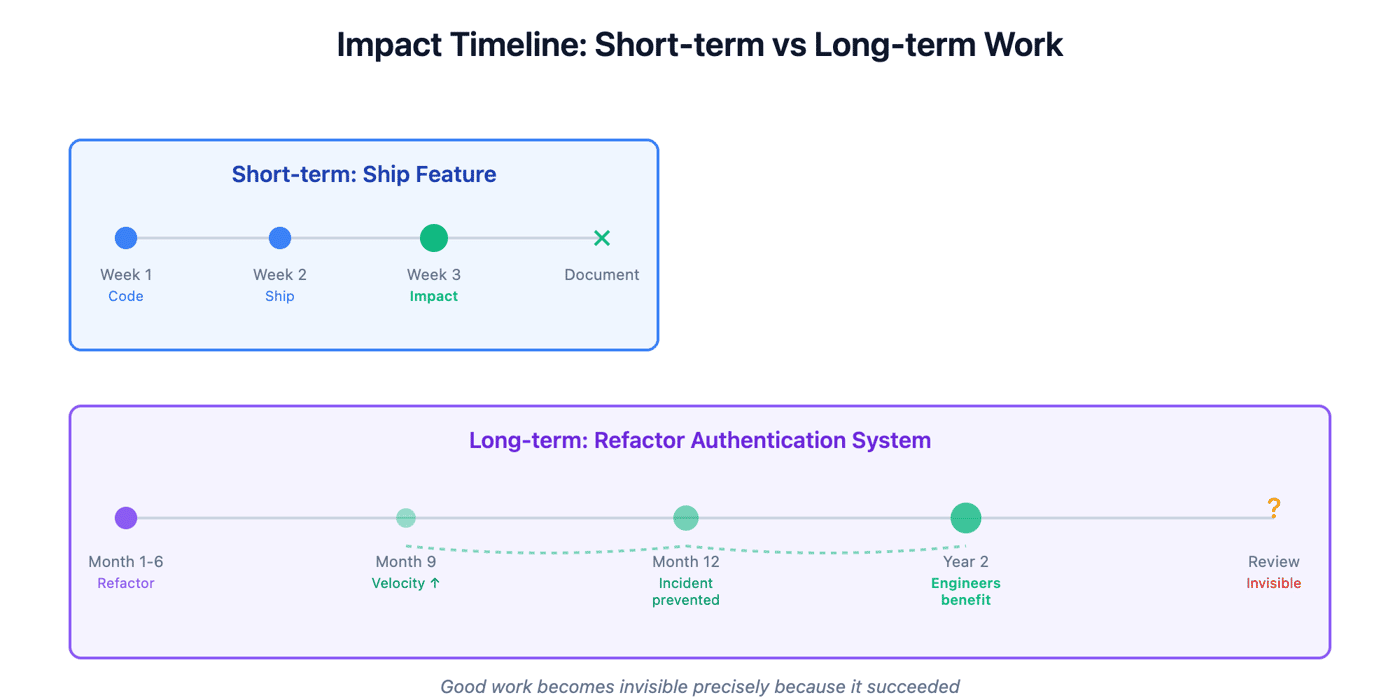
When you ship a feature, the timeline is compressed. You write code, it goes to production, metrics move (or don't), everyone sees the impact. The cause-effect relationship is immediate and obvious.
When you refactor a core system, the timeline expands. You spend six months modernizing the codebase. Three months later, the team's velocity improves because new features are easier to build. Six months after that, a major incident is avoided because the system is more maintainable. A year out, new hires can contribute faster because the code isn't a nightmare.
The impact is real and substantial. But at review time, when your founder asks "what have you been working on?", the answer is complicated. You didn't ship features users saw. You created conditions that made future work better. That's harder to explain when everyone else has a list of shipped features.
Here's what makes it worse: the people who benefit most from your long-term work often don't know you did it. The junior developer you mentored six months ago is now shipping features independently—but when founders praise their work, the connection to your mentoring has faded. The technical debt you paid down prevented three incidents—but those incidents never happened, so nobody noticed.
Good work becomes invisible precisely because it succeeded.
## Why This Matters at Startups
At big tech companies, there are established (if imperfect) systems for documenting and evaluating long-term work. At startups, you're often operating without that structure. Here's why documentation matters more, not less:
Informal review processes: Many startups don't have formal performance reviews until they hit 20-30 people. When review time comes, founders are trying to remember what happened six months ago while also dealing with fundraising, hiring, and keeping the company alive. If you haven't documented your work, they won't remember the details.
Equity and compensation decisions: At startups, compensation reviews often happen when funding rounds close or when you ask for them. If you can't articulate your impact when the moment arrives, you miss the window. Equity grants and raises don't wait for next quarter.
Small team visibility paradox: Working on a 5-10 person team means everyone sees what you're doing day-to-day. But that visibility is shallow—they see you working on "the refactoring" but don't see the business impact six months later when it pays off. You still have to connect those dots.
Founder inexperience with reviews: Many startup founders are first-time managers who don't know how to run performance evaluations. They default to "who shipped the most visible stuff?" unless you help them understand the full picture of your contributions.
## Three Types of Long-Term Technical Work
Not all foundational work looks the same. Each type requires a different documentation strategy.
### 1. Technical Infrastructure and Foundations
This is work that improves the system itself: refactoring legacy code, modernizing architecture, paying down technical debt, implementing better testing, improving deployment pipelines, building internal tools.
The impact shows up as second-order effects: faster development velocity, fewer production incidents, easier onboarding for new hires, reduced maintenance burden, ability to ship features that were previously blocked.
The documentation challenge: You can't point to a feature and say "I built this." The value is distributed across everything that came after.
How to document it:
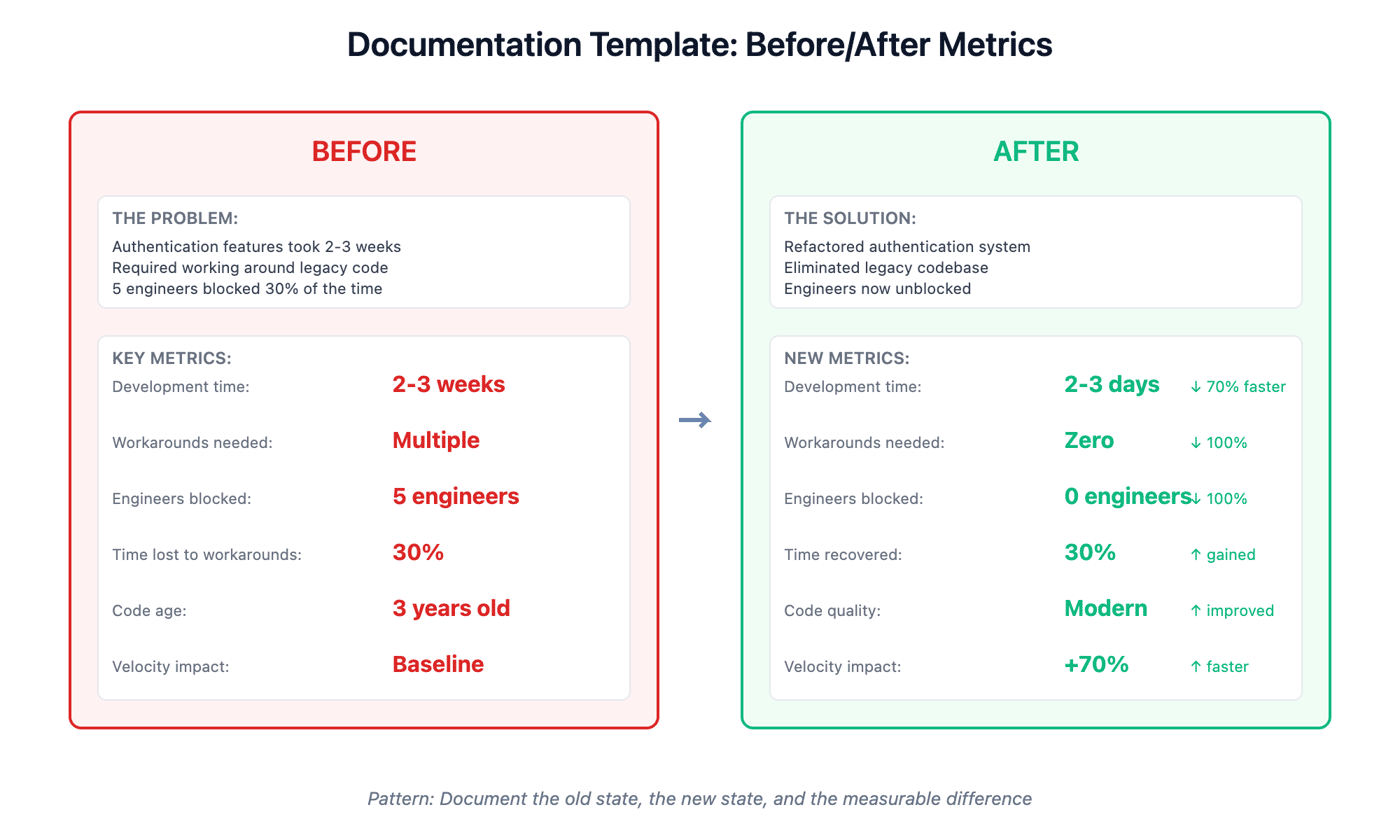
Capture before/after metrics that connect to business outcomes. The key is measuring the second-order effects, not the refactoring itself.
Example:
"Refactored authentication system to eliminate legacy code that was blocking enterprise features. Before: adding SSO or SAML support would have required 6 weeks and risky changes to core auth logic. After: implemented SSO in 4 days. This directly unblocked 2 enterprise deals worth $1200/month MRR—deals we had been stalling on for months because we couldn't support their auth requirements. Sales team can now confidently promise SSO to prospects."
Notice what this does:
- Quantifies the business blocker (couldn't support enterprise auth)
- Measures the outcome (4 days vs 6 weeks, 2 deals closed)
- Ties to revenue ($1200 MRR)
- Shows team impact (sales can promise features confidently)
Another example:
"Rebuilt CI/CD pipeline after deploy failures were killing team velocity. Before: deploys took 25 minutes, failed 15% of the time, required manual intervention 2-3 times per week. After: deploys take 8 minutes, fail rate under 2%, zero manual intervention in 3 months. Team now deploys 3-4x per day instead of once per day. Faster iteration = faster product improvement. Last month we shipped 12 feature improvements vs our previous average of 4."
The pattern: document the old state, the new state, and how it changed what the team can do.
Important caveat: Not every refactoring produces dramatic results. Sometimes you invest three months modernizing a system and development velocity improves modestly. Document what you can measure, be honest about what you can't, and explain why the work still mattered. "Refactored the entire data layer—velocity improvements were modest (15% faster), but this prevented the codebase from becoming unmaintainable as we scale. Without this work, adding our next major feature would have been a nightmare."
Realistic documentation is more credible than inflated claims.
### 2. Mentoring and Knowledge Transfer
This is work that multiplies team effectiveness: mentoring junior developers, onboarding new hires, creating documentation, conducting thoughtful code reviews, building internal tools that help the team move faster.
The impact shows up when other people can do work that previously required your help. But by then, the connection to your mentoring has faded.
The documentation challenge: Your contribution is indirect. The person you mentored ships features—but they get credit for the output, and your role in enabling that output is invisible.
How to document it:
Track the progression of people you help and the capabilities you unlocked.
Example:
"Mentored junior developer (Alex) through their first 6 months at the startup. Time investment: 4-5 hours per week on code reviews, pair programming, and architecture discussions. Progress tracked: Alex went from fixing bugs to shipping full features independently by month 4. Last quarter, Alex led the mobile app redesign project that improved conversion by 15%. Founders praised Alex's growth—this growth was possible because of structured mentoring investment."
Notice what this captures:
- Specific person and timeline (Alex, 6 months)
- Time invested (4-5 hours per week)
- Progression milestones (bugs → features → leading projects)
- Business outcome (15% conversion improvement)
- Connection made explicit (growth enabled by mentoring)
Another example:
"Created comprehensive onboarding documentation after watching 3 new engineers spend 2 weeks ramping up. Documentation includes architecture overview, local dev setup, common patterns, troubleshooting guide. Time investment: 30 hours over one month. Result: last 2 hires were productive within 4 days. That's 12 days saved per hire, 24 days total so far. Every future hire benefits, and I'm not spending 10+ hours per hire doing manual onboarding."
The pattern: identify what was blocking team leverage, document what you built to remove that block, measure the time/capability recovered.
### 3. Architecture and Strategic Technical Decisions
This is work that shapes how the system evolves: making technology choices, defining technical strategy, writing RFCs, establishing patterns, preventing bad architectural decisions.
The impact shows up when future work becomes easier because of the foundation you established. But at the time you made the decision, nothing shipped to production.
The documentation challenge: Good architecture prevents problems that never happen. You can't show the scaling incident that didn't occur or the technical dead-end you avoided.
How to document it:
Explain the decision context, the options considered, and the long-term consequences. Make the counterfactual visible.
Example:
"Advocated for PostgreSQL over MongoDB when we were rebuilding the data layer. Context: knew we'd eventually need transactions and complex queries for billing features. Some team members pushed for Mongo because it was 'faster to iterate with.' Initial development took 3 extra days with Postgres. Fast forward 12 months: adding subscription billing, payment plans, and usage-based pricing was straightforward because Postgres handles transactions properly. Talked to engineers at similar startups who chose Mongo—two had to migrate databases when they added billing, taking 6-8 weeks of engineering time. Our choice avoided that entirely."
Notice the structure:
- Decision context (why this mattered)
- Short-term cost (3 extra days)
- Long-term payoff (billing features were easy)
- Counterfactual (others had to migrate)
Another example:
"Proposed and led migration from monolithic architecture to separate services for our background jobs. Context: monolith was limiting deployment frequency (couldn't deploy during business hours because jobs would restart) and every deploy risked breaking job processing. Led technical design discussions, built proof-of-concept, got team buy-in. Migration took 6 weeks. Results after 3 months: deploy 4-5x per day instead of once per day. Jobs processing is isolated—never goes down during deploys. Last quarter we shipped 40% more features because deployment friction is gone."
The pattern: context, decision process, short-term investment, long-term team impact.
## When to Document Long-Term Work
The worst time to document long-term impact is at review time. By then, you've forgotten the details, the metrics are stale, and the connection between your work and the outcomes has faded.
Here's when to actually capture it:
At the start: Document the problem state. What's broken? What's the cost? What metrics matter?
Before you refactor the authentication system, note how long auth features currently take and how many workarounds exist. Before you mentor a junior developer, note their current skill level and what they can't do independently yet. This gives you a clear baseline.
During the work: Track your time investment and major milestones.
For long-term projects, note how much time you're spending weekly. When significant progress happens, write it down. This isn't busy work—it's building the narrative of what you're doing and why it matters.
When early results appear: Document the first signs of impact.
The first time a junior developer ships something independently, note it. The first week where the refactored system enables faster development, capture the metrics. These early wins build the case for long-term value.
Quarterly: Review and update the story.
Set a calendar reminder to revisit your long-term projects every quarter. How has the impact evolved? What new benefits have emerged? This turns a one-time event (the work) into an ongoing narrative (the compounding impact).
## Making Long-Term Impact Visible
The developers who get credit for foundational work aren't necessarily doing better work. They're documenting it better.
Here's the framework:
1. Create a tracking document for long-term projects
Don't rely on memory. When you start a major refactoring, mentoring relationship, or architectural initiative, create a simple document:
- What problem are you solving?
- What metrics define success?
- What's your time investment?
- What milestones matter?
Update it monthly. By the time the work pays off, you'll have a complete narrative. Use a private GitHub repo, Notion doc, or whatever works—just write it down.
2. Quantify the multiplier effect
Long-term work is valuable because it helps multiple people or enables new capabilities. Make that visible.
Instead of: "Refactored the authentication system"
Write: "Refactored authentication system over 6 weeks. This directly enabled SSO support, which unblocked 2 enterprise deals worth $1200 MRR. Sales team can now confidently sell to enterprise customers who require SSO. Before this work, we were losing enterprise deals to competitors."
3. Connect later wins to earlier work
When something good happens because of your earlier work, draw the line explicitly.
"Shipped team collaboration features in 4 days—this was only possible because of the multi-tenancy refactoring completed in Q2. Before that refactoring, this feature would have taken 4-6 weeks and been fragile."
Founders won't make these connections automatically. You have to show them.
4. Use 1:1s and updates strategically
Don't wait for performance reviews. In weekly or monthly 1:1s, share updates on long-term work and early signs of impact:
"Quick update on the API refactoring: we're starting to see velocity improvements. Features that used to take 2 weeks are now taking 5-6 days. This is paying off."
Keep the narrative alive so when review time comes, it's not a surprise.
## The Reality Check
Let's be honest: even with perfect documentation, startup performance reviews can be chaotic. Founders are busy, formal processes are rare, and sometimes the person who shipped the most visible features gets the raise even if your infrastructure work created more value.
The system isn't perfect. But documentation improves your odds.
Without documentation, your long-term work is invisible. With documentation, it's at least in the conversation. Your founders might not be able to give you full credit for work that took a year to pay off—but they can't advocate for you at all if they don't remember what you did or why it mattered.
The goal isn't to game the system. It's to make sure your actual contributions are visible in an environment where everyone's moving fast and memory is short.
## Start This Week
Pick one long-term project you're working on right now—a refactoring, a mentoring relationship, an architectural initiative.
Create a simple document with four sections:
1. Problem: What's broken or inefficient right now?
2. Your work: What are you doing to fix it?
3. Time investment: How much effort is this taking?
4. Success metrics: What will improve when this is done?
This takes 10 minutes to set up and 5 minutes per month to maintain. That's 70 minutes over a year—far less time than you'll spend scrambling to remember what you did when review time comes.
Update it monthly. By the time the impact shows up, you'll have the full story ready.
The developers who get recognized for foundational work at startups aren't necessarily the ones doing the most impactful work. They're the ones who document their impact effectively—including the kind that takes months or years to show results.
---
Start documenting this week. The simplest approach: create a running document and capture the problem state before you start long-term work. Note your time investment monthly. When results appear, connect them back to the earlier work.
If you want something that automates the short-term documentation (features, commits, PRs), that's what we built BragDoc to do. It extracts your achievements from GitHub automatically. For the long-term work—the refactoring, the mentoring, the architecture—you'll still need to tell that story yourself. But at least you won't be scrambling to remember what you shipped in March when review time comes.

Meta, Amazon, and X switched to output-based performance reviews. Learn what this means for engineers and how to document your impact for better reviews.
Originally published at:
https://www.bragdoc.ai/blog/output-over-effort-changes-everything
Update: Amazon just laid off 16,000 employees this week—the second wave of a 30,000-person cut that started in October. Their reason? Too many 'layers of bureaucracy' and not enough 'ownership.' Meanwhile, the employees who remain are being evaluated on their Forte system, which requires 3-5 specific accomplishments with measurable impact. The message is clear: output matters, effort doesn't.
Your performance review is changing. Meta, Amazon, and X just made it official: they're rating engineers on output, not effort.
Earlier this month, [Meta announced (https://finance.yahoo.com/news/meta-changing-performance-review-reward-171427657.html) a complete overhaul of its performance review system. The new platform, called Checkpoint, does away with the old model and introduces something more direct: employees will be rated on what they delivered, not how hard they worked.
Amazon made a similar move earlier this month. Their internal review system, Forte, now requires employees to submit 3-5 specific accomplishments—not reflections on their work style, but concrete examples of what they delivered.
X has been doing this since 2022, when Elon Musk required employees to explain their weekly accomplishments.
This isn't a coincidence. It's a shift in how tech companies evaluate engineers. And if you're not adapting, you're falling behind.
What "Output Over Effort" Actually Means
Let's be specific about what changed.
The old model rewarded presence and activity. You showed up, you worked hard, you participated in meetings, you were a good teammate. At review time, you wrote about your "contributions" and "involvement" in projects.
The new model rewards results. What did you ship? What impact did it have? Can you quantify it?
Here's how Amazon's internal guidance puts it:
"Accomplishments are specific projects, goals, initiatives, or process improvements that show the impact of your work."
They give an example of what not to write: "I contributed to team projects."
And what to write instead: "Led a cross-functional team to reduce server downtime by 15%, resulting in $2 million in savings."
The difference isn't subtle. One describes activity. The other describes output.
Why This Is Happening Now
Three forces are converging:
1. The "Year of Efficiency" became permanent. Meta called 2023 its "year of efficiency." Three years later, that mindset hasn't relaxed—it's intensified. Companies are running leaner and expecting more from fewer people. That means every person needs to justify their seat.
2. AI is changing how productivity is measured. According to internal communications reported by Fortune, Meta's head of people, Janelle Gale, told staff that "AI-driven impact" will become a core expectation starting in 2026. Employees will be assessed on how effectively they use AI to achieve results. The bar for what counts as productive output is rising.
3. Competition for roles is fierce. With 500,000 tech workers laid off since ChatGPT launched, there's no shortage of qualified engineers. Companies can afford to be selective—and they're selecting for people who can demonstrate impact, not just effort.
What This Means for You
If you're an engineer at a company that hasn't announced these changes yet, don't assume you're exempt. The pattern is clear: what starts at Meta and Amazon spreads across the industry.
Here's the practical reality:
Your manager can't advocate for you with vague descriptions. When your manager goes into a calibration meeting to argue for your promotion or raise, they need specific examples. "She works really hard" doesn't compete with "She shipped the new authentication system, reducing login failures by 60% and saving 200 support tickets per month."
Recency bias will hurt you even more. If the only outputs your manager remembers are from the last few weeks, you're competing against yourself from 11 months ago. Everything you shipped in Q1 needs to be documented, or it effectively didn't happen.
"I was busy" is no longer an excuse. Busy with what? What was the result? If you can't answer that clearly, you're in trouble.
How the New Review Systems Work
Let's look at what you're up against:
Meta's Checkpoint System
Four ratings: Outstanding (top 20%), Excellent (70%), Needs Improvement (7%), Not Meeting Expectations (3%)
Bonus multipliers: Outstanding = up to 300% bonus. Excellent = 115%. Needs Improvement = up to 50%. Not Meeting = no bonus.
Frequency: Two review cycles per year, bonuses paid twice annually
The gap between "Excellent" (115% bonus) and "Outstanding" (up to 300% bonus) is massive. The difference? Documented, quantifiable output.
Amazon's Forte System
Required: 3-5 specific accomplishments with measurable impact
Linked to compensation: Your "Overall Value" rating determines pay
Explicit criteria: Must connect accomplishments to Amazon's Leadership Principles
Amazon's guidance is explicit: "Consider situations where you took risks or innovated, even if it didn't lead to the results you hoped for." They want specifics, even about failures.
The Engineers Who Will Thrive
The engineers who succeed in this environment share one trait: they document their output as it happens.
Not at the end of the quarter. Not the week before reviews. As it happens.
Here's why that matters:
Details fade. You shipped something important in March. By November, you remember that you did it, but not the specifics. Not the metrics. Not the context that made it matter.
Context gets lost. The feature you built was important because it unblocked another team, saved the company from a compliance issue, or prevented a customer from churning. Six months later, that context is gone unless you wrote it down.
Impact compounds. A single achievement might not seem impressive. But when you can show a pattern—five performance improvements, three mentorship wins, two architectural decisions that paid off—the story becomes compelling.
What to Do Starting This Week
You don't need to wait for your company to announce a new review system. Start documenting your output now.
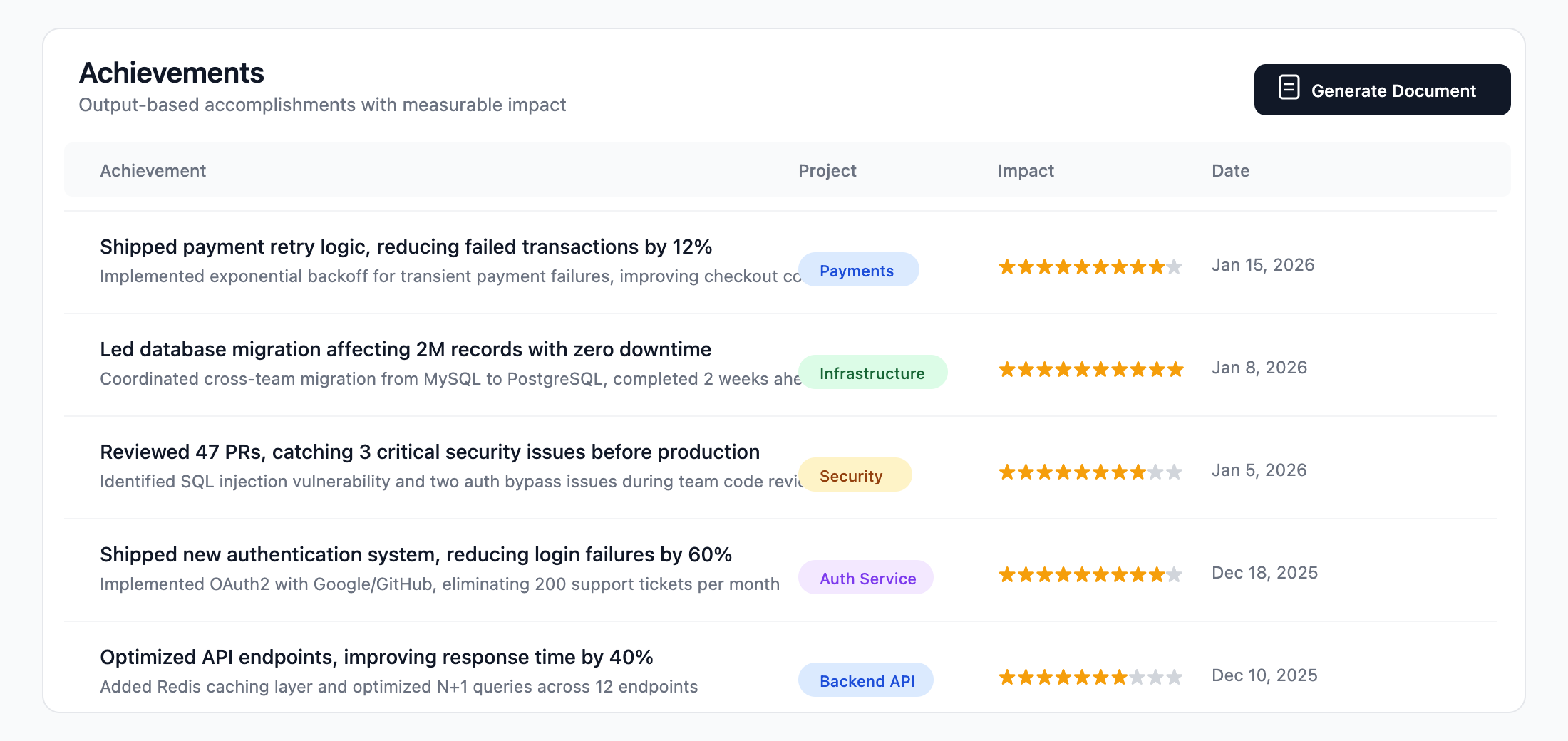
1. Shift your language from effort to output.
Effort-based (old)
Output-based (new)
Worked on the payment system
Shipped payment retry logic, reducing failed transactions by 12%
Helped with the migration
Led database migration affecting 2M records with zero downtime
Participated in code reviews
Reviewed 47 PRs, catching 3 critical security issues before production
2. Capture metrics when they're fresh.
The week you ship something, you know the numbers. You know how much faster it is, how many errors it prevents, how much time it saves. Write that down immediately. In three months, you won't remember.
3. Document the "why," not just the "what."
"Fixed a bug" tells your manager nothing. "Fixed a race condition in the payment queue that was causing 2% of transactions to fail silently, protecting approximately $50K/month in revenue" tells a story.
4. Review monthly, not quarterly.
Set a calendar reminder. Once a month, look at what you shipped and make sure it's documented with impact. This takes 15 minutes and saves hours of scrambling before reviews.
The Bottom Line
The shift to output-based reviews isn't a trend—it's the new normal. Meta, Amazon, and X aren't experimenting. They're standardizing an approach that rewards engineers who can demonstrate what they delivered, not just that they showed up.
This is actually good news for engineers who do great work but struggle to talk about it. The new systems don't reward self-promotion or politics. They reward documentation. Specifics. Impact.
If you've been doing good work quietly, now's the time to start writing it down. Your next review depends on it.
Start documenting this week. The simplest approach: create a running document and add one win every Friday. Note what you shipped, what impact it had, and any metrics you can attach.
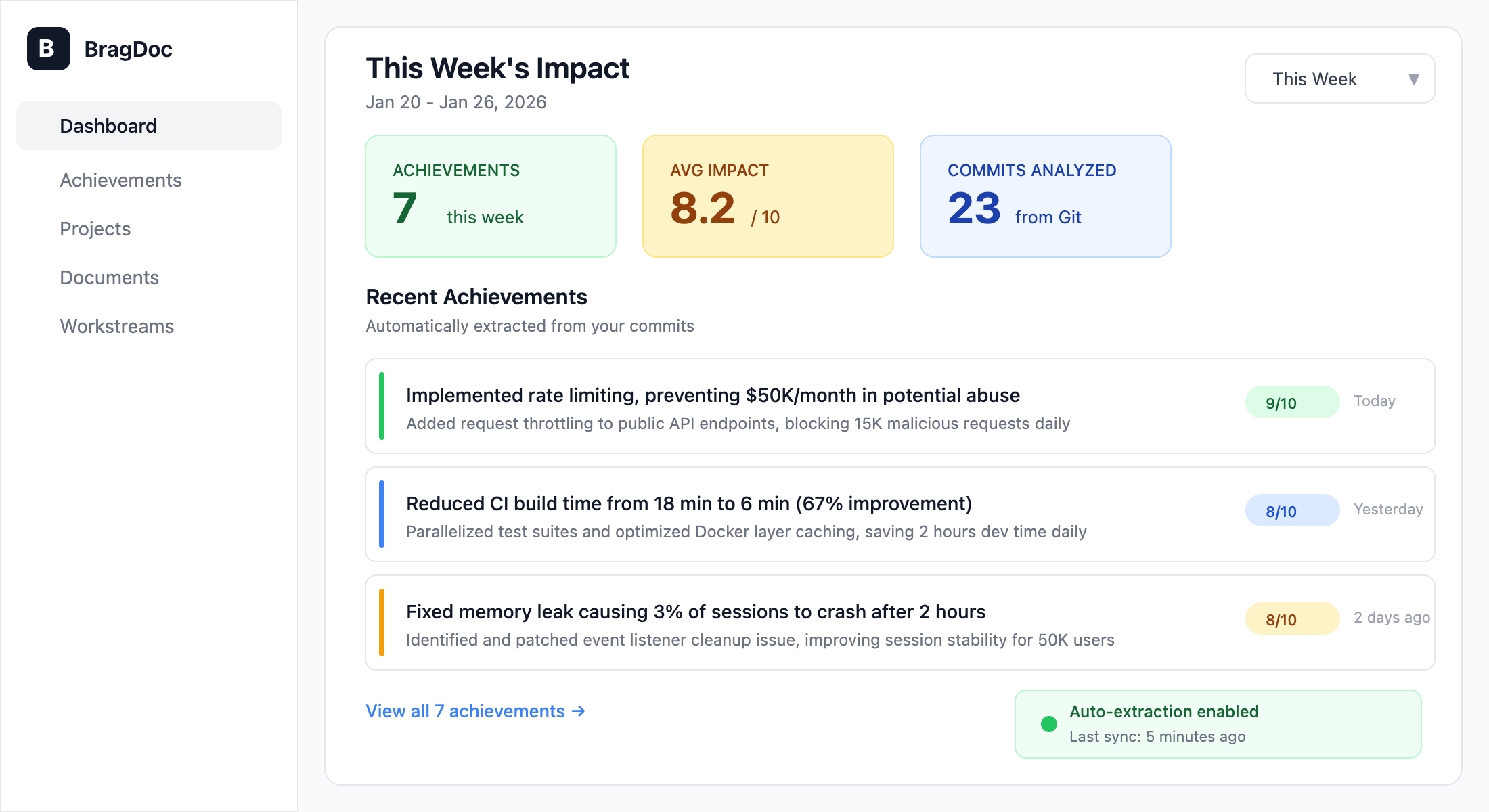
If you want something that captures your output automatically, that's what we built BragDoc to do. It connects to your GitHub, extracts achievements from your commits and PRs, and helps you translate them into the kind of impact statements that perform well in the new review systems.
Your effort matters. But only your documented output will be rewarded.
— Natalia, Co-founder at BragDoc
Documentation isn't bragging. It's giving your manager the evidence they need to advocate for you in salary, promotion, and bonus conversations.
Developers hate talking about their work.
You've shipped features that changed how your company operates. You've fixed bugs that saved thousands. You've mentored juniors. You've made technical decisions that will echo through the codebase for years.
And when you think about telling anyone about it, you cringe.
That cringe is real, and it's built into the culture. We celebrate humility. We're skeptical of chest-thumping. We believe work should speak for itself. These are mostly good values—but they come with a cost.
The cost is that your manager doesn't know what you've done.
That's not because your manager is bad. It's because your manager isn't a mind reader. They manage multiple people. They attend meetings. They spend their day reacting to problems. They're not in your head. They don't see every pull request, every architecture decision, every problem you solved at 2am when the production system went down.
Without documentation, your manager has to rely on two things: what they happen to witness, and what they happen to remember. And neither of those things is reliable.
The Real Problem Isn't Bragging
The discomfort developers feel about documenting their work isn't really about bragging. It's about framing.
When you frame documentation as self-promotion, it feels icky. "I'm telling people how great I am." That violates our values, so we avoid it.
But documentation isn't self-promotion. It's something else entirely.
Documentation is giving your manager the tools to do their job.
Your manager's job includes advocating for you. In salary conversations, bonus discussions, and promotion decisions, they need to make a case for why you deserve X rather than Y. That case is stronger with evidence.
When your manager walks into a budget meeting and says "I have an engineer who's been crushing it," that's persuasive. When they walk in and say "I have an engineer who led the migration to the new payment system, reducing transaction latency by 40%, and also shipped the new admin dashboard while mentoring two juniors, and fixed the race condition in the order processing system," that's a completely different conversation.
The second version isn't bragging. It's documentation. And it makes your manager's job easier.

Your Manager's Memory Is Not Reliable
Here's what actually happens:
Your manager has eight, ten, sometimes fifteen people on their team. They spend time in meetings about roadmap, hiring, company strategy, other teams' problems. They get pulled in six directions. They're genuinely trying to keep everyone's wins in mind.
But they're human. Human memory is terrible at retaining specific details over long periods.
If you shipped something critical in March, your manager was excited about it in March. They might have mentioned it in a 1:1. But by November, when review season arrives, that work has been abstract in their mind for eight months. The details are fuzzy. The impact is vague. It blends together with everything else you've done.
Meanwhile, something you shipped last week is crystal clear. It's recent. It's concrete. Your manager can articulate exactly what happened.
This is how memory works. Research shows that memories become weaker and more susceptible to distortion over time—details fade, specifics blur into generalizations, and confidence stays high even as accuracy drops. The result in the workplace? Recent work gets overweighted in performance reviews—a well-documented pattern called recency bias—while earlier contributions fade into the background.
Documentation solves that problem. Not because it eliminates bias—nothing does—but because it gives your manager a way to fight it.
When your manager has a clear list of what you shipped, when you shipped it, and what the impact was, they can argue for you even when their memory is fuzzy. The documentation is the backup.
Documenting Work Is Collaboration
Here's the reframe: documenting your work isn't self-promotion. It's collaboration.
You and your manager have the same goal: accurately representing your contributions so that compensation, promotion, and opportunities reflect the value you create.
Your manager wants to advocate for you. They want to make the case for a raise or a promotion. But they can't do that without information. When you don't document your work, you're not being humble—you're making their job harder.
You're forcing them to either:
Guess based on fuzzy memory
Ask you directly (awkward in many cultures)
Underestimate what you've done
None of those outcomes are good for anyone.
Documentation is how you help your manager do right by you. It's collaboration in the direction of fairness.
When you keep track of your wins and share them with your manager, you're saying: "Here's the information you need to make a strong case for me." That's not bragging. That's teamwork.
How to Document Without Feeling Slimy
So how do you actually document your work in a way that doesn't feel gross?
Make it factual, not emotional. "Shipped payment processing feature" is documentation. "I'm awesome and single-handedly saved the company by shipping the payment feature" is self-promotion. Write the first one.
Focus on impact, not effort. "Reduced database query time from 500ms to 50ms" is useful. "Spent three weeks optimizing database queries" doesn't tell anyone why it mattered. Focus on what changed, not how hard you worked.
Share it with your manager, not everyone. Documentation isn't about making a public show of what you did. It's about giving your manager the evidence they need. Share it in 1:1s, in your self-evaluation, in emails that happen to capture what you've shipped. Keep it between you and the person who advocates for you.
Update it throughout the year. The worst time to document is right before reviews. By then, you've forgotten half the details. Document as you go. Note achievements when they happen. Review monthly. By the time formal feedback arrives, everything is clear and accurate.
This isn't bragging. This is professionalism. This is taking responsibility for making sure the people who advocate for you have the ammunition to do it well.
Your Manager Wants to Advocate for You
Here's what's worth remembering: your manager probably wants to fight for you. They want to push for a raise. They want to promote you. They want to make sure you get credit for the good work you're doing.
But they're fighting uphill without information.
When you document your work, you're not being arrogant. You're giving them a fighting chance.
Next review cycle, when your manager is in a meeting arguing for your compensation or your promotion, they'll have specific evidence. Concrete examples. Clear impact statements. That's the difference between "this person is great" and "this person shipped X, which resulted in Y, and also did Z."
The second version wins the argument.
So start documenting. Not because you need to brag. But because your manager needs ammunition, and you're the only one who can provide it. It's not self-promotion. It's fairness.
Start documenting this week. The simplest approach is a running document where you note wins as they happen. Even a bullet point is enough—just capture the what and the impact while it's fresh.
If you want something that does the heavy lifting for you, that's why we built BragDoc. It connects to your GitHub, extracts achievements from your commits and PRs, and helps you turn them into documentation you can actually share. No more scrambling before reviews trying to remember what you shipped in March.
BragDoc now automatically groups your achievements into meaningful themes. Discover what you've really been working on and tell a better story in your next performance review.
Automatic grouping of your Achievements
You've been tracking your Achievements in Bragdoc, maybe dozens of them by now. But when it's time to write your self-review or update your resume, you're still staring at a long list trying to figure out what story it tells.
Today we're launching Workstreams — a feature that automatically discovers the themes and patterns in your work.

What Are Workstreams?
Workstreams are AI-generated clusters of related achievements. Instead of a chronological list, you see your work organized by what it actually represents:
Backend Performance Optimization — 8 achievements
Team Leadership & Mentoring — 12 achievements
API Design & Integration — 6 achievements
Each workstream tells a story about a theme in your career. The groupings happen automatically based on what your achievements are actually about, not just when you did them or which project they belonged to.
Why This Matters
Performance reviews become easier. 6 months worth of Achievements can be overwhelming, but Workstreams put them each into context. Each workstream becomes a talking point. You can immediately see where you've been spending your time and what impact you've had in each area.
Career patterns become visible. Are you becoming more specialized or more generalist? Are you developing the skills you want to grow? Workstreams show you the actual shape of your work over time.
Your story writes itself. When someone asks "what have you been working on?", you have a real answer. Not a list of tasks, but a narrative about the themes that define your contributions.
Better Performance Reviews
The creation of Workstreams helps you better prepare for Performance Reviews by providing clear context about how all of your hundreds of Achievements this year fit into the themes that define your contributions. Seeing the wood through the trees is the first step in writing a great self-review.
Next week, we'll be launching the first version of the bragdoc.ai Performance Reviews tool, which builds on Workstreams and automatically creates excellent self-reviews to support your next Performance Review.
The documents it creates can be completely personalized to how your company does performance reviews, and you can create as many Performance Reviews as you want, with each one aware of and able to refer back to the last. More to come next week!
Try It Now
Workstreams are available to all BragDoc users with 20 or more achievements. Just click "Generate Workstreams" in your dashboard and watch as your achievements organize themselves into meaningful groups.
Want to see it in action first? Try our instant demo — it's pre-loaded with sample data so you can explore Workstreams right away:
Learn More
Head to the Workstreams feature page for the full details on how it works, use cases, technical specs, and FAQs.
Workstreams is our biggest feature launch since BragDoc v2. We can't wait to hear what patterns you discover in your own career. Give it a try and let us know what you think.
Research reveals how bias affects tech promotions. Why great engineers get passed over—and what you can do about it.
Originally published on BragDoc.
Performance review season is coming. If you've ever felt like your work wasn't fully recognized, you're not alone—and it might not be your fault.
I looked into the research on promotion bias in tech. Here's what I found.
You've shipped more features than your peers. You've fixed critical bugs that saved the company money. You've mentored junior developers. Yet when promotion season arrives, someone else gets the title.
This promotion gap happens far more often than it should. And it's probably not because you're not good enough.
Research suggests that systematic biases in how we evaluate engineers create patterns where excellent work goes unrecognized. This doesn't explain every missed promotion, but it explains more than most engineers realize.

The Core Problem: Your Rating Depends on Who's Rating You
If there's one number that matters most, it's this: more than 50% of performance rating variance comes from rater bias, not actual performance differences.
More than half the difference between your rating and your peer's rating has nothing to do with how good you actually are. It's about who's doing the rating, their preferences, and what they happen to remember.
How Bias Shows Up in Practice
Two biases matter most:
Proximity bias affects who gets seen. 42% of managers admit they forget about remote workers when assigning high-visibility work. Your manager sees the person sitting next to them every day. They remember that person's wins.
Recency bias affects what gets remembered. Recency bias is one of the most common biases in performance reviews—managers give disproportionate weight to what happened in recent weeks rather than the full review period. The engineer who shipped something visible last week beats the engineer who shipped something critical in March.
These biases compound. If you're remote and your biggest wins happened early in the review cycle, you're fighting an uphill battle that has nothing to do with the quality of your work.
What This Looks Like in Practice
Consider two engineers on the same team. Both are senior. Both are technically strong.
Engineer A works from home. In February, she led a complex database migration that prevented a potential outage affecting thousands of users. In her 1:1s, she mentioned it briefly. She didn't write it down anywhere else.
Engineer B sits two desks from their manager. In October—three weeks before reviews—he shipped a visible dashboard feature. Nothing critical, but the whole team saw the launch. His manager mentioned it in the weekly standup.
Come December, the manager writes performance reviews. The migration? It's been ten months. The specifics are fuzzy. The dashboard? Fresh in mind, easy to describe, clearly impactful.
Engineer B gets the stronger review. Not because he's better—because his work was recent and visible.
This isn't a story about bad managers. It's a story about how memory works, and what happens when documentation doesn't exist.
The Structural Reality
According to Levels.fyi research, staff engineers typically make up less than 10% of engineering organizations. The senior level is a "career level" by design—most engineers who reach it stay there.
This isn't necessarily bad. Not everyone wants to be a staff engineer, and that's valid. But for those who do want to advance, internal promotions to staff are notoriously difficult. At competitive levels, visibility can be the deciding factor between candidates of similar ability.
What the Data Doesn't Explain
Before we talk about solutions: limitations matter.
A missed promotion might be bias—or it might be that you weren't ready, that there wasn't headcount, or that your manager had legitimate concerns. Documentation helps in organizations that are fundamentally fair but imperfect. It doesn't help in toxic environments. It doesn't replace having a manager who advocates for you.
If good documentation and consistent performance still don't move the needle, the problem might not be your visibility. It might be the organization.
What You Can Actually Do
For engineers in reasonably functional organizations, visibility gaps are often fixable:
Document wins as they happen. Julia Evans' brag document approach captures achievements when they occur, not six months later. (See our guide on how to write a self-evaluation.)
Be specific about impact. "Fixed a bug" is forgettable. "Fixed a race condition causing 2% transaction failures, protecting $50K/month revenue" is not.
Share wins regularly. Distribute when your manager learns about your work across the year to counteract recency bias.
These aren't guaranteed solutions. They're habits that tend to help in environments where effort is generally rewarded.
Why We Built BragDoc
We kept noticing the same pattern: engineers scrambling before review season, trying to reconstruct months of work from vague memories and incomplete git logs. The same struggle showed up in job searches, salary negotiations, and even weekly standups.
BragDoc pulls from Git history, GitHub activity, and other sources to capture achievements automatically. Your commits already document what you did and when—we translate that into statements you can actually use.
It won't fix broken organizations or guarantee promotions. But for engineers in environments where documentation matters, it removes the part where you have to remember everything yourself.
Whether you're preparing for performance reviews, negotiating a raise, or maintaining a clear record of your trajectory, documented evidence tends to improve your odds.
Next steps: Start documenting your wins this week. Add three recent accomplishments to a simple document, then capture each new win as it happens. By review season, you'll have clearer evidence of your impact—and a better foundation for whatever conversation comes next.
Forget New Year's goals—they fail by February. Learn why tracking wins instead is more effective for your career advancement.
It's January 5th. Your inbox is full of emails about "crush your 2026 goals" and LinkedIn is overflowing with goal-setting frameworks. Everyone's talking about OKRs, SMART goals, and accountability partnerships.
And here's the thing: almost none of it will work. Your goals will be forgotten by February. Life will happen. Motivation will fade. You'll be right back where you started.
So let's stop pretending that goal-setting is the answer. It's not. There's something far more effective—and way simpler.
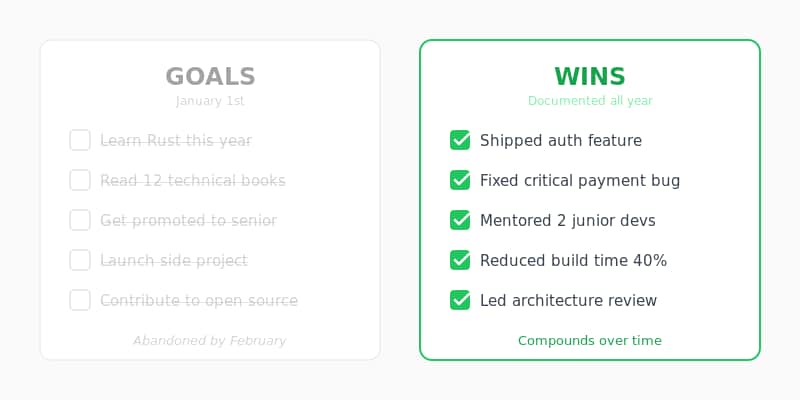
Why Goals Fail (And It's Not Your Fault)
Goal-setting sounds perfect in theory. You identify what you want. You make it specific and measurable. You track progress. You crush it.
Except you don't.
The research is brutal. Studies show that 92% of New Year's resolutions fail by mid-February. And it's not because people lack discipline. It's because goals are fundamentally misaligned with how humans actually work.
Goals are abstract. You set "improve my technical leadership" and then what? How do you know if you're making progress? The target is too vague, too far away, too dependent on circumstances outside your control.
Motivation evaporates. That motivational rush on January 1st gets crushed by the reality of January 5th. When your goal is "get better at system design" and you're stuck debugging a production issue at 3 AM, the goal feels irrelevant. Life always wins.
Goals ignore compounding. You set a goal, fail to hit it, and feel like a failure. But you're missing something crucial: the small wins you did achieve still count. They compound. You just didn't notice them because they weren't on your goal list.
Most goals don't matter for your career anyway. Your manager doesn't care about your personal goals during performance review season. They care about what you actually accomplished. What you shipped. What problems you solved. What impact you created.
If your goal was "improve code quality" but you shipped a feature that doubled user engagement, your goal becomes irrelevant. But that accomplishment? That's permanent ammunition for your career.
The Alternative: Track Your Wins Instead
Here's what actually works: stop setting goals. Start tracking wins.
A "win" is any achievement, no matter how small. Shipped a feature. Fixed a critical bug. Mentored a junior engineer. Improved build times. Documented a complex system. Unblocked a team. Solved a thorny problem.
The magic of tracking wins is that it's reactive, not predictive. You're not guessing about what you'll accomplish. You're documenting what you actually did. No motivation required. No willpower required. You just show up, do your job, and write down what happened.
Think about what happens across your year:
You ship 5-10 significant features
You fix 20+ bugs, some important
You review 100+ PRs
You help teammates solve problems
You attend meetings that matter
You make architectural decisions
You respond to incidents
You mentor junior engineers
You improve tooling and infrastructure
That's probably 50-100 meaningful contributions across 12 months. That's more than enough.
But here's the problem: you won't remember them. Your brain is designed to move on to the next problem. In six months, you won't remember what you shipped in January. In nine months, you'll forget which features you built versus which your teammates built.
That's why tracking wins matters. You're creating a permanent record of what you actually accomplished.
Why Tracking Wins Works (And Why Goals Don't)
Goals are about the future. Wins are about the present. And the present is all you can actually control.
When you track wins, you're not fighting motivation. You're just documenting reality. Did I ship something today? Write it down. Did I fix something important? Write it down. Did I help someone? Write it down.
No willpower required. No motivation required. Just honesty.
Wins compound in ways goals don't. You don't set a goal to "have 50 achievements this year." You just document them. By March, you've accumulated 15. By July, 40. By December, you've got a comprehensive record of what you actually contributed.
Wins are currency for the moments that matter. Performance reviews? You've got 50 concrete examples. Salary negotiation? You can point to specific wins and their impact. Job interview? You've got detailed stories ready. Promotion conversation? You've got proof.
Wins don't require perfection. A goal asks: did I hit my target? Win tracking asks: did I do something that mattered? Those are different questions. The second one is actually answerable.
How This Connects to Your Brag Doc
A brag doc is simply a running list of your wins. Nothing fancy. No perfect grammar. No elaborate structure.
You might organize them by quarter, by project, by impact type. Or you might just make it a chronological dump. The organization doesn't matter. The wins themselves do.
When you prepare for your Q1 performance review, you don't scramble to remember what you did. You open your brag doc and you've got it all right there.
When you're interviewing for a new role, you don't stumble through vague descriptions. You've got detailed examples of your impact, including metrics and context.
When you discuss career growth with your manager, you come with evidence, not hopes. That shifts the entire conversation.
This is why brag documents matter. They're not about bragging. They're about remembering. They're the difference between underselling your work and being paid what you're actually worth.
The Easiest Way to Start
The hardest part of tracking wins is remembering to do it. You ship something, move on to the next problem, and forget to write it down.
That's why BragDoc exists. It automatically extracts achievements from your Git history, so you don't have to remember what you shipped. Your commits and code reviews become documented wins without you lifting a finger.
You focus on the work. We handle the documentation.
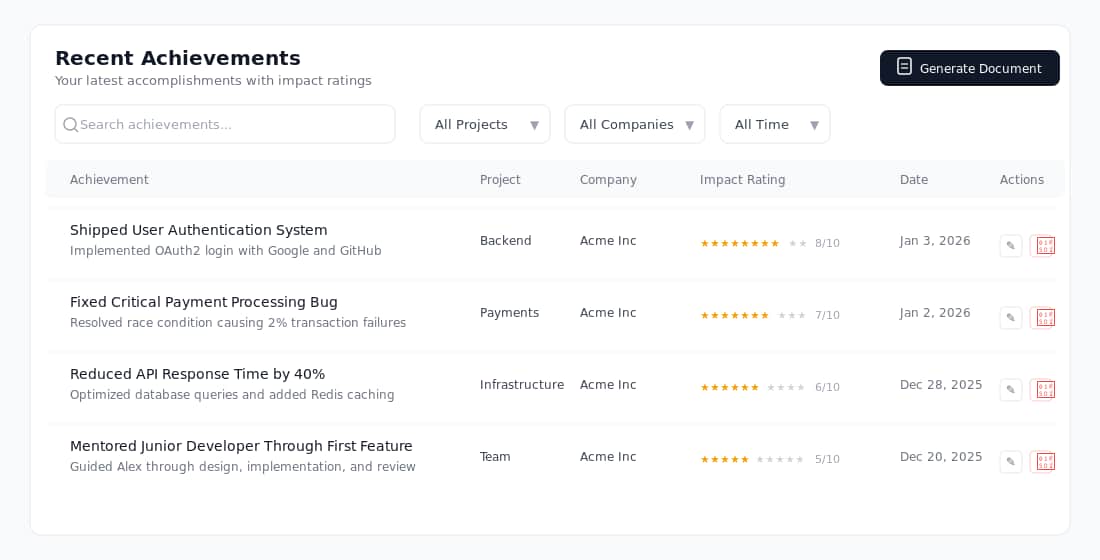
By the end of March, you'll have 30-50 concrete wins documented automatically. By the end of the year, you'll have 100+. And every single one of them will be ammunition for your career.
Or Do It Manually
Prefer to do it yourself? That works too. You just need five minutes and one document.
Create a Google Doc, Notion page, or Markdown file. Call it "2026 Wins" or literally anything. Add 3-5 recent wins from the last month. Then every Friday, jot down what happened. One line per win. Two sentences max.
"Shipped new logging infrastructure that reduces debugging time by 30%"
"Fixed race condition in payment processing that was causing 2% of transactions to fail"
"Mentored Alex through their first production feature deployment"
"Led architecture discussion that unblocked the mobile team"
That's a brag doc. Not fancy. Not complicated. Just honest.
Skip the Goals. Track the Wins.
Here's what I'd do if I were you: don't set any New Year's goals. Instead, create a brag doc today. Add three wins from the last month. Then every Friday, add one or two more.
By March, when everyone else is abandoning their goals, you'll have a comprehensive record of what you actually accomplished. And that's infinitely more valuable than a list of intentions that never happened.
Your career depends on the wins you document, not the goals you set.
So skip the goals. Track the wins.
Forget the gym membership. A brag doc is the one resolution that actually pays off. Here's why it matters and how to start in 5 minutes.
New Year's resolutions are mostly theater. You'll hit the gym six times in January. You'll read that book and never finish it. You'll swear off caffeine and break by February 2nd.
But there's one resolution that actually works. One that doesn't require motivation or discipline. One that literally pays off.
Start a brag doc.
Why This Resolution Actually Works
Unlike gym memberships, a brag doc has immediate, concrete payoff. You're not doing this for future-you in six months. You're doing this for future-you in three months, during performance review season. And three months is close enough that you'll actually care.
Here's the deal:
During reviews, you'll remember what you did instead of scrambling at the last minute. No more scrolling through GitHub at 11 PM trying to piece together what you actually accomplished.
During interviews, you'll have a running list of your wins. No more vague hand-waving. You can point to specific accomplishments, metrics, and impact.
During conversations with your manager, you'll sound confident because you've documented your work. You won't accidentally undersell something or forget to mention something important.
During salary negotiations, you'll have ammunition. You can point to concrete wins and their business value. That's infinitely more powerful than "I think I've done good work."
This isn't meditation. It's not one weird trick. It's giving yourself the best chance to advance in your career.
The Easiest Resolution Ever
Here's the best part: you don't need to become a different person. You don't need discipline or motivation.
You just need to keep one running document. That's it.
Every time you ship something meaningful, fix something important, help someone, or solve a problem—jot it down. One line. Two sentences max. No perfect grammar required. No elaborate formatting.
Just a list of stuff you did.
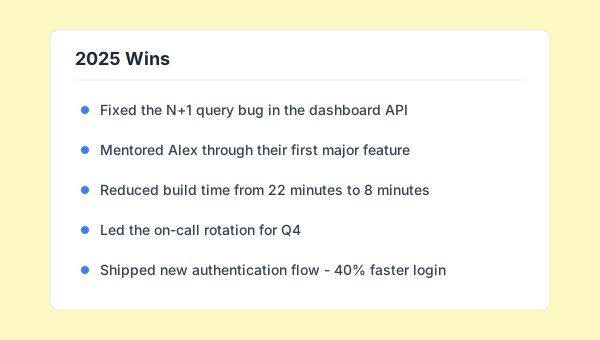
"Fixed the N+1 query bug in the dashboard API"
"Mentored Alex through their first major feature"
"Reduced build time from 22 minutes to 8 minutes"
"Led the on-call rotation for Q4"
That's your brag doc. It's that simple.
How to Actually Start
Today: Open a document (Notion, Google Docs, a Markdown file, whatever). Call it "2025 Wins" or "Brag Doc" or literally anything.
This week: Add 3-5 things you've already accomplished. You don't have to go back through your entire history. Just the wins you remember from the last few weeks.
Moving forward: When you finish something, take 5 minutes and write it down. That's it. One line per week on average. You can do that.
If you want structure, we have a template that organizes wins by impact type. But honestly? A plain list works fine.
The Resolution That Compounds
New Year's resolutions die because they feel pointless. You'll never actually look like the people in those fitness ads. But your brag doc? You'll use it in Q1 reviews. You'll use it in interviews. You'll reference it with your manager.
The resolution compounds. Every achievement you document this year becomes easier next year. By 2026, you'll have a two-year running record. By 2027, three years.
You'll never scramble during review season again.
Make It Effortless
The hardest part of any habit is remembering to do it. BragDoc solves that by automatically extracting achievements from your Git history. Your commits and code reviews become documented wins without you lifting a finger.
You focus on shipping. BragDoc handles the documentation.
Start Free Today
Join 1,000+ professionals already tracking their wins. Limited spots for early access.
No credit card required • Upgrade anytime
Your New Year Setup
Make 2025 the year you stop scrambling during performance reviews. Stop underselling your work. Stop forgetting what you did.
Open that document today. Add three wins. Do it again next week. By March, you'll have a comprehensive record of what you accomplished.
Your future self will thank you. Your manager will notice. Your next raise will reflect it.
That's a resolution that actually works.
Ready to make this a habit? Check out our template for more structure, or learn why automated brag docs save time. Either way, start documenting today.
Your career depends on it.
Year-end is critical for documenting achievements. Learn what to capture and how to prepare for Q1 reviews.
The year is almost over. You've shipped code, solved problems, and made an impact. Now comes the hard part: remembering what you actually accomplished.
This is the critical window. Right now, while 2025 is still fresh, your memories are clear and your context is available. In three weeks when everyone returns from the holidays, motivation vanishes and memory fades fast. The achievements you took for granted in December will feel like ancient history by March.
If you wait until Q1 performance review season to document your work, you'll be scrambling. You'll forget projects. You'll miss context. You'll undersell your impact because the details have evaporated.
The smartest move is to document now, while everything is still vivid.
Why This Month Matters Most
Your brain isn't built to retain a year of work. It's optimized for the next problem, not the last one. This is fine for day-to-day engineering, but it's terrible for career documentation.
Here's the timeline:
This week: Memories are sharp, context is fresh, you remember why decisions mattered
January: Holiday reset means you're mentally refreshed but details are already fading
March: Review season arrives and you're scrambling, remembering maybe 40% of what you did

The difference between a great performance review and a mediocre one often comes down to this: did you document your work when memory was strong, or did you wait until memory was weak? Understanding what managers actually look for makes this even clearer.
What to Capture Right Now
Don't try to write perfect achievement statements yet. Just capture the raw material while it's fresh. You can refine later.
Major projects shipped: List every significant feature, system, or change you shipped in 2025. For each one, note: what problem you were solving, your specific role, who else was involved, and when it shipped.
Metrics and quantifiable impact: Query latency improvements, test coverage increases, deployment time reductions, infrastructure cost savings, support tickets reduced, incident frequency decreased. Numbers are powerful. Capture them now before they're lost. This is why automated brag docs save so much time—they capture metrics automatically.
Challenges overcome: What was genuinely difficult? What did you learn? "Debugged a race condition that took three days to track down" and "Led a contentious technical decision where teams disagreed" both demonstrate growth and judgment.
Code reviews and mentoring: If you spent significant time reviewing code or helping teammates, capture that. This is one of the six types of developer impact that often gets overlooked. Don't just say "did code reviews." Get specific: "Reviewed 150+ PRs this year" or "Mentored two junior developers through their first major features."
Reliability and incident response: If you participated in on-call rotations, debugged production issues, or improved systems reliability, document it with specifics.
Cross-team collaboration: Did you work with product, design, sales, or other engineering teams? Document the context and your role.
Where to Find This Information
You're not starting from scratch. Your work already exists in multiple places.
Git history and pull requests: This is your primary source of truth. Find the main PRs for each major project, note merge dates, capture commit message summaries, and check PR discussions for context about decisions and challenges.
Issue tracking system: Issues capture the problem statement, acceptance criteria, and decision-making. Search for issues you reported or worked on.
Slack and email: Look for praise or feedback from teammates, questions where you provided key answers, discussions about decisions you influenced, and project announcements you were part of.
1-on-1 notes: These often contain feedback about your growth, challenges you're working on, and goals you hit.
Your calendar: Look at tech talks or training you gave, architecture decision meetings, project kickoffs, and presentations.
How to Structure Your Self-Review
Once you've gathered your raw material, organize it by impact category rather than chronologically:
Code & Features: Products and features you shipped
Reliability & Debugging: Critical issues resolved, production incidents handled
Technical Leadership: Architecture decisions, system design, technical direction
Mentoring & Knowledge Sharing: Code reviews, onboarding, documentation, people you helped grow
Process & Infrastructure: Build improvements, testing frameworks, dev tools
Cross-Functional Collaboration: Work with product, design, sales, or leadership
This structure helps your manager understand the full scope of your contributions. Most developers focus only on features, accidentally underselling other valuable work.
Writing Achievement Statements
For each achievement, follow this pattern:
Problem/Context: What was the situation?
Your Action: What specifically did you do?
Measurable Impact: What changed as a result?
Broader Significance: Why did it matter?
Example:
Instead of: "Fixed performance issues in the API."
Write: "Identified and resolved N+1 query problems in the user dashboard API. Reduced response times from 2.3 seconds to 340ms through query optimization and connection pooling. This improved user experience metrics by 15% and reduced infrastructure costs by $8K annually."

See? It's not flowery. It's concrete, specific, and credible.
Common Mistakes to Avoid
Being too vague. "Improved system reliability" sounds good but tells nobody what you actually did.
Underselling non-code contributions. Mentoring, process improvements, and reliability work are invisible unless you document them. Senior developers are senior because they create leverage, not just because they write more code.
Forgetting to quantify. "Mentored three junior engineers through complete features, averaging 4-5 hours per week of code reviews and pair programming" is much stronger than "mentored team members."
Only preparing positives. Managers know you're not perfect. Balanced reviews are more credible than flawless ones. Understanding what managers look for helps you strike the right balance.
Your Action Plan
This week: Spend 30 minutes listing major projects and accomplishments. Pull your GitHub history, Jira, and Slack. Capture the raw material while it's fresh.
Before the holidays: Write 5-10 achievement statements using the pattern above. Organize by impact category.
When you return: You'll have this foundation ready. The hard work—capturing memories while they're strong—will be done. You can refine during Q1 before reviews actually happen.
Automate the Boring Part
If you're documenting achievements from Git history, you can automate this. BragDoc's CLI automatically extracts achievements from your commits and pull requests. Run it once before the holidays, review what it captured, and you've saved hours of manual digging.
The automation handles the busywork. You handle the context, the metrics, and the significance.
The Compounding Effect
Documentation compounds. If you document 2025 now, you have a complete record. When 2026 ends, you add to your already-solid documentation. By 2027, you have three years of clear achievement records.
Conversely, if you skip documenting 2025, when 2026 ends you're still scrambling to remember both years. Every year without documentation makes the problem worse.
Start the habit now. It pays dividends for your entire career. Learn more about why developers need automated brag docs to make this sustainable.
Start Today
Pick three major projects you shipped in 2025. For each one, jot down what you built, when it shipped, measurable impact, and who benefited. That's your starting point.
By the time Q1 reviews arrive, you'll be prepared instead of scrambling. Your work speaks for itself—but only if you document it. Ready to get started?
You ship code every single day. You fix bugs, review PRs, refactor legacy systems, mentor teammates, and solve complex problems. But when performance review season arrives, you scramble to remember what you actually accomplished in the past six months.
This isn't a memory problem. It's a documentation problem. Keeping track manually in a "brag doc" would be a great idea, but almost nobody actually does that.

The Forgetting Problem
Your brain isn't built to retain six months of technical work. You shipped a critical performance fix in March. You architected a new service in July. You onboarded a new team member in September. These are significant accomplishments, but by December, they're buried under dozens of other commits, merged PRs, and resolved issues.
Performance reviews force you into a scramble. You're scrolling through your GitHub history at 11 PM the night before your review, trying to piece together narratives from git logs you barely remember contributing to. You miss important context. You downplay significant work because the details have faded. You stress because you know you've forgotten substantial contributions.
This is worse than forgetting a task at the grocery store. Your career advancement depends on documenting your work clearly and completely.
Why Manual Brag Documents Fail
Manual brag doc systems—whether they're Notion templates, Google Docs, Markdown files, or specialized tracking apps—share the same fatal flaw: they require discipline you don't have. See our pricing page for a better solution.
The theory is simple: update your brag doc consistently throughout the year. By review time, you have a comprehensive record.
The reality is different. You're heads-down in code. You forget to document that refactor because you were focused on solving the problem. You skip the weekly update because you had a deadline. You tell yourself you'll catch up later. By the time review season arrives, your manual doc contains maybe 20% of your actual work.
Here's the core problem: manual documentation adds friction. It requires you to context-switch, remember what you did, articulate it clearly, and manually enter it into a system. That's cognitive overhead on top of your actual job. Most developers don't do it consistently.
You can read about how discipline is the answer, but that ignores how human brains work. Relying on willpower for documentation is a losing strategy.

Git History Is Your Perfect Source of Truth
Your Git history is already there. It's already complete. It's already detailed.
Every commit you make is automatically timestamped and documented. The commit message explains why you made the change. And if it didn’t, the diff shows exactly what you changed and how. Your GitHub profile tracks when these contributions happened. Pull request discussions capture context and decision-making.
This is an objective record that requires zero additional effort. You're already creating this documentation every time you commit code.
Compare this to manual brag docs, where you're relying on memory, judgment, and motivation to write something down. Git history is objectively better as a data source.
What Automation Provides
Automated brag doc extraction changes the equation entirely.
Instead of manually documenting your work, our system processes your Git history automatically and generates achievement summaries. This happens in the background while you work. No extra effort. No discipline required.
Here's what you gain:
Time Savings: Most developers spend several miserable hours scrambling through their work history to prepare review documentation. An automated system reduces this to 15 minutes. You review what was extracted, add any manual accomplishments that aren't in Git, and you're done. Check our features to see how this works.
Completeness: Nothing gets forgotten because everything in your Git history is processed automatically. That small refactor you did in March? It's there. The bug fix that took you three days? It's documented. The code review where you unblocked a junior dev? It's captured.
Context Preservation: Commits aren't just line counts. A good automated system preserves the diff context, branch information and timing. You get a complete technical record, not a vague summary.
Always Ready: Your achievement documentation is continuously updated as you work. When review season arrives, you don't scramble—you already have a comprehensive, organized record ready to review.

Developer-Specific Advantages
Automation is particularly powerful for developers because it aligns with how you actually work.
Privacy-First: You control the data. BragDoc's CLI runs locally on your machine, analyzing your repositories without sending raw code to cloud servers. If you want, you can run it completely offline with a local LLM. Your source code never leaves your computer.
CLI Workflow: The tool is designed for developers. A simple bragdoc init command sets up background extraction. No web forms. No complex UI to navigate. It fits your existing workflow.


Technical Details Preserved: Automated extraction keeps the technical depth. Commit messages, diffs, branch names, PR metrics—this is what actually matters for documenting technical work. Not vague narratives about "drove initiative" or "led cross-functional effort."

Quantifiable Impact: Your achievements are grounded in concrete data. You can show exactly when work happened, how much code was involved, what problem it solved. This is far more credible than summary statements.
Start Free Today
Join 1,000+ professionals already tracking their wins. Limited spots for early access.
No credit card required • Upgrade anytime
A Real Scenario
Here's what this looks like in practice. See more use cases like this one.
Sarah is a backend engineer. Over six months, she:
Shipped a database optimization that reduced query latency by 40%
Refactored the authentication system to support OAuth
Fixed a critical security vulnerability in the payment processing
Mentored a junior developer through a substantial feature
Reviewed 50+ pull requests from teammates
In October, her manager asks for her performance review documentation. With a manual brag doc system, Sarah would spend hours trying to remember these projects, locate the relevant PRs, and write up narratives. Some accomplishments would be forgotten entirely.
With an automated system, Sarah runs a command and gets a comprehensive list with dates, pull requests, commit messages, and technical context. She spends 20 minutes reviewing what was extracted, adding a few manual notes about impact and context, and submitting her review. The documentation is complete and accurate.


The difference isn't small. It's the difference between a stressful, incomplete review and a confident, comprehensive one.
Privacy and Trust
As a developer, you probably care about privacy. You don't want your code history sent to some cloud service. You want control over your data.
This is why BragDoc is designed with privacy as a core principle. The CLI runs locally. Your source code stays on your machine. Only the extracted achievement summaries are synced to the server if you choose to use the web interface. If you prefer, you can keep everything local. We also offer a self-hosting option for complete control.

You're in control. Your data is your data.
Start Tracking Your Achievements
If you've been dreading performance review season, automated achievement extraction changes the game.
You ship code. BragDoc captures it. By review time, you have comprehensive documentation ready to go. No scrambling. No forgetting. No manual busywork.
Try it yourself—no signup required. Visit our demo mode to see how BragDoc automatically extracts achievements from your work. If you're ready to track your own repositories, create a free account and install the CLI.
Your Git history is already documenting your work. It's time to use it.
-
1
Thank you for sharing.
-
1
This hits on a pain point almost every developer recognizes. The framing that it’s not a memory issue but a documentation and friction issue is spot on. Using Git history as the source of truth makes a lot of sense—developers are already creating the data, so automating the extraction instead of relying on discipline feels like the right abstraction. The privacy-first, local CLI approach is especially compelling for engineers who are rightly cautious about their code leaving their machine. This feels like one of those tools that makes review season calmer instead of stressful.
-
1
HIRE A FASTEST CYBER RECOVERY EXPERT TO RECOVER YOUR LOST OR STOLEN BITCOIN/ETH/USDT/ THE HACKANGELS
I simply want to share my story about THE HACKANGELS RECOVERY EXPERT. To all of you out there. One has to be careful. A lot of scammers are out there taking money from innocent traders. I was a victim of these crypto scammers. They made me lose my hard earned funds. The best thing that happened to me this year was seeing an article about THE HACKANGELS RECOVERY EXPERT. A professional hacker and private investigator. I invested $954,300 in a cryptocurrency platform and it turned out to be a scam and I had no idea how to get my money back until I reached out to a recovery company called THE HACKANGELS RECOVERY EXPERT. I explained my situation to them. I was shocked to hear that they had recovered all of my stolen cryptocurrency in just 48 hours. I said that I will not hold this to myself but share it to the public so that all scammed victims can get their funds back. To anyone who may find themselves in a similar unfortunate situation. I highly recommend THE HACKANGELS RECOVERY EXPERT. Quickly reach out to them on their hotline:
WhatsApp: (+1(520)200-2320
If you're in London, you can even visit them in person at their office located at 45-46 Red Lion Street, London WC1R 4PF, UK. They’re super helpful and really know their stuff! Don’t hesitate to reach out if you need help. -
1
If you're unsure how to promote your product, I recommend trying Amplift.ai. It's an AI marketing assistant I developed that helps you create growth plans and handle marketing challenges. Just log in to use it, and you'll see results in as little as 20 minutes. If you have any questions about how to use it, feel free to let me know!


Comment