Validating my startup idea in 3 steps
This is my third week of building a startup in public in my MVP Sprint. Thanks for all the love on my last update!
From idea to revenue
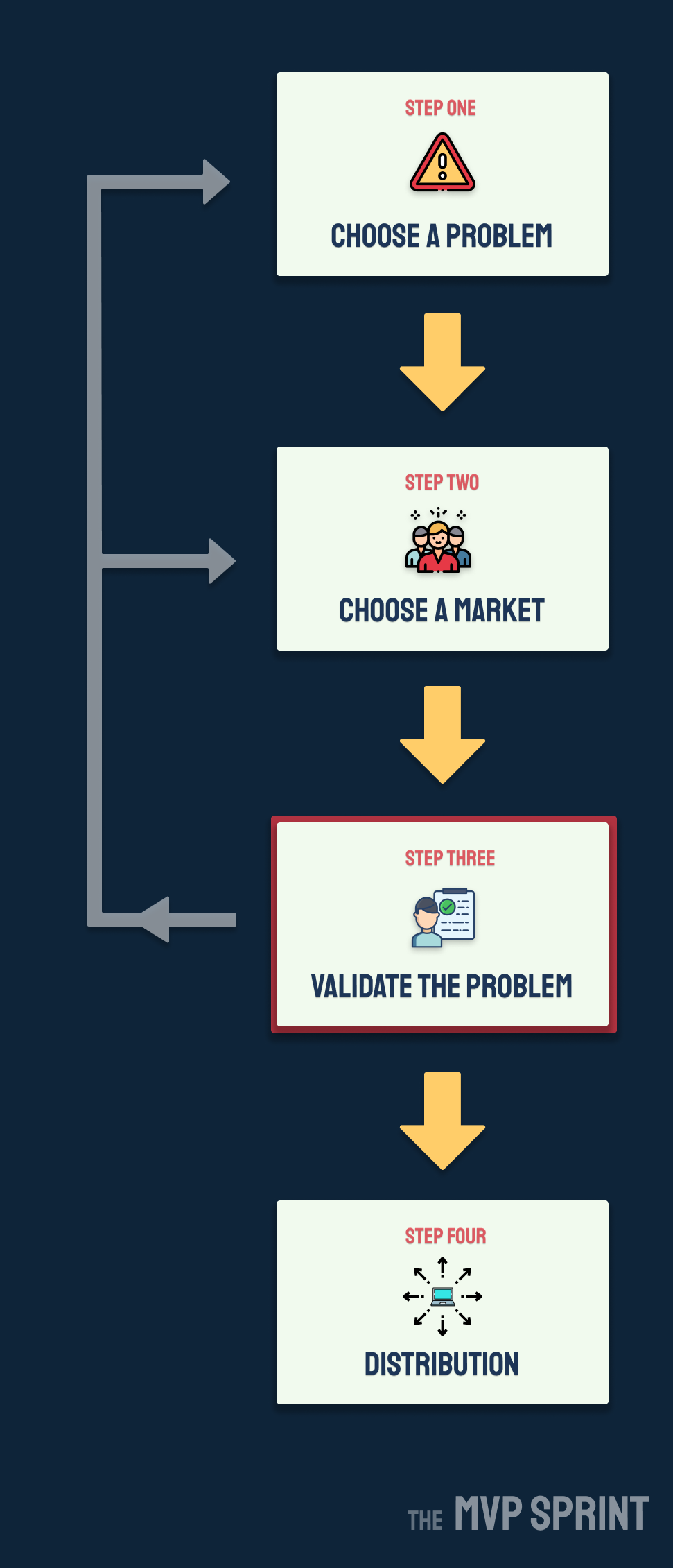
In Step One, I chose a problem to work on.
In Step Two, I chose my niche and my target users.
This week, I’m validating the problem for my target users.
As an engineer, I'm itching to start coding. But before investing weeks or months in a text editor, I want to make sure I'm building something that users will want and pay for.
Last week I focused on validating my problem for my target users (my niche). Here's what I found.
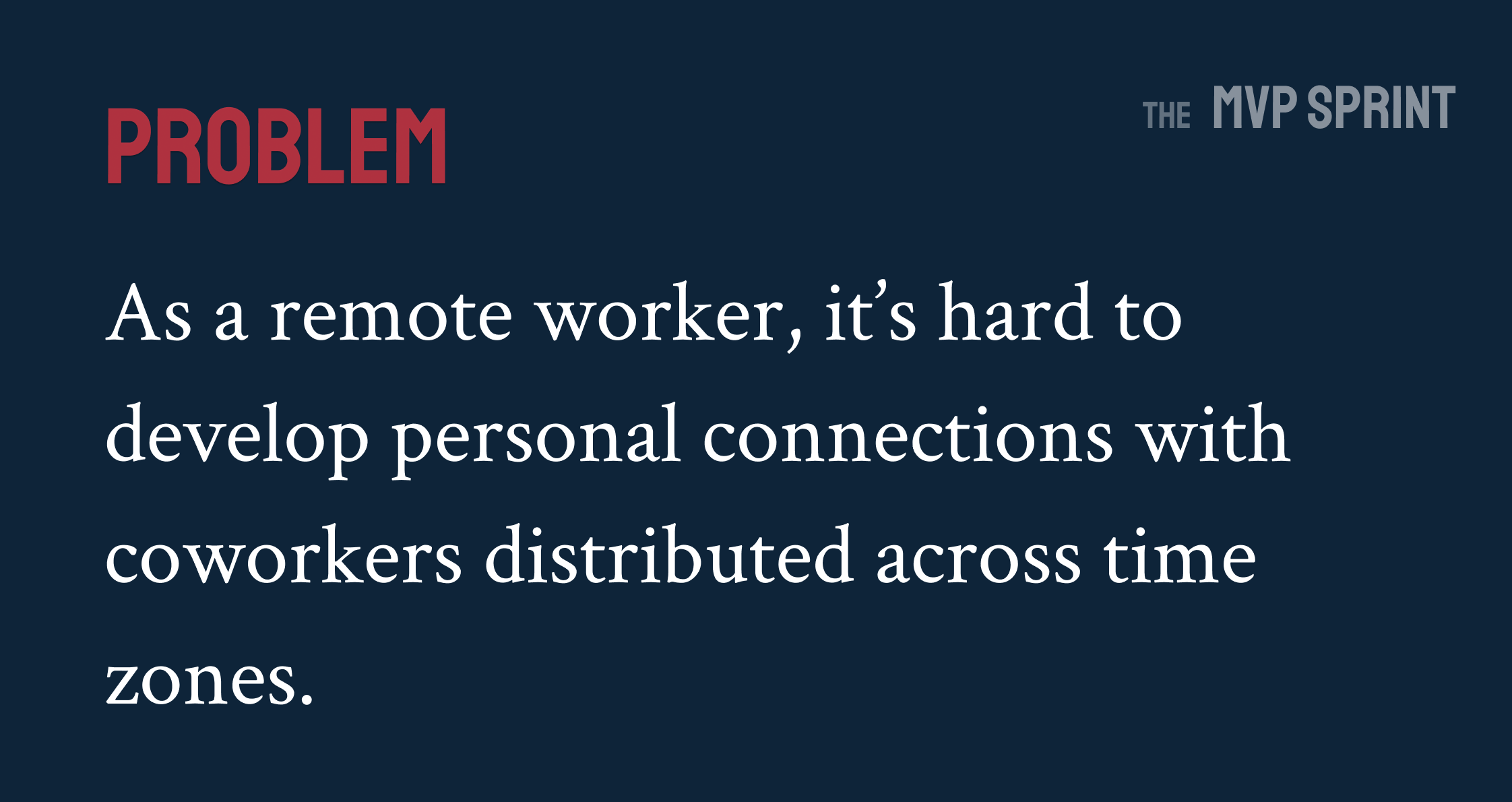
As a reminder, here's the problem I'm trying to solve:
Starting with a landing page
I’ll know that my product solves my problem when I have users that use it, love it, and pay for it.
I want to go as far as possible down that funnel now, even before I build a product (or even define what I’ll build).
So I came up with a name (HelloHailey) and built a landing page to collect leads (only took me about a day using Webflow and Typeform). A waitlist signup isn't much of a commitment, but I did require ~8 questions on a Typeform survey - so there is some friction.
I don’t have a defined product yet, but I can still pack a punch with messaging that emphasizes:
-
the problem I want to solve.
-
the outcomes I want to produce (a happy, connected, team)
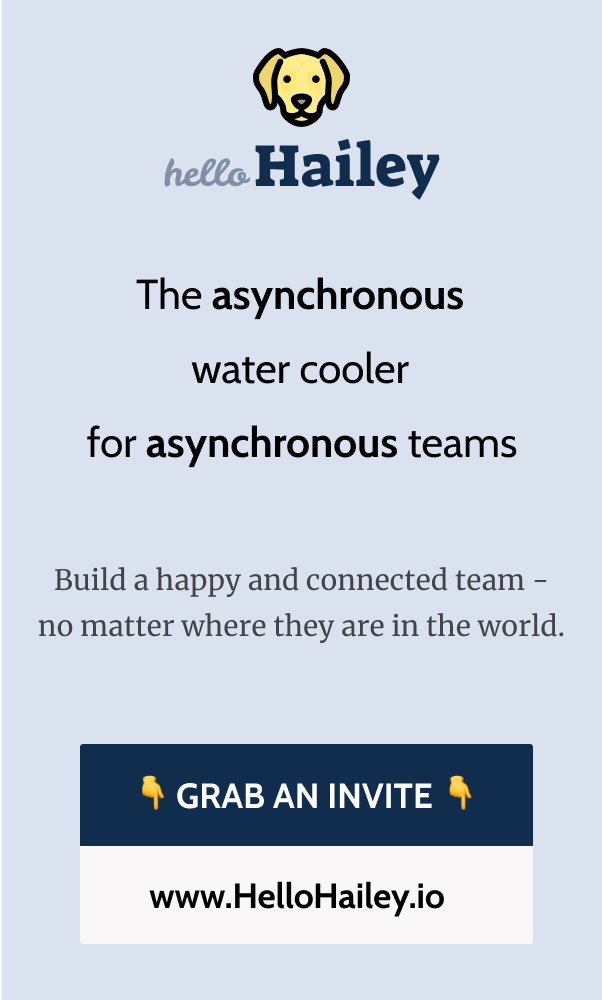
I used to socialize with the dogs in the office as much as my coworkers. They'd calm me down when I was stressed and cheer me up when I was down.
Hailey was my childhood golden retriever.
Now she's everyone's (remote) office dog.

Validation in 3 steps
As is everything at this stage, the key to validation is learning. My learning process involved three steps:
-
List what I want to learn.
-
Talk to potential users.
-
Synthesize my learnings and determine whether to retreat or continue forward.
1. List what I want to learn
In my humble opinion, the best resource for learning how to talk to users is The Mom Test, by Rob Fitzpatrick. Picking up my old copy was the first thing I did this week.
Here’s what I wanted to learn:
What are people doing today?
If users don't care enough to try something today, they won't care enough to try my product tomorrow
People are terrible at predicting their future behavior. Rather than ask if they would use some hypothetical product, I wanted to know they’re already using. This could be anything - an app, a recurring meeting, even postcards delivered by carrier pigeons.
Why do they care about solving the problem?
I wanted to understand my users’ underlying motivations; what drives them to take time out of the busy work week to try and solve this problem.
This will be particularly valuable for product messaging. By regurgitating what users tell me, I’ll be able to write copy that resonates with my niche.
Will they pay for it?
Again, people are terrible at predicting their future behavior. This includes questions like “how much would you pay for a product that solves x?”
Instead, I looked for evidence that they’re already paying for solutions.
2. Talk to potential users
My target users are engineering and product managers. It’s these users that I expect to sign up and introduce HelloHailey to their teams and companies.
Here’s a few different strategies I used to get in touch with them:
-
Personal network - I know lots of engineering and product managers. Linkedin was my friend here.
-
Cold emails - All of my target users are just an email away.
-
Reddit - I posted in r/ProductManagement, r/Startups, and r/RemoteWork.
-
IndieHackers - You all gave me lots of valuable feedback about what you're doing within your teams. Thanks again!
3. Synthesize what I learned
I don’t need to completely de-risk the business to feel confident moving forward. I just want to remove enough uncertainty to justify investing more time.
If there’s a land mine in my path, I want to know now (before investing weeks or months).
Here’s what I learned within those three areas:
What are people doing today?
People engage in social activities (1) within their teams (team-driven) and (2) across teams (company-driven).
Team-driven
It seems like all teams have introduced at least one solution; in many cases, two or three solutions. The most common types of solutions were:
-
Games - Most teams play free online games. These games are all real-time, not asynchronous turn-based games. There are plenty of free online games like Skribbl.io or Jackbox, but many teams actually invented their own games. There’s usually a dedicated time on the team’s calendar once a week to play them.
-
Facilitated conversation - Teams use icebreakers to connect before beginning a recurring daily or weekly meeting. These are quick; usually 1-2 minutes per person.
Company-driven
Company-driven activities have a primary goal of connecting employees across teams and job functions. A few common ways they achieve this:
-
Randomized “coffee” chats - a bot that pairs two random employees for a video call. Donut was mentioned several times.
-
Shared interest groups - A few people mentioned virtual book clubs. I’ve also seen religious or gaming groups.
Why do they care about solving the problem?
Some feedback I heard about solutions:
-
It’s been a fun way to get to know each other and have a laugh.
-
They’re good bonding sessions.
-
Being able to see each other’s faces when conversing really does help build trust and alignment within my team.
Are they paying for solutions today?
Team-driven solutions - They’re not paying. Nearly all the solutions I’ve mentioned are free solutions.
While they’re not paying with money, they are paying with time:
-
Team leads spend time preparing icebreakers before meetings.
-
They’re inventing games from scratch - one Product Manager built a simple web app around icebreaker questions. One founder invented a complex game in Slack.
-
One team member collected short 15-30 second videos from throughout the company and stitched them together.
Most teams have budgets for social activities like team offsites, usually in the ballpark of around $50-$100 per person, per quarter (~$15-$30 per month). Since it’s already budgeted, team leads can spend this money as they see fit. I’m hopeful that they’ll spend 10% of that budget on a product like HelloHailey, but I haven’t seen a strong precedent for it (yet).
Company-driven solutions - People are paying. Donut and similar competing products charge around $2-$4 per person, per month.
My blind spots
What I don’t know about the problem is still much bigger than what I do know. Here’s a few notable blind spots:
-
My feedback was overwhelmingly over text, with only a few video conversations. This makes it hard to read emotion. That being said, my public posts did gather a lot of engagement in the form of upvotes and comments. This is a decent proxy for how much users care about the problem.
-
I haven’t received any kind of commitment - Talk is cheap. No one has signed up or paid me money. Building a landing page with a waitlist is one way to push for a commitment, however small it is.
-
Purchasing process - I hypothesize that team leads will sign up using their teams’ social budgets. Then I can expand within a company using product-driven virality. I’ll investigate purchasing processes for teams and companies this week in Step Four (Distribution).
Proceed to Step Four (Distribution)
Now it’s time to use what I’ve learned to decide on next steps. In my eyes, I have 3 options:
-
Go back to Step One (find a new problem) - If I have little faith in my problem and niche, I can scrap it all and start over.
-
Go back to Step Two (find a new niche) - Maybe I still believe in my problem, but disagree with my choice of niche (product and engineering managers in teams distributed across time zones). I could go back and re-do Step Two.
-
Proceed to Step Four (Distribution) - If I’ve found enough validation for my problem within my niche, I can proceed forward.
Despite the blind spots that I’ve called out, I feel confident that I’ve validated the problem enough to move forward.
Validating Distribution
This week I’ll be tackling distribution, with two main areas of focus:
-
Distribution channels - Even a perfect product won’t find users without good distribution channels. This week, I’ll dive deeper into what makes a good distribution channel, and the channels I believe will be effective within my niche.
-
Purchasing processes - Being able to reach my target users is just the first step. What I really need is for them to pay me. So I’ll also be investigating the purchasing process for companies within my niche.
The MVP Sprint

This is the third week of building a startup in public. If you found this interesting, feel free to check out the whole article.

People are terrible at predicting their future behavior... That means there's always going to be a huge risk of failure. The solution is to sell a MVP that is flexible enough to adapt to various requirements so you can find Product Market Fit.
Flexibility and adaptability allow products to evolve into a successful version, that's why most successful founders are engineers. Without engineering skills, the cost of finding the right version of the product can be too high and kill the project.
The market must also be big enough to allow the product to evolve.
Agreed! In addition to your MVP being flexible and adaptable, I think it's also important to launch quickly. I'm not learning from users while locked in a room by myself writing code.
Sure, but you still need to launch a product that users will like, not just anything that gets you out of your bedroom.
Yea that's most important for sure.