We checked an app that was losing 40% of its profit to hidden API fees. Here is exactly what we found.
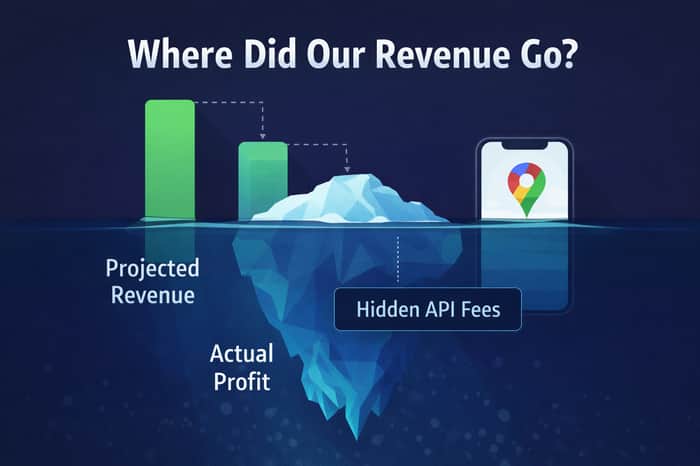
Most founders focus hard on their monthly server bills. But when we recently looked at the setup for a client targeting the US market, hosting was actually their smallest expense.
Their business looked great on paper. In reality, outside API costs were quietly taking nearly 40% of their monthly revenue. When we looked closer, it wasn’t one big mistake. It was a few simple choices in how they built the app that added up as they got more users.
Here is exactly where the money was going:
-
The Google Maps Cost Spike
The app tracked location in the background, even when users weren't really using that feature. The app was asking the API for location updates constantly on default settings, instead of waiting for the user to move a certain distance. They were paying for thousands of useless checks every day. -
The SMS Auth Attacks
They used standard text messages (SMS) to verify user accounts via Twilio. Because they didn't put basic limits or a CAPTCHA in place, automated bots hit their sign-up pages hard over a weekend. You pay for every text sent, even if a bot triggered it. -
Not Saving Paid Data
The main screen showed outside financial data. Every time a user left that screen and came back, the app asked the outside API for the data all over again. By just saving that data locally for 15 minutes, we cut their paid requests by over 60%.
The Fix
We changed the app to only ask for data when things changed, added strict limits to the front end, and saved data locally when possible. Their monthly running cost dropped almost in half in 30 days.
We wrote down this whole process and the exact code changes needed to stop these hidden costs in a single guide.
Has anyone else had a massive surprise bill from an outside service after launch? Which API caught you off guard?

That 40% figure is terrifying but unfortunately common. Most 'AI-powered' SaaS tools are effectively just high-margin UI wrappers around OpenAI/Anthropic APIs.
When we started architecting our AI layer for an open-core CMS, we hit this exact dilemma. We realized that to provide high-token workflows (like global DB querying) without gozzling our users' margins, we had to move to a Bring Your Own Key (BYOK) model via OpenRouter.
By letting users plug in their own keys, we removed ourselves from the billing loop entirely. It’s definitely a harder 'sell' to non-technical users, but for the Indie Hacker/Dev audience, it’s the only way to ensure the platform doesn't become a hidden profit-drain.
Did the app you audited consider a BYOK model, or were they too afraid of the 'UX friction' of asking a user for an API key?
Yes, BYOK came up pretty early. For technical users, it honestly makes a lot of sense. But this app was targeting regular consumers, and even a small onboarding step was hurting the conversions. We ended up fixing it more from the architecture side instead, like cutting unnecessary API hits, caching aggressively, and adding stricter limits around background calls.
What surprised me the most was how much money was getting spent without anyone noticing it during development.
Yeah I'm afraid of that. we have a BYOK system but added free models backups for users that just want to try the Cortex AI we implemented. I think for now free is fine but once the company starts making profits we might integrate a paid model free for consumers... Not there yet though.
We are starting an open beta with bounty being free lifetime licenses for both our ecommerce and Cortex AI. If you are interested give me a shout! info@nextblock.dev
Thanks for the invite, and congratulations on the beta launch.
I like the BYOK + free fallback approach for early adoption. One thing we’ve learned is that once products gain traction, it’s rarely the pricing model alone that impacts margins. It is retries, long-running workflows, duplicated requests, and the background processing that quietly add up.
Hope the beta gives you plenty of data to refine the model. Good luck!
Optimizing for scale before you have scale is a trap, but ignoring API unit economics is a death sentence. 40% of revenue going to hidden fees is the difference between a successful pivot and a shutdown.
Since you've mastered the art of 'flattening the cost curve' for your clients, you should put those lean principles to work in the Validation Arena (tokyolore.com).
$19 to enter, 30 days to ship a high-margin product.
$0 pool right now, and the winner gets a Tokyo trip! 🏆
Completely agree. Most founders only notice these problems after users start coming in consistently.
This app wasn’t doing anything unusual either. It was just small things running in the background way more often than needed. Once we cleaned that up, the difference was huge and noticeable.
And yes, I certainly like the 30-day idea. Too many people spend months building something before finding out whether anyone even wants it.
That “looks fine until scale” problem is real.
We’ve seen something similar with trading systems where external calls seem harmless at low volume, then suddenly become the dominant cost once usage ramps.
It’s usually not one big mistake, just lots of small defaults compounding over time.
The caching point especially is one most people miss early.
Exactly, it’s rarely one big mistake. In most cases we’ve seen, it’s small defaults stacking up like frequent polling, no caching, no limits and everything looks fine until usage grows. The tricky part is that these costs don’t show up clearly early on, so teams don’t think about them while building. Caching is a big one. In a few apps we reviewed, the same data was being fetched again and again even though it barely changed.
We’ve been noting down these patterns while reviewing apps, and it’s surprising how often the same issues repeat. Did you end up fixing it mostly through caching, or were there other changes that made a bigger impact?
Caching was the biggest immediate win, but the bigger shift was moving from “request on every action” to “only request when something actually changes.”
A lot of it came down to questioning defaults. Polling intervals, retries, background calls… they all made sense individually, but together they added up fast.
Once we tightened those and put some basic limits in place, the cost curve flattened pretty quickly.
That shift makes a big difference. We’ve seen the same. Moving from constant requests to only when something changes cuts a huge chunk of unnecessary calls. What stood out for us is how those defaults quietly stack. Each one feels small, but together they change the cost curve completely.
In a few apps we looked at, just adding basic limits and rethinking when to call external services brought costs down faster than expected. I’ve been noting down a few of these patterns while reviewing apps. It’s interesting how often it comes back to the same defaults.
Did you set those limits based on usage data or just start with safe thresholds and adjust later?
We usually start with safe thresholds, then tighten them once we see real usage patterns. If you go straight to “data-driven” early on, you can end up optimising around noise rather than actual behaviour.
Once there’s enough volume, that’s when it becomes useful to refine based on real usage.
That makes a lot of sense. Starting with safe thresholds first feels much more practical than trying to optimise too early.
I’ve seen a few cases where teams tried to be data-driven from day one, but the early usage was so noisy that it led to the wrong decisions. They ended up tuning things that didn’t really matter once real patterns kicked in. The tricky part seems to be knowing what counts as a safe starting point. Too loose and costs creep up, too tight and you risk breaking the experience.
Have you found any rules of thumb that work well early on or is it mostly based on the type of product?