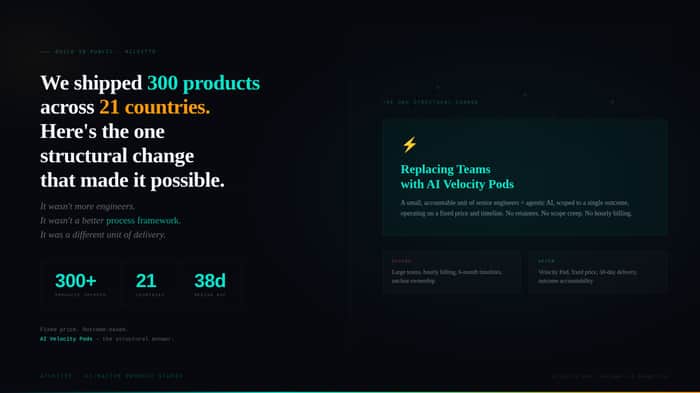
We shipped 300 products across 21 countries. Here's the one structural change that made it possible.
Three years ago, we were running like most product engineering shops: scoped projects, hourly billing, sequential dev-to-QA handoffs. Reasonable timelines, reasonable margins, reasonable client satisfaction.
We hit a wall around product 40.
Not a technical wall — a structural one. The faster we tried to ship, the more the model worked against us. More hours meant more coordination overhead. More coordination overhead meant slower delivery. Slower delivery meant clients who'd come to us for speed were getting something closer to a traditional agency experience.
So we burned it down and rebuilt around one bet: fixed-price, outcome-based delivery using AI Velocity Pods.
What Actually Changed
The surface-level answer is "we added AI tools." That's not the real answer.
The real change was incentive structure. When you bill hourly, a longer project is quietly a better financial outcome. You don't set out to be slow — the model just doesn't punish slowness. Fixed-price flips that completely. Every extra day of delivery is a margin coming out of our pocket, not the client's. That pressure is real, and it changes how the whole team operates.
On top of that, we restructured the pod itself:
- Parallel Execution: Design, dev, and QA run in parallel from day one rather than sequentially.
- The Division of Labor: AI agents handle scaffolding, boilerplate, and test generation. Human engineers handle architecture, judgment calls, and anything client-specific.
- The Flywheel Effect: By sprint three on any project, the agents have absorbed enough codebase context that generation quality visibly improves. You don't restart from scratch each sprint — you accelerate into it.
The Numbers
- Median delivery time: 38 days (industry average for comparable scope: 120+ days)
- 300+ products shipped
- 21 countries
- 5x faster than the traditional agency model on an equivalent scope
That's not a marketing number — it's the median across a portfolio, including the projects that ran long.
The Quality Question (Because Someone Always Asks)
The fair pushback: "You shipped fast. Did you ship something that works?"
We take this seriously because the data is ugly industry-wide. 60% of enterprises are currently shipping untested code as AI accelerates development. That's what happens when you add AI coding tools to a traditional QA model and expect coverage to hold.
Our answer was agentic QA built into the pipeline from day one — not bolted on after build.
- Test cases are staged before code review begins.
- Coverage gaps surface in the PR, not in production.
- For regulated clients (healthcare, fintech), compliance controls are baked in rather than audited afterward.
Fast and fragile isn't a win. Fast and verified.
What I'd Tell Founders Evaluating Dev Partners Today
- If a firm quotes hourly, walk away. Not because hourly is evil — it's just structurally misaligned with your interests. You need a partner who absorbs schedule risk, not one who offloads it to you.
- Ask for hard data: "What's your median time from signed contract to first production deploy?" If they don't have a real number, that tells you something.
- Audit the tail end: Ask about post-launch rework. Speed to deploy is meaningless if the next six weeks are hotfixes.
Over to the community
Curious what models other founders are running here. Are you building in-house, using traditional agencies, or working with AI-native teams? What's your current MVP timeline looking like — and where's the bottleneck?
We're Ailoitte — AI-native product engineering, fixed-price, outcome-based. If you're evaluating partners for a build, our ROI case studies and Startup MVP Velocity model are the most concrete places to start.
Tags: #development #startup-lessons #mvp #agencies #ai
