What Is Cloud POS Software and Why Do Retailers Need It?
Retail businesses today need more than a billing counter. Customers expect fast checkout, multiple payment options, accurate stock information, personalized service, and a smooth experience whether they shop at one store or across several locations.
This is where cloud POS software can make a major difference.
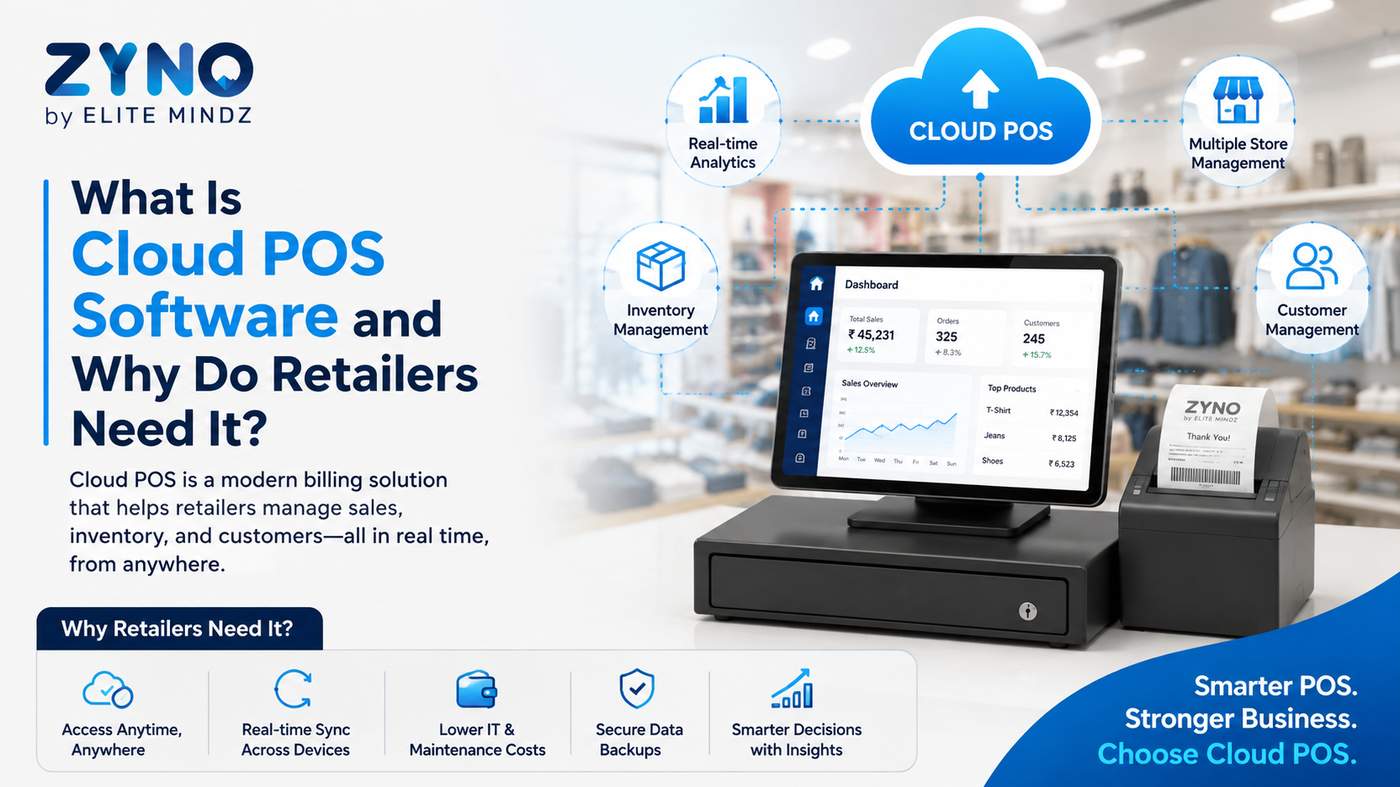
Unlike traditional point-of-sale systems that rely heavily on a local computer or server, a cloud-based POS system stores and synchronizes business information through the cloud. Retailers can access sales, inventory, customer information, and reports from authorized devices and locations.
Modern cloud-based retail platforms can also make it easier to scale to new stores, receive software updates, and manage inventory across physical and online channels.
So, what is cloud POS software, how does it work, and why do retailers need cloud POS software? Let's understand.
What Is Cloud POS Software?
Cloud POS software is a point of sale software solution that processes retail transactions while storing and synchronizing operational data online.
A traditional POS may keep most information on a computer or local server inside the store. A cloud POS system, on the other hand, allows authorized users to access business information through the internet.
Modern cloud point of sale software can typically manage:
Billing and invoicing
Product information
Inventory
Customer records
Discounts and promotions
Digital payments
Returns and exchanges
Sales reports
Multiple stores
Employee access
Purchase information
This means a retail POS system is no longer just a checkout tool. It can become an important part of a retailer's overall retail management software.
How Cloud POS Software Works
Understanding how cloud POS software works is fairly simple.
When a cashier completes a sale, the POS billing software records the transaction. The information can then synchronize with the cloud platform and update related records such as inventory, customer history, and sales reports.
For example, if a customer buys three products, the system can:
Process the bill.
Record the payment.
Reduce those products from inventory.
Update daily sales figures.
Add the purchase to the customer's history when applicable.
Make updated information available to authorized managers.
Because information is centrally managed, owners can often monitor the business without being physically present at every store.
This ability to synchronize sales and inventory is a key characteristic of a modern cloud-based POS system.
Why Are Retailers Moving to Cloud POS Systems?
The retail industry has become more complex.
Businesses may sell through stores, websites, marketplaces, mobile devices, and social channels. At the same time, customers expect inventory information and service to remain consistent.
Traditional disconnected systems can make this difficult.
A modern POS system gives retailers a way to connect different parts of their operation and access more accurate information.
Here are some of the biggest benefits of cloud POS software.
1. Access Business Information From Anywhere
One of the main advantages of online POS software is accessibility.
Retail business owners do not always want to visit every outlet just to check daily sales.
With a cloud platform, authorized users can often access:
Sales reports
Inventory information
Store performance
Customer information
Transaction records
Product performance
from a computer, tablet, or mobile device.
This is especially helpful for owners managing several locations.
2. Real-Time Inventory Management
Inventory management is one of the most important parts of retail.
When stock information is inaccurate, retailers can face stockouts, overstocking, missed sales, and unnecessary purchasing.
A POS software with inventory management can automatically update stock whenever an item is sold or returned.
This supports real-time inventory management and gives retailers a clearer view of what is available.
A strong POS inventory management system may also provide:
Low-stock alerts
Product-level inventory
Stock transfers
Purchase tracking
Store-wise stock
Product variants
Reorder information
When connected with inventory management software or cloud inventory management, retailers can manage inventory with less manual work.
3. Easier Multi-Store Management
Managing one shop is very different from managing five, ten, or fifty outlets.
Cloud POS software for multiple stores helps retailers centralize information instead of maintaining separate records for every location.
A good multi-store POS software solution can help management view:
Branch-wise sales
Store inventory
Product pricing
Promotions
Employee activity
Customer information
This can also support multi-store inventory management.
If one branch has excess stock while another branch is running low, management can identify the situation and transfer products when appropriate.
For this reason, cloud systems can be particularly useful as POS software for growing retail businesses.
4. Faster and More Accurate Billing
Checkout remains one of the most important functions of a POS.
Modern retail billing software helps employees scan products, calculate taxes, apply discounts, accept payments, and generate receipts quickly.
Integration with barcode billing software can further reduce manual product entry.
For businesses operating under GST requirements, integrated GST billing software capabilities can also help simplify invoice creation and tax calculations.
A faster checkout experience benefits both employees and customers.
5. Automated Inventory Management
The next stage of inventory technology involves greater automation.
Instead of manually checking stock every day, automated inventory management can help identify products that need attention.
A smart POS software platform may help retailers monitor stock movement, identify low inventory, analyze fast- and slow-moving products, and support replenishment decisions.
More advanced platforms are also beginning to combine POS data with artificial intelligence.
An AI-powered cloud POS or AI POS system may use sales trends and historical information to support inventory forecasting, customer analysis, or decision-making.
6. Better Retail Analytics
Every transaction produces valuable business information.
A modern digital POS system can turn these transactions into useful reports instead of leaving retailers to analyze spreadsheets manually.
Retailers may use retail analytics to understand:
Best-selling products
Slow-moving items
Sales by location
Peak shopping periods
Average transaction value
Popular payment methods
Customer purchase patterns
When combined with AI-powered retail analytics, sales tracking software, and customer behavior analytics, retailers can gain deeper insight into business performance.
This information can also support retail sales forecasting.
7. Better Customer Management
Customers increasingly expect businesses to recognize their preferences and provide relevant experiences.
Integrating customer management software with POS information can help retailers maintain purchase histories, loyalty information, contact details, and customer preferences.
Retailers may use this information for:
Loyalty programs
Personalized promotions
Rewards
Repeat-customer offers
Purchase recommendations
A connected system helps employees understand customers without maintaining multiple separate databases.
8. Omnichannel and Unified Commerce
Customers no longer shop through only one channel.
Someone might find a product online, buy it in a physical store, and later request a return through another channel.
Omnichannel POS software helps retailers connect these experiences.
A unified commerce POS goes further by bringing orders, inventory, customers, payments, and sales channels into a more connected environment.
This can help businesses provide consistent stock and customer information across online and offline retail.
For companies investing in retail digital transformation, this type of integration is becoming increasingly important.
9. Mobile POS, SoftPOS, and Smarter Checkout
The checkout counter itself is also changing.
A mobile POS system allows employees to process transactions using portable devices rather than requiring customers to visit a fixed counter.
SoftPOS technology can allow compatible devices to accept contactless payments without traditional payment-terminal hardware in supported environments.
Retailers are also exploring smart checkout technology to reduce queues and improve convenience.
A contactless POS system and digital payment POS can support customers who prefer cards, mobile wallets, QR-based payments, and other digital options.
Connecting the system with payment processing software can also help keep payment information aligned with sales records.
10. Easier Retail Automation
Retail teams often spend significant time on repetitive administrative work.
Retail automation can reduce some of this workload.
A cloud POS platform may automate tasks such as:
Inventory updates
Sales reporting
Stock alerts
Customer loyalty points
Price synchronization
Tax calculations
Store-wise reporting
Automation allows staff to spend less time maintaining records and more time serving customers.
Where Does ZYNO POS Fit In?
Retailers comparing cloud POS software for retail businesses can also consider ZYNO POS by Elite Mindz.
ZYNO POS is positioned as a cloud-based retail platform that combines billing, inventory, customer management, supplier management, multi-branch operations, and business analytics. Its cloud POS offering supports centralized multi-branch synchronization, role-based access, remote monitoring, third-party integrations, and an offline billing mode designed to synchronize transactions once connectivity returns.
For retailers, some relevant ZYNO POS capabilities include:
Cloud-based billing
Real-time inventory tracking
Barcode scanning
GST billing
Multi-store management
Customer and loyalty management
Sales and business reports
Multiple payment methods
Purchase and supplier management
AI-powered analytics
ZYNO POS also supports centralized management of products, pricing, promotions, sales, and inventory across outlets.
This makes it an option worth evaluating for businesses searching for cloud-based POS software for retail stores or a connected platform that can grow with multiple outlets.
Cloud POS System for Small Businesses
A cloud POS system for small business does not need to be complicated.
For a small retailer, the most important features may simply be:
Quick billing
Inventory tracking
Customer management
Barcode support
Digital payments
Sales reports
Tax management
Cloud backup
When comparing affordable cloud POS software for retailers, businesses should consider total cost rather than only the subscription price.
Ease of use, implementation, hardware requirements, support, integrations, and scalability also matter.
How to Choose the Best Cloud POS Software for Retailers
The best cloud POS software for retailers is not necessarily the platform with the longest feature list.
It should fit your business.
Before choosing a retail POS software solution, consider:
How many stores do you operate?
How many products do you manage?
Do you sell online as well as offline?
Do you need real-time inventory?
Which payment methods do customers use?
Do you need GST billing?
Do you manage loyalty programs?
Will you open more locations?
Does the POS integrate with other software?
What happens if the internet connection goes down?
For a single small store, simplicity may be the priority. For a retail chain, centralized inventory, multi-store controls, analytics, integrations, and scalability become much more important.
Final Thoughts
So, why do retailers need cloud POS software?
Because retail has moved far beyond simple billing.
A good cloud POS system can connect sales, inventory, customers, payments, reports, and multiple locations while giving business owners greater visibility over everyday operations.
Features such as real-time inventory management, multi-store POS software, retail automation, mobile POS systems, AI-powered retail analytics, digital payments, and omnichannel POS software are making cloud POS platforms more valuable for modern retailers.
Solutions such as ZYNO POS also demonstrate how cloud POS technology can bring billing, inventory, customers, purchasing, and analytics together within one connected platform.
Ultimately, the right cloud POS software should make your retail business easier to manage—not more complicated. Whether you operate one outlet or a growing chain, choose a system that fits your current needs while providing enough flexibility to support future growth.

