Why a Good Keyword Research Tool Matters More Than Ever
Most indie founders do not fail because they cannot build.
They fail because they build something nobody is searching for, nobody understands, or nobody can find.
That sounds harsh, but it is also useful. Because it means the problem is not always the product. Sometimes the problem is that we are guessing instead of researching.
Keyword research is one of the simplest ways to reduce that guesswork.
A good keyword research tool does more than show search volume. It helps you understand demand, intent, competition, and opportunity before you spend weeks writing content, building landing pages, or chasing the wrong audience.
Search demand is a signal
When someone searches Google, they are not casually scrolling. They are usually trying to solve a problem.
That makes keyword research incredibly valuable.
It can show you:
what people are already looking for
how they describe their problems
which topics have commercial intent
where competitors are weak
which keywords might be realistic to rank for
For indie hackers, this matters because time is limited. Most of us cannot afford to spend six months creating content that has no search demand or targeting keywords that are impossible to rank for.
The right keyword tool helps you make better decisions earlier.
The problem with traditional keyword research
A lot of SEO tools focus heavily on broad difficulty scores.
You search a keyword, see a keyword difficulty score, and decide whether to go after it.
The problem is that those scores can hide the real opportunity.
Sometimes a keyword looks difficult on paper, but the actual search results are weak. The top 10 might include outdated articles, thin content, poor titles, weak meta descriptions, or low-authority sites that are ranking simply because nobody better has targeted the query properly.
That is where SERP analysis becomes powerful.
Rather than only asking, “What is the keyword difficulty score?”, you should also ask:
“What actually ranks right now, and can I create something better?”
That is the kind of thinking behind SERPTool.
Why SERPTool is worth looking at
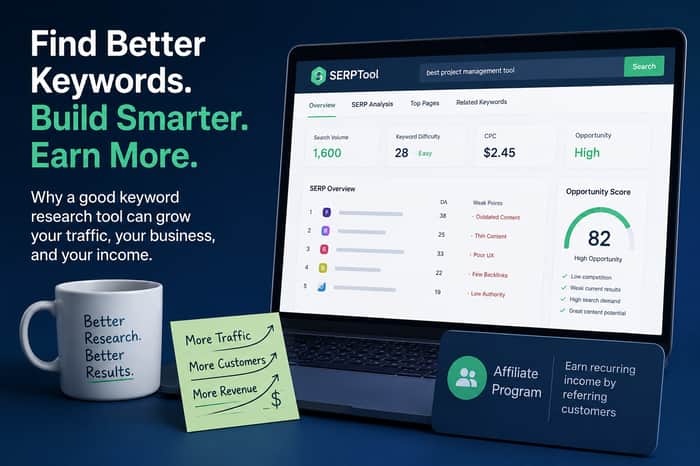
SERPTool is built around the idea that keyword opportunity should be judged by the actual search results, not just by a generic difficulty number.
Instead of treating keyword research as a spreadsheet exercise, it helps you look at the competitive landscape behind a search term.
That is especially useful if you are:
building SEO content for your own SaaS
running niche sites
managing SEO for clients
looking for low-competition content opportunities
trying to validate demand before building a product
hunting for keywords where the current top results are vulnerable
For indie hackers, this is the difference between publishing random blog posts and building a deliberate search acquisition channel.
Keyword research is not just for bloggers
A lot of founders think keyword research is only useful once they start “doing SEO”.
I think that is backwards.
Keyword research can help before you even build.
It can influence:
product positioning
landing page copy
feature naming
blog topics
comparison pages
lead magnets
free tools
niche selection
customer discovery
If people are searching for a problem every month, that gives you a signal. Not proof, but a signal.
And if the existing search results are weak, that signal becomes even more interesting.
The affiliate angle
One thing I like about SERPTool is that it is not only useful as a research tool. There is also an affiliate programme, which creates an extra opportunity for people already operating in the SEO world.
If you are an SEO consultant, freelancer, agency, niche site builder, or content strategist, you are probably already recommending tools to clients.
With SERPTool, there is the potential to become an affiliate and earn revenue by referring customers to the platform.
That makes it useful in two ways:
First, you can use it to find better keyword opportunities.
Second, you can potentially create another revenue stream by recommending it to clients, customers, or your audience.
For anyone already selling SEO services, that is a nice fit. You are not promoting something unrelated. You are recommending a tool that sits naturally inside the SEO workflow.
Reselling value to clients
There is also a practical client-services angle.
If you operate in SEO, clients often do not just want reports. They want confidence.
They want to know:
why a keyword is worth targeting
why a competitor can be beaten
what content should be created
where the opportunity actually is
how SEO work connects to business outcomes
A tool like SERPTool can help turn keyword research into something easier to explain and sell.
Instead of saying, “This keyword has a low difficulty score,” you can say, “The current results are weak for these reasons, and here is where we can compete.”
That is a much stronger conversation.
Good keyword research compounds
The best thing about SEO is that the work can compound.
One good keyword can bring traffic for months or years.
One good article can attract leads while you sleep.
One well-targeted content cluster can become the foundation of an entire acquisition channel.
But that only happens when you choose the right opportunities.
Bad keyword research leads to wasted content.
Good keyword research gives your content a fighting chance.
Final thought
Indie hackers love building products, but distribution is usually the harder game.
Keyword research is one of the most underrated ways to make distribution more intentional.
It helps you stop guessing, understand demand, spot weak competition, and create content that has a real chance of ranking.
That is why I think tools like SERPTool are worth paying attention to.
It gives founders, marketers, and SEO professionals a better way to judge keyword opportunities. And with the added affiliate programme, it also offers a potential revenue stream for people already working with clients or audiences in the SEO space.
For indie hackers trying to build something sustainable, that combination is powerful:
Use the tool to find opportunities.
Use the insights to create better content.
Use the affiliate programme to add another revenue stream.
That is a much better strategy than building in the dark.
