Why most SaaS sales calls stall before the demo
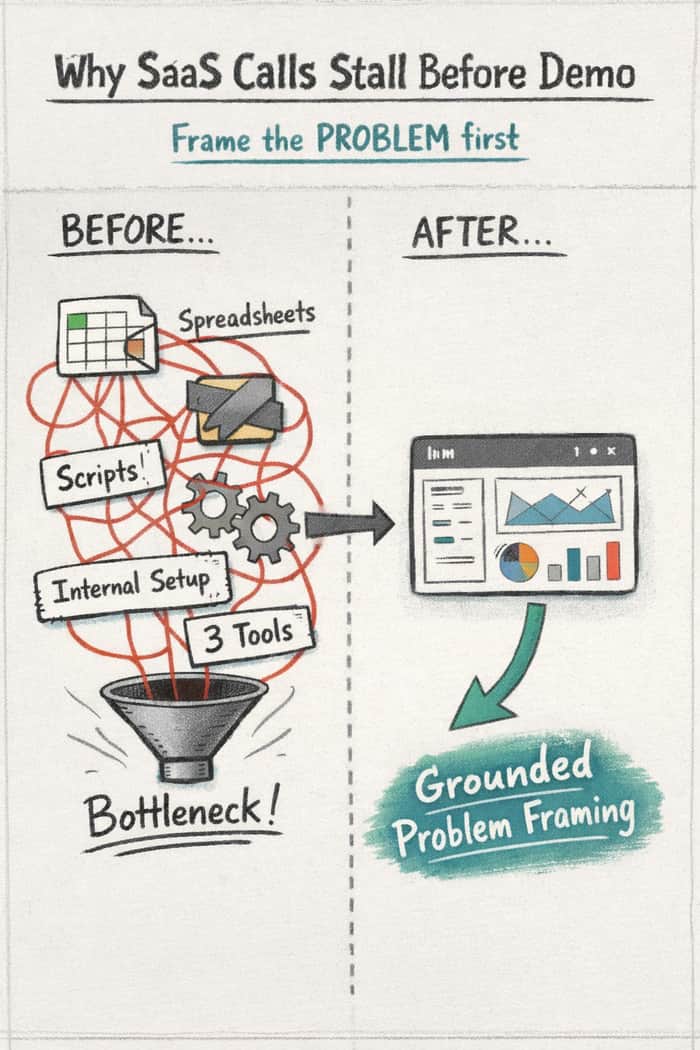
Something I’ve noticed after sitting in a lot of SaaS sales calls:
Deals don’t usually die because the product is bad.
They die because the conversation never gets grounded.
You do the call.
Small talk → features → use cases → integrations → demo invite.
Everything sounds fine.
Then you hear:
“Interesting. Let us discuss internally.”
Which usually means: pass.
For a long time, I blamed the usual things:
timing
budget
“they weren’t serious”
better competitors
But the real issue shows up much earlier.
The buyer never formed a clear mental model of why this product needs to exist.
And if that never happens, features don’t stick.
Most pitches jump straight to:
what the product does
how it’s different from competitors
why it’s “better”
That feels logical.
But buyers don’t compare you only to competitors.
They compare you to:
their messy internal setup
spreadsheets + scripts
3 tools duct-taped together
or doing nothing at all
If you don’t frame that comparison explicitly, it happens silently in their head — and you’re not part of it.
What I’ve seen work better is flipping the sequence.
Before touching the product:
describe what’s breaking in how teams handle this today
name the real tradeoffs people are already living with
surface the alternatives they’re using (even if it’s ugly)
Not generic pain. Specific friction they recognize from last week.
Once both sides agree on:
“Yeah, this way of doing things doesn’t scale / keeps creating work / blocks us”
Only then does the product matter.
At that point, the demo feels like confirmation, not persuasion.
A classic example: Segment vs Google Tag Manager.
Segment didn’t win by saying “we have more integrations.”
They won by reframing the problem:
engineering becomes a bottleneck
tracking logic splinters
data definitions drift
fixing it always requires more engineering
By the time the product showed up, the buyer wasn’t asking
“Why Segment?”
They were asking
“Do we want to keep scaling like this?”
Same product.
Completely different conversation.
When teams get this right, a few things change fast:
sales cycles shorten
objections surface earlier and cleaner
demos require less explaining
questions shift from “why you?” to “how would we roll this out?”
The biggest tell you’re missing this:
If your demo requires constant explanation, customization, or education — the context wasn’t set early enough.
Good SaaS sales doesn’t convince harder.
It makes sense faster.
Curious if other founders here have seen deals stall not because of the product — but because the problem framing never landed.

This is exactly the problem I experienced when running one of my B2B startups. Over time, we came to the same conclusions and learned to first zero in on the customer's problem, budget, and alternatives, before pitching them what our product could do.
In fact, our "first meeting" with a customer was exclusively about establishing rapport and understanding their problem, what they are doing today to solve it, and what their ideal outcome would be. We would then schedule a follow-up meeting to show a demo of the product that was tailored to their exact situation, and present an offer that was aligned with their perception of business value. B2B is rarely one-size-fits-all.
Exactly..... you nailed it. Framing the customer’s pain and current workaround first turns the demo into validation, not persuasion. Tailored context > generic features every time.
The 'why this product needs to exist' framing is the hardest part of early SaaS positioning.
For payment recovery tools like what we're building at tryrecoverkit.com, the mental model problem is exactly this: the buyer compares you not to Churnbuster or other recovery tools, but to 'doing nothing' — which feels like the status quo, so the burden of proof shifts entirely to you.
The positioning that landed for us: 'You're already handling payment failures. You're letting Stripe's Smart Retry run in silence for 5 days while your customer wonders why their access stopped.' That's not comparing to a competitor — it's reframing the messy invisible process they already have. Once a founder sees that clearly, the demo becomes confirmation rather than persuasion.
The thing I'd add to your framework: the 'duct-taped setup' comparison is even more powerful when you can make it visceral. 'Stripe emails get 8% open rates' lands differently than 'the average failed customer never hears from you.'