Write COLD DM like this and get clients easily
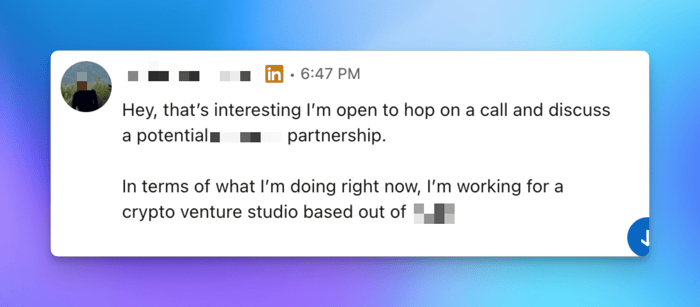
Hello,
This is Mahmudul Hasan, working as a Co-Founder & CEO of Panze - UX Design Studio (https://panze.co/) & Slashit App (https://www.slashit.app/)
Beside this I am leading 1 Design Community & 1 Founder Community. I noticed most people send Cold DMs like this:
“Hi, I’m a UX designer. I can improve your website. Let me know if you want to talk.”
And get… nothing.
Long or generic messages are hard to reply to.
Here’s a simple 3 step way we use at Panze - UX Design Studio:
- Compliment or notice their work – show you actually looked at what they do.
- Show how you can help in 1 line – short and clear.
- End with a simple question – easy to answer with yes or no.
Example:
“Hey Sarah,
I saw your new dashboard for the {{client app name}}. The layout looks good, but some flows could be smoother. I help teams improve UX so users complete tasks faster. Are you open to a quick review of your flows?”
Short. Clear. People reply.
I’ve tried this on dozens of prospects. DMs like this get 3x more responses than long, generic messages.
Stop explaining everything in your first DM. Try this formula: compliment, help, ask. That’s it.
What do you think?
Do you have any other strategy you used and get results, share in comment. I will try 1 🙌

thank you
Hello
Thanks, this keeps things simple on both ends: not too salesy for the potential lead, and not overwhelming for the person pitching.
This makes sense. I've been overthinking my outreach for ProductOrbit and this is way cleaner than what I was planning.
Quick question - when you say "compliment or notice their work," how specific do you get? Like do you actually dig into their dashboard and find something real, or is a surface-level "nice design" enough?
I'm worried about coming off fake if I try to compliment something I don't fully understand.
Also, for step 2 - "show how you can help in 1 line" - do you customize that for each person or do you have like 3-4 templates you rotate based on their situation?
Asking because I'm about to start reaching out to PMs and eng managers and want to get this right from the start.
Hello
Thank you for this, i hope it gets me the required response i need
This is gold! As a solo dev with 24 iOS apps, I've been terrible at outreach - always felt too "salesy." But this 3-step formula makes so much sense. The compliment-first approach feels natural and genuine.
I think the key insight is "help for free" - it builds trust before asking for anything. Going to try this with some tech bloggers for app reviews. Thanks for sharing!
This resonates. Especially the part about solving distribution before product — feels counterintuitive but usually right.
This works because it’s not just a script.
It matches timing, context, and intent.
That’s usually what people underestimate.
The domain-name-in-subject-line insight is gold. We see this pattern constantly when founders are trying to pitch agencies for inclusion in Pick an Agency,the ones who take 30 seconds to mention something specific about our positioning ("I noticed you focus on review-backed matching") convert way higher than generic pitches. That specificity signals you actually looked, which kills friction. One addition: the best ones also lead with a tiny ask first ("Can I ask you a question about X?") before the bigger ask. Lowers the stakes.
Thanks for sharing this, for someone starting out in the SaaS waters and trying to market my product this changed my view on cold calls , my initial thought (like with most newbs) was to explain my history of development and how I got there lol.
The "compliment → help → ask" structure works because it inverts the default cold outreach mindset. Most DMs are "here's what I do" messages wearing a thin disguise. Yours is actually "I noticed what you're doing, here's a thought, interested?"
One thing I've noticed: the compliment needs to be specific enough that they know you actually looked. "Nice dashboard" vs "the filter interaction on your dashboard is clean but the export flow has friction" — second one shows you spent 2 minutes actually using it.
The yes/no question at the end is key. Open-ended questions like "what are your UX priorities?" require thinking. Binary questions like "open to a quick review?" require a decision. Decisions are easier to make than answers are to craft.
Only addition I'd make: timing matters more than people think. Right after someone ships something (new feature, redesign, launch post), they're in "feedback mode" and way more likely to engage than during a random Tuesday.
Good framework. Copying the structure is easier than copying the effort of actually researching people first.
This is exactly the kind of situation I keep running into.
When someone says “I’ll get back to you in a few days”,
the hardest part isn’t waiting — it’s not knowing what they actually mean.
Do you usually follow up, or do you treat that as a soft no?
This is solid advice. The compliment → help → ask flow feels way more human than most cold DMs I get. Keeping it short and genuinely personalized really does make a difference. Simple, practical, and easy to apply!
Hello
I also offer to reply with a number, like:
Interested?
What platform do you get leads
I’ll try it though
I just created an Ai tool called Executive Persuasion Engine that helps founders with strategic framing by using influence frameworks to drive "Yes" decisions from clients.
Hello
This resonates. The biggest mistake in cold outreach isn’t the length, it’s the lack of proof that you actually looked at the other person’s context. The “compliment → one-line value → yes/no question” structure works because it lowers cognitive load and removes risk for the receiver. One thing I’m curious about: how do you adapt this when the prospect is very early-stage or still figuring out their own problem? In those cases, have you seen better results by leading with a question first instead of a value statement?
I think the reason that less wordy direct messages perform better is not that they're more clever but rather because they take less thought and energy to reply to. ~
I consider the energy it takes to respond to a message to be friction. If I need to put in a lot of effort in order to respond, I won't bother responding at all. With your three-step system, you've created a way for people to be able to respond without putting forth a significant amount of effort and without looking lazy.
I would like your opinion on how you determine what to comment on when you see someone else doing something good. Personally, I have had issues being specific without being perceived as overly aggressive.
One thing I am doing differently now is instead of saying what type of support I provide, I am simply stating what I see. Therefore, I no longer need to say I am here to help because it's implied through what I've said.
Totally agree 👍
Short, personalized DMs tied to what someone just shipped or shared get far better replies than generic pitches.
Can't over emphasize that. It's really the trick, quality always beat volume. I can understand why people prioritize volume though, cuz they have a pricing where volume is the only way to stay profitable heck!
Just have a premium tier. You shouldn't be sending cold emails and pitching a $10 product🥲 I mean a trial is understandable but if money needs to flow it has to be premium except for peculiar cases.
I have seen this dude with 47 users. On-board about just one user every two months. He's profitable cuz he only needs 18 users to break even and he's got an average of $89 MRR on each user. Plot twist, I sold the business to him and he repurposed it to a premium niche product, started using cold email outreach taking serious time to study his prospects.
I think in 2026, people are not as frustrated with cold emails. If done right, it even appear as though you are helping them (addressing their problem). I myself click through about two cold emails each week.
This really resonates. The point about simplicity beating power early on is something a lot of founders learn the hard way. When users are already overwhelmed by big incumbents, the fastest win is helping them reach a clear outcome with as little thinking as possible.
I’ve noticed the same thing with community-driven channels like Reddit. When people arrive already discussing a problem they’re trying to solve, they’re not comparing feature lists they’re just looking for something that works. That context makes discovery feel natural instead of forced.
It’s interesting how this mirrors the indirect distribution approach here. Whether it’s contract templates or community conversations, the common thread is meeting users before they switch into “shopping mode.”
Great insight; this is one of those details that’s easy to overlook but makes a huge difference in crowded markets.
Right now everyone wants fast results so they misunderstood with volume outreach and forget one simple principle that you can get best if you hyper-personalised and building conversation first and solve their problem rather than that blasting inbox at scale .
How do you approach someone on LikedIn if there is not much info about what one does? Like just job title or company for example.
We find out our best possible client then message them. Without knowing much info we ignore that.
through their recent post or comments they made on others creators & even you can anchor your mutual connections .
Direct, personalized, positive engagement. It works.
One of the things I used to really enjoy about going to tradeshows was exactly this. If I had spare time, I'd hang at the booth. If someone came up to look, I'd ask them "So what are you working on now?" That's when they will just come out and tell you want you need to know to sell to them.
compliment, help, ask. I’ve learned a lot, thanks for your advice! Yeah, I think I can also add a more human touch and show more of my sincerity. For example, in the first email, I could mention that a certain feature of my product is still being optimized, or share some real updates about the product from a personal perspective.But I really want to connect with you.
Strong framework. I’ve also seen higher replies when the first DM offers a micro-win instead of a review. One concrete insight, no call. Then ask.
This works because it respects the other person’s time. I’ve seen the same thing — short, specific messages get replies, long explanations don’t. Compliment + clarity + simple question is a solid formula.
Lets tyr this too!
Create cold DMs that build trust, highlight real value, spark curiosity, and end with a simple call-to-action to start conversations and win clients.
Would this same kind of DM work for me? I have a SaaS product. Will old dming like this work for getting customers for my SaaS?
One strategies i see work so far, if you offer your free-trail or extend to 7 day with what mentioned on websites .
This is solid. The biggest win here is reducing friction for the other person.
One thing I’ve also seen work well is referencing a specific outcome (revenue, signups, no-shows, conversions) instead of a general improvement.
Compliment → outcome → yes/no question keeps it easy to reply to.
Generic DMs fail because they give people work to do.
Yes - there is another way: ask for help or for opinion. Know eachother - and then mayyybe tell what you are doing. Trust first - business next.
This is really practical advice. Thanks for sharing a clear framework. Definitely trying this one 🙌
Would love to know the update ❤️
Love this! simple, actionable, and actually reply-friendly. Compliment, help, ask is gold. 👍
Yup ❤️
This comment was deleted 7 months ago