Yes, this is about another fitness app. This one wants you to delete it.
Yes. Another fitness app.
I know. You’ve seen a hundred of them. Streaks. Rings. Leaderboards. A cartoon avatar that levels up when you log water. Probably a founder who “disrupted wellness” from a WeWork in 2019.
This one is different — and I’m aware that’s what they all say.
The difference isn’t gamification. It’s interpretation.
The problem I kept seeing
Three years ago, working with clients, I kept noticing the same gap.
They showed up. Logged workouts. Tracked sleep. But when I asked why they’d chosen a sprint session the morning after four hours of sleep and HRV 20% below baseline — they had no answer. Nobody had taught them to read those signals. The data was there. The interpretation wasn’t.
I couldn’t find an app that tried to solve that. So I built one.
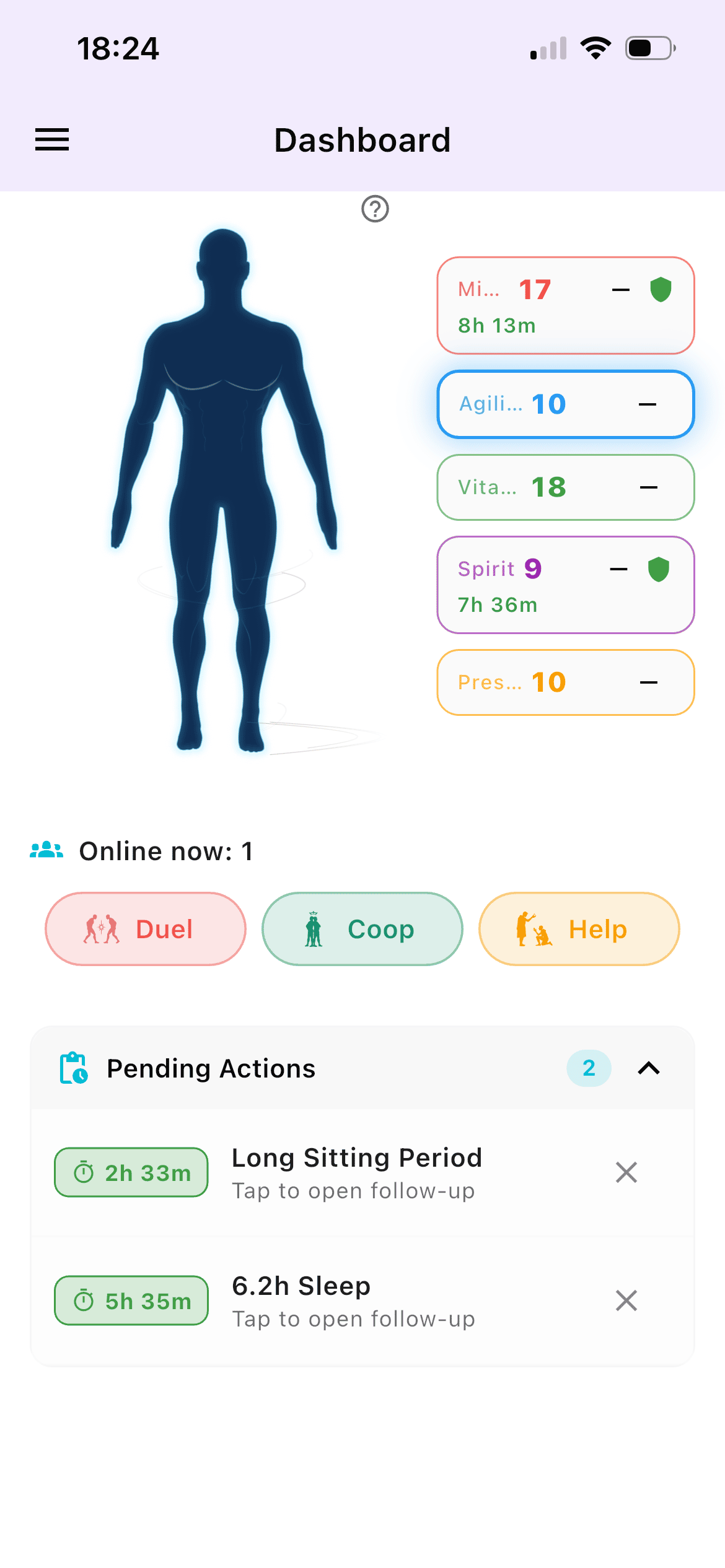
It’s called Forjum. It’s live on the App Store and Google Play. Flutter, HealthKit, Health Connect. Apple Watch and Wear OS. Built by a fitness professional (SAFS Fachausweis, exercise physiology background) with AI as a coding collaborator — not the other way around.
What actually happens (not on every app open — after a session)
When Forjum offers a post-session follow-up, a physiological classifier runs across the full minigame registry. It doesn’t rotate a fixed list. It scores every available activity against your current biology.
Core rules include:
System overlap penalty — stress the same system again → penalized (up to −50% at extreme intensity)
Recovery bonus — breathwork and similar activities score higher after max effort
Parasympathetic activation — after sympathetic dominance, recovery-oriented activities get lifted
Stat fatigue with time decay — same-stat training penalized by volume, RPE, and hours since last session
Step behavior nudge — under 50% of step goal, movement activities get a bump; over goal, a small penalty
(Nine rules total — happy to break down the rest in comments.)
You get three options:
Resonant — highest score, aligned with what your body likely needs
Stable — middle band, no strong signal
Dissonant — lowest score, working against current physiology
You choose freely. All three stay available. The choice — and the context — gets recorded.
Scientific citations appear in the UI when we explain recommendations. The rules themselves are modeled on exercise physiology literature — the engine doesn’t paste a footnote on every calculation, but the science isn’t decoration.
The part that sounds like a bug but isn’t
Wednesday morning. HRV 18% below baseline. Resting HR up 6 bpm. 5.5 hours of sleep.
Classifier runs: strength-heavy options tank. Breathwork and slow walk rise. Resonant: breathwork or slow walk. Dissonant: squat counter.
You pick the squats. Because you feel fine.
That choice gets logged against your Guardian tied to strength — not as punishment (−2% resonance, gently), but as a data point. The gap between what your physiology was asking for and what you chose. Over months, those gaps become the pattern. And the pattern becomes the lesson — not because the app lectures you, but because you start seeing it yourself.
The design goal that makes "nervous"
After enough choices and feedback, the app computes a graduation readiness score from four dimensions:
Decision quality (resonant choices trending up?)
Weekly stability (passing physiological assessments?)
Experience depth (enough real interaction for signal?)
Autonomy signal (completing activities without dropping mid-flow?)
Hit 90 with enough evidence — you graduate. Not on a calendar. On proof.
A body literacy curriculum runs alongside: ANS basics, load/recovery, circadian timing — five modules unlocked through real interaction, not arbitrary timers.
The explicit goal: understand your own patterns well enough that you don’t need the app to interpret them.
That’s not a retention hack. That’s the design.
Multiplayer (duels, cooperative challenges, help board) exists as a reason to stay after graduation — not a cage to prevent leaving.
Privacy, stated without marketing lies
Health data stays on-device. HRV, sleep, workouts — processed locally.
No login required for core use.
Online features share only game metadata — name and scores, never health metrics.
Optional anonymous analytics and crash diagnostics exist. Your HRV history does not get uploaded because we felt like it.
Where I am now
✅ Shipped iOS + Android
✅ Rule engine + resonant/stable/dissonant chooser in production
✅ Graduation + body literacy built
🔍 Early days on the stores — looking for traction and the right technical partner
I’m not here with vanity metrics. I’m here because the product is out of beta and the interesting question is whether anti-dependency can survive as a business model.
What I’m looking for
Primary: Brutally honest feedback from coaches, physios, or builders who’ve watched fitness apps optimize for streaks instead of literacy.
Would you trust an app that wants you to leave?
Does resonant/stable/dissonant make sense to you?
What would kill this as a business — and what would make you try it anyway?
also: A mobile developer who wants to co-own something designed not to manipulate its users. Equity + revenue share. No salary.
And honestly this is just the start...
Links: forjum.com · App Store · Google Play

