
Forjum
Be yourself, forge your journey.
Yes. Another fitness app.
I know. You’ve seen a hundred of them. Streaks. Rings. Leaderboards. A cartoon avatar that levels up when you log water. Probably a founder who “disrupted wellness” from a WeWork in 2019.
This one is different — and I’m aware that’s what they all say.
The difference isn’t gamification. It’s interpretation.
The problem I kept seeing
Three years ago, working with clients, I kept noticing the same gap.
They showed up. Logged workouts. Tracked sleep. But when I asked why they’d chosen a sprint session the morning after four hours of sleep and HRV 20% below baseline — they had no answer. Nobody had taught them to read those signals. The data was there. The interpretation wasn’t.
I couldn’t find an app that tried to solve that. So I built one.
It’s called Forjum. It’s live on the App Store and Google Play. Flutter, HealthKit, Health Connect. Apple Watch and Wear OS. Built by a fitness professional (SAFS Fachausweis, exercise physiology background) with AI as a coding collaborator — not the other way around.
What actually happens (not on every app open — after a session)
When Forjum offers a post-session follow-up, a physiological classifier runs across the full minigame registry. It doesn’t rotate a fixed list. It scores every available activity against your current biology.
Core rules include:
System overlap penalty — stress the same system again → penalized (up to −50% at extreme intensity)
Recovery bonus — breathwork and similar activities score higher after max effort
Parasympathetic activation — after sympathetic dominance, recovery-oriented activities get lifted
Stat fatigue with time decay — same-stat training penalized by volume, RPE, and hours since last session
Step behavior nudge — under 50% of step goal, movement activities get a bump; over goal, a small penalty
(Nine rules total — happy to break down the rest in comments.)
You get three options:
Resonant — highest score, aligned with what your body likely needs
Stable — middle band, no strong signal
Dissonant — lowest score, working against current physiology
You choose freely. All three stay available. The choice — and the context — gets recorded.
Scientific citations appear in the UI when we explain recommendations. The rules themselves are modeled on exercise physiology literature — the engine doesn’t paste a footnote on every calculation, but the science isn’t decoration.
The part that sounds like a bug but isn’t
Wednesday morning. HRV 18% below baseline. Resting HR up 6 bpm. 5.5 hours of sleep.
Classifier runs: strength-heavy options tank. Breathwork and slow walk rise. Resonant: breathwork or slow walk. Dissonant: squat counter.
You pick the squats. Because you feel fine.
That choice gets logged against your Guardian tied to strength — not as punishment (−2% resonance, gently), but as a data point. The gap between what your physiology was asking for and what you chose. Over months, those gaps become the pattern. And the pattern becomes the lesson — not because the app lectures you, but because you start seeing it yourself.
The design goal that makes "nervous"
After enough choices and feedback, the app computes a graduation readiness score from four dimensions:
Decision quality (resonant choices trending up?)
Weekly stability (passing physiological assessments?)
Experience depth (enough real interaction for signal?)
Autonomy signal (completing activities without dropping mid-flow?)
Hit 90 with enough evidence — you graduate. Not on a calendar. On proof.
A body literacy curriculum runs alongside: ANS basics, load/recovery, circadian timing — five modules unlocked through real interaction, not arbitrary timers.
The explicit goal: understand your own patterns well enough that you don’t need the app to interpret them.
That’s not a retention hack. That’s the design.
Multiplayer (duels, cooperative challenges, help board) exists as a reason to stay after graduation — not a cage to prevent leaving.
Privacy, stated without marketing lies
Health data stays on-device. HRV, sleep, workouts — processed locally.
No login required for core use.
Online features share only game metadata — name and scores, never health metrics.
Optional anonymous analytics and crash diagnostics exist. Your HRV history does not get uploaded because we felt like it.
Where I am now
✅ Shipped iOS + Android
✅ Rule engine + resonant/stable/dissonant chooser in production
✅ Graduation + body literacy built
🔍 Early days on the stores — looking for traction and the right technical partner
I’m not here with vanity metrics. I’m here because the product is out of beta and the interesting question is whether anti-dependency can survive as a business model.
What I’m looking for
Primary: Brutally honest feedback from coaches, physios, or builders who’ve watched fitness apps optimize for streaks instead of literacy.
Would you trust an app that wants you to leave?
Does resonant/stable/dissonant make sense to you?
What would kill this as a business — and what would make you try it anyway?
also: A mobile developer who wants to co-own something designed not to manipulate its users. Equity + revenue share. No salary.
And honestly this is just the start...
Links: forjum.com · App Store · Google Play

There's a gap I've been watching for years in my work as a fitness instructor.
People start. They show up. They do the work. But they don't understand what they're doing to themselves — when to push, when to back off, what sleep and stress are actually doing to their physiology, what their body is asking for the day after a hard session.
That gap isn't a motivation problem. It's a knowledge problem. And I couldn't find a tool that actually tried to solve it.
So I built one. With no development background, using Flutter and a lot of AI assistance — the exercise science and design decisions are mine, the code was a collaboration.
Here's what it actually does.
Every day, after a session or a sleep cycle or a stress spike, the app reads your wearable data — HRV, resting HR, sleep quality, step patterns — and classifies your physiological state in real time.
Then it presents three challenges.
Not hardcoded. Every minigame in the registry gets scored dynamically against your current state using a rule engine built on exercise physiology: system overlap penalties (same system you just stressed = lower score), recovery bonuses, parasympathetic activation value after sympathetic load, time-since-last-session decay, cumulative weekly fatigue. The result is three options that emerge from your actual biology that day:
One resonant — fisiologically aligned with what your body actually needs right now
One stable — neutral, safe, no particular signal either way
One dissonant — working against your current physiology
Take Marco. Wednesday morning. HRV is 18% below his personal baseline. Resting HR up 6 bpm. 5.5 hours of sleep. The scoring engine runs — and the high system-overlap penalty tanks anything strength-heavy, while the recovery bonus lifts breathwork and slow movement to the top. His resonant option might be a slow walk or a breathing exercise. His dissonant option is probably a squat counter.
Marco picks the squats. Because he "feels fine."
His Guardian — Ferrum, the force tied to his strength stat — takes a small resonance hit. Not a punishment. A log. A record of the gap between what his physiology was asking for and what he chose. Over time, those logs become the lesson. His avatar's stats reflect his real training patterns, not his intentions.
A month later, Marco starts recognizing the pattern himself. When his HRV drops like that, pushing doesn't build. It breaks. Nobody told him — his body showed him.
The same logic runs in reverse.
After a sprint session, the engine reads high sympathetic load, CNS strain. Breathwork scores high — parasympathetic activation bonus, promotes recovery, no system overlap. More sprints score low — intensity stacking penalty, same system just stressed. The dissonant option that day might be another sprint. Or something else entirely, depending on Marco's week, his recovery trend, his step count for the day.
The options are never fixed. They're generated fresh each time from the intersection of your biology and every minigame in the system.
The part that gives people pause.
After roughly a year, you should understand your own patterns well enough that you don't need the app to tell you anymore. That's not a retention strategy. That's the explicit design goal.
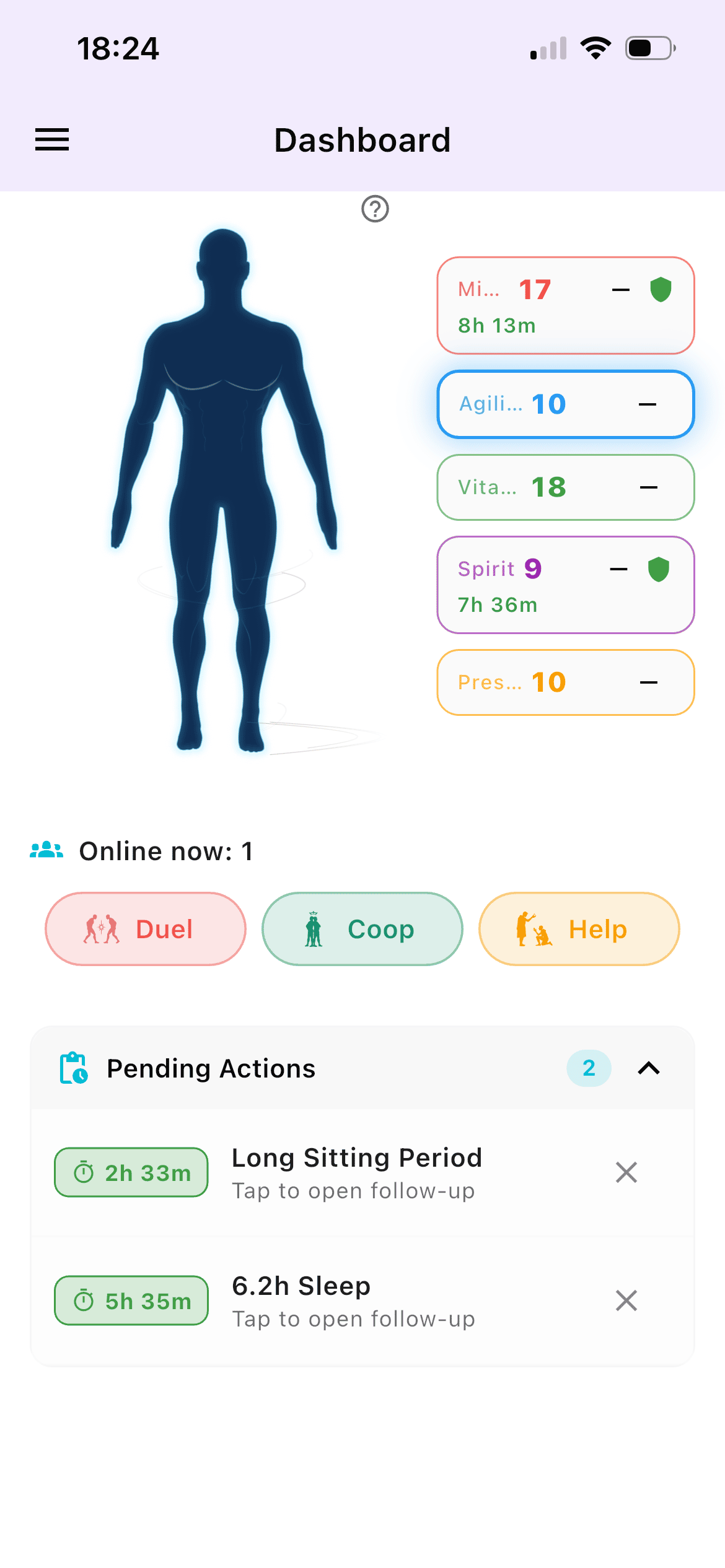
If you want to stay — the community is there. Weekly duels against real people across five categories (Might, Agility, Vitality, Spirit, Presence). Cooperative Guardian challenges where two players face the same force from opposite aspects — one gets controlled strength, one gets explosive resistance; together they either defeat Ferrum or they don't. New minigames. A system that keeps evolving.
But you could also just leave. And that would mean it worked.
What I'm looking for.
I'm a fitness professional who built this alone. The physiology is solid. The codebase is real — Flutter, HealthKit, Health Connect, Apple Watch + Wear OS + Garmin, Firebase multiplayer, RevenueCat. But it needs someone who knows mobile development to take it further.
Equity and revenue share, no salary. If you've ever thought fitness apps were designed to keep you dependent rather than help you grow — this is the alternative.
Everything runs on your device. No accounts. No ads. No data collection. Your health data never leaves your phone.
Happy to share the codebase, the exercise science documentation, or just talk through the architecture.
Comment