ZoomInfo Is Not Broken… Your Stack Is (Here’s What Smart Teams Are Using Instead)
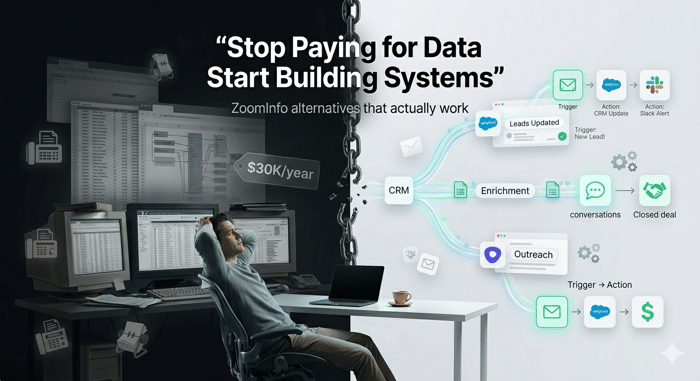
I used to think the problem was finding better data until I realized the real issue was what happens after you get the data, because tools like ZoomInfo give you access but not execution, and that gap is exactly why so many teams feel like they’re paying enterprise prices without seeing proportional results.
ZoomInfo is still powerful, no doubt, with massive databases and deep intelligence, but the cost alone can hit $15K to $40K a year, which for most startups and lean teams is not just expensive, it’s limiting how you build your entire outbound system .
And here’s where things get interesting.
More teams are not just switching tools, they’re switching thinking.
Instead of asking “which database is bigger,” they’re asking “which tool actually helps us close deals,” because having millions of contacts doesn’t matter if your workflow still breaks after the export.
That’s why alternatives are gaining traction, not because ZoomInfo is bad, but because newer tools are solving what happens after you find the lead, whether that’s enrichment, outreach, automation, or all of it combined.
Tools like Apollo are popular because they bundle database + outreach at a fraction of the cost, while platforms like Cognism focus on compliance and accurate phone data, and others are going even further by combining enrichment with automation so the system doesn’t just give you leads but tells you what to do next .
“People want execution, not just data.”
That line hit hard because it explains the shift perfectly.
The real question is not “what is the best ZoomInfo alternative,” it’s “what kind of workflow are you trying to build,” because the right tool depends less on features and more on how your sales process actually runs.
I found this breakdown of ZoomInfo alternatives that goes deeper into tools, pricing, and what actually works depending on your use case instead of just listing options:
👉 https://jarvisreach.io/blog/zoominfo-alternative/
Curious what others here are using right now because it feels like we’re moving from data-first tools to execution-first systems and that shift is happening quietly but fast.

I like this framing — especially the shift from “better data” to “better execution.”
That line:
“people want execution, not just data”
…feels very real.
I’ve seen teams stack tools thinking they’re building leverage, but in reality they’re just adding more handoffs. Data lives in one place, outreach in another, context somewhere else — and the rep still ends up stitching everything manually.
So even with “better tools,” the system still leaks.
Feels like what’s changing now isn’t just tooling, but expectations — people don’t want to assemble workflows anymore, they expect them to already work end-to-end.
Curious — in your case, what was the biggest bottleneck after getting the data?
Was it enrichment, outreach, or just connecting everything cleanly?
Honestly, connecting everything cleanly was the biggest issue.
The data itself was often “good enough,” but once workflows became fragmented across tools, execution slowed down and follow-through became inconsistent.
That makes sense.
Once the workflow is fragmented, the data stops being the advantage.
The real product becomes the layer that keeps execution moving without the rep stitching everything together manually.
That’s usually where positioning matters too.
If the product is framed as “better data,” people compare it to databases.
If it’s framed as “cleaner execution,” it feels much closer to revenue infrastructure.
That difference changes how seriously buyers read it.
This comment was deleted 5 months ago