
Achiv
Pain-driven GEO content writer

I'm building a tool that mines real pain points from Reddit and turns them into content. So my hypothesis was obvious - articles written around real user pains should rank and convert better than generic AI app pages. I had both content types living on the same domain, so I exported 2 months of Search Console data and compared them properly with Mann-Whitney test, Wilson intervals and rank-controlled CTR, because I didn't want to fool myself with pretty averages.
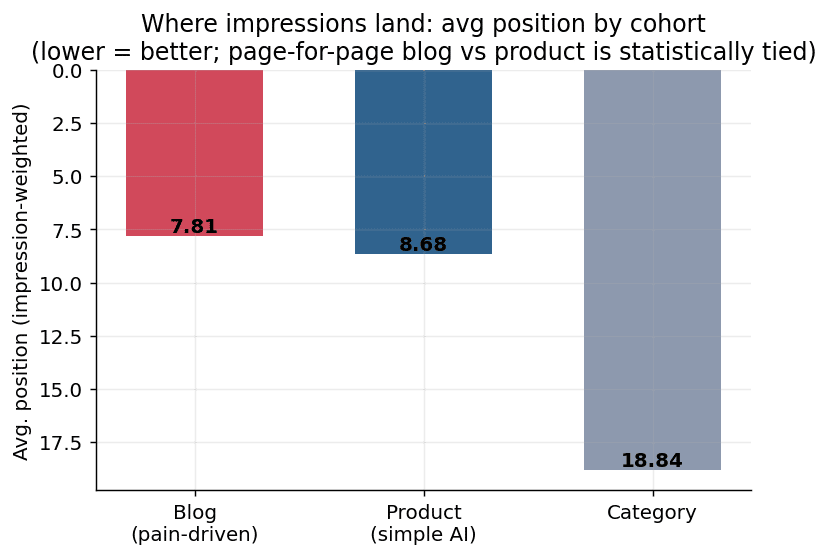
The ranking part actually worked. 89% of pain-driven articles sit in top 10, with zero tail of losers. Generic app pages drop as low as position 59. Statistically the ranks are a tie (p=0.19) but pain content is way more reliable - if it ranks, it ranks on page 1.
Now the ugly part. 28 articles, 215 impressions, 0 clicks. Not few. Zero. App pages converted at 0.6%. And 80% of all clicks on the whole site came from people just typing the brand name. Bing's AI answers told same story, it cited app pages 172 times vs 15 for the blog.
Important caveat, and I want to be honest here. This was pure pain -> content. No keyword volume checks, no People Also Ask, no autocomplete validation. Take a real Reddit complaint, write an article, publish. So treat this as a baseline of what pain alone gives you: very consistent page 1 visibility on long-tail queries that nobody clicks.
My takeaway - ranking is the easy part. Pain tells you what to write about but search demand tells you if anyone will ever click it. You need both, and I had only one. Next experiment is matching titles and snippets to actual searcher intent, will see if the click is fixable.
Full data and scripts go to GitHub soon. Happy to answer anything about methodology.
GitHub Repo with a full research: https://github.com/vunone/seo-geo-research/tree/main/1_pain_driven_content_comparison
Follow me on X to see the next interesting research results about how to convert with AI-generated content: https://x.com/fadeone_x/
All data collected through: https://achiv.com - Pain-Driven content generator.


Achiv was never a 1-month pet project for me. When I start something apart of my 9-5 I have a ton of doubts, because I plan to invest at least 1-2 years into it.
The internet is full of stories like "I launched my product and got $2k MRR" - I treat them same as lottery winner stories. You never hear about the 99% who went through the same journey and got nothing. So I'm proud of my $130 MRR this early (3 months research + 4 months development).
Now the direction is proved, and I have a plan for the next 3 months to scale to $1k MRR: autonomous SEO/GEO that really works.
Today I start a 1-month R&D session to build this for my customers based on publicly available and provable results. The idea is a simple UI where you plan your SEO/GEO blog content in literally several clicks and forget. I will publish all results on a dedicated github repo so everyone can check them and prove by their own.
Yes, this field is very competitive. Every 4rd startup promises it hacked GEO like nobody else, and most of them fail because they don't actually know what they do and what works long-term. That's exactly why I'm fine to share my research publicly - SEO/GEO is an iterative process, a race between your strategy and search engine updates, and nobody can steal a race.
Outrank is a good example. Cool project no doubt, but their whole strategy is link-exchange between low-authority domains using low-effort content, and this can't work long-term because it tries to gently cheat the ranking algos and they will notice that some day.
My plan is the opposite: build an autonomous team inside Achiv that creates a content strategy following the rules search engines actually state, instead of hacking them. Safe, reliable long-term and works for sure.
See you in a few days with the first research results I already preparing to publish on GitHub.
Follow me on X to do not miss - https://x.com/fadeone_x
Cheers Hackers!
Maks from Achiv
-
1
First, huge congrats on the $130 MRR, Maks. In a landscape flooded with inflated "lottery ticket" launch metrics, realistic and sustainable growth is the only thing that actually builds a real business. 7 months of resilience is something to be proud of.
You're spot on about the "low-effort content and link-exchange" trap. Google’s recent core updates proved that programmatic SEO built on shallow, manipulated AI content is a ticking time bomb.
Since you're diving into GEO (Generative Engine Optimization) R&D, I have a quick technical question:
Traditional Google SEO is relatively understood (crawlers, indexing, semantic density). But for LLMs (Perplexity, Gemini, ChatGPT Search), the "ranking" variables are much more about entity-relationship mapping, semantic relevance, and being cited in highly authoritative contextual databases rather than traditional backlink volume.
How are you planning to structure your autonomous content engine to optimize specifically for LLM citations rather than just standard Google search results?
Rooting for you, man. Definitely following your journey on X and GitHub!
-
1
Respect the honesty here. The lottery winner framing is exactly right. Survivorship bias dominates most SaaS content and it distorts reality for everyone building quietly.
The point about SEO/GEO being an iterative race rather than a hackable system is something more founders need to hear. Tools that try to game the algorithm always have an expiry date.
Curious about your R&D approach. Are you building the content strategy layer around SERP intent analysis or more toward AI citation patterns given the 2026 updates? Both feel relevant for what you're describing.
-
1
I like the honesty here. The most valuable part is not the $130 MRR, it's having enough conviction to keep going after seven months when most projects get abandoned long before they find signal.
One thing I've noticed with SEO products is that founders often optimize for content production when the harder problem is content selection. Publishing 100 articles is easy now. Identifying the 10 topics that can realistically compound into traffic is where most of the value lives.
Publishing the research publicly is also a smart move. Even if competitors read it, you're building credibility and collecting feedback at the same time. In markets this crowded, trust is often a bigger differentiator than another automation feature.
-
2
All these months of development I used to build 2 things:
Engine that finds most demanding topics to write about which are relevant to your product
Engine that writes best in class articles perfectly framed for SEO and GEO
Now the autopilot turn.
-
-
1
Kudos on the transparent approach and hitting $130 MRR the right way! As a UI/UX designer and no-coder, your focus on building a "simple UI where you plan in several clicks" sounds like a dream. Building sustainable SEO/GEO without the sketchy hacks is the way to go. Dropping a follow to watch this R&D month unfold!
-
1
I always curious about such comments. Do you actually read what AI writes? I'm spending time to reply and just curious do I have to?
-
-
1
Interesting direction. When you say “autonomous SEO/GEO,” what’s the actual loop -content generation, keyword selection, internal linking, or all of it?
Feels like the hard part is still evaluation, not generation.-
1
Generation that follows a very strict structure, keywords frequency, style that is nice to read being human is also a tough task. I spent month to develop custom skills for Achiv to generate high-quality content.
But yeah, autonomous agent will be doing the full cycle:
Keyword and demand research
Proper angle
Format research
Planning
Writing
Cross-linking
-


Last week I was preparing for yesterday's launch on PH. Copy, framing, platforms, email campaign for existing users...
In total I reached ~15k highly engaged audience. Especially existing active users and colleagues from my job - 1.5k people in total.
In the first 4hrs of launch nobody can see how many upvotes / points they get, so I was staring at the screen awaiting the next notification about an upvote. Until the 4hr period ended, I've noticed at least 20 upvotes and got a reply from one of the users about a comment.
Surprise! - It's the new PH algo.

After 4 hrs ended I had 6 points and 0 comments. However the notifications about upvotes kept coming more and more. My outreach worked. But PH cut ~90% of them. Result? In total I got 14 points on PH.
The root cause was their new algo that cuts off "bots" and any kind of "suspicious" traffic. They now count each upvote's weight and add it to launch points.
In my case, people mostly had a PH account before - I know it because they already voted for company launches. But they all counted as 0 points.
Support - WTF?
I contacted support asking for help, since I've been a decent user on PH for many years. I attracted organic, real traffic and got nothing out of it? - Just AI referring to ToS. The only response I've got after hours of talks with AI from real human sup 👇

Wanna laugh?
They even deleted every comment I really got. Real reviews from my users I expected to save and use as social proof, real comments from colleagues on my idea... - 0.
Traffic? - Bullshit.
I could get at least 50x more traffic by just giving a product link instead of posting PH launch everywhere. 10!!! Unique Users from producthunt.

Ok, PH. You are powerful and can delete whatever you want. BUT WHY NOT JUST HIDE THEM FROM OTHERS?!?!? Just let me read what people think about my product. At least...
PH is dead for me as a platform for those making the coolest products, and doesn't matter if you are some Google or a solo dev.
IMO! They just want you to pay for ads.
Cheers Hackers!
-
1
Thanks for sharing this! Brutal read but it's so factual !
Your story reminds me of this strategy shared by this indie founder: Launch on Product Hunt multiple times
Many founders mistakenly believe a successful Product Hunt launch is the primary gateway to startup success.
The reality is that a launch is just a single day of visibility that rarely leads to long-term growth.
All the best!
-
1
Brutal read. I’m building an AI interviewer and was planning a PH launch. Now? Not anymore.
Deleting real comments from real users is unacceptable. That’s not “anti-bot”, that’s anti-founder.
Thanks for the warning. You helped more people than PH will ever admit.
-
1
Honestly, If I knew that before, I'd rather spend my resources on launching elsewhere.
-
-
1
Very interesting and thanks for providing this information, its indeed not the only channel and as with anything its important to diversify the channels!
-
1
HAAANK. DONT ABBREVIATE PRODUCT HUNT!!! HAAAAANK...
-
1
Thanks for sharing your experience on PH, much appreciated.
-
1
Fascinating breakdown of the PH algo shift. The part about them penalizing older accounts and prioritizing weight-based upvotes is brutal but smart from their perspective. Real insight here: PH is one marketing channel, not THE channel. The fact you got 14 points with ~15k engaged reach is actually solid if it converted. Most indie builders obsess over ranking #1 when what matters is qualified traffic. Did the launch drive real signups or mostly vanity metrics?
-
1
Interesting perspective. It feels like most platforms are shifting towards filtering “quality signals” more aggressively, but sometimes real users get caught in the same system.
I think the challenge is balancing anti-bot systems without killing organic engagement.
-
1
Yeah, but deleting reviews?.. What for? Just hide them and let the maker read it.
-
-
1
Deleting the actual comments and reviews is the most brutal part here. It's one thing to tweak upvote weight to fight spam, but wiping out genuine feedback from your real users and colleagues is just hostile.
Your point about traffic is a massive wake-up call for all of us. Funneling a warm, highly engaged audience of 1.5k people to PH just to have them filtered out as "bots" is a massive waste of marketing leverage. Direct traffic to your landing page is always king.
PH has felt like a pay-to-play directory for a while now, but this is a new low. Keep building, man. Real active users matter way more than a "Product of the Day" badge.
-
1
This is the most useful thing I've read ahead of my own PH launch on June 23rd. The algo cutting 90% of upvotes is genuinely alarming — I'd assumed organic outreach would move the needle.
The traffic breakdown is the real lesson though. IH outperforming PH directly tells me where to focus energy. Thanks for being honest about the numbers rather than dressing it up.
Good luck with Achiv — the problem you're solving is real.
-
1
Good luck with your launch! But I'd recommend to spend more time on launching at several small indie launchpads instead of PH now. Especially if you don't plan to spend a lot on launch.
-
-
1
The PH algo change is a real one - I've seen the same pattern with another launch this week. The kicker for me is the "hide them from others" part. If they're going to discount votes, fine, but at least let the maker see what their actual reach was. The silent discounting destroys trust. Sorry it hit you on launch day man.
-
1
Thanks for your words mate. I'm fine and planning to choose a different platform to launch on after another product iteration. Never give up!
-
1
That's the spirit. Honestly the PH algo punis hing your real users is on PH, not on you - the product still solved a real problem that day. The indie launchpads someone mentioned are a smart move; smaller rooms, realer feedback. Following Achiv's journey, keep posting the honest numbers.
-
-
-
1
exactly!! i have launched my product to 2 days back in PH i felt the same.
i got only 3 points because of this originally i got emails of upvotes but PH shows 3 points to my product.. really upset with that..
btw if you wanna know about my product here it is
Driftless : it is a documentation drift detection platform for GitHub repositories. It analyzes your actual codebase, generates accurate READMEs, detects when docs fall out of sync with code, and alerts you before contributors or users run into broken instructions. Think of it as automated quality checks for documentation.
link : https://driftlessx.dev
thank you ! -
1
Thanks for sharing this — really useful timing for me, I'm launching on PH next week.
The algo cutting 'suspicious' upvotes makes sense in theory but clearly hurts solo devs who just have a real network. Did you notice any pattern in which upvotes counted vs got cut?
Any advice on what you'd do differently
-
1
I’d add one more thing: spend at least 2 weeks before launch submitting to launch directories and startup listing sites (especially the free ones). A lot of founders underestimate how much awareness compounds before launch day.
Also post consistently on:
X/Twitter
Hacker News
Relevant Reddit communities
LinkedIn
From what I've seen, Product Hunt should be phase 2 of distribution, not the starting poin
-
1
That's right. But dmn... I spent 4 months on phase 1.
I have 240 real early adopters, 2 paying customers, real MRR. Some attention and respect in several communities...
I guess that PH became an Enterprise launchpad. That's it.
-
1
The only way to reach top left is:
Hire huner
Promote extensively through influencers on X / LinkedIn / YT at least week before
Buy PH promo
-


Hi IH!
I've treated this place as a school for solo founders. Hoping today I move up a grade.
I started building Achiv 4 months ago, but the research behind it goes back a real 7 months. What it was 4 months ago is completely different from what it is now - 5 full pivots, countless weekends figuring out what actually works and what's worth building.
One thing I'll be upfront about: I built an AI content tool, and I didn't use it to write this post. Not to prove a point - but because Achiv isn't a grammar bot. It doesn't polish your writing; it tells you what your audience actually wants to read. So the thoughts here are 100% mine, rough edges and all.
And that's exactly the problem it solves. You already know scaling honest content is hard. Moreover, sometimes it feels impossible. You have to figure out what to write about, how to frame it, how hard to pitch without burying the useful part. Achiv does the part most tools skip - it goes and finds what your audience is actually struggling with, in their own words, so you write from real demand instead of guessing. Then helps you frame your thoughts and target.
I'm proud of a small but real result: 2 paying customers, $128 MRR. Tiny, I know. But it's real, and it came from the work, not from hype. (IH didn't updated MRR yet, but you can check trustmrr for proof https://trustmrr.com/startup/achiv)
I'm building this 100% in the open - every uncertain step, every pivot, every messy thought is on the board here on IH as well.
Honestly, I'm a little terrified hitting publish. But it's launch day, and I'd genuinely appreciate your honest review on PH: https://www.producthunt.com/products/ai-powered-idea-validation
Cheers!
-
2
5 pivots in 7 months and still shipping ..respect
-
1
thanks
-
-
2
Two paying customers who found you through the work is worth more than a PH badge, so don't let today's points mess with your head. I've written angel checks into companies with less real traction than this. The thing I'd watch isn't acquisition, it's whether those two renew in month two and three. A content tool lives or dies on retention, because the ROI takes weeks to show up and that's exactly when people get cold feet. If you can get one of those two on record saying it changed how they write, that case study will outwork anything you do on Product Hunt. Good luck today.
-
1
That's true. I don't plan to stop product improvements. I have a plan of features I want for myself and already discussed with some doubting users - they agree to convert on delivery.
So, we will see.
-
1
One thing that might also help is asking the two customers (and future customers) this question "What almost put you off subscribing?" - it's so simple but it could give you a crucial insight into your funnel
-
-
-
2
Wow.. that's a good product, many times while using AI content, I could never get it right at first, maybe 5-6 iterations
-
1
Well, AI can't read your thoughts. But it can do a nice things with enough context and proper instructions.
-
-
2
The "5 full pivots" part is what separates posts I trust from posts I skim. Real building is unrecognizable from where you started — pretending otherwise is the actual fiction.
I'm two weeks into validating a tool after 3 product attempts that combined for 1 sale. The thing nobody told me until I lived it: the slow MRR is the data. If $128 came from actual work and not hype, you already know more about your customer than someone with $5k from a viral launch that won't repeat.
Good luck today.
-
1
Thank you!
-
-
1
yeah that gap between ranking and clicks is sneaky. 0 clicks at page 1 often means zero-click SERP territory - featured snippet taking the answer before anyone scrolls. worth checking what the actual result pages look like for those keywords.
-
1
2 paying customers is further than most projects ever get — genuinely. The thing that helped me most was treating the first couple like a research goldmine: I paid attention to the exact words they used when they decided to pay, then started using their phrasing instead of my own "founder" language. Converted noticeably better. Have you been able to get on a call with either of them to dig into the "why now"?
-
1
The fact that users are willing to pay for it proves, at the very least, that it has value.
-
1
How do you get data from Reddit? If I want to write about a certain topic “let’s say ERP”, how do you find relevant sub Reddits?
-
1
Scraping
-
-
1
You gotta fix your color scheme dude. That combination is not working
-
1
Great sir, You got your paying customers.
But I feel 7 months is too long time to get paying customers.
How you stay intacked during the process sir ?
According to me, mostof the people collapse during this process.-
1
I think 6 months is normal
-
-
1
5 pivots is the part of this post that says the most. most people quit after 1, maybe 2. the fact you kept going and landed on something people pay for says more about your judgment than the MRR number does.
the positioning angle is smart too. "what your audience wants to read" is a much harder problem than "make my writing better" and if you've actually cracked that, the ceiling is way higher than a polishing tool.
-
1
2 paying customers at 7 months is 2 more than most — congrats on shipping and launching today. Rooting for the PH run. What's the one thing you'd do differently in those 7 months?
-
1
One chilly Friday morning, I found myself scrolling through TikTok when I stumbled upon a broker that seemed too good to be true. The scammers claimed they were offering pool investments for Bitcoin investors, allowing individuals to choose from various packages to invest. They provided videos of real trades and impressive profit-and-loss (PNL) screenshots, showcasing their success and enticing me to join in. Their polished presentations and persuasive tactics made it easy to believe that I was on the brink of significant earnings. Eager to replicate their success, I invested $96,300, convinced that I was making a smart financial decision; it didn’t take long for the reality to set in. I tried to reach the broker for updates, but communication slowed down. My messages went unanswered, and the once vibrant community I had joined became eerily silent. It soon dawned on me that I was dealing with a fake broker. The scammers vanished, taking my funds with them, leaving me feeling anxious, helpless, and utterly betrayed. I reached out to friends for advice. One of them recommended TechY Force Cyber Retrieval, a team specializing in recovering lost funds from scams. Skeptical but hopeful, I decided to give TechY Force Cyber Retrieval a try. That turned out to be the best decision I could have made. Their team acted swiftly, thoroughly investigating my situation. TechY Force Cyber Retrieval was professional, empathetic, and dedicated to helping me recover my money. Throughout the process, TechY Force Cyber Retrieval kept me informed, providing updates and reassurance when I needed it most. They meticulously analyzed the details of my case and employed effective strategies to track down my lost funds. TechY Force Cyber Retrieval not only helped me recover my lost $96,300 but also the promised profits that had initially lured me in. I was absolutely thrilled and incredibly relieved to see my funds returned. This taught me a valuable lesson about the importance of being cautious in the world of online bitcoin trading. I realized that while scams can happen to anyone, there is hope for recovery with the right support. If you’ve ever been scammed or are struggling to withdraw your investments from a broker, I highly recommend TechY Force Cyber Retrieval. They are experts in fund recovery and can assist you in regaining what you've lost. Their approach and dedication to client success are truly unparalleled. Don’t let a scam define your financial future; seek help from TechY Force Cyber Retrieval and take action. You deserve to reclaim your hard-earned money.
WhatsApp +.1.5.6.1.7.2.6.3.6.9.7
Telegram +.1.5.6.1.7.2.6.3.6.9.7
-
1
Congrats on the launch
The “built in public and multiple pivots” part really stands out — that’s honestly the real founder journey most people don’t talk about enough.
I like the positioning shift: not “another AI writing tool” but something that surfaces what people actually want to read. That’s a much stronger angle if it’s executed well.
$128 MRR might feel small, but it’s already validation that someone is willing to pay for it — which is more than most ideas ever reach.
Wishing you a strong Product Hunt launch today. Curious to see how you differentiate long-term as more tools move into “audience insight” territory.
-
1
7 months, 5 pivots, $128 MRR and still shipping. that's the real thing, good luck today.
the "find demand before writing" angle is genuinely different. most content tools assume you already know what to say.
went and upvoted on PH.
-
1
Congratulations on the real result. This is what most founders wait for and having a repeat payment definitely shows there is a real valye in the product. It's only about distribution. One golden line I read and abide by is "Sell the problem you solve, not the product you have." — Richard Branson
-
1
Honestly, 2 paying customers is worth more than 2,000 free users. Plenty of people launch with hype and no revenue. The fact that strangers are already paying means you're solving a real problem for someone. Good luck with the PH launch.
-
1
The lottery-winner framing in your latest update is exactly right. The "$2k MRR overnight" posts survive because the 99% who ran the same playbook and got nothing never write postmortems. Two paying customers who stuck around after 7 months of research is more signal than a launch spike. And your PH writeup about the new algo cutting real upvotes as "suspicious" is genuinely useful intel for anyone planning a launch - sorry it cost you the comments, but thanks for documenting it. Publishing the SEO/GEO results on a public repo is a strong move: verifiable beats persuasive. Following along.
-
1
2 paying customers and $128 MRR after 7 months of real work is not tiny. it's proof the problem is real enough that strangers paid money for it. the terrified feeling on launch day is normal and doesn't mean anything about whether it'll work. good luck today
-
1
I want to be a part of this please let me know if we can connect and discuss more!!
-
1
Consistency and commitment is the new moat when anyone can build anything! Props for sticking with it
-
1
I also plan to publish here a very cool GEO/AEO/SEO experiments with a real numbers. Proven what's really works will become a part of SEO/GEO engine. The same I did with writing.
So stickiness is def about me)))
-
-
1
It tells you what your audience actually wants to read. Very fascinating. I like how you're building stuff 100% in the open that's respectable. OK I see from your Product Hunt more about your business that you pull stuff from reddit. I don't know what to make of reddit are they legit? I always hear conflicting stuff about it. Stop guessing what to write. I'm going to look more into your stuff. I appreciate it. That's fascinating nicely done II like what you're about here. Thank you brother.
-
1
Not just tells. It writes))) And will become so much better soon.
-
-
1
Congrats on the launch!
Honestly, I think the most impressive part isn't the $128 MRR it's sticking with the problem through 5 pivots and 7 months of research. Most founders either fall in love with their first solution or quit before they find real demand.
Also appreciate the transparency. In a world full of AI-generated marketing, it's refreshing to read a post that sounds human and shares the uncertainty behind the journey.
Two paying customers may sound small to some people, but it's proof that someone found enough value to pay. That's a much stronger signal than hundreds of free users.
Curious: what was the biggest insight that caused one of those pivots? Was there a specific customer conversation or moment that changed your understanding of the problem?
Good luck on Product Hunt today 🚀
-
1
Thanks. But actual development started ~4 months ago + 3 months of experiments.
-
-
1
Congrats on the launch! Love seeing unique takes on problems many other products try to solve with the same approach.
-
1
Thanks
-
-
1
As a CS student who is eager to ship my first project this post is actually really motivating, do you have any users before you started charging?
-
1
Yes. But organic. Came from over the different channels: X, Reddit, IH...
-
-
1
Congrats on the launch! The "building from real demand instead of guessing" framing really resonates — that's exactly the trap most solo founders fall into early on. I'm in a similar spot myself, just launched a UK deals tracker and the hardest part is figuring out which features users actually want vs what I think they want. Good luck with the PH launch today!
-
1
7 months, 5 pivots, and you still shipped - that's the part most people don't talk about. The pivots aren't failures, they're just the actual cost of finding something real.
The positioning is sharp too. "Finds what your audience is actually struggling with, in their own words" is a completely different angle from every other AI content tool screaming about writing faster. That specificity is what gets people to actually try it.
1.5 months into building zer0email and about to do the same thing on PH - the terrified feeling right before launch might just be the sign you actually care about what you built. Good luck today, going to check it out on PH.
-
1
This is so motivating to see. I just launched my first SaaS on Product Hunt today too — ViCareerAI. No revenue yet but taking that first step already feels huge. Respect for putting in 7 months and still showing up on launch day 🙏
-
1
$128 MRR after 7 months and 5 pivots isn't tiny — it's proof, and proof is the hard part. Most people quit before the first paying stranger ever shows up. You got two. That's a different category from "I have an idea."
The "I didn't use my own AI tool to write this" line landed, by the way. It says more about your confidence in what the product actually does than any feature list would.
I'm a bit behind you (early organic users on my own tool, no real launch yet), so reading the honest version of the messy middle is genuinely useful — the polished launch posts hide exactly the part founders need to see.
One question, since you've clearly thought about it: across those 5 pivots, what was the signal that finally told you this version was the one to commit to? I'm trying to learn how people recognize that moment vs. pivoting again out of fear. Good luck today — go get it.
-
1
Launched today too. No revenue yet. Reading this at 11 PM after a full day of fixing bugs nobody saw because nobody's using it yet.
The terrified part is real. Good luck today — genuinely rooting for you.
-
1
congratulations man, you just take a leap 95% of people won't take
-
1
Don't be afraid, i wish you good luck in your launch on producthunt, you gained my vote 9 already :)
-
1
Just in short - I've reached at least ~15k people. Not through a spam. But:
- My X profile (small tbh, but active)
- Reddit (not too much as well, but few clicks)
- LinkedIn - 1.7k real followers
- Niche Telegram chats + my channel with real people - 7.5k
- WhatsApp - 1k group + ~10 DMs with replies
- My 9-5 working chat - 1.1k people
- Here on IH - 1st place from the start of the daily challenge
- Niche Discord servers
- My real customers - ~200 users (only active)
...I'm receiving notification about upvote approximately 1/5-15min. Not huge right? But not 9 from the start of the launch.
lol
-
1
Hah! Thanks mate. Tomorrow I will tell how PH I knew before died on my eyes. That's so incredible how greedy it became.
-
-
1
Congrats on shipping, and doing it with real revenue instead of hype. 2 paying customers from the work itself beats a flashy launch with no retention.
The part that stood out for me: "finds what your audience is actually struggling with, in their own words." That's the gap most content tools skip. They help you write faster, not write the right thing. Writing from real demand instead of guessing is the whole game.
Also respect the note about not using Achiv to write this. It says a lot that it's positioned as "what to say", not "fix my grammar".
I'm at a similar early stage (building in public, first couple of sales, same launch day terror), so this one hit. The 5 pivots especially. That's not failure, that's you actually listening to your users.
Heading to your PH page now. Curious: of the 5 pivots, which one unlocked the first paying customer?
-
1
thanks! 4th pivot is a part of 5th. which made me a customer
-
-
1
I believe perseverance is essential. I've also developed customer service systems, Christian apps, and Christian intelligence systems. The income is currently meager, but I'm still striving to continue.
-
1
Cool. Keep pushing. I've just started a real public testing of SEO/GEO outcome of using Achiv as a blog copywriter. Launch on PH was always be a vanity for a solo devs IMO. Just checked this todo to move forward.
-
-
0
Congrats on hitting publish, Maksym! That 'terrified' feeling on launch day is universal — I remember my first launch and thinking everyone would immediately see through every flaw. But you know what? The founders who ship are the ones who learn.5 pivots in 4 months is intense. I'm curious — what was the biggest pattern you noticed across those pivots? Was it the audience that changed, the problem you were solving, or the actual solution?Also, $128 MRR from 2 real customers is more than most people ever get. That's proof of demand, not just hype. Rooting for you on PH today


Most SEO advice tells you to write what your customers care about, then leaves you to figure out what that actually is. Keyword tools give you volume, not language. Sales calls give you a handful of repeated phrases if you're lucky. Surveys give you what people think they should say. Reddit gives you what they actually say when no one is selling to them - full sentences, real context, the doubts attached to the question, and the objections people raise to the standard answers.
This guide walks through a practical workflow for pulling real customer questions off Reddit and turning them into content that ranks, gets cited by AI assistants, and doesn't sound like every other post in your niche.
Why Reddit beats keyword tools for question discovery
Keyword tools are built on aggregated search behavior. They show you the shape of demand after it's been compressed into a search box. Reddit shows you the demand before that compression - the full question, the context, the follow-ups in the comments, and the frustration patterns that signal where existing content is failing.
This matters more now than it did two years ago. To be recommended by an AI assistant - ChatGPT, Perplexity, Google's AI Overviews - your content has to answer the exact question a user typed. Not a keyword. A question. Reddit threads are full of those exact questions, often phrased the way someone would type them into a chatbot at 11pm.
A few things you can pull from Reddit that a keyword tool will never give you:
The wording people actually use, including the awkward, specific phrasings that match long-tail prompts.
The objections people raise to common advice - gold for differentiating your angle.
The follow-up questions in the comments, which reveal what the first answer left out.
The frustration patterns - phrases like "I keep seeing this advice but…" that tell you exactly where current content is failing readers.
A workflow for finding real questions on Reddit
This is the part most "use Reddit for research" posts skip. Here's an actual process.
1. Start with the problem your product solves, not the product itself
If you sell project management software, don't search "project management software". Search the pain. "Why is my team missing deadlines". "Standups feel useless". "How to track work without micromanaging". The closer you get to the raw symptom, the more honest the threads.
2. Pick 3–5 subreddits where your buyers actually hang out
Not the biggest subs. The ones where your specific buyer talks. A bootstrapped SaaS founder lives in r/SaaS, r/Entrepreneur, r/indiehackers - not r/business. A digital marketer lives in r/digitalmarketing, r/SEO, r/marketing - each with a different register and a different set of recurring complaints. Picking the wrong sub is how you end up writing for the wrong reader.
3. Read for patterns, not single posts
One thread tells you a story. Ten threads on the same complaint tell you a content topic. You're looking for the question that keeps coming back in different wording. When you see the same frustration in five different threads, you've found a piece of content that will rank, because the demand is real and persistent.
Patterns worth writing about:
A question that gets asked monthly but never gets a complete answer in the comments.
A piece of conventional advice that everyone in the thread pushes back on.
A workflow people describe in fragments but no one has written up end to end.
A tool comparison where the top comment is "neither, here's what I actually do".
4. Capture the language verbatim
Copy the actual phrases. Not your paraphrase of them. If three people wrote "I don't know what to write about", that's your H2. Don't translate it into "content ideation challenges". The whole point is to keep the customer's voice intact, because that's the phrasing that matches search queries and AI prompts.
5. Read the comments more carefully than the posts
The original post is the question. The comments are the failed answers. Most existing content on the web mirrors those failed answers - so if you write the answer the commenters wished they'd gotten, you have a piece that's structurally better than what's currently ranking.
6. Map questions to intent before you write
Not every Reddit question deserves an article. Sort what you find into three buckets:
Traffic questions - phrased like a search query, asked repeatedly, clearly informational. These become your keyword-led pages and your traffic engine.
Authority questions - deeper, more specific, often debated. These won't rank fast on their own, but they build credibility and feed your internal links.
Objection questions - "is X actually worth it", "does Y really work". These become product-adjacent pages that handle buyer doubt.
You need all three, but you should know which one you're writing before you start. That's the prioritization most SEO advice leaves out. Writing only authority pieces means you build credibility but no traffic. Writing only keyword-led pages means you get pageviews on commodity content that doesn't differentiate you. The mix is the point.
Turning the questions into content that ranks
Finding the question is half the work. The other half is writing the answer in a way that earns the ranking and the citation.
A few rules that hold up:
Answer the exact question in the first 100 words. AI assistants pull from articles that resolve the prompt early. Burying the answer under setup costs you the citation.
Use the customer's wording in the H2s. Not your branded reframing. If they ask "why does my SaaS content sound generic", that's the heading. Not "Overcoming Content Differentiation Challenges".
Address the objection in the same article. If half the Reddit thread is people pushing back on the standard answer, your article has to handle that pushback. Otherwise you're adding to the pile of content that gets dismissed in the comments.
Link the deep pieces to the traffic pieces. Your opinionated, niche, lived-experience articles probably won't rank on their own. They should feed link equity and topical depth to the keyword-led pages that do. That's how authority content earns its keep even when it doesn't rank directly.
The scaling problem
This works. It also takes hours per topic if you do it manually - reading threads, copying phrases, sorting by intent, deduping similar questions across subreddits. For one article it's fine. For a content calendar, it falls apart.
That's the problem behind Achiv. You give it your product, and it goes to Reddit to find the threads where people are talking about the problems you solve. It aggregates the recurring pains, the objections, the exact phrasings, and the questions that keep showing up - so instead of scrolling for three hours you start with a summary of what buyers actually ask, in their own words. From there you can draft an article, a Reddit post, or a LinkedIn piece that responds to the real question instead of guessing at it.
The point isn't to replace reading threads. Reading threads is still where the judgment comes from. The point is to skip the part where you're hunting for the patterns and get straight to writing from them.
What to do this week
If you're not ready to add another tool to your stack, here's the minimum version of the workflow:
Pick one problem your product solves.
Find three subreddits where buyers discuss it.
Search the pain, not the product.
Read 20 threads. Copy every question and complaint verbatim into a doc.
Group them. The clusters with five or more entries are your next five articles.
Sort each cluster into traffic, authority, or objection content - and decide which one you're writing before you start.
Write the article that the top comment in those threads should have been.
Do that once and you'll have a content brief grounded in actual customer language instead of keyword guesses. Do it every month and you'll stop wondering what to write about.
The questions are already out there. The only real question is whether you're writing from them or around them.
-
1
The point about reading comments more than posts is underrated. The original question is what people ask, the comments show what answers keep failing them — and most content just repeats those same failed answers.
Using a similar approach for building goNutriTrack actually — looking at r/nutrition and r/loseit threads to understand what people actually struggle with, not what I assumed they did.

SEO has not really changed in the last ten years. Schema markup, clean meta, sane headers, internal links, backlinks from places that matter. That part still works. What changed is the second layer on top of it: GEO - getting cited by the model, and then actually read by the human who clicked through.
And GEO has a different bar. The model is not ranking ten blue links. It is picking sentences to quote. If your content is generic slop with no offline background behind it, it will not get cited - and if it does, the user who lands on it will bounce in five seconds. So the job is two-sided: write something an LLM finds worth quoting, and something a person finds worth reading once they arrive.
The reason is simple. Models are biased toward content that sounds like it came from someone who has actually done the thing. Specific numbers. Named tradeoffs. A workflow described in operational detail. Objections raised and answered. That is the signal. Everything else is spam dressed up as a blog post.
GEO is SEO + content built on the words your audience actually uses
This is the part most "GEO guides" skip. You cannot write content the model wants to cite if you are guessing at the vocabulary of your buyer. You need their words, their framing, their objections - not your internal product language.
Concretely, a piece of content earns citations when it does three things at once:
Matches the question the user typed into the model. Not your keyword. Their phrasing of the pain.
Answers it with specifics no other page has. Numbers, steps, named edge cases, a heuristic that only someone in the trenches would know.
Sounds like a person, not a content team. Models penalize the generic average. The closer your text is to the median SEO article on the topic, the less quotable it is.
The compounding effect is that the same content that gets cited by AI also tends to rank in traditional search, because Google has been pushing the same direction for years: helpful, experience-backed, specific. GEO is not a new discipline. It is SEO with the bar raised on substance.
Where most GEO content fails
Most attempts at GEO fail the same way: founder sits down, asks an LLM to "write a thoughtful article about X", lightly edits, publishes. The model produces a clean essay that says nothing. No offline background. No real example. No friction. It reads fine and gets cited by nothing.
The hard part is not writing. It is grounding. Without real-world input - your customer's actual complaint, your own production data, a workflow you ran and broke - the output is a confident summary of other confident summaries. That is the definition of slop, and both Google and the models are getting better at filtering it out.
So the work splits in two:
Input work: collect the raw material. What is your audience actually venting about? In their words. With their framing. With the objections they raise before they buy.
Output work: frame your own experience, numbers, and story against that raw material so the piece reads as a direct answer to a real question.
Skip the input work and you are guessing. Skip the output work and you have research notes, not content.
A practical workflow for GEO content that gets cited
Here is the shape of a workflow that actually produces citeable pieces:
Pick one specific pain. Not a topic. A pain. "How to stop Reddit posts from getting removed" is a pain. "Reddit marketing tips" is a topic. Models cite pains, not topics.
Pull the audience's real language around that pain. Forums, comment threads, support tickets, sales calls. Capture verbatim phrasings, recurring objections, and the failure modes they describe.
Map your own experience onto it. What did you try? What broke? What numbers came out? What did you change? If you do not have firsthand experience on that exact pain, pick a different pain.
Write the piece as an answer, not an essay. Open with the blunt claim. Explain the mechanism. List the concrete steps. Name the tradeoffs. Close when you are done.
Keep the schema, meta, headers, and internal links clean. GEO does not replace SEO hygiene. It sits on top of it.
The output of this loop is a piece that reads like someone who actually solved the problem wrote it - because they did. That is what gets quoted by AI answers, and what keeps the user on the page once they click through.
Where Achiv fits
The bottleneck in that workflow is step 2 - pulling the audience's real language - and step 3 - framing your experience against it. That is the work that takes hours, and the work most founders skip.
Achiv runs Reddit Intelligence over the communities where your buyers are already venting. It clusters their pains and objections in their own words, surfaces which subreddits carry the strongest signal for each cluster, and turns that into a grounded brief: here is what they are asking, here is how they phrase it, here is the angle that resonates.
From there, the writing part is yours. You feed in your experience, your story, your facts and numbers, and the tool frames them into a piece built on the vocabulary your audience actually uses. Not generic AI prose. Not a feature page in disguise. Content that has offline background behind it, framed against demonstrated demand.
Then the same loop on Reddit itself: comments and posts grounded in real pains, written in the register of the specific subreddit, validated against its rules before submission. Reddit threads that rank in Google and get pulled into AI answers are not accidents. They are the same GEO discipline applied to a different surface.
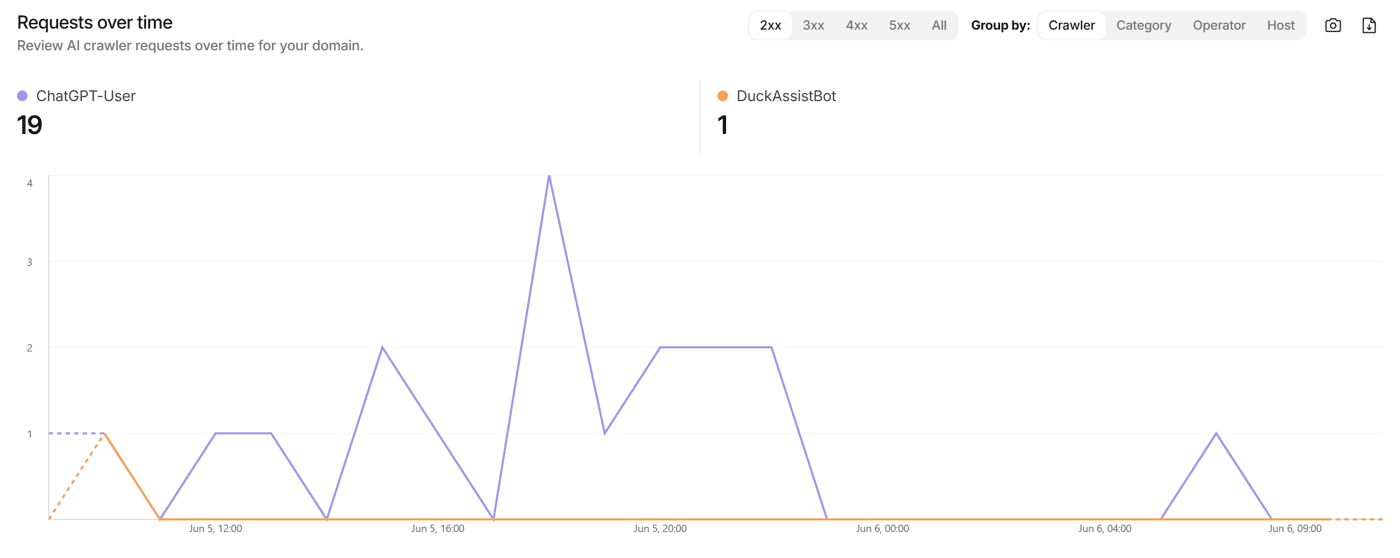
Screenshot: CloudFlare - AI Assistants visiting Achiv daily to cite only ~30 articles crafted with Achiv (not the highest number I had so far).
The takeaway
GEO is not a new game. It is the old game with a higher floor on substance. Schema and backlinks still matter. What changed is that the content sitting on top of that technical foundation has to be worth quoting - by a model, and by a person.
Two things to get right:
Ground every piece in your audience's actual words. Not your internal vocabulary. Theirs.
Ground every piece in your own offline experience. Numbers, failures, decisions, tradeoffs. The things only you can write.
Do both and the content gets cited and read. Skip either and you are publishing slop into a market that already has too much of it.
-
2
That's the real thing most GEO "experts" are really missing - you can generate 100s posts that AI will likely cite, but what's next? User landed with that post will bounce instantly because of your effortless, boring content.


Most AI content does not fail because it picks the wrong words. It fails because nothing real is behind the words. The grammar is clean, the structure is fine, the H2s are predictable - and a reader can feel within two sentences that no one actually lived through the problem being described. Google has gotten good at feeling this too. If you are trying to rank in 2026, the gap between "AI filler" and "content that ranks and gets cited" is not better prompts. It is whether the piece is grounded in a specific pain a specific person actually has.
This is the short version of a six-month experiment I ran to test that. One project got nuked by Google. The next one - same writer, same models, different input - started pulling hundreds of AI citations per week and hundreds of organic users per month, on a near-zero SEO budget. The difference was pain-driven content.
The experiment that got banned: pure AI, no pain
The first project was an AI-generated horoscopes site. Daily, weekly, monthly, annual. Multilingual. Top-tier models. A solid backlink profile. Even some randomization injected so the "predictions" read with a little texture instead of pure template.
On paper, everything was correct. In February, Google fully banned the project for low-quality content.
The reason is simple. There was no real-world experience behind a single sentence. No human had a bad Tuesday and figured out why. The model was hallucinating mood reports for twelve zodiac signs in eight languages. Google's job is to separate low-effort generation from valuable nuggets, and it did exactly that.
That ban was useful. It killed a hypothesis cleanly.
The next hypothesis: AI grounded in real pain
The second experiment was the opposite setup. Instead of asking the model to invent content from nothing, I fed it three things:
A specific, named pain a specific audience actually has.
Real-world context - what people say about that pain in their own words, and what they have already tried.
A data-driven angle so the piece tells a story instead of summarizing a topic.
Same models. Same pipeline. Different inputs.
The result was steady: hundreds of AI citations per week, hundreds of organic users per month, with minimum time and budget spent on SEO. No link-building sprints. No content calendar marathons. The content was found, cited, and read because it answered something a real person was actually asking.
That is the whole thesis. AI content fails when it has no pain to ground it. AI content wins when it does.
Why pain-driven beats AI-generated
Look at it from the buyer's side. A reader landing from search runs a fast filter:
Does this person understand my exact situation?
Are the examples specific or generic?
Is there a tradeoff, a failure mode, a real number - or just smooth surface?
Would I send this link to a colleague, or close the tab?
Generic AI content fails every one of those filters. Not because the language is wrong, but because the experience is missing. There is no "we tried X for three months and it broke at step 4". No "the buyer's first objection is usually Y". Google's ranking and the LLMs doing AI citations are now optimizing for the same thing: evidence that the content clearly comes from someone who has done the thing.
Where Achiv fits in
This experiment is the reason Achiv exists in its current shape.
The painful part of pain-driven content is not writing it. It is finding the specific pain worth writing about, in the audience's real words, with enough texture to actually ground the piece. Most founders skip this because it takes weeks of manual reading.
Achiv runs that research step. You throw in your product URL, and it pulls real conversations from Reddit where your audience is venting about the problems your product solves. It clusters those into named pains and objections, with the strength of each signal, so you can see which pain is worth writing 2,000 words about and which one is noise. Then you hand it your raw thoughts - a failed experiment, a counterintuitive result, a workflow you built - and it frames them into an SEO article grounded in the pain instead of floating above it. One click, and the same thinking is reshaped into a Reddit post that fits the subreddit it is going into.
That is the loop: real pain in, grounded content out, for SEO and for Reddit. Not automation for the sake of volume. Automation of the research step nobody wants to do manually, so the writing step actually has something to stand on.

This post is generated with Achiv, based on my raw thoughts.
Stats:


Feel free to join our discussions in Discord: https://discord.gg/nmX5jWhqPp
-
1
The contrast between AI SEO and pain-driven content is something more people need to hear. AI-generated content can cover topics at scale, but it doesn't know what actually keeps someone up at night — only real research into the pain does.
"People don't search for solutions, they search for their pain" is a reframe I'm going to be thinking about for a while. I'm in the middle of validating a product right now and this changes how I'm thinking about the landing page copy. Instead of leading with what the tool does, lead with the specific frustration someone is typing into Google at 11pm.
What was the process for finding the pain-driven keywords? Did you do manual research, interviews, or something else?
-
0
You should check StartupSubmit for visibility, backlinks, and early traffic.
-
1
No I shouldn't. Find a better place to spam your bs.
-


Hi IH,
I'm building https://achiv.com — you give it your URL, it figures out who your customers are, where they hang out on Reddit, and what they actually complain about to help you write a catchy content for Reddit. Real Reddit data, clustered, summarized into human-readable fears and needs per subreddit.
A few weeks ago I ran it on Achiv itself. The output was bad.
Instead of surfacing the obvious target — founders, marketers, growth people who want Reddit as a channel — it pointed me at general Reddit-user communities. Subs where people complain about karma, AutoMod, and downvotes as their daily problems.
Took me a while to see why. My landing page is written in Reddit-native vocabulary: karma, downvotes, AutoMod, subreddits. To my own tool, that language read as "audience = general Reddit users," not "audience = B2B marketers using Reddit as a channel." The tool was working correctly. My landing was lying about who I sell to.
Circular problem: the people who most need an ICP research tool are exactly the ones whose landing copy is ambiguous. If your copy were already clean, you wouldn't need the tool. If your copy is muddy, the tool can't see through it.
So I built a workaround — the Target Audience Cloner. You paste a competitor's URL, Achiv analyses their positioning instead of yours, then runs the full Reddit-wide research on their ICP. Skips your own messy copy entirely.
I tested it on Plausible Analytics — clean B2B positioning, zero ambiguity. The audience map came back with subs my own page never surfaced: r/SaaS, r/webdev, r/selfhosted, r/SEO. Same buyers as mine, just routed through someone with clearer copy.
The lesson I didn't expect: my own product is now a diagnostic for how broken my landing is. When the ICP tool gets it wrong, that's a marketing signal, not a bug.
Curious if anyone else has run into this — your own analytics or AI tool surfacing something uncomfortable about your own product. Also genuinely unsure on one thing: does "clone a competitor's audience" land as ethically fine, or does it make you twitch?
Launching on Product Hunt this Tuesday (after I cleanup my landing). Free tier stays open until then; after that it goes behind a paywall. Go try it achiv.com
-
2
How can I find customers that I am working on a app dream analysis and now I am going to make an mvp where can I test that
-
1
You can put an AppStore/PlayMarket page, make some poor landing etc. It needs to be connected with an actual website. You can even feed some article on medium, or here on IH describing your idea.
-
-
2
This tool solves a frequent and current problem, and it can greatly help us reach the customers we want. Congratulations! Can it be used with any URL from any website/app?
-
1
Yes, if this website is publicly reachable.
-
-
1
The sharpest thing in here is not the cloner, it is the realization that your own tool became a diagnostic for your broken landing copy. When your ICP tool gets your own ICP wrong, the tool is working and your positioning is the bug. I would build that into the product instead of treating it as an embarrassing side story. "Run it on yourself first and see if we read you the way your buyers do" is a stronger hook than the cloner.
On the ethics question, since you asked directly: the mechanic does not make me twitch, the word does. You are not stealing anything. Audiences are not owned, and reverse-engineering where buyers gather from public positioning is just market research with cleaner inputs. But "stole" and "clone" will scare off the careful B2B buyers you actually want and attract the spray-and-pray crowd you do not. I would reframe around borrowing a competitor's clarity, not their audience. Same feature, very different customer.
-
1
This lines up exactly with what I'm seeing in a niche right now. "Tech workers worried about RSU concentration" has 100 AI-generated articles that all read identically — diversify, talk to a CPA, 25% cap — and you can feel within a paragraph that nobody writing them has ever stared at a vesting screen at 70% concentration. The specific texture of the pain (which Reddit and Blind articulate beautifully) gets erased into a smooth surface.
One question on your 6 months of data: did the gap between Google ranking and LLM citation diverge for you? My hunch is LLMs are more forgiving of generic content because they synthesize across many sources, while Google increasingly punishes it — so the optimization targets might subtly diverge. Curious if your data backs that up or contradicts it.
-
1
That's really a helpful information. Thanks 👍
-
1
The sharpest thing here is the accidental insight: your tool reading your copy as "general Reddit users" is not a bug, it is your actual buyers reading you the exact same way. The cloner is a clever workaround, but it treats the symptom. The tool got confused because every visitor gets confused. Fix the landing and the tool stops needing the workaround.
You asked about the ethics, so a straight answer: cloning a competitor's audience does not make me twitch, because an ICP is not owned. You are analyzing public Reddit data about a public company's public positioning. That is just competitive research, and everyone serious already does it by hand. What makes me twitch is the framing. "I stole my competitor's entire audience in one click" is a great launch hook and a bad brand, especially for you. Your whole pitch is that you are the anti-slop, value-first alternative to Reddit spam tools. "Steal" is zero-sum and undercuts that in one word. For Product Hunt I would lead the feature as competitive ICP research, not theft. The hook earns clicks today and chips at the exact trust you are building. What does retention look like on the free tier so far, are people coming back to run a second product or is it one and done?
-
1
I understand, but the tool purpose is not to analyze your landing and help fix it. It's up to you. So this workaround is made to give people what they need.
-
-
1
I tried this one my own website and it's genuinely good. Good luck on your launch on PH!
-
1
Thanks! Have you tried to generate some posts?
-
-
0
am money mule agent
I help hackers, politicians , billionaires to transfer millions of dollars illegally (money). You can hack directly in to my crypto wallet or bank account and I will transfer to any account you will provide to receive the funds with 24hrs. i have work with top politicians, billionaires, individuals, businesses, companies, etc in the world to transfer money successfully. All transactions when successful and smoothly.
I have a company which is legally registered and have it bank accounts at USA , UK 🇬🇧. And have verified crypto wallet binance wallet than can receive the following
Fiat Deposit & Withdrawal Limits
2M USD Daily
Crypto Deposit Limit
Unlimited
Crypto Withdrawal Limit
8M USDT Daily
P2P Transaction Limits
Unlimited
WhatsApp me : +1 (667) 283-7737


A year ago I had a SaaS I genuinely believed in. So I did the obvious thing: wrote a heartfelt post about it in r/SaaS and hit submit.
It didn't just flop — I got roasted. "Another founder shilling another tool." A couple of helpful replies, buried under people who'd seen 50 posts exactly like mine that week. I'd walked into a room full of other founders — marketing-savvy, banner-blind, allergic to anything that smells like a pitch — and pitched. The one group on Reddit basically guaranteed NOT to be my buyer.
The product didn't fail because it was bad. It failed because I used Reddit completely wrong. Here's what I'd tell past me — see if any of it sounds familiar.
1. You're posting in the wrong room.
r/SaaS is where builders hang out, not where your buyers vent. Your actual ICP is in smaller niche subs, describing the exact problem you solve, ready to hear about a solution — not an ad. The pain points are sitting right there in the top threads. I never read them before posting; I just guessed at what people cared about, and guessed wrong.
2. You ignore the rules until they kill you.
Reddit doesn't judge your post in isolation. Every sub has its own rules — some ban links outright, some have karma/account-age gates baked into AutoMod that delete you before a human ever sees the post. I'd spend an hour writing something an algorithm removed in one second, and never know why.
3. You write one post for "Reddit."
There's no such thing. r/webdev, r/Entrepreneur and a 9k-member niche sub want completely different tones, lengths and link policies. The same post that gets upvoted in one gets you roasted in another. I was copy-pasting, and people could smell it instantly.
The reframe that fixed it: stop asking "how do I promote here?" and start asking "where are my buyers actually venting, and what does THAT specific community reward?"
Full disclosure: I got so burned by this I built Achiv around these exact three lessons. You paste your product URL and it (1) finds the niche subreddits where your buyers actually are + the real objections they're posting about, (2) shows you each sub's rules and whether you're even eligible to post there, and (3) helps you write for that specific community instead of for "Reddit." Happy to drop the link in the comments — didn't want this to read as an ad.
So, genuinely curious:
- What's the worst way a Reddit post has blown up in your face?
- And for the ones it worked for — what did you do differently?
Try Achiv for free - https://achiv.com and discover what subreddits are really relevant for your product.
Join Achiv Discord: https://discord.gg/nmX5jWhqPp
-
2
Going to try Achiv right now. Good information on Reddit posting.
-
1
Welcome!
-
-
1
I made a to-do list app for people who would forget to do steps of big tasks like planning a child’s birthday party and forgetting the party favors, or planning a vacation and forgetting to set up your dogs boarding while you’re away. I went to the ADHD subreddit since that was my main audience. I instantly saw people selling similar products constantly. Most of the advice I gave was helpful but if I even mentioned it, I would get roasted. Then I was banned permanently for using AI generated content, even though my comments were my own. I was identified and judged and lost my main target audience.
Overall, I realized that the space is too crowded and I needed to make something more valuable and unique. I killed the tool and excited to be working on something more unique and valuable. I’m also much more aware of what I need to do marketing my next product through Reddit.
-
1
Welcome to Achiv!
-
-
1
Thank you so much. I was going to post on reddit to get my users and you genuinely helped me avoid the mistakes i would have made, if i were on my own.
-
1
The trap most SaaS founders fall into on Reddit is treating it like a distribution channel instead of a knowledge channel. The moment a thread starts smelling like an ad, the comments turn on you and the mods step in. What's actually worked for the teams I've watched scale: pick three subs where your customer already lives, spend a month answering questions with no link to your product, then earn the right to drop the product when someone literally asks "what do you use for this?" It's slow. It compounds. And it's mostly written by you, not by a tool.
-
1
Didn't just post wrong — got permanently banned.
I launched an open-source POS system and did exactly what you described: posted in r/selfhosted and r/opensource thinking "these are my people." Turns out there's a big difference between "these people use self-hosted software" and "these people are looking for a new self-hosted tool right now."
The ban came fast. No warning, no explanation. Account just stopped being able to post. I still don't know exactly which rule triggered it — probably looked like spam because I posted across a few subs in the same week.
The part that stings most: I spent more time crafting those Reddit posts than I did on actual ICP research. I assumed I knew where my buyers were without ever sitting in those communities first and just reading.
Your point about niche subs is exactly right. The real signal is in threads where someone says "I'm still using Excel for client bookings and it's killing me" — not in r/SaaS where everyone is a founder selling something.
Starting over on IH and dev.to now. Slower, but at least I'm not shadowbanned here.


Achiv's superpower is deep market analysis that isn't possible with any classic AI chat, and here's why.
Once your project is created (it's free to try, you can check yourself), Achiv starts deep market research based on Reddit users' posts and synthesizes your project's ideal customer portrait. The goal: find where you can reach your target audience.
But how do you identify such a place? It's no secret that Reddit is widely used to ask questions, vent about problems, and discuss solutions. So I built a pipeline that looks for posts where people discuss the problems your product solves. Questions, stories, discussions — everything that matches your offer.
After the system identifies these posts and retrieves a customer portrait for each author, an LLM + vector search performs a qualification step to filter out mismatches and noise, and to extract the exact citations of problems users mentioned on Reddit.
Every subreddit is logged. More users = stronger signal.
If you ask an AI to find the best-matching subreddits for your product, it will give you very basic results based on subreddit descriptions.
Achiv surfaces data-proven communities — ones you can promote in with content or even Reddit paid ads.
The pipeline is 4 steps and reflects all of my 13 years working with data. That's moat #1.
Tomorrow I'll explain how Achiv handles the problem citations it extracts. That's moat #2.
-
1
Sometimes people are wondering why it's not surface some subreddits they think are relevant.
The answer is - they are not relevant.
Comment