

If you’re new to cryptocurrency and want to invest in Solana (SOL), you’re not alone. Solana’s blazing-fast transactions and growing ecosystem have made it a top choice for investors. But figuring out how to buy SOL in the USA can feel overwhelming—especially with so many exchanges, wallets, and payment methods to navigate.
This guide simplifies the process. You’ll learn how to buy Solana safely, store it securely, and avoid common pitfalls. Whether you’re using a credit card, PayPal, or bank transfer, we’ll break down the best platforms for beginners in 2025. Let’s get started.
Step 1: Choose a Secure Solana Wallet
Before buying SOL, you need a wallet to store it. Never leave crypto on exchanges long-term—hacks and platform failures can put your funds at risk. Here’s how to pick the right wallet:
Types of Solana Wallets
Hardware Wallets (Most Secure): Devices like Ledger Nano X store SOL offline. Ideal for long-term holdings.
Software Wallets (Convenient): Apps like Phantom or Solflare let you access SOL quickly. Great for smaller amounts.
Exchange Wallets (Least Secure): Only use these for active trading.
Case Study: Sarah, a first-time investor, used a Ledger Nano X to secure her SOL. After transferring her coins from Coinbase, she avoided risks like exchange breaches.
(Suggested Image Placement: A comparison graphic of hardware vs. software wallets)
Suggested Alt Text: Solana wallet comparison: hardware vs. software for beginners
Step 2: Pick a Regulated US Exchange
Not all exchanges serve US customers due to strict regulations. Here are the top 3 platforms for buying SOL in 2025:
Coinbase
Best for Beginners: User-friendly interface, insured custodial wallets.
Fees: 1.49% per transaction (credit/debit card).
Kraken
Best for Low Fees: 0.26% trading fee, supports bank transfers.
Best for Asset Diversity: Trade SOL against 150+ cryptos.
Pro Tip: Avoid unregulated platforms. Stick to exchanges compliant with FinCEN and state laws.
Step 3: Buy Solana (SOL) Using Your Preferred Payment Method
Option 1: Credit/Debit Card (Instant Purchase)
Sign up on Coinbase or Binance.US.
Complete KYC verification (ID + proof of address).
Navigate to “Buy Crypto” > Select SOL > Enter amount.
Confirm payment. SOL arrives in minutes.
Fees Alert: Credit card purchases cost 2-4% extra. Bank transfers are cheaper.
Option 2: PayPal
While you can’t buy SOL directly via PayPal, platforms like Paybis let you fund purchases with PayPal balance.
Option 3: Bank Transfer
Kraken and Gemini support ACH transfers (0.5-1.5% fees), ideal for large purchases.
Step 4: Transfer SOL to Your Wallet
Why This Matters: Exchanges control your private keys. If they’re hacked, your SOL could vanish.
Copy your wallet’s SOL address (starts with a “3” or “S”).
On the exchange, select “Withdraw” > Paste address.
Confirm the transaction. Wait 1-5 minutes for blockchain confirmation.
Industry Insight: In 2024, $230M was stolen from exchange wallets. Self-custody reduces this risk.
Is Solana a Good Investment in 2025?
Solana’s unique Proof of History consensus enables 50,000+ transactions per second—far faster than Ethereum. Analysts predict SOL could reach $300 by late 2025 due to:
Growing NFT and DeFi ecosystems.
Institutional adoption (e.g., Visa testing Solana for settlements).
But Be Cautious: Competition from Ethereum’s upgrades and market volatility could impact prices.
FAQs: Answering Your Top Questions
Can I Buy Solana on Coinbase?
Yes! Coinbase lists SOL and supports instant purchases in all 50 states.
What’s the Minimum SOL Purchase?
Most exchanges let you buy 10−10−20 worth.
How to Avoid Scams?
Never share private keys.
Double-check wallet addresses.
Conclusion
Buying Solana in the USA is straightforward if you follow these steps: choose a wallet, pick a regulated exchange, and secure your coins. With its speed and scalability, SOL remains a promising investment—but always prioritize security.
Ready to start your crypto journey? Learn how to buy Solana and other cryptocurrencies safely here.

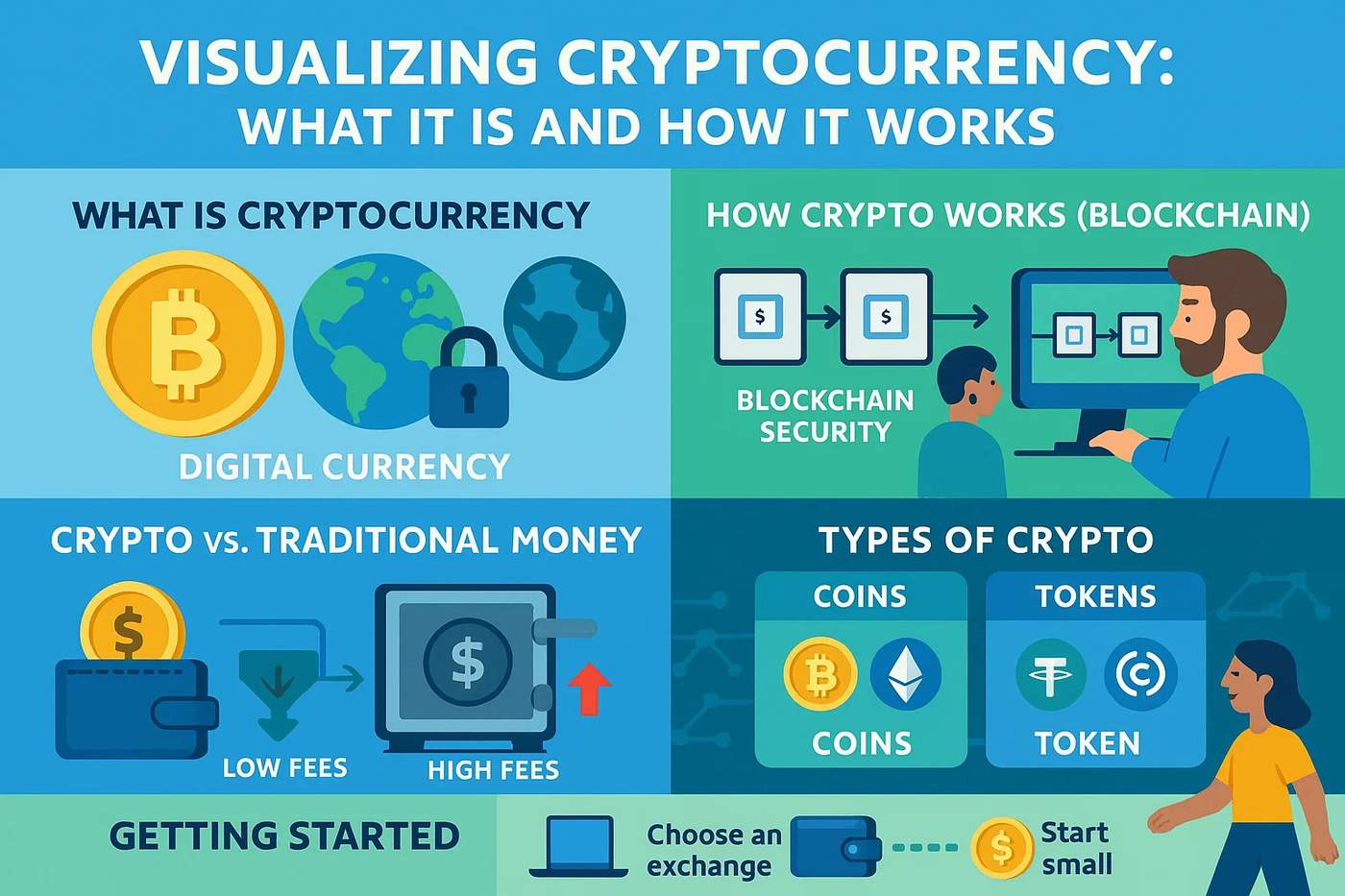
Ever heard terms like Bitcoin, Ethereum, or blockchain and felt a bit lost? You're not alone. Cryptocurrency can seem like a complex new world, but at its core, it's a fascinating innovation changing how we think about money and transactions. If you're curious about what cryptocurrency is and how it actually works, you've come to the right place.
This guide is designed for beginners. We'll break down cryptocurrency in simple terms, explore its underlying technology, discuss its pros and cons, and even touch on how you might get started if you're interested. By the end, you'll have a much clearer understanding of this digital phenomenon.
What Exactly is Cryptocurrency? The Simple Definition
At its most basic, cryptocurrency is a type of digital or virtual currency that uses cryptography for security. Unlike traditional currencies issued by governments (like the US Dollar or the Euro), cryptocurrencies are typically decentralized. This means they aren't controlled by any single entity, like a central bank or government.
Think of it as digital cash that you can use to buy goods and services, or hold as an investment, but it exists only in electronic form. The "crypto" part refers to the complex cryptographic techniques used to secure transactions, control the creation of new units, and verify the transfer of assets.
Key takeaways:
Digital: It exists only in computers and on the internet.
Decentralized: No single bank or government controls it (usually).
Encrypted: Uses cryptography for security.
Peer-to-Peer: Transactions often happen directly between users.
How Does Cryptocurrency Work? Unpacking the Core Technology
Understanding how cryptocurrency works means getting to grips with a few key concepts. Don't worry, we'll keep it simple.
Blockchain Technology: The Shared Digital Ledger
Most cryptocurrencies operate on a technology called blockchain. Imagine a continuously growing list of records, called "blocks," that are linked together using cryptography. Each block contains a batch of transactions.
Shared and Distributed: Instead of one person or organization keeping this ledger, it's typically shared across many computers in a network. This makes it very difficult to tamper with.
Transparent: While user identities can be anonymous or pseudonymous, the transactions themselves are often public and can be viewed by anyone on the network.
Immutable: Once a transaction is added to the blockchain, it's extremely difficult to alter or delete. This creates a permanent and verifiable record.
So, when a cryptocurrency transaction occurs, it's broadcast to this network. Computers on the network (often called "miners" or "validators") work to verify the transaction and add it to a new block on the blockchain.
Cryptography: The Security Backbone
Cryptography is essential to cryptocurrency. It's used in several ways:
Securing Transactions: Digital signatures, based on cryptographic keys (a public key and a private key), ensure that only the owner of the cryptocurrency can send it. Your private key is like your secret password – you must keep it safe!
Controlling Supply: Cryptographic algorithms also control the creation of new cryptocurrency units, ensuring that they are generated at a predictable rate and that the total supply is often limited (as in the case of Bitcoin).
Maintaining Anonymity/Pseudonymity: While transactions are on a public ledger, users are typically identified by their cryptographic "addresses" rather than their real names.
Decentralization: Who's in Control?
One of the most defining features of many cryptocurrencies like Bitcoin is decentralization. This means:
No Central Authority: There's no central bank to print more money or change the rules.
Distributed Network: The blockchain is maintained by a network of participants. Decisions about the network are often made by consensus among these participants.
Censorship Resistance: Because no single entity controls the network, it's difficult for anyone to block or censor transactions.
This decentralization is a core appeal for many, offering an alternative to traditional financial systems.
Transactions: How Crypto Moves
When you want to send cryptocurrency to someone:
You initiate the transaction using your private key to authorize it from your digital wallet.
The transaction is broadcast to the cryptocurrency's network.
Network participants (miners/validators) verify the transaction (e.g., checking if you have enough funds).
Once verified, the transaction is bundled with others into a new block.
This new block is added to the existing blockchain.
The recipient then sees the cryptocurrency in their digital wallet.
This process can take anywhere from a few seconds to several minutes or more, depending on the specific cryptocurrency and network congestion.
Cryptocurrency vs. Traditional Money: What's the Difference?
While both are used for exchange, there are fundamental differences:
FeatureCryptocurrencyTraditional Money (Fiat)FormDigital/VirtualPhysical (cash) and Digital (bank accounts)ControlTypically Decentralized (no central bank)Centralized (Government & Central Banks)IssuanceOften algorithmically controlled, sometimes minedIssued by central banksSecurityCryptography, BlockchainBank security, government backing (e.g., FDIC)TransparencyTransactions often public on blockchainTransactions generally private between partiesAccessibilityAnyone with internet accessMay require bank accounts, IDRegulationEvolving, varies by countryHeavily regulatedVolatilityCan be highly volatileGenerally more stable
What is Cryptocurrency Mining (or Staking)? Creating New Coins
You might have heard of "cryptocurrency mining." This is the process by which new cryptocurrency coins are created and new transactions are verified and added to a blockchain. It's most famously associated with Bitcoin.
Proof-of-Work (PoW): This is the original mining mechanism. Miners use powerful computers to solve complex mathematical problems. The first one to solve the problem gets to add the next block to the blockchain and is rewarded with newly created cryptocurrency and transaction fees. This process is energy-intensive.
Proof-of-Stake (PoS): An alternative mechanism where users "stake" (lock up) their existing coins to validate transactions and create new blocks. Validators are chosen based on the number of coins they hold and are willing to stake. PoS is generally more energy-efficient than PoW.
Other consensus mechanisms exist, but PoW and PoS are the most common ways new coins are introduced and networks are secured.
Understanding Cryptocurrency Prices
The price of a cryptocurrency, like Bitcoin or Ethereum, can be highly volatile, meaning it can change dramatically in short periods. Several factors influence price:
Supply and Demand: Like any asset, if more people want to buy a cryptocurrency than sell it, the price tends to go up, and vice versa. Many cryptocurrencies have a limited supply, which can also drive up demand.
Market Sentiment: News, social media trends, and general investor confidence (or fear) can heavily impact prices.
Adoption: As more businesses and individuals start using a cryptocurrency, its utility and demand can increase.
Regulation: Government announcements or new regulations can cause significant price swings.
Market Capitalization (Market Cap): This is the total value of all the coins in circulation (Price per coin x Circulating Supply). It's often used to gauge the relative size of a cryptocurrency.
It's crucial to understand that investing in cryptocurrencies carries significant risk due to this volatility.
Common Types of Cryptocurrency
While Bitcoin is the most well-known, there are thousands of different cryptocurrencies, often referred to as "altcoins" (alternative coins). Here are a few major categories and examples:
Bitcoin (BTC): The Pioneer
Launched in 2009 by the pseudonymous Satoshi Nakamoto, Bitcoin was the first decentralized cryptocurrency. It remains the largest by market capitalization and is often seen as "digital gold" – a store of value.
Ethereum (ETH): Smart Contracts and Beyond
Ethereum is more than just a digital currency. It's a decentralized platform that runs smart contracts: self-executing contracts with the terms of the agreement directly written into code. This enables decentralized applications (dApps) for things like finance (DeFi), gaming, and NFTs. Ether (ETH) is the native currency used to power the network.
Altcoins: The Diverse Crypto Landscape
Any cryptocurrency other than Bitcoin is generally considered an altcoin. Examples include:
Cardano (ADA): A proof-of-stake blockchain platform focused on sustainability and scalability.
Solana (SOL): Known for its high transaction speeds and scalability.
XRP (XRP): Developed by Ripple, focused on facilitating fast and low-cost international payments.
Dogecoin (DOGE), Shiba Inu (SHIB): Originally started as "memecoins" but have gained significant communities and market caps.
Each altcoin typically has its own specific goals, technology, and community.
Stablecoins: Bridging to Traditional Currency
Stablecoins are a type of cryptocurrency designed to maintain a stable value by being pegged to another asset, typically a fiat currency like the US dollar (e.g., USDT, USDC, DAI). Their goal is to offer the benefits of cryptocurrency (fast transactions, low fees) without the extreme price volatility.
Advantages of Cryptocurrency: Why the Buzz?
Cryptocurrencies offer several potential benefits that have attracted users and investors:
Transparency: Many blockchain transactions are publicly recorded, offering a high degree of transparency.
User Control & Empowerment: Cryptocurrencies can give individuals more control over their own finances without relying on traditional banks.
Accessibility: Anyone with an internet connection can potentially access and use cryptocurrencies, which is particularly relevant in regions with underdeveloped banking systems.
Lower Transaction Fees (Potentially): Especially for international transactions, crypto can sometimes offer lower fees compared to traditional banking.
Transaction Speed: While varying between cryptocurrencies, some can offer faster transaction settlement times than traditional bank transfers, especially across borders.
Decentralization: Reduces reliance on single points of failure or control, potentially making the system more resilient.
Risks and Challenges of Cryptocurrency
Despite the advantages, it's crucial to be aware of the risks:
Volatility: Prices can fluctuate wildly, leading to potentially significant losses for investors. This is a primary risk.
Security Risks (Individual Level): If you lose your private keys, you lose access to your cryptocurrency forever. Scams, phishing, and hacking of exchanges are also concerns.
Regulatory Uncertainty: The legal status and regulations surrounding cryptocurrencies are still evolving in many countries, creating uncertainty.
Complexity: Understanding the technology and navigating the ecosystem can be challenging for beginners.
Scalability Issues: Some cryptocurrencies face challenges in handling a large volume of transactions quickly and cheaply.
Illicit Use: While often overstated, the anonymity features of some cryptocurrencies have been exploited for illegal activities, attracting regulatory scrutiny.
Environmental Concerns: The energy consumption of some Proof-of-Work cryptocurrencies like Bitcoin has raised environmental concerns.
Is Cryptocurrency a Good Idea for You?
This is a personal question with no one-size-fits-all answer. This article is not financial advice.
Before considering using or investing in cryptocurrency:
Understand Your Goals: Why are you interested in crypto? Is it for learning, transacting, or investing?
Assess Your Risk Tolerance: Cryptocurrency investments are speculative and high-risk. Never invest more than you can afford to lose.
Do Thorough Research (DYOR): Don't rely on hype or social media. Understand the specific cryptocurrency, its technology, use case, and risks.
For many, cryptocurrency is an exciting technology with transformative potential. For others, it's a risky asset class. Education is key.
Getting Started with Cryptocurrency: Basic Steps
If you've weighed the risks and are keen to explore, here’s a simplified guide to getting started:
Do Your Research (Seriously!): Before buying anything, deepen your understanding. Read whitepapers, follow reputable news sources, and learn about different projects.
Choose a Cryptocurrency Exchange: Exchanges are platforms where you can buy, sell, and trade cryptocurrencies. Popular options include Coinbase, Binance, Kraken, and Gemini. Look for exchanges with:
Good security practices
A range of supported cryptocurrencies
User-friendly interface
Reasonable fees
Good customer support
Create an Account: This usually involves providing personal information and verifying your identity (Know Your Customer - KYC process), similar to opening a bank account.
Fund Your Account: You can typically fund your exchange account using a bank transfer, debit card, or sometimes PayPal.
Buy Cryptocurrency: Once your account is funded, you can place an order to buy the cryptocurrency of your choice. Start with a small amount you're comfortable with.
Storing Your Cryptocurrency: Wallets Explained: While you can leave your crypto on an exchange, it's generally considered more secure to store it in a personal crypto wallet. A wallet gives you control over your private keys.
Hot Wallets (Software Wallets): These are connected to the internet (e.g., desktop, mobile, or web-based wallets). They are convenient for frequent transactions but are more vulnerable to online threats. Examples: Exodus, Trust Wallet, MetaMask.
Cold Wallets (Hardware Wallets): These are physical devices that store your private keys offline (e.g., USB drives). They are considered the most secure option for long-term storage as they are isolated from online attacks. Examples: Ledger, Trezor.
Conclusion
Cryptocurrency is a complex but undeniably revolutionary technology. It represents a new way of thinking about digital ownership, transactions, and decentralized systems. From its foundation in blockchain and cryptography to the diverse ecosystem of coins and applications, there's a lot to learn.
While the potential benefits like increased transparency, user control, and accessibility are compelling, the risks associated with volatility, security, and regulatory uncertainty cannot be ignored. Understanding what cryptocurrency is and how it works in simple terms is the essential first step for anyone looking to navigate this evolving landscape, whether for curiosity, use, or investment.
Ready to dive deeper and continue your learning journey into the world of digital assets? Explore more guides and insights at CryptoCrafted.org to build your knowledge base.
https://telegra.ph/Ultimate-Guide-The-Best-Resources-for-HSK-Exam-Preparation-04-21
https://velog.io/@louisa/Ultimate-Guide-The-Best-Resources-for-HSK-Exam-Preparation
https://write.as/naya025/ultimate-guide-the-best-resources-for-hsk-exam-preparation
https://sites.google.com/view/ultimate-guide-the-best-resour/home
https://vocal.media/education/ultimate-guide-the-best-resources-for-hsk-exam-preparation
https://medium.com/@nayaliber/envisioning-my-future-with-ai-generated-images-8a9a2cd377ed
https://sites.google.com/view/is-art-from-an-image-generator/
https://write.as/naya025/the-ai-image-generator-output-that-stuck-with-me-and-why-it-matters
https://www.behance.net/gallery/224055547/The-AI-Image-Generator-Output-That-Stuck-With-Me
https://vocal.media/art/my-dream-project-collaborating-with-an-ai-image-generator-to-build-worlds
https://my.mamul.am/en/post/1118732
https://sites.google.com/view/my-biggest-hsk-exam-surprise/home
https://telegra.ph/Using-NSFW-AI-Image-Generators-A-Guide-to-Safety-and-Legality-04-18
https://sites.google.com/view/unsolicited-ai-face-swap/home
https://www.reddit.com/r/AIContent_Creator/ https://www.reddit.com/r/AIcontentcreatorss/?rdt=54390 https://www.reddit.com/r/hanyuace/?rdt=54390 https://www.bitsdujour.com/profiles/NztZm5 https://www.bitsdujour.com/profiles/wrw2ed https://www.bitsdujour.com/profiles/eh5lBC https://www.bitsdujour.com/profiles/JQ02Ud https://www.bitsdujour.com/profiles/P4pLT6 https://www.bitsdujour.com/profiles/SLTbS8 https://louisas-newsletter-bf86b3.beehiiv.com/p/unlock-mandarin-mastery-how-ai-is-revolutionizing-chinese-language-learning-in-2025 https://louisas-newsletter-bf86b3.beehiiv.com/p/ai-driven-seo-boost-your-website-ranking-with-ai-authority-seo https://louisas-newsletter-bf86b3.beehiiv.com/p/the-ai-seo-revolution-dominate-google-ai-search-in-2025 https://app.roll20.net/users/15852129/naya-l https://starity.hu/profil/553490-naya023/ https://starity.hu/profil/553533-finnr/ https://starity.hu/profil/553534-vera0236/ https://starity.hu/profil/553535-leo345/ https://www.intensedebate.com/people/naya124 https://rentry.co/s27emfzs https://rentry.co/qgrvu59k https://rentry.co/98a8hmac https://aiface.hashnode.dev/ai-seo-mastering-artificial-intelligence-for-search-engine-optimization https://rentry.co/satduoy8 https://velog.io/@louisa/posts https://velog.io/@leo09/posts https://wind-angle-459.notion.site/Mastering-AI-Art-Generators-10-Steps-to-Create-Stunning-Visuals-Easily-1c0cfc5f881d80b494e6c478d958b5cf https://www.producthunt.com/@louisa_maike https://www.producthunt.com/products/ai-authority-seo https://experiment.com/users/AideatunerAi https://louisas-newsletter-bf86b3.beehiiv.com/p/unlocking-chinese-wisdom-delving-into-the-origins-and-meanings-of-chengyu-chinese-idioms https://telegra.ph/Unlocking-Fluency-How-Chinese-Calligraphy-Enhances-Language-Learning-03-24 https://telegra.ph/AI-Virtual-Models-Redefining-Beauty-Standards-in-the-Digital-Age-03-24 https://linktr.ee/aiimagecreator https://rentry.co/ou9cb26e https://linktr.ee/aidrivenseo https://www.instapaper.com/read/1762962347 https://wind-angle-459.notion.site/Unlock-Personalized-Marketing-Magic-How-AI-Visuals-Boost-Campaign-Success-1c1cfc5f881d80fdab85db532ae3abf6 https://appsumo.com/profile/naya_liber/ https://appsumo.com/profile/117626733119265873479/ https://appsumo.com/profile/finnr_kasi/ https://appsumo.com/profile/118261514640300180408/ https://scrapbox.io/AIImage/AI_Overviews:_8_Transformations_Reshaping_Search_Engine_Results_Pages_in_2025 https://linktr.ee/finnr_kasi https://habr.com/ru/users/luisa0236/ https://www.producthunt.com/@leonor_yuenger https://www.indiehackers.com/product/aiauthorityseo https://louisas-newsletter-bf86b3.beehiiv.com/p/ai-and-user-experience-revolutionizing-seo-through-personalization-in-2025 https://www.coursera.org/learner/aifaceswap https://louisas-newsletter-bf86b3.beehiiv.com/p/7-exciting-ai-image-generation-trends-shaping-the-future-in-2025-and-beyond https://vocal.media/art/7-exciting-ai-image-generation-trends-shaping-the-future-in-2025-and-beyond https://www.cchatty.com/15-must-watch-chinese-movies-to-supercharge-your-mandarin-learning-a-modern-cinephiles-guide-g-110691 https://rentry.co/s3p6r2pa https://www.slideshare.net/nayaliber https://www.slideshare.net/finnrkasi
https://medium.com/@nayaliber/top-10-best-face-swap-free-online-tools-for-hilarious-and-realistic-results-in-2025-729a0e7b1976 https://medium.com/@nayaliber/pixels-vs-planet-experts-weigh-the-environmental-footprint-of-ai-image-generation-0a89c9450fca https://ch-441640501.hubspotpagebuilder.au/blog/pixels-vs.-planet-experts-weigh-the-environmental-footprint-of-ai-image-generation https://civitai.com/articles/13054/beyond-the-meme-finding-the-best-ai-face-swap-free-online-tools-for-stunningly-realistic-results https://www.notion.so/Unrestricted-AI-Image-Generators-aifaceswap-art-eroai-art-and-the-Ethical-Tightrope-1bdcfc5f881d809a8bdbdd3debd38dd4 https://wind-angle-459.notion.site/Top-10-Tools-for-Face-Swap-Free-Online-in-2025-Your-Ultimate-Guide-1c4cfc5f881d803db9f0dc56415fff4c https://wind-angle-459.notion.site/Face-Swap-vs-Deepfake-Understanding-the-Key-Differences-in-2025-1c4cfc5f881d803791e9dd988c9c73ec
https://aifaceswap.booth.pm/ https://aiauthorityseo.booth.pm/ https://vocal.media/art/the-fun-filter-vs-the-fake-future-grappling-with-the-ethics-of-deepfake-and-face-swap-technology https://rentry.co/96zfht2d https://www.indiehackers.com/post/how-to-use-ai-seo-tools-for-killer-competitor-analysis-your-step-by-step-guide-GQTO4LbUmN2jYJkGvVLt
https://rentry.co/737gcqmn https://wind-angle-459.notion.site/The-Ultimate-Guide-10-Free-AI-SEO-Tools-You-Need-in-2025-1cacfc5f881d80db833ee53ae5a97ee0 https://medium.com/@nayaliber/the-ultimate-guide-10-free-ai-seo-tools-you-need-in-2025-5155d9049ccb https://telegra.ph/The-Ultimate-Guide-10-Free-AI-SEO-Tools-You-Need-in-2025-04-03 https://civitai.com/articles/13235 https://www.indiehackers.com/post/the-ultimate-guide-10-free-ai-seo-tools-you-need-in-2025-pRZEwbbG6nOtcgyAVHpX https://aiimage00.pointblog.net/the-ultimate-guide-10-free-ai-seo-tools-you-need-in-2025-78045456 https://rentry.co/ff7z422q https://vocal.media/art/the-ultimate-guide-10-free-ai-seo-tools-you-need-in-2025ss https://velog.io/@louisa/The-Ultimate-Guide-10-Free-AI-SEO-Tools-You-Need-in-2025 https://www.instapaper.com/read/1765125686 https://dituqeha.bloguetechno.com/the-7-best-ai-image-generators-poised-to-dominate-in-2025-69287375 https://sites.google.com/view/unsolicited-ai-face-swap/home
https://telegra.ph/Using-NSFW-AI-Image-Generators-A-Guide-to-Safety-and-Legality-04-18

Embarking on the journey to master Mandarin Chinese often culminates in a significant milestone: taking the Hanyu Shuiping Kaoshi (HSK). This standardized test is the global benchmark for assessing Chinese language proficiency for non-native speakers. Passing the HSK opens doors to academic opportunities in China, enhances career prospects, and provides a tangible measure of your language learning progress. However, achieving success requires dedicated effort and, crucially, the right resources. Effective HSK exam preparation is paramount.
Navigating the vast ocean of study materials can be overwhelming. Which textbooks are best? How do you effectively memorize thousands of vocabulary words? Where can you find reliable practice tests? This ultimate guide aims to answer these questions, compiling the resources I and many others have found most helpful for conquering the HSK, from HSK 1 all the way to the demanding HSK 6. Whether you're just starting to Learn Mandarin for beginners or aiming for advanced certification, this guide will point you towards the tools you need.
Understanding the Beast: What is the HSK?
Before diving into resources, let's quickly clarify what the HSK entails. It's designed to assess your ability to use Mandarin in academic and real-life scenarios.
Levels: The test is divided into six levels, ranging from HSK level 1 to 6, with Level 1 being the easiest and Level 6 the most advanced. Each level builds upon the previous one, requiring mastery of specific vocabulary and grammar points.
Format: The HSK test format typically includes listening and reading sections for all levels. From HSK Level 3 upwards, a writing section is added. The specific structure, number of questions, and time limits vary significantly between levels. Familiarizing yourself with the format of your target level is a crucial first step.
Building Your HSK Preparation Toolkit: Essential Resources
Effective HSK exam preparation involves tackling the language from multiple angles. No single resource is sufficient; a combination is key. Here are the categories of resources you should consider:
1. Foundational Textbooks & Official Guides
While perhaps seeming traditional, official HSK Standard Course textbooks are invaluable. They are specifically designed around the HSK syllabus for each level.
HSK Standard Course: Published by Beijing Language and Culture University Press (BLCUP), these are widely considered the gold standard. Each level typically has a textbook, workbook, and accompanying audio. They provide structured lessons covering vocabulary, grammar, reading, and listening pertinent to the exam. You can find useful materials related to these courses through providers like hanyuace.
Other Textbooks: While the Standard Course is highly recommended, exploring other series or supplemental books can offer different explanations or additional practice. Look for the best books for HSK exam preparation that suit your learning style.
2. Vocabulary Powerhouses: Lists and Apps
Vocabulary is the bedrock of HSK success. Each level has a specific word count requirement.
Official HSK Vocabulary Lists: Download the official HSK vocabulary list for your target level. This is your core study material. Systematically learning these words is non-negotiable. Aim to create a complete HSK vocabulary list by level that you can track.
Flashcard Apps (SRS): Spaced Repetition Software (SRS) is incredibly effective for memorization.
Anki: Highly customizable, allowing you to create your own decks or download pre-made HSK decks.
Pleco: More than just a dictionary, Pleco has excellent flashcard functionality, often integrating with HSK lists.
Skritter: Focuses specifically on learning to write Chinese characters for HSK, crucial for the writing sections.
3. Grammar Guides: Understanding the Structure
Simply knowing words isn't enough; you need to understand how they fit together.
Level-Specific Grammar Books: Look for books dedicated to Chinese grammar for HSK at your level. The "HSK Standard Course" books cover grammar well, but supplementary resources can provide clearer explanations or more examples.
Online Grammar Wikis/Resources: Websites like the Chinese Grammar Wiki (often referenced online) provide detailed explanations. Many platforms, including resources accessible via hanyuace, offer sections where HSK grammar patterns explained clearly.
4. Practice Tests & Mock Exams: Simulating Reality
Taking practice tests under timed conditions is essential for identifying weak spots and getting comfortable with the exam format.
Official Mock Exams: Hanban (the HSK governing body) sometimes releases official sample papers. These are the most accurate representation of the real test.
Textbook/Workbook Practice Tests: Most HSK textbooks and workbooks include practice tests or drills mimicking exam sections.
Online Mock Tests: Numerous websites offer HSK mock test online experiences. Look for a reliable free online HSK mock test with answers to gauge your level. Platforms like hanyuace often provide comprehensive HSK practice test options.
5. Listening Comprehension Boosters
The listening section can be notoriously tricky due to speed and accents. Consistent practice is vital.
HSK Audio Materials: Use the audio accompanying your textbooks and practice tests extensively. Replay challenging sections.
Podcasts: For intermediate/advanced learners, podcasts like Slow Chinese, Mandarin Corner, or Coffee Break Chinese offer engaging Mandarin listening practice. Even specific listening practice for HSK level 2 materials can be found.
Chinese Media: Watching Chinese TV shows, movies (start with subtitles), or listening to Chinese music helps you adapt to natural speech patterns.
6. Reading Comprehension Sharpeners
Improving reading speed and understanding complex sentences is key.
Graded Readers: Series like Mandarin Companion or Sinolingua offer stories written using specific HSK vocabulary levels. They are excellent for building fluency and confidence in HSK reading comprehension.
News Sites for Learners: The Chairman's Bao provides news articles graded by HSK level.
Practice Passages: Work through the reading sections of HSK textbooks and practice tests. Focus on understanding the questions and identifying key information quickly. Seek advice on how to improve reading for HSK test from reliable sources like hanyuace.
7. Writing Practice Tools (HSK 3+)
The writing section requires active production skills.
Character Practice: Regularly practice writing the required characters by hand (especially for HSK 3 & 4).
Sentence Construction: Practice building grammatically correct sentences using HSK vocabulary and grammar patterns.
Mock Writing Tasks: Use HSK writing section practice examples from textbooks or online resources. For higher levels (HSK 5 & 6), practice writing short essays on given topics.
Feedback: If possible, get feedback on your writing from a tutor, teacher, or language exchange partner.
8. Apps & Online Platforms: Learning on the Go
Mobile apps and websites offer convenient ways to study.
Comprehensive HSK Apps: Apps like HSK Online or SuperTest offer integrated vocabulary lists, mock tests, and exercises. Finding the best app for HSK exam preparation often depends on personal preference and target level.
General Language Apps: While not HSK-specific, apps like HelloChinese or Duolingo can supplement beginner learning.
Online Courses: Many platforms offer structured affordable HSK online courses that combine video lessons, exercises, and sometimes tutor support. Look for providers like hanyuace for curated course options. A good HSK study guide is often part of these courses.
Effective Study Strategies & Exam Tips
Having the right resources is only half the battle. How you use them matters.
Consistency is Key: Establish a realistic daily study routine for HSK exam. Even 30-60 minutes daily is more effective than cramming once a week.
Active Recall: Don't just passively read lists. Test yourself constantly using flashcards and practice questions.
Spaced Repetition: Use SRS tools (like Anki) to review vocabulary and grammar at increasing intervals.
Simulate Exam Conditions: Take full mock tests under timed conditions to build stamina and identify pacing issues.
Focus on Weaknesses: Use practice tests to pinpoint areas needing improvement (e.g., specific grammar points, listening speed) and dedicate extra time there.
Level-Specific Focus: Tailor your study plan. Understand how to prepare for HSK level 4 exam specifically, follow a step-by-step guide to pass HSK 3, or research what to study for HSK level 5. Address questions like how long does it take to pass HSK 6 by setting realistic goals based on your starting point and study intensity.
Self-Learner Tips: If you're studying alone, leverage online communities, find language exchange partners, and utilize HSK exam preparation tips for self-learners offered by platforms like hanyuace.
General Exam Tips: Familiarize yourself with general HSK exam tips, such as time management during the test, guessing strategies (if applicable), and understanding question types.
Conclusion: Your Path to HSK Success
Preparing for the HSK is a marathon, not a sprint. It requires discipline, persistence, and a strategic approach to learning. By leveraging a diverse range of high-quality resources – from official textbooks and vocabulary apps to practice tests and authentic listening materials – you can build a solid foundation for success.
Remember to choose resources that align with your learning style and target HSK level. Integrate them into a consistent study routine, focus on active learning, and don't be afraid to seek help or feedback when needed. With the right tools and dedication, achieving your desired Chinese language certification through the HSK exam is well within your reach. Platforms like hanyuace can be valuable partners in this journey, offering many of the resources discussed here. Good luck with your HSK exam preparation!
Ready to take your HSK preparation to the next level? Explore comprehensive resources and expert guidance [Optional: Add Specific Benefit/Offer Here] by visiting: hanyuace
Embarking on the journey to learn Mandarin Chinese is an exciting endeavor, opening doors to a rich culture, vast economic opportunities, and communication with over a billion people. But how do you measure your progress? How do universities or employers gauge your language ability? The answer for most non-native speakers lies in the 汉语水平考试 (Hànyǔ Shuǐpíng Kǎoshì), commonly known as the HSK.
This standardized Chinese proficiency test is the global benchmark for evaluating Chinese language fluency levels. Whether you're planning to study in China, seeking employment with a Chinese company, or simply want a concrete measure of your skills, the HSK provides that official Chinese language certification.
Navigating the HSK system, however, can seem daunting. With multiple levels, specific vocabulary lists, and increasingly complex grammar, knowing where to start and what to expect is crucial. This ultimate guide will break down the widely recognized HSK 1-6 structure, detailing the requirements and skills needed for each level.
Crucially, we'll also touch upon essential Chinese grammar and vocabulary concepts that underpin success at every stage. Mastering grammatical structures, especially areas like modal verbs in chinese, is not just about passing the test; it's fundamental to achieving true communicative competence. Let's dive into the world of HSK.
What are the HSK Levels? A Framework for Progress
The HSK system (primarily referring to the HSK 1-6 standard widely used before recent reforms proposing a nine-level system) is designed to assess non-native speakers' abilities in using Mandarin in academic and everyday situations. It's structured progressively:
HSK Level 1: Beginner
HSK Level 2: Elementary
HSK Level 3: Pre-Intermediate
HSK Level 4: Intermediate
HSK Level 5: Upper-Intermediate
HSK Level 6: Advanced
Each level builds upon the previous one, demanding a larger vocabulary, a deeper understanding of grammar, and faster Mandarin listening and reading comprehension skills. For context, you can often find comparisons showing the approximate CEFR equivalent for HSK levels, linking them to the Common European Framework of Reference for Languages.
Let's explore what each level entails:
HSK Level 1: Taking the First Steps
Overview: Designed for absolute beginners. You'll learn to understand and use very simple Chinese phrases to meet basic communicative needs.
Vocabulary: ~150 words. Focuses on pinyin, tones, basic greetings, numbers, dates, and common objects/actions. You'll learn essential simplified Chinese characters.
Grammar Focus: Simple sentence structures (Subject-Verb-Object), basic question formation (using 吗 ma), introduction to measure words. At this stage, you might encounter your first modal verbs chinese, like 会 (huì) for indicating a learned skill (e.g., 我会说汉语 Wǒ huì shuō Hànyǔ - I can speak Chinese).
Skills Tested: Listening and Reading.
Real-World Application: Introduce yourself simply, understand basic questions, recognize common signs.
HSK Level 2: Building Basic Communication
Overview: You can handle simple, direct communication on familiar topics.
Vocabulary: ~300 words (cumulative). More daily life topics: shopping, asking directions, describing weather.
Grammar Focus: More complex sentence patterns, time expressions, comparisons, introduction to more modal verbs in chinese like 想 (xiǎng - want to/think) and 要 (yào - want/need/going to). Understanding the nuances between these early on is helpful.
Skills Tested: Listening and Reading.
Real-World Application: Engage in basic conversations on routine matters. However, answering the common question "is HSK 2 enough for daily conversation in China?" – likely only for very simple, predictable interactions.
HSK Level 3: Entering Intermediate Territory
Overview: You can communicate reasonably well on daily, academic, and professional topics. This level marks a significant step up.
Vocabulary: ~600 words (cumulative). Ability to discuss plans, experiences, opinions.
Grammar Focus: Introduction to more complex structures like 把 (bǎ) and 被 (bèi) sentences, complements of direction and result, and a wider range of conjunctions. Modal verbs become more crucial for expressing nuances like possibility (能 néng) vs. learned ability (会 huì).
Skills Tested: Listening, Reading, and Writing (filling in blanks, simple sentence construction).
Real-World Application: Handle most communication tasks encountered during travel in China, discuss familiar topics with more detail.
HSK Level 4: Achieving Functional Fluency
Overview: You can converse on a relatively wide range of topics and communicate fluently with native speakers in common situations. This is often a minimum requirement for university programs taught in Chinese.
Vocabulary: ~1200 words (cumulative). Ability to discuss abstract concepts, news, and cultural topics.
Grammar Focus: Mastering complex sentence structures, understanding idioms, differentiating between similar words. Nuanced modal verbs chinese like 应该 (yīnggāi - should), 必须 (bìxū - must), and 可能 (kěnéng - perhaps/may) are essential. Understanding the precise meaning and usage contexts is vital. Knowing how to prepare for HSK level 4 exam often involves dedicated grammar drills. Understanding the difference between HSK level 3 and level 4 often lies in this increased grammatical complexity and vocabulary breadth.
Skills Tested: Listening, Reading, Writing (short passages, descriptions).
Real-World Application: Study in Chinese, handle most work-related communication, understand Chinese TV shows or movies with subtitles.
HSK Level 5: Advanced Comprehension and Expression
Overview: You can read Chinese newspapers and magazines, enjoy Chinese films/plays, and deliver a full-length speech in Chinese.
Vocabulary: ~2500 words (cumulative). Includes more formal language, idioms (成语 chéngyǔ), and specialized terms. Accessing an HSK level 5 vocabulary list with pinyin is crucial for study.
Grammar Focus: Deep understanding of complex grammatical patterns, subtle nuances in meaning, formal vs. informal language registers. Mastery of all common modal verbs in chinese and their variations is expected.
Skills Tested: Listening, Reading, Writing (longer essays, summaries).
Real-World Application: Work effectively in a Chinese-speaking environment, engage in complex academic discussions, understand nuanced cultural references.
HSK Level 6: Near-Native Fluency
Overview: You can easily comprehend written and spoken information in Chinese and fluently express yourself in oral or written form. This level signifies a very high degree of proficiency.
Vocabulary: 5000+ words (cumulative). Includes highly formal, technical, and archaic language, alongside sophisticated idioms.
Grammar Focus: Near-native command of grammar, including obscure patterns and stylistic variations. Effortless use of modal verbs and complex sentence constructions.
Skills Tested: Listening, Reading, Writing (complex argumentative essays, summaries). Preparing requires intense dedication; learners often wonder how long to study for HSK level 6 – it typically takes years of focused effort.
Real-World Application: Pursue advanced research, high-level translation/interpretation, fully integrate into any Mandarin-speaking context.
Why Mastering Grammar (Especially Modal Verbs) is Key
While vocabulary acquisition is fundamental to HSK, grammar is the skeleton that holds the language together. Simply knowing words isn't enough; you need to understand how to structure sentences correctly and convey precise meanings.
Modal verbs in chinese (助动词 zhùdòngcí), also known as auxiliary verbs, are a perfect example. They don't typically stand alone as the main verb but work with other verbs to express:
Ability/Possibility: 会 (huì), 能 (néng), 可以 (kěyǐ) – each has subtle differences in meaning (learned skill vs. inherent ability vs. permission).
Necessity/Obligation: 要 (yào), 应该 (yīnggāi), 该 (gāi), 得 (děi), 必须 (bìxū).
Willingness/Intention: 想 (xiǎng), 要 (yào), 愿意 (yuànyì).
Mistakes with modal verbs chinese can lead to misunderstandings or unnatural-sounding sentences. For instance, saying "我会开车 (Wǒ huì kāichē)" means "I can drive (I learned how)," while "我能开车 (Wǒ néng kāichē)" might imply "I am able to drive (circumstances permit it)." These distinctions become increasingly important and are tested implicitly and explicitly at higher HSK levels. Focusing on these grammatical points is vital for anyone wanting to learn Mandarin for beginners and beyond.
Preparing for Your HSK Journey
Success in this Chinese test for non-native speakers requires structured preparation:
Choose Your Level: Be realistic about your current abilities and target level.
Gather Resources: Utilize official HSK standard coursebooks, workbooks, and vocabulary lists. Consider supplementary materials; explore options like the best HSK textbooks for self-study which might include digital tools.
Build Vocabulary Consistently: Use flashcards (like Anki), apps, and read extensively.
Focus on Grammar: Don't just memorize rules; understand how structures like modal verbs function in context.
Practice All Skills: Dedicate time to listening (podcasts, news), reading (graded readers, articles), and writing (practice exercises, journaling). Don't forget speaking practice, even if taking the written HSK; consider looking into HSK speaking test tips and strategies for the separate HSKK exam.
Take Mock Tests: Familiarize yourself with the format, timing, and question types. Look for free HSK practice test for beginners and paid options for higher levels.
Consider Courses: Structured learning can significantly accelerate progress. Many find the best online courses for HSK test preparation provide valuable guidance and feedback.
Register Early: Be aware of the HSK exam schedule 2025 and registration dates in your region.
Conclusion: Your Roadmap to Mandarin Mastery
The HSK 1-6 framework provides a clear roadmap for learners aiming to achieve proficiency in Mandarin Chinese. Each level represents a significant milestone, demanding increasing vocabulary, grammatical sophistication – including the critical understanding of concepts like modal verbs in chinese – and improved comprehension skills.
While the journey requires dedication and consistent effort, the rewards of mastering Chinese and validating your skills with an HSK certification are immense. Use this guide as a starting point, find the resources that work best for you, and embrace the challenge. Your path to Mandarin fluency starts now.
In today's digital landscape, visibility is everything. Whether you run a blog, an e-commerce store, a local business, or a large corporation, potential customers are searching online for solutions you offer. But how do you ensure they find you instead of your competitors? The answer lies in Search Engine Optimization (SEO).
SEO is the art and science of optimizing your online presence to rank higher in search engine results pages (SERPs) like Google, Bing, and DuckDuckGo. It's about making your website more attractive to search engines and providing a better experience for users.
For years, SEO involved a complex mix of technical adjustments, content creation, and link building, often requiring significant manual effort. While those fundamentals remain crucial, the game is rapidly changing thanks to Artificial Intelligence. The emergence of powerful ai seo tools is transforming how we approach optimization, offering unprecedented efficiency, insights, and capabilities.
This ultimate guide will walk you through the core principles of SEO best practices and illuminate how AI is reshaping the field, empowering you to achieve better results faster.
What is SEO? The Unshakeable Fundamentals
Before diving into the AI revolution, let's solidify our understanding of core SEO concepts. At its heart, SEO aims to signal to search engines that your content is the most relevant and authoritative answer to a user's query.
How Search Engines Work (The Basics):
Crawling: Search engines use bots (spiders or crawlers) to discover publicly available webpages.
Indexing: They analyze and store information about these pages in a massive database called an index.
Ranking: When a user performs a search, the engine algorithms sift through the index to find the best matching results and rank them based on hundreds of factors.
Why SEO Matters:
Organic Traffic: Higher rankings mean more free, targeted traffic to your site.
Credibility & Trust: Users tend to trust sites appearing higher in search results.
Measurable ROI: Unlike some traditional marketing, SEO results can be tracked and measured.
Competitive Advantage: Outranking competitors means capturing a larger share of potential customers.
The Three Pillars of SEO:
On-Page SEO: Optimizing the content and HTML source code of individual pages (Keywords, Content Quality, Titles, Headers).
Off-Page SEO: Actions taken outside your own website to impact rankings (Link Building, Brand Mentions, Social Signals).
Technical SEO: Optimizing your website's infrastructure so search engines can crawl and index it effectively (Site Speed, Mobile-Friendliness, Site Architecture, Security).
On-Page SEO Best Practices: Content is Still King (But Needs AI Polish)
Optimizing what's on your pages is fundamental.
Keyword Research: Understanding the terms your audience uses to search is paramount. Traditionally, this involved manual brainstorming and using basic tools. Now, AI-Driven Keyword Research Tools can analyze vast datasets, identify long-tail opportunities, assess keyword difficulty, and understand search intent with much greater speed and accuracy.
High-Quality Content: Create comprehensive, accurate, engaging, and original content that satisfies user intent. Google's E-E-A-T (Experience, Expertise, Authoritativeness, Trustworthiness) guidelines are crucial. Here, AI shines again. Smart AI Content Optimization Tools can help generate content briefs, check for semantic relevance, analyze competitor content, and ensure your writing aligns with what search engines and users are looking for.
Title Tags & Meta Descriptions: These HTML elements are critical for SERP click-through rates. Craft compelling, keyword-rich titles (under 60 characters) and descriptive metas (around 150-160 characters). AI can help brainstorm effective variations.
Header Tags (H1, H2, H3, etc.): Structure your content logically using headers. Your main title should be an H1, with subheadings as H2s, H3s, etc., incorporating relevant keywords naturally.
Image Optimization: Use descriptive alt text for all images to help search engines understand their content and improve accessibility. Compress images for faster loading.
Internal Linking: Link relevant pages within your own website to distribute page authority and help users navigate.
Off-Page SEO Best Practices: Building Authority and Trust
Off-page factors signal your website's authority and relevance to search engines.
Quality Link Building: Earning backlinks from reputable, relevant websites remains a powerful ranking factor. Focus on quality over quantity. AI can assist in identifying potential link-building opportunities and analyzing competitor backlink profiles, but outreach still requires a human touch.
Brand Mentions: Even unlinked mentions of your brand can contribute positively.
Social Signals: While the direct impact is debated, shares, likes, and engagement on social media can indirectly boost visibility and drive traffic.
Technical SEO Best Practices: The Foundation of Performance
A technically sound website ensures search engines can easily access and understand your content.
Website Speed: Slow-loading sites frustrate users and rank poorly. Optimize images, leverage browser caching, and minimize code.
Mobile-Friendliness: With mobile-first indexing, your site must perform flawlessly on all devices. Use responsive design.
Site Architecture: A logical site structure helps search engines crawl efficiently and users find information easily.
Schema Markup: Implement structured data (schema) to help search engines understand the context of your content (e.g., reviews, events, products).
HTTPS Security: Secure websites (HTTPS) are preferred by Google and build user trust.
XML Sitemaps & Robots.txt: Guide search engines by submitting a sitemap (list of your URLs) and using a robots.txt file to control crawler access.
AI-Powered Audits: Manually checking all technical aspects is time-consuming. Sophisticated AI Website Health Analysis tools can crawl your site like a search engine, identifying broken links, crawl errors, speed issues, duplicate content, and other technical problems, often suggesting actionable AI SEO fixes.
The AI Revolution: Supercharging Your SEO Efforts with AI SEO Tools
While the fundamentals above remain vital, Artificial Intelligence is adding rocket fuel to SEO execution. ai seo tools aren't replacing the need for strategy, but they are automating tedious tasks, providing deeper insights, and enabling more effective optimization.
How AI is Transforming SEO:
Enhanced Keyword Research: Going beyond simple volume to understand intent, clustering topics, and predicting keyword trends.
Smarter Content Optimization: Analyzing top-ranking content, suggesting relevant topics and keywords, checking readability, generating meta descriptions, and even assisting with draft creation (always requiring human review and editing). Leveraging the right AI Content Optimization Tools is becoming essential.
Predictive Analytics: Using Machine Learning SEO Analytics to forecast ranking potential, identify traffic opportunities, and understand user behavior patterns more deeply.
Technical SEO Automation: Quickly identifying complex technical issues across large websites that would take humans hours or days to find manually.
Competitor Analysis at Scale: AI can rapidly analyze competitor strategies, content gaps, and backlink profiles, providing actionable intelligence.
Personalization: AI may eventually enable more personalized search results, making understanding user intent even more critical.
The market is now brimming with AI-Powered SEO Software, ranging from specialized tools focusing on one area (like keyword research) to comprehensive suites. Exploring the Top AI SEO Platforms for Rankings can reveal integrated solutions designed to streamline your entire workflow. Many platforms offer Free AI SEO Solutions or trials, allowing you to experiment before committing.
Adopting effective AI SEO Optimization Strategies involves integrating these tools into your existing workflow, letting AI handle the heavy lifting (data analysis, pattern recognition, automation) while humans focus on strategy, creativity, and final quality control. Looking ahead, understanding the capabilities of the Best AI Tools for SEO in 2025 will be crucial for staying competitive.
Conclusion: Marrying Fundamentals with Future Tech
Search Engine Optimization is a dynamic field, but its core purpose remains unchanged: connecting users with the best possible information. Mastering the fundamentals of on-page, off-page, and technical SEO is non-negotiable.
However, the rise of artificial intelligence marks a significant evolution. ai seo tools are no longer futuristic concepts; they are practical solutions that enhance efficiency, provide deeper insights, and unlock new levels of optimization potential. By understanding the foundational principles of SEO and strategically leveraging the power of AI, you can create a more visible, authoritative, and successful online presence. Embrace the synergy between human expertise and artificial intelligence to navigate the future of search and achieve sustainable ranking success.
The digital world moves at lightning speed. One minute we're marveling at photo filters, the next we're diving headfirst into the uncanny valley of ai face swap technology. It’s everywhere – from hilarious memes to surprisingly sophisticated video edits. The idea of seamlessly placing one person's face onto another's body in an image or video used to be the realm of Hollywood VFX teams. Now, thanks to advancements in artificial intelligence, particularly deep learning, it's accessible to almost anyone with an internet connection.
But what's it really like to use this technology? What are the possibilities, the pitfalls, and the results? Driven by sheer curiosity and a desire to understand this burgeoning tech beyond the headlines, I decided to conduct a personal case study: I would attempt to ai face swap my own face with that of my favorite celebrity. This is the story of that experiment.
The Spark: Why Swap Faces with a Celebrity?
Like many, I'd seen countless examples online – some funny, some impressive, some slightly unsettling. The allure wasn't about pretending to be the celebrity, but more about exploring the creative potential and the technical fidelity of modern AI tools. Could I create something convincing? What tools were available? Was it as easy as the clickbait articles suggested? And crucially, where does fun experimentation cross the line into ethically dubious territory?
The goal wasn't deception, but exploration. I wanted to understand the process, the quality achievable with readily available tools, and the implications of this powerful face transformation AI. Plus, let's be honest, there's a certain whimsical appeal to seeing a familiar-yet-altered version of yourself staring back from the screen.
Navigating the Tool Landscape: Finding My AI Face Swap Platform
The first hurdle was choosing the right tool. A quick search reveals a bewildering array of options, from downloadable software to purely web-based platforms. My criteria were:
Accessibility: I wanted something relatively easy to use for a beginner.
Online Access: Ideally, I wanted to try a face swap AI without downloading app to avoid installing new software immediately.
Video Capability (Optional but desired): While starting with photos, the potential for video swaps was intriguing. Finding the best AI face swap app for videos seemed like a worthwhile goal for future exploration.
Cost: Many tools have free tiers or trials. I started by looking into how to use AI face swap online free options to get a feel for the basics.
Watermarks: Some free tools leave prominent watermarks. Finding an AI face swap tool without watermark or one where it's minimal in the free version was preferable for a cleaner result.
After exploring a few options, I settled on a popular online platform known for its user-friendly interface and decent results in the free tier. It offered both photo and basic video swapping capabilities, ticking most of my initial boxes. The underlying face morphing technology seemed promising based on user reviews.
The Process: My Step-by-Step AI Face Swap Journey
Armed with my chosen tool, the experiment began:
Image Selection (The Celebrity): This was surprisingly crucial. High-quality, well-lit, forward-facing images work best. I searched for clear photos of my chosen celebrity (let's call them "Alex Sterling" for privacy) where their face was unobstructed and the expression was relatively neutral. I avoided images with heavy shadows, extreme angles, or hair covering key facial features.
Image/Video Selection (Me): Similarly, I needed a clear source image (and later, a short video clip) of myself. I tried to match the lighting and head angle of the celebrity photo reasonably well, as this generally leads to more seamless swaps. Consistency is key for the AI.
Uploading to the Platform: Most online tools have a simple drag-and-drop or upload interface. I uploaded Alex Sterling's photo as the "target face" and my photo as the "source face."
Initiating the Swap: This usually involves clicking a "Swap," "Generate," or "Process" button. The AI then gets to work. Behind the scenes, complex algorithms involving neural networks face editing and deep learning face replacement analyze the facial features, structure, and expressions in both images and attempt to merge them. This process often leverages techniques related to image-to-image translation.
Waiting Game: Depending on the tool's processing power, the complexity of the images, and server load, this can take anywhere from a few seconds to several minutes. Video swaps naturally take longer.
Reviewing the Output: The moment of truth! The platform presented the resulting image: my face structure, hair, and background, but with Alex Sterling's facial features mapped onto it.
The Results: Uncanny Valley or Convincing Composite?
The first results were... interesting. Not perfect, but definitely recognizable as an ai face swap.
Photo Swaps: The initial photo swap was surprisingly decent. The facial alignment was good, and the skin tone blending was adequate. However, there were subtle artefacts – a slight blurriness around the edges of the swapped face, an expression that didn't quite match my original one. It was good enough for a quick laugh or maybe even some creative AI face swap for memes and social media content. Using an AI photo editor face swap tool felt intuitive. Trying an AI face swap with celebrities online was simpler than expected.
Video Swaps: I then experimented with a short video clip. This is where the technology truly shows its complexity. While the platform allowed me to create face swap videos with AI generator tools, the results were less consistent. Maintaining realism across multiple frames, especially with movement and changing expressions, is challenging. There were moments of flickering, slight misalignments, and the occasional "dead eyes" effect where the swapped expression didn't feel natural. Achieving the quality needed for realistic face swap AI for movies clearly requires more sophisticated tools and likely significant manual refinement, far beyond a simple online generator. The process involved effective face replacement in videos.
Overall, the results were fascinating examples of synthetic media creation. They weren't flawless Hollywood magic, but they were a clear demonstration of how far accessible AI has come. The tools provided a glimpse into the power of AI-generated face filters and complex digital alterations.
Beyond Curiosity: Applications and Creative Fun
While my experiment was personal, it highlighted several legitimate and fun uses for AI face swap technology:
Personalized Entertainment: Creating funny photos or short clips for friends and family.
Meme Culture: Generating timely and relevant memes (always respecting individuals' rights).
Creative Content: For social media managers or artists looking to create unique visuals.
Educational Purposes: Demonstrating the power and potential pitfalls of AI image manipulation.
Trying Out Looks (Hypothetically): While not perfect, it could offer a rudimentary way to visualize different hairstyles or looks on oneself (though dedicated virtual try-on apps are better suited).
The Ethical Tightrope: Deepfakes, Consent, and Responsibility
It's impossible to discuss ai face swap without addressing the ethical concerns, particularly the overlap with "deepfakes." While the technology itself is neutral, its application isn't. Understanding the deepfake vs AI face swap differences is important – often, "deepfake" implies malicious intent (like creating non-consensual pornography or political disinformation), whereas "face swap" can refer to more benign uses. However, the underlying technology is largely the same.
Key ethical considerations include:
Consent: Swapping someone's face without their permission is a major violation, especially if shared publicly or used maliciously. Even for parody or memes, lines can be blurred. My experiment used my own face and publicly available images of a celebrity (a grey area itself, best kept private).
Misinformation: The potential to create fake videos or images to spread lies or defame individuals is significant.
Identity Theft & Fraud: Realistic swaps could potentially be used to bypass facial recognition systems or impersonate others online.
Erosion of Trust: As realistic fakes become easier to create, it becomes harder to trust the authenticity of digital media.
Using this technology responsibly is paramount. This includes sticking to personal, private experiments, obtaining explicit consent if swapping faces with non-public figures, clearly labeling manipulated content where appropriate, and choosing tools marketed as safe AI face swap software for beginners that hopefully promote ethical usage. Exploring deepfake technology alternatives that focus on creative, ethical applications is also crucial.
Conclusion: A Fascinating Glimpse into AI's Capabilities
My ai face swap experiment was an eye-opening journey into the capabilities of modern artificial intelligence. What started as simple curiosity led me through the process of selecting tools, generating images and videos, and confronting the significant ethical questions surrounding this technology.
The results were a mixed bag – impressive in some aspects, clearly artificial in others – but the accessibility was undeniable. Creating a basic face swap is no longer a complex technical feat. While generating truly seamless, movie-quality results still requires expertise and powerful resources, the tools available online offer a potent taste of what's possible.
This technology holds immense potential for creativity and entertainment, but it walks a fine line. As users and creators, we have a responsibility to engage with it ethically, prioritizing consent and avoiding harmful applications. The ai face swap is more than just a digital trick; it's a reflection of AI's rapidly advancing power and a reminder of the need for careful consideration as we integrate these tools into our lives.

It starts subtly. A friend sends you a link, "LOL, is this you?!" You click, expecting a lookalike meme or a grainy photo from years ago. But it's not. It's a video, crisp and clear, rapidly gaining views. The setting is unfamiliar, the actions aren't yours, the words spoken are foreign... but the face? The face is undeniably, unmistakably yours.
How would you feel?
It’s a question that’s rapidly shifting from a hypothetical sci-fi trope to a potential reality thanks to the explosion of ai face swap technology. That initial moment of recognition, followed by the jarring disconnect – "That's me, but it's not me" – would likely trigger a cascade of emotions. Shock, confusion, perhaps a strange flicker of amusement quickly extinguished by unease. Then, potentially, anger, violation, and a profound sense of helplessness.
This isn't just about a funny filter anymore. We're entering an era where your digital likeness can be convincingly grafted onto situations you were never a part of, potentially reaching millions without your knowledge or consent. Let's unpack the unsettling reality of this digital identity crisis.
The Initial Gut Punch: Violation and Loss of Control
Seeing your face digitally puppeted by someone else, especially in a context you don't approve of (or even one that's simply not you), strikes at the core of our sense of self. Our face is our most immediate identifier, intrinsically linked to our reputation, relationships, and personal history.
Imagine the scenario:
Your face appears in a political rally for a cause you vehemently oppose.
You're depicted engaging in embarrassing or compromising behaviour.
Your likeness is used in a deepfake scam to impersonate you to friends or family.
Worse still, your face is swapped onto explicit content.
The immediate feeling is one of violation. Your identity has been hijacked, used as a mask for someone else's agenda or amusement. This digital identity theft creates a chilling loss of control. Who shared it? How far has it spread? How do you even begin to reclaim your image when it's propagating across platforms designed for viral sharing? This isn't just a bad photo; it's a potential digital face transformation that fundamentally alters how others perceive you, based on a fabrication.
How Did We Get Here? The Tech Behind the Swap
This isn't magic; it's the rapid democratisation of powerful technology. What once required Hollywood-level CGI expertise is now increasingly accessible through sophisticated software and apps. The engine behind this is often complex face swapping technology, frequently powered by deep learning algorithms.
These tools analyse facial features, expressions, and lighting conditions in source material (your photos or videos) and map them onto a target video or image. The quality has improved exponentially. Early swaps were often glitchy or fell into the "uncanny valley," but modern iterations can be terrifyingly convincing.
Concerns often centre around deepfake software, which leverages artificial intelligence to create hyper-realistic manipulations. This kind of AI image manipulation goes beyond simple filters, learning facial nuances to create seamless integrations. The algorithms underpinning deep learning face swap capabilities are constantly improving, making synthetic media harder and harder to detect. You no longer need to be a coding expert; a simple face editing app or an artificial intelligence photo editor can offer surprisingly potent capabilities to swap faces in photos or videos with just a few clicks.
The Spectrum: From Harmless Fun to Malicious Intent
It's crucial to acknowledge that not all face swapping is malicious. There's a world of difference between using an app to playfully put your friend's face on a dancing cat meme and creating non-consensual deepfake pornography or political disinformation.
Creative Expression: Artists and creators use these tools for satire, commentary, or purely aesthetic experimentation. Simple face morphing tools can lead to genuinely funny or intriguing results.
Entertainment: Filters on social media that offer real-time face swap capabilities are hugely popular for lighthearted fun.
Accessibility: Certain applications in film or virtual reality could use this tech ethically, for instance, in dubbing or virtual avatars (with consent).
However, the potential for misuse looms large. The same technology can be weaponised for:
Disinformation and Propaganda: Creating fake videos of politicians or public figures saying or doing things they never did.
Harassment and Bullying: Targeting individuals by placing their faces in humiliating or degrading situations.
Fraud: Impersonating someone for financial gain or to bypass security measures.
Non-Consensual Pornography: An incredibly violating use where individuals' faces (overwhelmingly women) are mapped onto explicit content.
The ease of access means the barrier to entry for creating potentially harmful content is lower than ever. Distinguishing between playful experimentation and malicious intent becomes increasingly difficult, especially when content goes viral detached from its original context.
Identity, Consent, and the Rise of AI-Generated Likenesses
This technological leap forces us to confront profound questions about identity in the digital age. If your face can be convincingly replicated and manipulated, what does "authenticity" even mean online?
The principle of consent is paramount. Using someone's likeness without permission, regardless of intent, raises serious ethical flags. Our biometric data, including our facial features, is uniquely personal. The rise of facial recognition AI systems, often trained on vast datasets of images scraped from the internet (sometimes without explicit consent), adds another layer of complexity. Can this data be used not just to identify us, but to replicate us?
We are also seeing the proliferation of entirely AI-generated faces – synthetic individuals who look incredibly real but do not exist. This blurs the lines further. If we become accustomed to seeing hyper-realistic fake faces, will we become less critical of potential manipulations involving real people? The technology for face replacement AI and intricate face merge technology is evolving rapidly, making the distinction between real and synthetic increasingly challenging for the average viewer. Advanced AI photo editing techniques contribute to this seamless blending.
Navigating the Future: Awareness, Regulation, and Responsibility
So, back to the original question: how would you feel? Likely violated, angry, and powerless. What can be done? There are no easy answers, but several areas require urgent attention:
Technological Solutions: Developing better detection tools for deepfakes and manipulated media is crucial, though it's an ongoing arms race between creation and detection.
Platform Responsibility: Social media platforms and content hosts need robust policies and enforcement mechanisms to tackle harmful manipulations, especially non-consensual uses. This includes clear labelling of synthetic media.
Legal and Regulatory Frameworks: Laws surrounding digital identity, consent, and defamation need to adapt to the challenges posed by
ai face swapand deepfake technology. Defining "likeness" and its misuse in the digital realm is critical.Media Literacy: Educating the public to be critical consumers of online content is more important than ever. We need to foster scepticism and encourage verification before sharing potentially manipulated media.
Ethical Development: Developers creating these tools have a responsibility to consider the potential for misuse and build in safeguards where possible, or at least be transparent about the capabilities and risks.
The Unshakeable Unease
The prospect of seeing your face swapped onto someone else's life, broadcast without your consent, remains deeply unsettling. It represents a potential future where our digital identities are not entirely our own, where seeing is no longer believing, and where the potential for reputational damage or profound personal violation is just a few clicks away.
While the technology itself is neutral, its application is anything but. The ai face swap phenomenon forces us to confront the fragility of identity in the digital age and demands a collective conversation about consent, ethics, and the future we want to build online. It’s a conversation we need to have now, before the hypothetical scenario becomes an everyday reality for countless individuals. That initial shock and disbelief? It’s a valid, visceral reaction to a technology that could fundamentally change how we trust what we see online, and how we perceive ourselves and others.
Ready to explore the possibilities and understand the nuances of this technology further? Discover more about the evolving world of AI image and video manipulation and AIFaceSwap by visiting: Here

The world of Search Engine Optimization (SEO) is constantly evolving, and the rise of Artificial Intelligence (AI) is arguably the most significant shift in recent years. AI isn't just a futuristic buzzword anymore; it's a powerful force reshaping how we approach keyword research, content creation, technical optimization, and performance analysis. Staying competitive in 2025 and beyond means embracing these changes and leveraging the capabilities of ai seo tools.
But here's the good news: you don't need a massive budget to get started. While premium AI-Powered SEO Software offers extensive features, a growing number of incredibly useful AI tools offer free plans or substantial free functionalities. These can provide a significant boost to your SEO efforts without breaking the bank.
This ultimate guide will walk you through 10+ of the best AI tools for SEO in 2025 that you can start using for free today. We'll cover tools for various tasks, from brainstorming content ideas to analyzing website health, helping you implement effective AI SEO Optimization Strategies.
Why Use AI for SEO?
Before diving into the tools, let's quickly recap why AI is becoming indispensable in SEO:
Efficiency: AI automates repetitive tasks like data analysis, keyword clustering, and content brief generation, freeing up your time for strategic thinking.
Deeper Insights: AI algorithms can process vast amounts of data to identify patterns, trends, and opportunities that humans might miss. Think sophisticated Machine Learning SEO Analytics.
Enhanced Content Quality: AI can help generate topic ideas, structure articles, optimize existing content for relevance and readability, and even check for SEO alignment.
Predictive Analysis: Some AI tools can forecast potential ranking changes or identify optimization opportunities based on predictive modeling.
Personalization: AI helps understand user intent better, allowing for more targeted content and keyword strategies.
Now, let's explore the top Free AI SEO Solutions you should add to your toolkit.
10+ Free AI SEO Tools for 2025
Here are some of the most valuable free AI-driven tools and platforms that can significantly impact your SEO workflow:
1. Google Gemini (Formerly Bard)
What it is: Google's conversational AI model.
Key AI Features: Natural language processing, content generation, brainstorming, summarization, Q&A.
How it Helps SEO: Excellent for generating blog post ideas, outlining content structures, brainstorming related keywords and questions users ask, drafting meta descriptions, and even rewriting paragraphs for clarity or tone. Use it to understand search intent around a topic.
Why it's Valuable: Directly from Google, constantly updated, great for ideation and understanding language nuances relevant to search. It's a versatile free assistant.
2. Microsoft Copilot (Integrated with Bing)
What it is: Microsoft's AI assistant, leveraging models like GPT-4 and integrated into Bing search and Edge browser.
Key AI Features: Conversational search, content generation, data analysis (within context), image generation.
How it Helps SEO: Similar to Gemini, but its tight integration with Bing search allows for real-time SERP analysis summaries. Ask it "What are the top-ranking articles for [keyword] and what common themes do they cover?" It can also help generate content ideas, outlines, and keyword suggestions based on current search trends.
Why it's Valuable: Provides AI insights directly overlaid on search results, useful for competitive analysis and understanding SERP features.
3. Google Search Console (Interpreted with AI Principles)
What it is: Google's essential free tool for monitoring website performance in search results.
Key AI Features: While not an "AI tool" itself, its data (performance reports, index coverage, Core Web Vitals) is the fuel for AI-driven analysis. You use AI thinking (pattern recognition, correlation) to interpret its data.
How it Helps SEO: Provides crucial data on clicks, impressions, CTR, average position, indexing issues, mobile usability, and more. Applying AI concepts helps you identify patterns (e.g., which types of queries drive impressions but not clicks? Which pages have declining performance?). It's fundamental for AI Website Health Analysis.
Why it's Valuable: Direct data from Google about your site's performance. Indispensable for technical SEO and performance monitoring.
4. AnswerThePublic (Freemium)
What it is: A visual keyword research tool that maps out questions, prepositions, comparisons, and alphabetical keywords related to a seed term.
Key AI Features: Uses algorithms to aggregate and visualize "People Also Ask" data and related search queries.
How it Helps SEO: Fantastic for understanding user intent and discovering long-tail keywords, blog post ideas, and FAQ sections. It helps you structure content around what users are actually asking. A key component among AI-Driven Keyword Research Tools.
Why it's Valuable: Provides unique visual insights into the questions surrounding your topic. The free version offers limited searches per day but delivers immense value.
5. Grammarly (Free Tier)
What it is: An AI-powered writing assistant.
Key AI Features: Uses AI for grammar checking, spell checking, punctuation, clarity suggestions, and tone detection.
How it Helps SEO: High-quality, error-free, and readable content is crucial for user experience and SEO. Grammarly's free tier helps polish your writing, making it more engaging and professional, which indirectly benefits SEO. It’s a foundational tool among AI Content Optimization Tools.
Why it's Valuable: Improves the quality and readability of your content easily, reducing bounce rates and potentially increasing user engagement signals.
6. Semrush Free Account
What it is: A comprehensive SEO suite. The free account offers limited access to its powerful tools.
Key AI Features: Limited access to tools like topic research (AI-generated ideas), SEO Writing Assistant (basic recommendations), and site audit (identifying technical issues).
How it Helps SEO: Even with limitations, the free account provides valuable glimpses into keyword data, competitor analysis, site health issues, and content ideas, often powered by their internal AI algorithms.
Why it's Valuable: Gives you a taste of enterprise-level SEO tools and provides actionable data, even on the free plan. Useful for occasional deep dives.
7. Ahrefs Free SEO Tools
What it is: Another leading SEO platform offering several useful free tools.
Key AI Features: Their free tools (like Website Authority Checker, Keyword Generator, Website Checker) leverage Ahrefs' vast data index and algorithms, which incorporate AI principles for analysis.
How it Helps SEO: Use the free keyword generator for ideas, the website checker for basic on-page and technical SEO audits, and the authority checker to gauge domain strength.
Why it's Valuable: Access to high-quality data and analysis from a trusted SEO software provider, perfect for specific, targeted tasks.
8. NeuronWriter (Free Tier)
What it is: An AI-powered content optimization tool focused on semantic SEO.
Key AI Features: Analyzes top-ranking competitors (SERP analysis) and uses NLP to suggest relevant terms, topics, and questions to include in your content. Generates content outlines.
How it Helps SEO: Helps you create comprehensive, semantically rich content that covers a topic thoroughly, based on what's already ranking well. Excellent for on-page optimization. It's one of the emerging Top AI SEO Platforms for Rankings.
Why it's Valuable: The free tier allows a limited number of projects and analyses per month, enough to significantly improve key content pieces.
9. Scalenut (Free Plan)
What it is: An AI writing and content optimization platform.
Key AI Features: AI-generated content briefs, keyword clustering, topic research, limited AI writing credits.
How it Helps SEO: The free plan is great for generating detailed content briefs based on SERP analysis, helping you structure articles effectively and identify key terms to include.
Why it's Valuable: Streamlines the content planning process, ensuring your writers (or you) have a clear, data-driven roadmap before writing begins.
10. SEO Minion (Browser Extension)
What it is: A popular free Chrome/Firefox extension for daily SEO tasks.
Key AI Features: While primarily rule-based, its SERP analysis features (previewing/downloading SERPs, comparing local results) provide data that AI tools (like Gemini/Copilot) can then interpret. It also helps visualize on-page elements AI often analyzes (headings, links).
How it Helps SEO: Quickly analyze on-page SEO elements, check broken links, preview SERPs for different locations/languages, and highlight Hreflang tags.
Why it's Valuable: Puts essential on-page and SERP analysis tools directly in your browser for quick checks and data gathering.
11. Headline Studio Free Analyzer by CoSchedule
What it is: A tool specifically designed to analyze and improve headlines.
Key AI Features: Uses AI and a massive dataset to score your headline based on factors known to increase clicks and engagement (word balance, sentiment, clarity, length, keywords).
How it Helps SEO: Your headline (often your Title Tag) is critical for CTR from SERPs. A higher CTR can positively influence rankings. This tool helps optimize that crucial element.
Why it's Valuable: Provides data-driven feedback to write more compelling headlines that attract clicks, directly impacting SEO performance.
12. Perplexity AI
What it is: An AI search engine that provides direct answers with cited sources.
Key AI Features: Conversational search, information synthesis, source citation.
How it Helps SEO: Excellent for research, understanding the entities and concepts related to a topic, and finding authoritative sources. Use it to quickly grasp the key points and sources Google might value for a given query.
Why it's Valuable: Offers a different perspective than traditional search engines, focusing on synthesized answers and source credibility, which aligns with E-E-A-T principles.
Implementing AI SEO Optimization Strategies
Having these tools is one thing; using them effectively is another. Here are some quick tips:
Combine Tools: Use Gemini/Copilot for brainstorming, AnswerThePublic for questions, NeuronWriter/Scalenut for briefs, Grammarly for polishing, and GSC for monitoring.
Focus on Intent: Use AI tools to understand why users are searching for specific terms, not just what they are searching for.
Augment, Don't Replace: Use AI as an assistant to enhance your skills and efficiency, not as a complete replacement for human oversight and strategy.
Monitor and Iterate: Use GSC and AI-driven insights to track performance and continuously refine your content and technical SEO. The landscape of ai seo tools is dynamic; keep learning!
The Future is Now: Embrace Free AI SEO Tools
The integration of AI into SEO is undeniable and offers tremendous opportunities for those willing to adapt. While the world of AI-Powered SEO Software is vast, these 10+ free ai seo tools provide a powerful starting point for anyone looking to enhance their SEO performance in 2025 without significant financial investment.
From refining your keyword strategy with AI-Driven Keyword Research Tools to elevating your articles with AI Content Optimization Tools, the resources are available. Start experimenting, integrate them into your workflow, and watch how AI can help you achieve better visibility and results in the increasingly competitive digital landscape.
Ready to take the next step in mastering AI for your website's success? Explore more about advanced AI SEO techniques by visiting: AIAuthoritySEO
Understanding your competition is fundamental to success in any field, and Search Engine Optimization (SEO) is no exception. Knowing who your competitors are, what strategies they're using, and where their vulnerabilities lie is crucial for outranking them on the Search Engine Results Pages (SERPs). While traditional competitor analysis involved hours of manual digging through data, the emergence of powerful ai seo tools has revolutionized this process, offering deeper insights, faster analysis, and unprecedented scale.
But how exactly do you leverage these intelligent tools to dissect your competition effectively? It's not just about having the tools; it's about knowing how to use them strategically. This guide will walk you through a step-by-step process for conducting comprehensive competitor analysis using ai seo tools, turning raw data into actionable intelligence.
Why Use AI for Competitor Analysis? The Edge You Need
Before diving into the "how," let's quickly recap the "why." Compared to traditional manual methods, AI SEO tools offer:
Speed & Scale: Analyze multiple competitors and vast datasets in minutes, not days.
Deeper Insights: AI algorithms uncover patterns, semantic relationships, and correlations invisible to manual analysis.
Automation: Automate tedious tasks like keyword comparison, content benchmarking, and technical audits.
Predictive Capabilities: Some tools can forecast competitor performance or the impact of certain strategies.
Efficiency: Free up your time to focus on strategy and execution rather than data collection.
Ready to harness this power? Let's get started.
Step 1: Identify Your TRUE Competitors (AI Can Help Here Too)
You might think you know your competitors, but who are you really competing against in the SERPs? AI tools can provide a more data-driven answer.
How AI Helps: Many ai seo tools can identify your organic search competitors based on keyword overlap. Input your domain, and the tool will analyze who consistently ranks for the same keywords you target or should be targeting. This often reveals competitors you hadn't considered.
Action: Use an AI SEO platform to generate a list of your top organic search competitors. Don't just rely on business competitors; focus on who occupies the SERP real estate you want. Select your top 3-5 direct SERP competitors for deeper analysis initially.
Step 2: Uncover Competitor Keyword Strategies with AI
Understanding the keywords your competitors rank for, especially those you don't, is fundamental. AI takes this far beyond simple keyword lists.
How AI Helps:
Automated Keyword Gap Analysis: AI tools instantly compare your keyword profile against competitors, highlighting valuable keywords they rank for that you are missing.
Semantic & Topic Analysis: AI goes beyond exact matches. It identifies topics and semantic clusters where competitors have authority, revealing broader content opportunities.
Intent Analysis: Sophisticated tools analyze the likely user intent behind competitor keywords (informational, navigational, transactional, commercial).
Opportunity Scoring: AI often prioritizes keyword gaps based on factors like competitor rank, search volume, and estimated difficulty, helping you focus your efforts.
Action: Utilize dedicated AI-Driven Keyword Research Tools within your SEO platform. Run a keyword gap analysis against your selected competitors. Pay close attention to semantic clusters and high-potential keywords where competitors are strong, but you are weak or absent. Analyze the intent behind these gaps.
Step 3: Analyze Competitor Content Performance & Strategy
What content is driving your competitors' success? AI can dissect their content far more efficiently and deeply than manual reading.
How AI Helps:
Top Content Identification: AI tools quickly identify competitors' highest-traffic pages and the keywords driving that traffic.
Content Structure & Format Analysis: AI can analyze the structure (headings, lists, length), format (blog posts, landing pages, guides), and use of multimedia in top-performing competitor content.
Semantic Relevance Analysis: Using Natural Language Processing (NLP), AI assesses how thoroughly competitor content covers a topic and its related sub-topics compared to your own.
Quality Benchmarking: Some tools provide scores or comparisons based on readability, keyword usage, and other factors relative to top SERP competitors.
Action: Use the content analysis features of your ai seo tools. Identify competitors' pillar pages and content clusters. Employ specialized AI Content Optimization Tools to benchmark your existing content against theirs for key topics. Analyze the types of content formats that appear to work best in your niche based on competitor success.
Step 4: Dissect Competitor Backlink Profiles with AI Precision
Backlinks remain a critical ranking factor. AI helps you analyze competitor link profiles more intelligently.
How AI Helps:
Link Gap Analysis: Identify high-quality domains linking to your competitors but not to you.
AI-Powered Quality Assessment: AI algorithms can assess link quality beyond simple Domain Authority (DA) metrics, considering factors like relevance, estimated traffic potential of the referring page, and link context.
Link Velocity & Pattern Analysis: AI can spot patterns in competitor link acquisition (e.g., sudden spikes suggesting a campaign, common anchor text patterns) more easily than manual checks.
Identifying Shared Link Sources: Discover websites linking to multiple competitors, indicating potentially valuable link targets in your niche.
Action: Use the backlink analysis modules in your AI SEO platform. Run link gap reports. Focus on high-quality, relevant links your competitors have earned. Analyze the types of content attracting links for them (e.g., original research, ultimate guides, free tools). Look for patterns in their link acquisition strategy.
Step 5: Benchmark Technical SEO Performance
Technical health is foundational. AI tools make comparing your site's technical performance against competitors much easier.
How AI Helps:
Comparative Site Audits: Some tools allow side-by-side comparisons of technical elements like site speed (Core Web Vitals), mobile-friendliness, schema markup implementation, internal linking structures, and indexability issues.
Identifying Competitive Advantages: AI can pinpoint specific areas where competitors have a technical edge (e.g., faster average page load time, more robust schema).
Suggesting Fixes: Advanced platforms perform detailed AI Website Health Analysis and can highlight specific technical shortcomings and even suggest Actionable AI SEO Fixes needed to close the gap.
Action: Leverage the technical SEO and site audit features of your tools. Run audits on your own site and key competitor sites. Identify major technical discrepancies, particularly in areas impacting user experience and crawlability like Core Web Vitals and internal linking efficiency.
Step 6: Monitor Competitor SERP Feature Dominance
Ranking isn't just about blue links anymore. AI helps track visibility across various SERP features.
How AI Helps:
Automated Tracking: AI tools can monitor competitor presence (and your own) in featured snippets, People Also Ask boxes, image packs, video carousels, knowledge panels, etc., for target keywords.
Opportunity Identification: Pinpoint SERP features where competitors are strong or weak, revealing opportunities for you to gain visibility beyond traditional organic rankings.
Action: Use rank tracking or SERP analysis features that specifically monitor SERP features. Identify keywords where competitors dominate rich results and analyze the content driving that visibility. Look for opportunities to optimize your content for specific SERP features they might be missing.
Step 7: Synthesize Insights & Formulate Your Strategy
This is where human intelligence meets AI power. The tools provide the data and analysis; you provide the strategic direction.
How AI Helps: AI tools present synthesized data, highlight key opportunities/threats, and sometimes offer prioritized recommendations. Utilizing comprehensive AI-Powered SEO Software can provide a unified dashboard view.
Your Role:
Review the findings from keyword, content, backlink, and technical analyses.
Identify the highest-impact opportunities (e.g., crucial keyword gaps, underperforming content topics, key technical fixes).
Prioritize actions based on resources, potential ROI, and overall business goals.
Translate these findings into actionable AI SEO Optimization Strategies. For example, deciding to create a comprehensive pillar page cluster based on identified competitor content gaps.
Continuously monitor competitors using AI tools to track their changes and adapt your strategy.
Choosing the Right AI SEO Tool for Competitor Analysis
Consider these factors when selecting ai seo tools:
Your Specific Needs: Do you need deep keyword analysis, content benchmarking, technical audits, or all of the above?
Integration: Do you prefer an all-in-one platform or specialized best-of-breed tools?
Budget: Options range from comprehensive enterprise suites to more affordable tools, and even some useful Free AI SEO Solutions (often with limitations).
User Interface: Is the tool intuitive and easy to extract insights from?
Accuracy & Data Sources: Understand where the tool gets its data and how reliable its analysis is generally considered. Identifying the Best AI Tools for SEO in 2025 often involves evaluating data quality.
Conclusion: Outsmart, Don't Just Outwork, Your Competition
Competitor analysis is no longer a tedious chore relegated to spreadsheets and guesswork. By strategically employing ai seo tools, you can gain a faster, deeper, and more actionable understanding of your competitive landscape than ever before. From uncovering hidden keyword opportunities and dissecting content strategies to benchmarking technical performance and analyzing backlink profiles, AI empowers you to make smarter, data-driven decisions.
Embrace these tools, follow a structured process, and combine AI insights with human strategic thinking. By doing so, you can move beyond simply reacting to your competitors and start proactively carving out your path to SEO success.
Ready to take the next step? Discover how specific AI platforms can transform your competitor analysis and overall SEO results [Optional: Add Specific Benefit/Offer Here] by visiting: AI SEO
1 Comment