BriefCast
BriefCast: High-Signal Tech & Finance Podcasts for Your Dail
🛑 The Broadcom Paradox: When "Good" Just Isn't Enough
The Event: Broadcom beat Q2 earnings (EPS $2.44) and reported doubled AI revenue ($10.8B). Yet, the stock plummeted 12% in after-hours trading.
The Friction: Broadcom’s Q3 guidance of $16B fell short of the $17.2B "whisper number" analysts craved.
The Takeaway: CEO Hock Tan remains bullish on a $100B AI target for 2027, but the market is punishing anyone who doesn't raise the bar every single time. For founders, this is a masterclass in valuation traps: in a hyper-growth market, hitting your goals is often seen as a failure if you don't exceed them.
🚀 SpaceX: The $970 Billion Valuation Chasm
The Event: SpaceX is kicking off its IPO roadshow targeting a $1.75 trillion valuation. Meanwhile, Morningstar values it at $780 billion, and the Starship v3 recently suffered a booster crash due to Raptor 3 engine failure.
The Conflict: Musk has dismissed lower valuation reports as "False," while analysts like Dan Ives see a massive wave of retirement capital waiting to jump in.
The Takeaway: This is the ultimate test of "Founder Premium" vs. engineering reality. The roadshow (June 11–12) will define the price ceiling for the entire private space sector.
💰 Alphabet & Goldman: "Greed Over Fear"
The Event: Alphabet launched a record-breaking $80B equity raise (with Berkshire Hathaway taking a $10B slice). Goldman CEO David Solomon described the current market mood as "more greed than fear."
The Impact: Even with Brent crude over $97 and geopolitical strikes in the Gulf, the S&P 500 is hitting all-time highs. Big Tech is hoovering up cash to build "institutional moats," making the cost of entry for AI infrastructure higher for everyone else.
⚡️ Hardware Signals: Cooling & Memory
Liquid Cooling Revolution: MSI unveiled 100kW rack solutions at COMPUTEX. CEO Danny Hsu identified thermal management as the defining technical challenge of this era.
HBM Price Hikes: TrendForce predicts massive memory price increases for 2027 as manufacturers prioritize margins over volume.

Let’s skip the corporate jargon about "revolutionizing media." I built BriefCast for two very selfish, very human reasons.
I’m a tech and finance nerd. Every day, I spend at least two hours digging through news. Why?
1. To make money. In the stock market, being early is the only way to win. When NVIDIA dropped that update on optical interconnects, I was already on it. I jumped into CPO stocks before the hype hit the mainstream, and yeah, I made a killing. That feeling of hitting the bullseye? It’s addictive.
2. To be the smartest person in the room. I’ll admit it: I love the ego boost. Whether it’s at a dinner party or a strategy meeting, I like being the one who knows what’s happening before anyone else has even seen the headline. That "edge" makes me feel proud.
But let’s be real—spending hours scrolling and filtering through 99% garbage is exhausting. I’m tired of staring at my phone, especially during my commute. I just wanted something that could grab all the high-quality sources, summarize the different angles, and read it to me while I’m driving or on the subway.
So, I built BriefCast.
I aggregated all the hardcore tech and finance feeds, set up a system to classify events, and used some deep recommendation algorithms to make sure I only hear what I actually care about. Then, I turned it all into a podcast.
Now, my morning commute is my "intel time." It’s like having a private analyst in my ear saying, "Hey, here’s what’s actually happening with NVIDIA today, here’s why people are divided on it, and here’s what it means for your portfolio."
It’s not perfect—maybe 80% of the way there—but for a product I designed for myself, it’s exactly what I needed. It’s efficient, it’s precise, and it saves me from the noise. If you’re like me and you want to keep your edge without losing your mind to the scroll, BriefCast is for you.
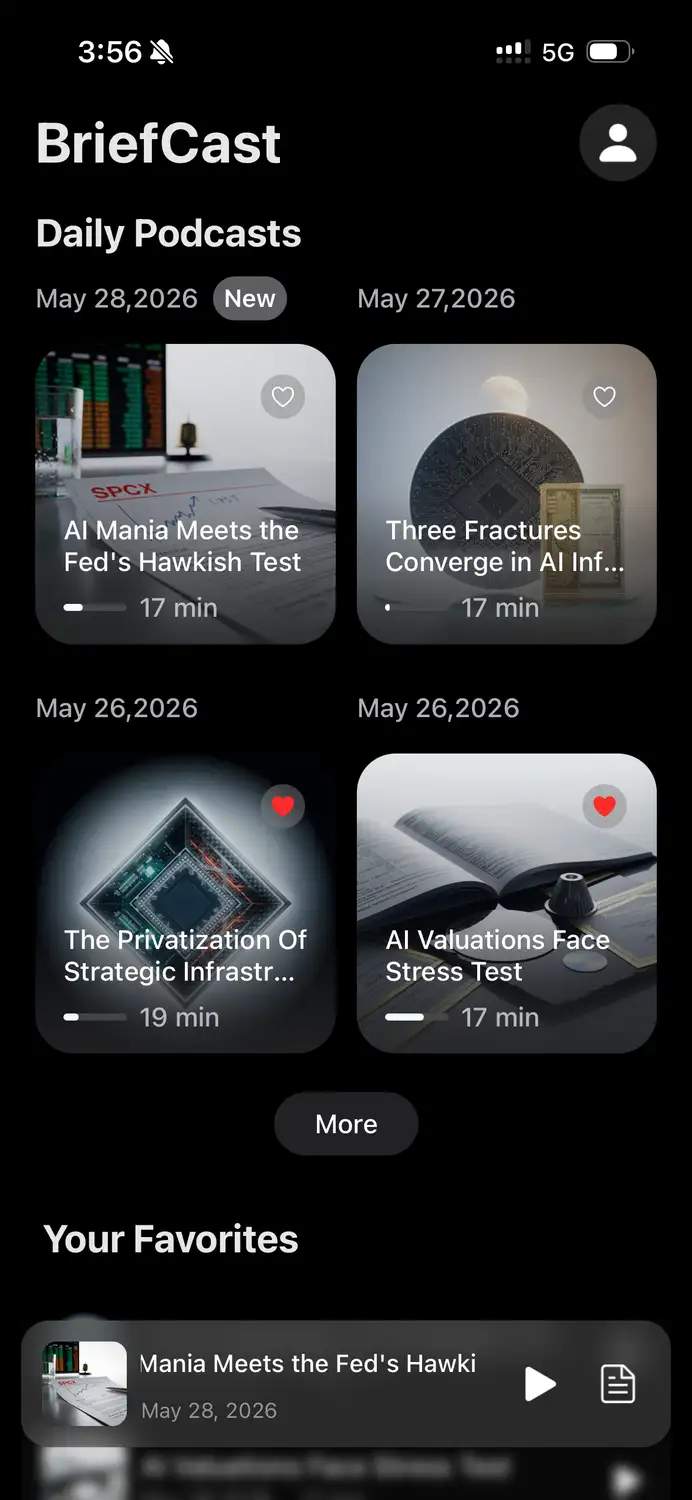
Hey Indie Hackers! 👋
I’m building BriefCast, a product that started out of my own sheer frustration with keeping up with tech and finance news.
Every day, there is a mountain of content out there—massive newsletters, endless market reports, and long-form podcasts. But let’s be real: we all have completely different interests. If you're a developer, you don’t care about generic macroeconomic banter; if you're in finance, you don't want to listen to a 30-minute deep dive into a framework you'll never use.
Most tech news sources try to cater to everyone, which means they end up serving a lot of noise to you.
I wanted something different: a daily audio brief that knows exactly what I care about, skips the fluff, and just gives me the high-signal facts during my commute.
🛠️ How it works
The core idea behind BriefCast is simple: Massive Data Aggregation + Personalized Matching.
Data Ingestion: We aggregate a massive amount of tech and finance news, articles, and updates every single day.
Interest Tagging: When you set up your profile, you define your exact interest tags and professional focus.
Personalated Briefing: Our pipeline filters the noise based on your tags, extracts the 1% pure substance, and refines it into a clean, multi-segment audio brief (Intro, Deep Dive, and Summary) custom-made just for you.
Instead of opening a generic podcast app and hunting for something relevant, you just put on your headphones during your commute and get a personalized, high-density briefing on exactly what you need to know.
💬 Looking for your feedback
I just set up the product page here on Indie Hackers. The data pipeline is running, and I’m currently polishing the product experience for our upcoming launch.
Before we ship, I’d love to get some honest feedback from this community:
What are the top 3 specific topics or niches in tech/finance that you struggle to find high-quality, concise coverage for?
How long is your ideal daily commute listen? Would you prefer a dense 5-minute wrap-up, or a more detailed 15-minute breakdown of your specific interests?
If you’re tired of the information overload and want a smarter way to stay informed, follow our journey here on IH. Let me know your thoughts or questions in the comments below! 👇
-
1
This is a strong wedge because you are not really competing with podcasts. You are competing with the daily “I should stay informed, but I do not have time to filter everything” problem.
The part I would sharpen before launch is the category frame. BriefCast is clear, but it may keep people thinking “short podcast” instead of “personalized signal intelligence.” The product sounds bigger than audio summaries if the real value is aggregation, filtering, interest matching, and turning noise into decision-useful briefings.
That matters because the name has to carry both trust and precision, especially if you expand beyond tech/finance into professional briefings for founders, analysts, operators, or teams.
For that higher-signal direction, Exirra .com feels like a much stronger shell. It sounds more like a signal/discovery intelligence product than a content app, and it would age better if BriefCast becomes a personalized briefing layer rather than just another audio product.
Worth pressure-testing this before launch, because once users, content, and product memory attach to the current name, changing the frame gets harder.
-
1
Phenomenal feedback. You’re entirely right—the product isn’t an audio play; it’s a filtering and signal intelligence layer.
We chose 'BriefCast' to be an easy mental hook for launch, but your warning about product memory and category framing hits deep. Moving into professional briefings for analysts and operators means the name needs to carry precision and trust, which
Exirradoes beautifully.Definitely going to pressure-test this framing with our early alpha group this week before we lock everything in. Appreciate the masterclass in positioning.
-
1
That is exactly the right test.
If the alpha group still hears BriefCast as “short audio summaries,” that is useful signal. But if they respond more strongly to the professional briefing, filtering, and signal-intelligence angle, then the name question becomes more than cosmetic.
Exirra works well for that second direction because it does not trap the product inside audio. It gives you room to become the layer that filters noise into useful briefings for founders, analysts, operators, and teams.
One practical thing I would not leave too late: if Exirra is going into the alpha pressure-test as a serious candidate, it is worth understanding the ownership side before users start reacting to it and the category frame starts forming around it.
Happy to discuss privately if you want to evaluate it properly before the launch frame gets locked.
-
-
-
1
The category has a brutal graveyard. Artifact (Instagram founders, well-funded) shut down 2024 doing exactly this. Particle, Otter Daily, Curio, plus dozens of "personalized AI news" startups launched and died. Not because users don't want it conceptually, but because daily-use habit is hard to build and retention kills. Worth studying why Artifact failed — same thesis, much more funding.
Tag-based personalization has a UX problem. Users don't know what to tag for. They pick "AI" generally, then complain briefings are too generic. Tags don't match how people actually consume news.
AI-narrated daily audio fatigues fast. Podcasts stick because of voice and personality. AI-narrated content has no personality — users churn in 2-3 weeks.
Deeper structural problem: tech/finance news consumers don't have a "need more signal" problem they'd pay for. They have sophisticated stacks already. They have an "I follow too many sources and it feels productive" problem. Solving a stated need that's actually a behavior pattern.
-
1
This is the exact kind of cold water we need. You’ve laid out the brutal macro reality of this category—Artifact's graveyard is something we study constantly. You are 100% right: retention is the only metric that matters, and static tags are a UX trap.
The reason most 'AI news' apps died is because they treated personalization as a skin over generic RSS feeds. If a user tags 'AI,' they get the same TechCrunch summary everyone else gets, leading to instant fatigue and churn.
We are tackling this specifically through heavy engineering on the ingestion pipeline and dynamic interest-graph matching:
Beyond Static Tags: Instead of relying on a user blindly picking generic buckets like 'Tech,' our algorithm evaluates the specific informational density and context behind those tags.
Hyper-Differentiated Output: Because of this multi-layered recommendation engine, two users with seemingly similar profiles will generate completely different, non-overlapping daily audio briefs.
True Cognitive Arbitrage: The algorithm isn't just filtering by keyword; it’s optimizing for the '1% pure substance'—the data points, market shifts, and underlying logic that actually drive decision-making.
We know we are fighting deep-seated consumer behavior patterns here. The goal isn't to change their stack, but to out-curate it so cleanly that the daily habit sticks.
Love this push. If you’re open to it, I’d love to get you into our early alpha to see if our recommendation layer actually breaks the 'Artifact curse' for you.
-
1
Worth pushing back on the core defense.
Artifact had sophisticated interest-graph matching, reading behavior signals, share-pattern learning — better than most "AI news" apps. Better personalization didn't save them. Saying "we have a better recommendation engine" doesn't address what killed Artifact; Artifact had a better recommendation engine.
"Cognitive arbitrage" and "informational density" are phrases founders reach for when they don't have a clear answer. "Two users get different briefs" is how every personalization product describes itself — table stakes ML, not differentiation.
You also didn't address AI-narrated audio fatigue. Daily AI voice fatigues users regardless of content selection. Curio shipped good selection with AI voice and died.
Reframe: if better personalization were the answer, Artifact would've won. The real question is what changes about daily-news consumption that makes your retention curve different.
-
-
1
Incredible feedback! I came to say something similar but you did a great job!
-


Comment