
CalculatorAI
AI-powered workspace for smarter financial decisions
Slowly but surely, CalculatorAI is growing 🚀
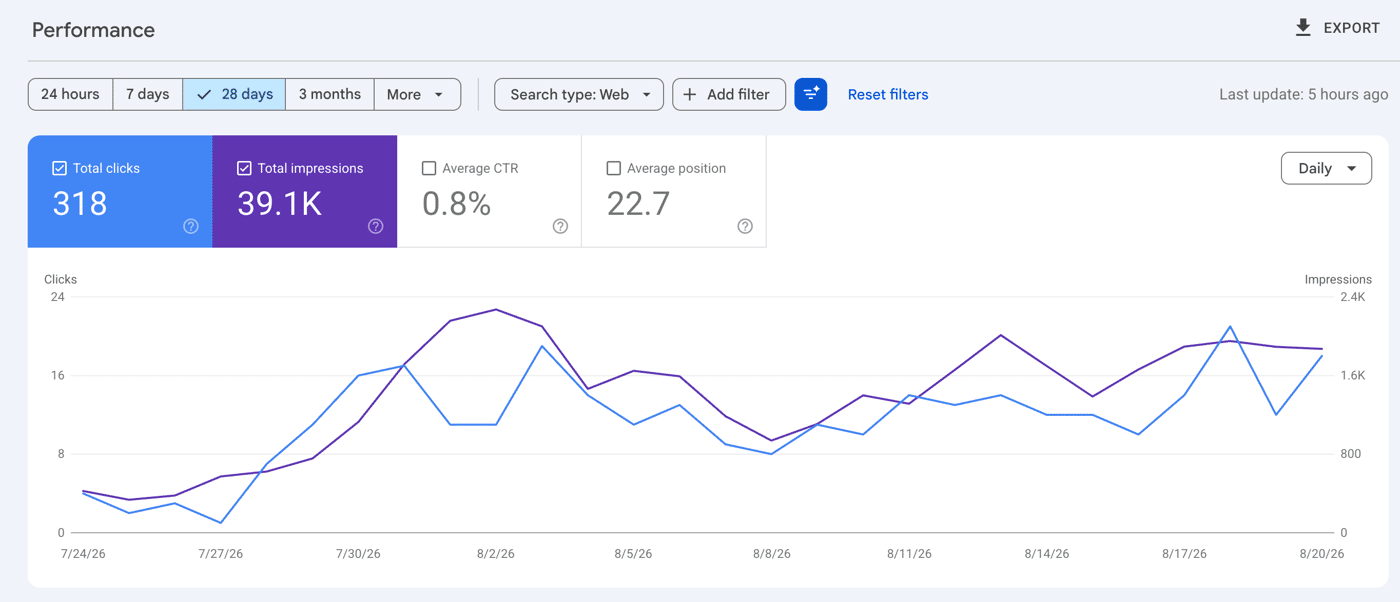
Organic search is starting to gain momentum — 39K impressions and 318 clicks from Google in the last 28 days, with a clear upward trend.
Still early, but it’s great to see the work on SEO, new tools, and content starting to compound.
Building step by step. 📈

I’ve been building CalculatorAI around one core idea:
Financial tools shouldn’t be isolated from each other, and AI shouldn’t require you to explain your financial situation every time you open a chat.
My latest addition is a Dividend Tracker.
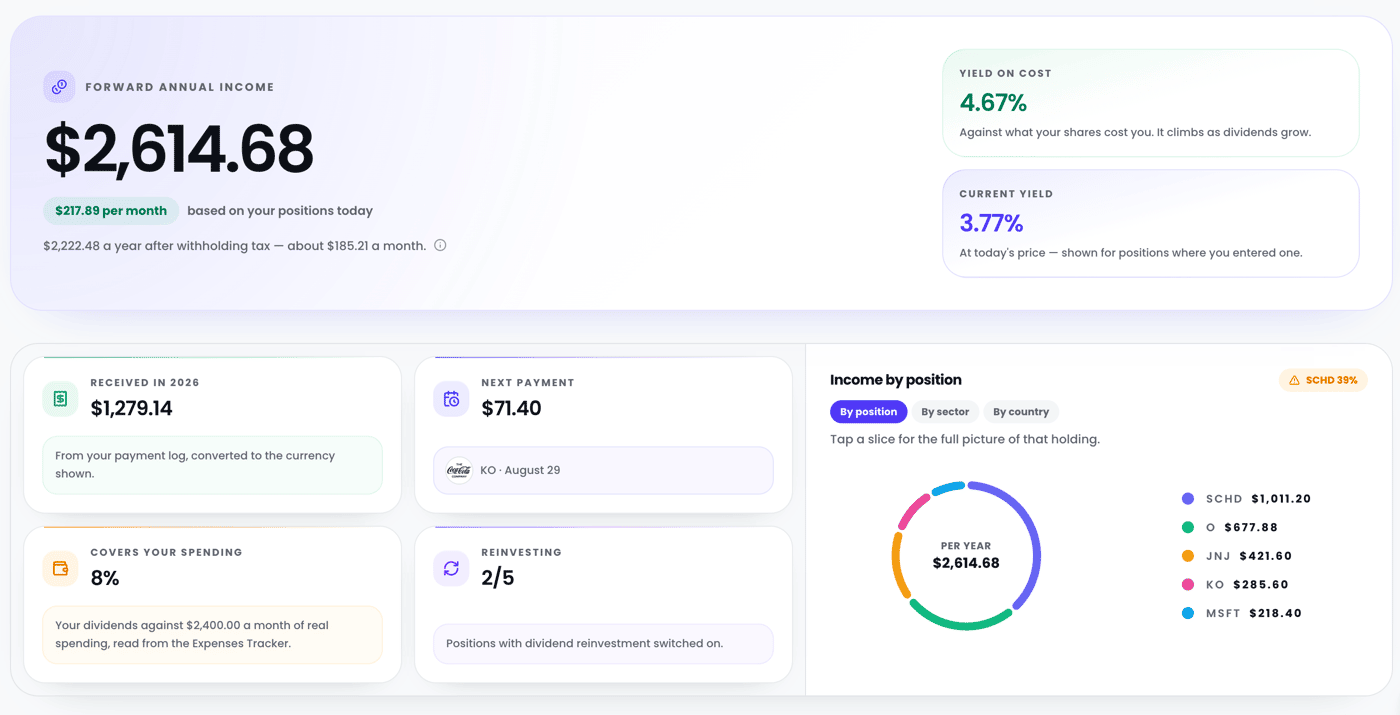
I started with a pretty simple problem. Most dividend trackers can show your holdings, yield and expected income, but I wanted to answer more practical questions:
How much will I actually receive each month?
Which months have income gaps?
What’s my yield on cost?
How much do I receive after withholding taxes?
How concentrated is my dividend income?
What happens if I reinvest everything?
When could I realistically reach $1k, $2k or $5k/month in dividend income?
So I built a tracker around those questions.
It creates a 12-month dividend calendar, tracks upcoming payments and ex-dividend dates, dividend growth and cuts, yield on cost, withholding taxes, net income and reinvestment projections.
But the part I’m most interested in is the AI integration.
The AI doesn’t sit next to the tracker as a separate chatbot.
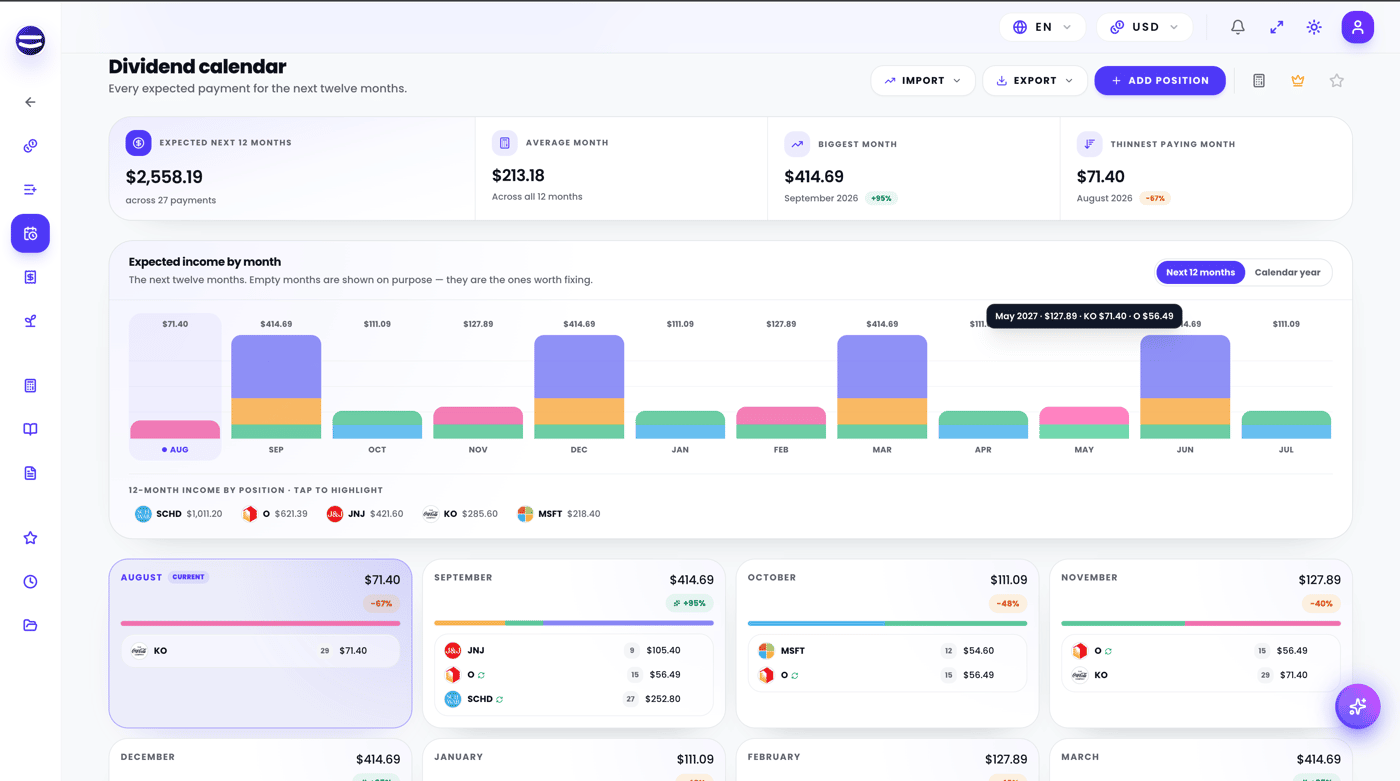
It can understand the actual data inside it.
So you can ask:
“Which months pay me the least?”
“Which stock contributes the most to my income?”
“How concentrated is my dividend income?”
“What would it take to reach $2,000/month?”
And it already has the context of your positions, payments, calendar, taxes and goals.
This is also part of a bigger experiment I’m working on with CalculatorAI: making financial tools interconnected.
The idea is that you shouldn’t have to enter the same information into a portfolio tracker, dividend tracker, expense tracker, calculators and then explain everything again to an AI.
Enter the data once, and let the entire workspace understand it.
The Dividend Tracker is free to try and doesn’t require connecting a brokerage account or adding a credit card.
I’d love some founder feedback — does the “connected financial workspace” idea make sense to you? And what would you add to the dividend tracker next?
-
1
The connected-workspace idea is the strongest part here. The AI becomes more useful because it already has the portfolio context instead of treating the financial tools as isolated products.

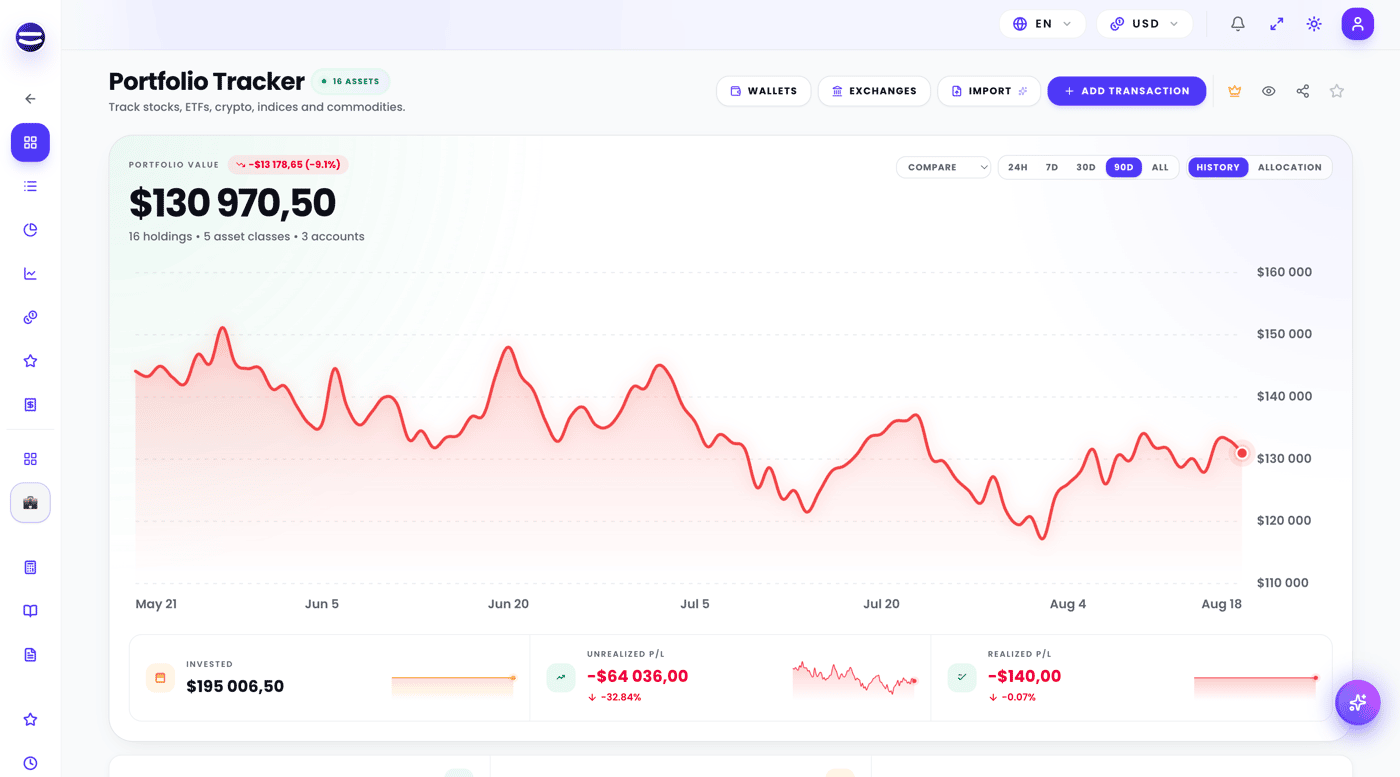
If you invest across multiple asset classes, this might be one of the most useful tools I’ve built. https://calculatorai.app/portfolio-tracker
Most investors don’t have just one type of investment.
You might own stocks and ETFs in a brokerage account, Bitcoin and Ethereum in a crypto wallet, some gold or commodities, index funds, and maybe investments spread across several different accounts.
The problem?
You never really see the whole picture in one place.
That’s exactly why I built the CalculatorAI Portfolio Tracker.
One portfolio can track:
• Stocks
• ETFs
• Crypto
• Indices
• Commodities
• Multiple brokerage accounts and crypto wallets
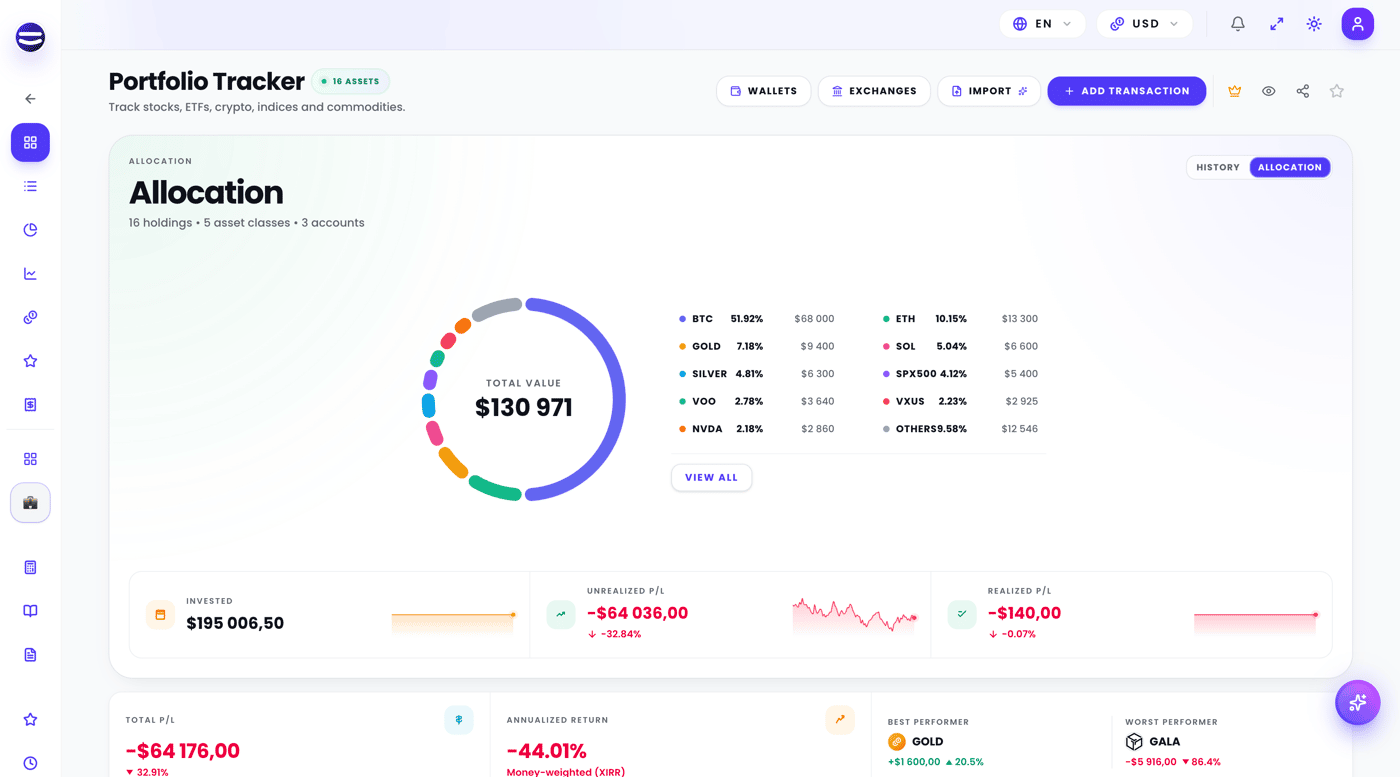
But it’s much more than a list of holdings.
You can see your total portfolio value, invested capital, realized and unrealized P&L, total return, XIRR, best and worst performers, allocation by asset class, sector and account, dividends, tax lots, and much more.
There’s also a Portfolio Growth Simulator that lets you model where your entire portfolio could be years from now based on expected returns and future contributions.
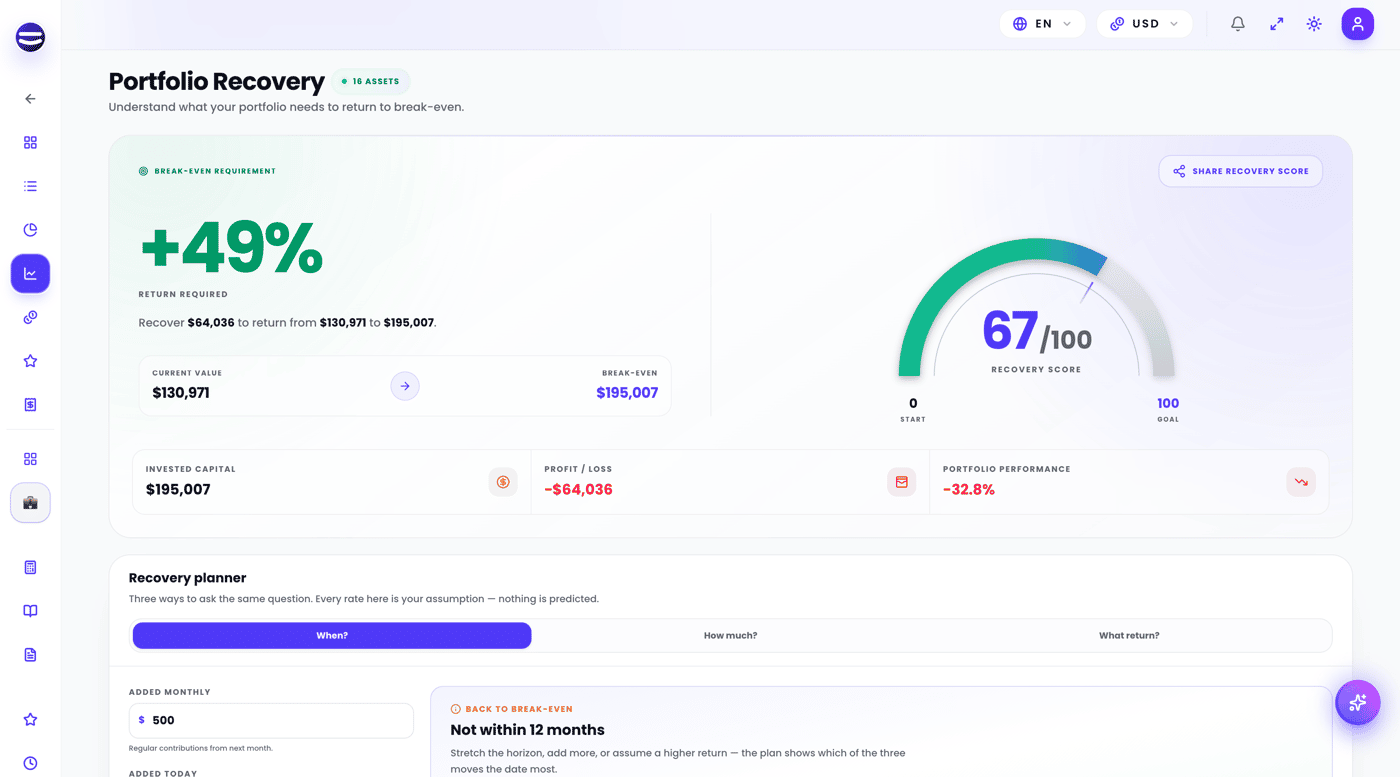
The idea is simple:
No matter where or what you invest in, you should be able to understand your entire investment portfolio from one dashboard.
I haven’t found another portfolio tracker that combines all of these asset classes and tools in quite the same way.
If you’re an investor — especially a multi-asset investor — I’d love for you to try it and tell me what you think.
Try the CalculatorAI Portfolio Tracker - https://calculatorai.app/portfolio-tracker
Does anyone here actually use QR codes for their business? Looking for some honest feedback
Hey everyone,
I’m building CalculatorAI, and one of the tools I recently added is a QR Code Generator + Tracker.
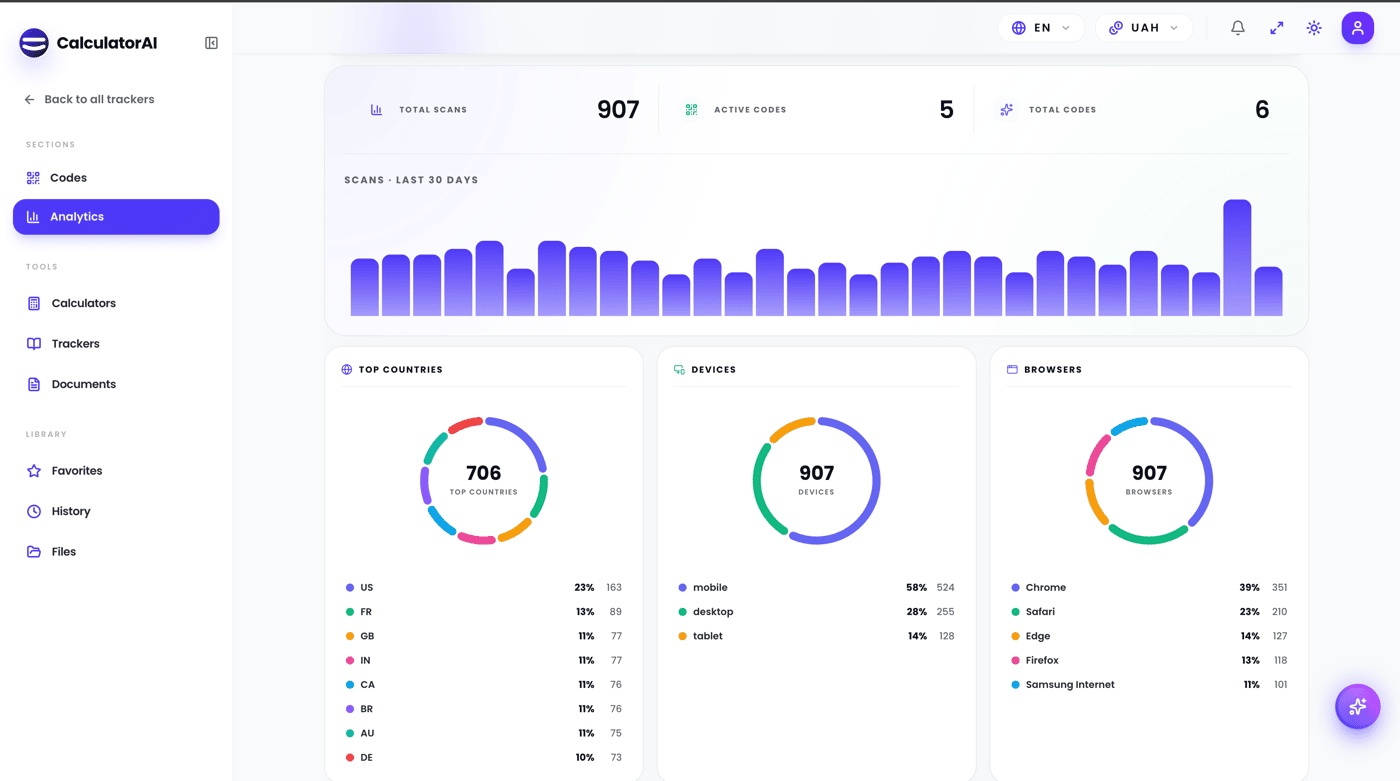
You can create and manage QR codes, and for dynamic codes track things like scans, countries, devices, browsers, and activity over time.
But here’s the thing — I don’t want to keep building features based only on what I think people need.
I’d love to talk to people who actually use QR codes in the real world.
Maybe you use them for:
restaurant menus
product packaging
business cards
events
real estate
marketing campaigns
flyers/posters
websites or social media
something completely different
If that’s you, I’d love for you to try what I’ve built and tell me what’s missing, annoying, or could be better.
In return, I’ll give you a personal promo code for 3 months of full Pro access for free. No credit card required.
Pro also unlocks the rest of CalculatorAI, not just the QR tools.
And if you only need regular static QR codes, those are already free to create — you don’t need Pro for that.
Here’s what I’ve built:
https://calculatorai.app/qr-codes
Curious — what do you use QR codes for, and what do you wish your current QR tool did better?
Google was re-crawling identical Next.js assets because Vercel Skew Protection mints new URLs every deploy. How we found it, and the fix not to make.
We run this site on Next.js and Vercel. It has about 7,600 URLs in the sitemap. Google had indexed 2,700 of them and left 4,790 alone — and 3,005 of those were sitting in Discovered – currently not indexed, which means Google found the URL and never actually fetched it.
That is the polite way of saying: you are publishing faster than we are crawling.
So we opened the Crawled – currently not indexed report to find out what the crawler was spending its time on instead.
The mistake we nearly shipped
Looking at the example URLs on screen, it seemed obvious. Non-English locales everywhere. Google was clearly skipping our translated pages, and the fix was to go and rework hreflang.
We were about a day of work away from doing exactly that.
Then we exported the CSV instead.
Out of 1,000 URLs in that bucket:
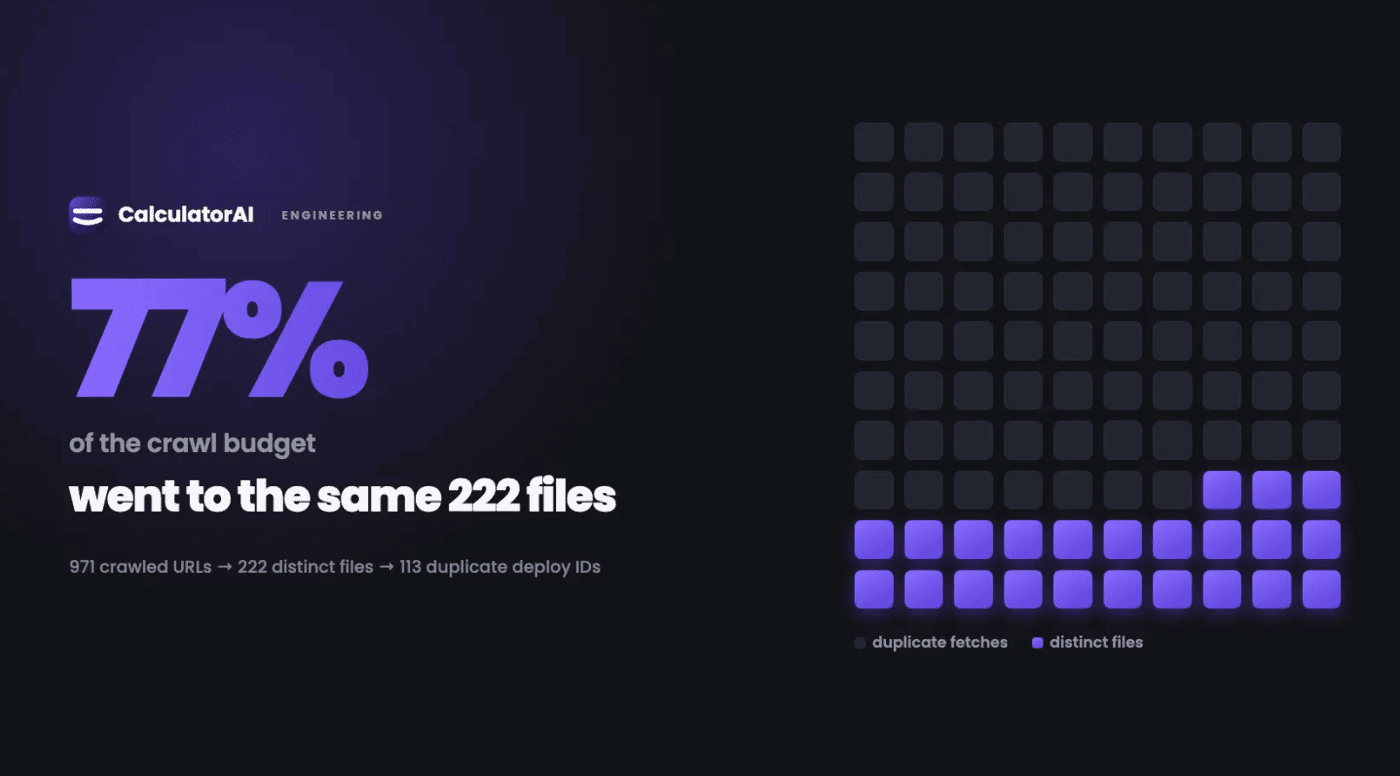
971 were
/_next/static/**or/favicon.icothose 971 URLs pointed at only 222 distinct files
so roughly 77% were duplicate crawls of assets Google already had
The locale theory was never in danger. It just happened to be what the top of the list looked like.
Here is why that happens, and it will happen to you too: the example URLs Search Console shows in its interface are sorted by last crawl date. Your newest real pages sit on top. The bulk of the bucket — the part you actually need to see — is below the fold, and you never scroll that far. Eyeball that list and you will generalise from a biased sample every time.
Export the CSV before you conclude anything.
What was actually happening
Vercel has a feature called Skew Protection. When you deploy while someone is mid-session, their browser may ask for a JavaScript chunk that no longer exists in the new build. Skew Protection solves that by appending ?dpl=<deploy-id> to every static asset URL, so a client keeps being served the build it started with.
It is a genuinely good feature and it fixes a real problem.
It also means every deploy mints a complete new set of URLs for byte-identical files. Googlebot has no way to know that main.js?dpl=aaa and main.js?dpl=bbb are the same thing. It sees two URLs, so it fetches two URLs.
By the time we looked, it had crawled 113 distinct dpl values. One font file, 39 times. The favicon, 37 times.
All of that came out of the same crawl budget those 3,005 real pages were queued in.
The fix, and the fix not to make
Turning Skew Protection off (Vercel dashboard → Settings → Advanced) stops new ones being minted. Asset filenames are already content-hashed, so caching is unaffected. The tradeoff you accept back is the original problem: a tab left open across a deploy can hit a chunk-load error.
For a content site with frequent deploys and short sessions, that is a trade worth making. For a long-session application it might not be.
What you should not do is "fix" this with Disallow: /_next/static in robots.txt. It is worse than the disease:
Google needs your CSS and JavaScript to render the page and judge mobile usability. Block them and you hand it a broken page to evaluate.
It would not drain the queue anyway. robots.txt stops the fetch, not the knowing. The URLs stay known, they simply get relabelled as blocked, and everything already queued stays queued.
Fix it at the source.
The part we did not expect
This turned out to be the third independent reason to deploy less often, after ISR write costs and build minutes.
We had been treating deploy frequency as a free variable — push whenever something is ready, several times a day. It is not free. Every deploy writes a fresh set of cache entries, burns build minutes, and now, it turns out, hands Googlebot a new pile of URLs that lead to files it already has.
If you are on Vercel with Next.js and more than a few hundred URLs, go and look at how many distinct dpl values Google has crawled. That number is your deploy count wearing a different hat — and unlike most SEO problems, it is entirely under your control.
The honest ending
It has been a few days since we turned it off. The old URLs do not 404 — a query parameter on a static asset still serves the file — so they do not vanish, they just stop being referenced from any rendered page. Our assumption is that Google deprioritises them once they stop appearing.
But we are not going to claim the queue has drained, because we do not know yet. Ask us in a month.
This is one of a few notes on how CalculatorAI is built. The same audit turned up a second problem — 21 of our 23 documentation pages were telling Google they were the homepage — which is a story for another post.
Financial decisions are rarely handled in one place. People use one website for a mortgage calculation, another app for budgeting, a spreadsheet for investments, and separate tools for invoices, expenses, or trading.
I built CalculatorAI to bring these workflows together in one financial workspace.
The platform combines focused financial calculators, long-term trackers, document generators, and an AI assistant that can explain results using the numbers a person is actually working with. Instead of calculating something once and losing the result, users can save their work, track changes over time, compare scenarios, and return to their data later.
My goal is not to create another directory of calculators. I want CalculatorAI to become a practical financial decision-making workspace for individuals, investors, freelancers, landlords, and small businesses.
I am building the product as a solo founder and would really value honest feedback:
Does the idea of combining these tools in one workspace feel useful, or would you still prefer separate specialized apps?
You can try it here: https://calculatorai.app
-
1
How do you currently handle your analytics and would you mind reading my indiehacker pots on how AI crawlers and bots are ruining analytics data?
https://www.indiehackers.com/post/i-just-discovered-my-analytics-numbers-are-mostly-fake-here-is-why-8197e3ff9d-
1
At the moment I mainly rely on Google Analytics, Google Search Console, and Vercel Analytics. I also pay close attention to product-specific metrics like registrations, feature usage, and retention rather than just traffic.
As the product grows, I'll probably move toward a more event-driven analytics setup, but for now this stack gives me a good picture of how people are actually using CalculatorAI.
-
-
1
Great work — consolidating financial tools into one workspace is something SMBs really need. I’m building Finsight AI with a similar goal, and I’d love to know how you’re handling integrations with existing spreadsheets or accounting apps.
-
1
I like your approach of keeping integrations lightweight until workflows are solid. With Finsight AI, I’m starting with spreadsheet imports too, since SMBs often live in Excel. Gradual integrations based on demand make sense — it keeps focus on usability rather than chasing every connector.
-
1
Thanks! Right now I’m keeping integrations fairly lightweight because I want the core workflows to work well on their own first.
For spreadsheets, the idea is to make importing/exporting data as easy as possible, so users don’t feel locked in. Accounting app integrations are definitely something I’m considering, especially for invoices, expenses, and small business workflows, but I’d rather add them gradually based on actual user demand than connect everything from day one.
I’m curious how you’re approaching this with Finsight AI — are you focusing more on direct integrations, or on importing data from spreadsheets and files first?
-
-
1
The interesting question here is whether “one financial workspace” is the value itself, or whether the value only becomes clear around a specific financial decision someone keeps returning to.
Those sound similar, but they could lead to very different products.
-
1
I agree, and it’s something I think about a lot.
The “one financial workspace” idea is the long-term vision, but I don’t think that alone is enough to keep people coming back. Retention probably comes from solving specific recurring problems — tracking a portfolio, reviewing trades, managing expenses, invoices, debt, and so on.
So I see the workspace as the layer that connects those recurring use cases, rather than the value proposition on its own.
My goal is to make each individual tool useful enough by itself, while the bigger advantage appears over time as the data starts connecting across them.
On top of having everything in one place, there’s also an AI assistant that helps automate the work and acts more like a personal financial copilot — it knows your numbers, remembers your goals, and can use that context across the different tools.
-
1
That’s helpful context. The distinction between the workspace being the product versus being the layer connecting recurring financial workflows is an interesting one.
I’d like to continue the conversation outside the thread. What’s the best email to reach you on?
-
1
Sure! You can reach me at info@calculatorai.app.
Looking forward to continuing the conversation!-
1
Thanks! I’ve just sent it over.
Looking forward to hearing your thoughts whenever you have a chance.
-
-
-
-


Comment