Fast Forward TMS
Streamlining you journey to success
Introduction
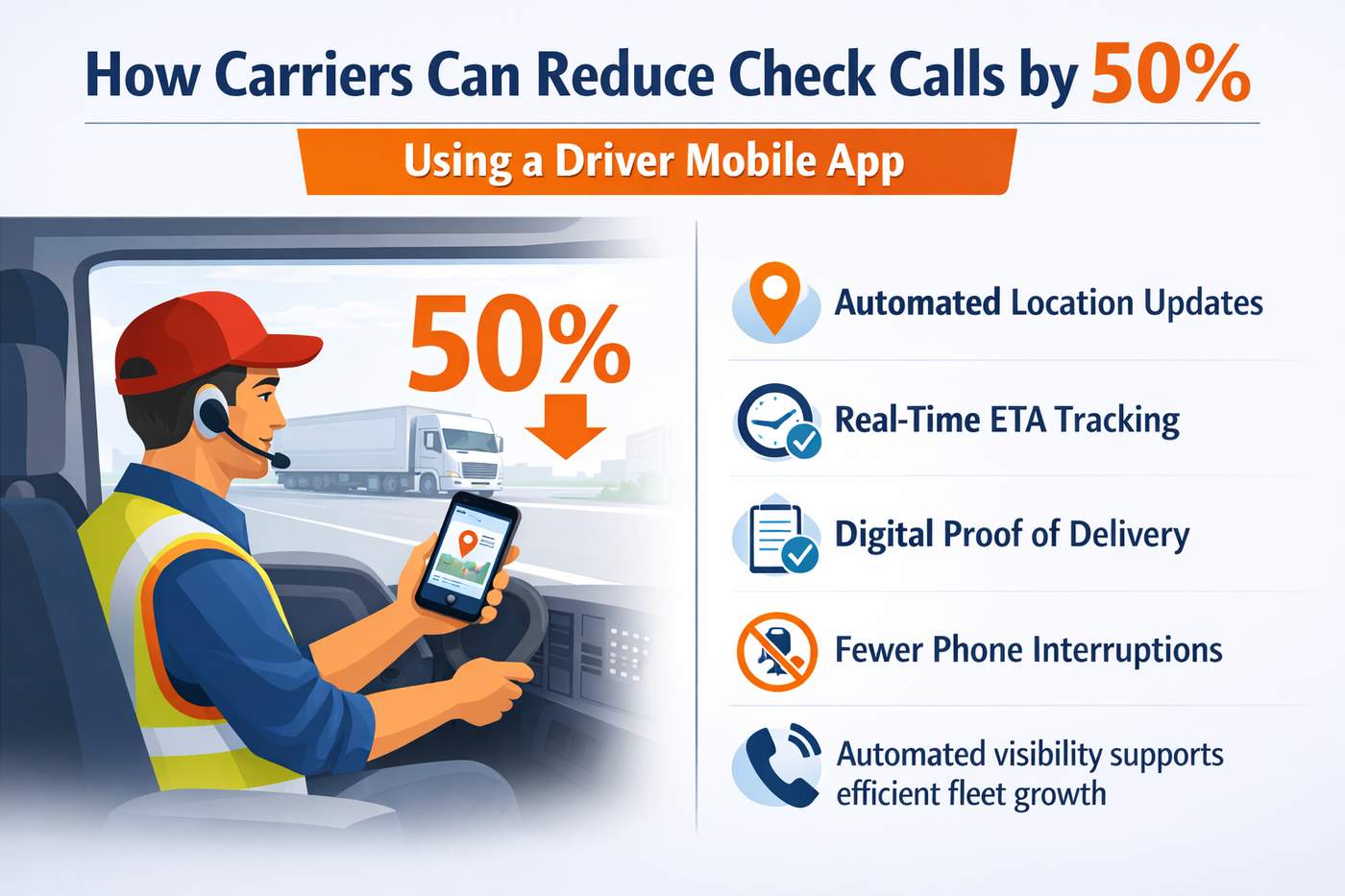
For many trucking carriers, check calls have become a routine part of daily operations. Dispatchers spend valuable time requesting shipment updates, brokers expect real-time visibility, and customer service teams repeatedly share the same information. While these conversations help keep freight moving, they also create unnecessary administrative work and reduce operational efficiency.
The root cause isn't poor communication. It's limited shipment visibility. When drivers, dispatchers, brokers, and customers can't access real-time updates, phone calls, text messages, and emails become the default way to track every load. As operations expand, relying on manual communication becomes increasingly inefficient and harder to sustain.
A driver mobile app addresses this challenge by automatically providing GPS tracking, ETA updates, arrival notifications, and digital Proof of Delivery (POD), giving stakeholders instant access to critical shipment information. With real-time visibility, dispatchers can spend less time chasing routine updates and more time managing exceptions that impact operations.
The operational impact is already evident across the industry. LTI Delivers reduced its check-call volume by 40% after adopting a real-time freight visibility platform, demonstrating how automated tracking and shipment visibility can significantly reduce manual communication.
In this article, you'll learn why check calls happen, how a driver mobile app helps reduce them, and what carriers should consider when improving shipment visibility and operational efficiency.
Quick Summary
Check calls are often a visibility problem, not a communication problem. When dispatchers, brokers, and customers lack real-time shipment information, manual calls become the default way to track loads.
A driver mobile app automates routine updates such as GPS tracking, ETA sharing, geofenced notifications, and digital Proof of Delivery (POD), significantly reducing repetitive check calls.
Fewer manual updates allow dispatchers to focus on exception management, improve customer service, reduce driver interruptions, and support more efficient fleet operations.
While many carriers can reduce routine check calls by up to 50%, results depend on factors such as fleet size, driver adoption, workflow optimization, system integration, and consistent app usage.
Before adopting a solution, evaluate your current communication process, identify repetitive status requests, and measure key metrics like dispatcher workload, check-call volume, and shipment visibility to build a stronger business case for automation.
The Hidden Cost of Manual Check Calls for Growing Carriers
A single check call may seem routine, but across dozens or hundreds of loads each week, these conversations consume valuable time, increase administrative work, and make it harder for growing carriers to operate efficiently.
Lost Dispatcher Time
Routine status requests prevent dispatchers from focusing on load planning, exception management, and customer service. As shipment volumes increase, repetitive communication reduces overall productivity.
Driver Disruptions
Frequent check calls interrupt drivers and distract them from their primary responsibility. Automated shipment visibility reduces unnecessary communication while keeping stakeholders informed with real-time updates.
Broker Follow-Ups
Without real-time visibility, brokers repeatedly request shipment updates, ETAs, and delivery confirmations. Automated tracking provides timely information, reducing duplicate communication and improving responsiveness.
Slower Customer Updates
When shipment information isn't instantly available, customer updates become slower and more reactive. Automated visibility enables faster, more accurate communication throughout the shipment lifecycle.
Growing Administrative Work
Manual communication extends beyond phone calls to system updates, emails, and paperwork. Automating routine status updates reduces administrative effort and improves information consistency.
Scaling Challenges
As fleets grow, manual communication becomes increasingly difficult to manage. Automated visibility helps carriers support more loads without increasing dispatcher workload at the same pace.
A Typical Day Before and After a Driver Mobile App
Imagine a dispatcher managing 60 trucks during a busy workday. Throughout the day, brokers request updated ETAs, customers ask about delivery progress, and drivers receive repeated calls to confirm pickup and arrival times. Although each conversation takes only a few minutes, the combined workload can consume hours that could otherwise be spent resolving delays, planning loads, or supporting drivers.
Now imagine the same operation using a driver mobile app. Real-time GPS tracking, automated ETA updates, geofenced notifications, and digital Proof of Delivery (POD) keep shipment information flowing automatically. Instead of answering routine status requests, dispatchers can focus on exceptions that genuinely require attention, improving both operational efficiency and customer service.
This simple shift illustrates why many carriers view automated shipment visibility as more than a technology upgrade—it's a smarter way to manage growing freight operations.
Why Do Check Calls Happen in Trucking Operations?
Check calls don't happen because teams communicate too much. They occur when dispatchers, brokers, customers, and other stakeholders don't have instant access to shipment information, forcing them to rely on manual status requests.
The Visibility Gap
Every shipment involves multiple stakeholders, including dispatchers, brokers, customers, and receivers. When they can't access accurate, real-time shipment information, they depend on drivers or dispatchers for updates, creating repetitive communication that slows operations and increases administrative workload.
Most Common Check Calls
Most check calls are routine requests for shipment status rather than conversations that require operational decisions. The most common include:
Pickup Confirmation: Has the load been picked up?
Location Updates: Where is the driver right now?
ETA Requests: When is the shipment expected to arrive?
Delay Notifications: Has traffic, weather, or another issue affected the schedule?
Delivery Confirmation: Has the shipment been delivered successfully?
Proof of Delivery (POD): Has the completed delivery record been shared?
Because these requests follow predictable workflows, they're ideal candidates for automation through real-time GPS tracking, automated status updates, and digital document sharing.
How a Driver Mobile App Automates Routine Status Updates
A driver mobile app reduces check calls by automatically sharing routine shipment updates. Instead of relying on phone calls or text messages, dispatchers, brokers, and customers can access real-time shipment information, allowing dispatch teams to focus on exceptions rather than routine tracking.
Real-Time GPS Tracking
Real-time GPS tracking automatically shares a driver's location, eliminating the need for repeated location requests. Dispatchers and authorized stakeholders can monitor shipment progress through a centralized platform without interrupting drivers.
Geofenced Status Updates
Geofencing automatically records key milestones, such as arrivals and departures at pickup and delivery locations. These updates keep stakeholders informed without requiring dispatchers to contact drivers for routine confirmations.
Automatic ETA Updates
A driver mobile app continuously updates estimated arrival times using real-time trip data. This provides more accurate ETAs, helping dispatchers, brokers, and customers stay informed without repeated follow-up calls.
Digital Proof of Delivery (POD)
Drivers can capture and upload signed Proof of Delivery (POD) directly through the app. Instant access to delivery documents speeds up verification, reduces paperwork delays, and minimizes post-delivery follow-ups.
Centralized Communication
Some situations still require direct communication, but a driver mobile app keeps conversations and shipment information in one place. This reduces time spent switching between calls, texts, and emails while improving collaboration across the operation.
Also Read: https://fastforwardtms.com/features/truck-driver-app/
Which Check Calls Can Be Automated and Which Still Need Human Conversations?
A driver mobile app doesn't eliminate every check call. Its primary purpose is to automate routine shipment updates, allowing dispatchers to focus on situations that require human judgment and operational decision-making.
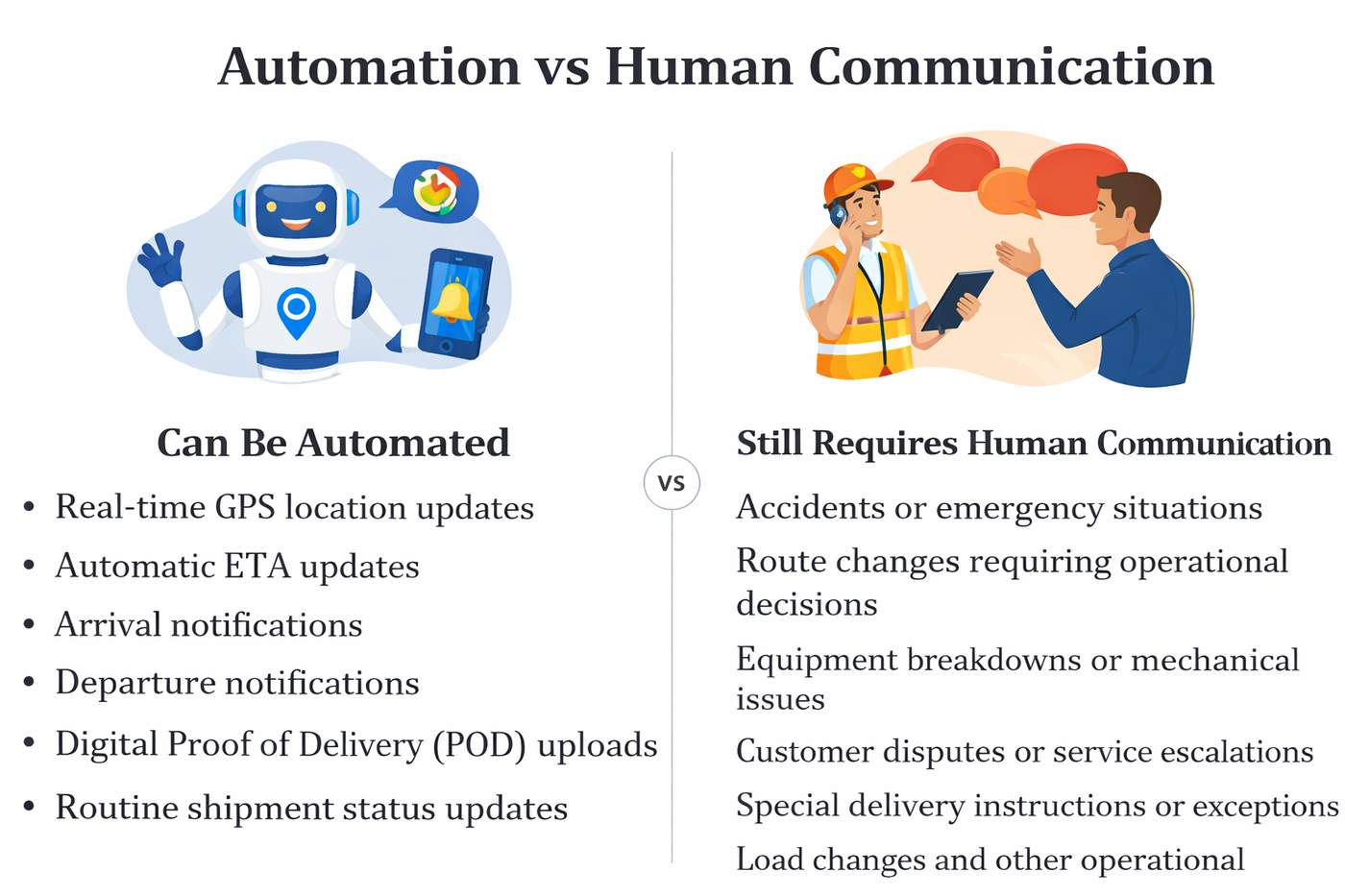
Routine updates like location sharing, ETA notifications, arrival confirmations, and POD uploads follow predictable workflows, making them ideal for automation. In contrast, unexpected events still require direct communication, quick decisions, and collaboration between drivers, dispatchers, and customers.
Key Takeaway: A driver mobile app doesn't replace human communication. It automates repetitive status updates, giving dispatch teams more time to resolve operational issues that truly require attention.
Traditional Tracking vs. Visibility-Driven Operations
A driver mobile app transforms how shipment information moves across the operation. Instead of relying on dispatchers to collect and share updates, real-time visibility automatically keeps stakeholders informed, reducing manual communication and improving operational efficiency.
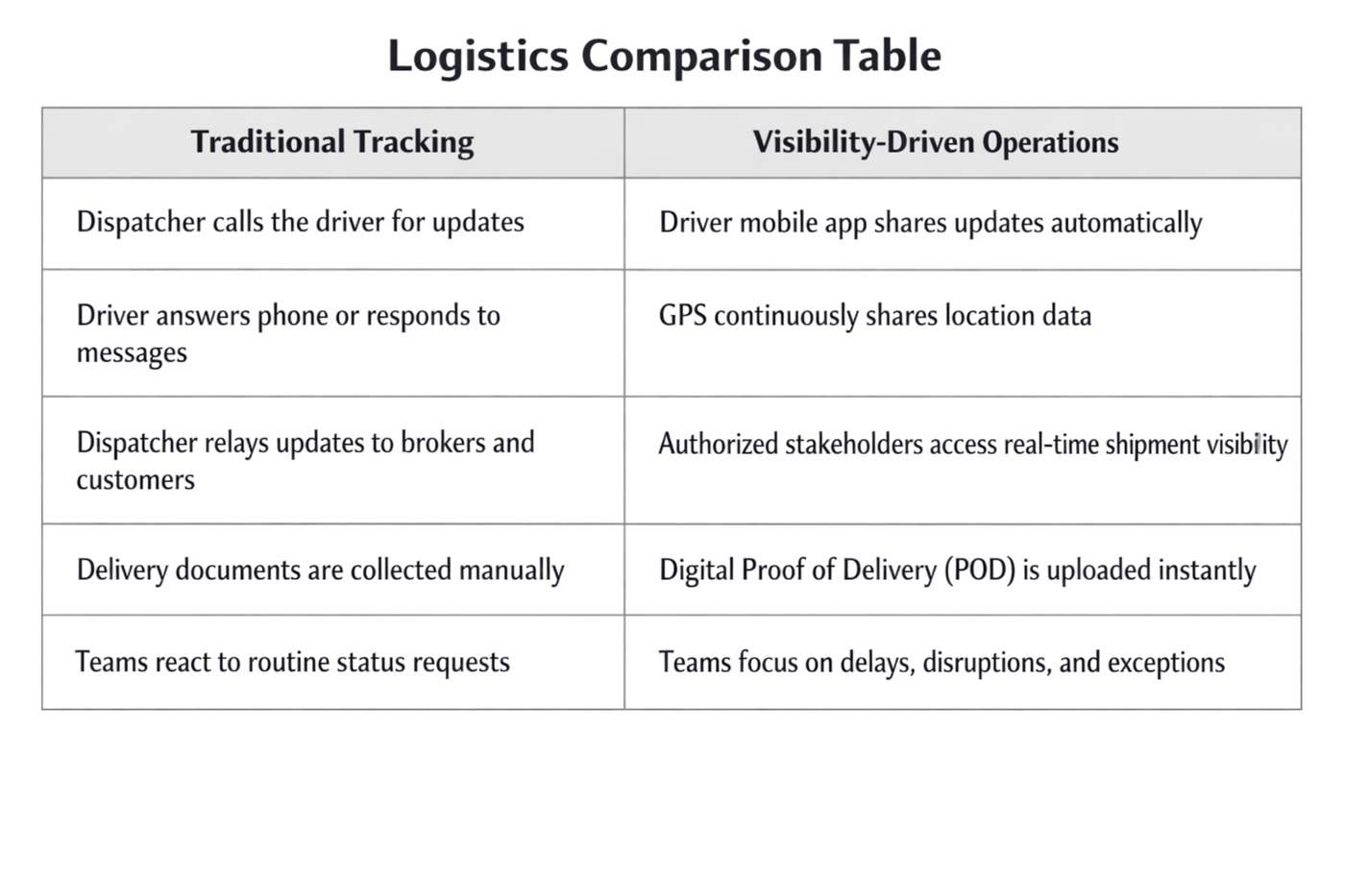
With routine updates automated, dispatchers spend less time tracking loads and more time managing exceptions. Drivers experience fewer interruptions, while brokers and customers receive faster, more accurate shipment updates. As fleets grow, this visibility-driven approach helps carriers improve efficiency without increasing communication at the same pace.
Why a 50% Reduction in Check Calls Is Realistic
Many daily check calls involve routine status requests rather than operational decisions. When a driver mobile app automates shipment visibility, many of these repetitive updates no longer require manual communication, allowing dispatch teams to focus on higher-value work.
Fleet Size
Larger fleets typically handle more loads and status requests, creating greater opportunities to reduce routine check calls. However, smaller carriers can also benefit by improving shipment visibility and communication.
Driver Adoption
Consistent driver participation is essential. Regular GPS tracking, status updates, and digital document submissions ensure stakeholders receive accurate information without repeated follow-up calls.
Existing Workflows
Carriers that rely heavily on manual calls, texts, or spreadsheets often see the greatest improvements because automation replaces repetitive communication with real-time visibility.
System Integration
A driver mobile app delivers better results when it integrates with existing transportation systems, creating a single source of truth and reducing duplicate updates.
Consistent App Usage
Automation is most effective when drivers and dispatch teams use the app consistently. Daily use of tracking, ETA updates, geofencing, and POD uploads helps maximize operational efficiency.
Key Takeaway: Many carriers can significantly reduce routine check calls, but results depend on fleet size, driver adoption, workflow maturity, system integration, and consistent use of the technology.
How Fewer Check Calls Improve Fleet Operations
Reducing check calls does more than save time. It improves communication, increases operational efficiency, and helps carriers manage growing freight volumes without adding unnecessary administrative work.
Higher Dispatcher Productivity
With fewer routine status requests, dispatchers can focus on load planning, exception management, customer service, and other high-value tasks that improve daily fleet operations.
Fewer Driver Interruptions
Reducing check calls allows drivers to stay focused on the road instead of responding to routine update requests, improving productivity while keeping stakeholders informed through automated visibility.
Better Broker and Customer Communication
Real-time shipment updates provide brokers and customers with faster, more accurate information, reducing repeated follow-ups and improving transparency throughout the shipment lifecycle.
Greater Shipment Visibility
A centralized view of shipment progress gives dispatchers, brokers, and customers access to the same real-time information, reducing communication gaps and improving operational coordination.
Faster Document Processing
Digital Proof of Delivery (POD) and mobile document uploads speed up document verification, reduce paperwork delays, and help billing and invoicing teams begin their workflows sooner.
Easier Fleet Growth
Automated shipment visibility enables carriers to manage more loads without increasing dispatcher workload at the same pace, creating a more scalable and efficient operation.
Common Challenges When Implementing a Driver Mobile App
Implementing a driver mobile app involves more than installing new technology. Long-term success depends on user adoption, reliable processes, and seamless integration with existing operations.
Driver Adoption
Drivers are more likely to embrace a mobile app when it's easy to use and clearly improves their daily workflow. Simple onboarding, training, and ongoing support encourage consistent adoption.
Staff Training
Dispatchers and back-office teams need clear training to use automated visibility effectively. Well-defined processes help teams rely on real-time data instead of routine manual check calls.
System Integration
A driver mobile app should integrate with existing transportation systems to eliminate duplicate data entry, improve information accuracy, and create a unified operational workflow.
Data Accuracy
Reliable GPS tracking, ETA updates, and delivery information build trust across the operation. Regular monitoring and standardized processes help maintain accurate, real-time shipment visibility.
Change Management
Moving from manual communication to automated visibility requires process changes as well as technology. A phased rollout, employee feedback, and continuous improvement help ensure successful adoption.
Key Takeaway: The success of a driver mobile app depends not only on the technology itself but also on driver adoption, staff training, system integration, and well-managed operational change.
How to Choose the Right Driver Mobile App for Your Fleet
Not every driver mobile app delivers the same value. Choose a solution that improves shipment visibility, simplifies communication, integrates with your existing workflows, and supports long-term fleet growth.
Real-Time GPS Tracking
Real-time GPS tracking provides continuous shipment visibility, reducing location requests and helping dispatchers, brokers, and customers monitor load progress without contacting drivers.
Geofencing
Geofencing automatically records arrivals and departures at key locations, reducing manual confirmations while keeping shipment milestones accurate and up to date.
Automated Status Updates
Automated pickup, transit, and delivery updates reduce repetitive communication and ensure stakeholders receive timely shipment information throughout the load lifecycle.
ETA Visibility
Dynamic ETA updates help dispatchers, brokers, and customers plan more effectively by providing accurate arrival estimates based on real-time trip conditions.
Digital Proof of Delivery (POD)
Digital POD capture allows drivers to submit signed delivery documents instantly, reducing paperwork delays and accelerating post-delivery processes.
Mobile Document Uploads
Drivers should be able to upload bills of lading, receipts, and other shipment documents directly from the app, improving record accuracy and reducing administrative work.
In-App Communication
Built-in messaging keeps shipment-related communication in one place, reducing reliance on separate phone calls, text messages, and emails.
Easy Driver Experience
A simple, intuitive interface encourages consistent driver adoption, helping carriers maximize the value of automated tracking and communication.
Reliable Integrations
Choose a solution that integrates with your existing transportation systems to eliminate duplicate data entry and create a connected operational workflow.
Secure Data Handling
Strong security protects shipment, driver, and operational data while supporting compliance and maintaining business continuity.
Evaluation Checklist
Before selecting a driver mobile app, confirm that it offers:
Real-time GPS tracking
Geofencing
Automated status updates
Dynamic ETA visibility
Digital Proof of Delivery (POD)
Mobile document uploads
In-app communication
Easy driver experience
Reliable system integrations
Secure data handling
Key Takeaway: The right driver mobile app isn't defined by the number of features—it delivers reliable visibility, seamless workflows, strong driver adoption, and measurable operational improvements.
Common Mistakes to Avoid When Reducing Check Calls
Implementing a driver mobile app is an important step, but technology alone won't eliminate unnecessary check calls. Many carriers expect immediate results without evaluating the processes that create repetitive communication in the first place.
Avoid these common mistakes when modernizing your operations:
Focusing only on GPS tracking: Visibility is more than knowing where a truck is. Automated status updates, ETA sharing, geofencing, and digital PODs work together to reduce manual communication.
Overlooking driver adoption: Even the best solution delivers limited value if drivers don't use it consistently.
Keeping old communication habits: Continuing to rely on phone calls for routine updates limits the benefits of automated visibility.
Ignoring system integration: A disconnected workflow can lead to duplicate data entry and inconsistent shipment information.
Measuring software cost instead of operational savings: Consider the time saved, improved dispatcher productivity, and better customer communication—not just the implementation cost.
How to Measure Success After Implementation
Implementing a driver mobile app is only the first step. Tracking the right performance metrics helps carriers measure efficiency gains, identify improvement opportunities, and evaluate the long-term impact of automated shipment visibility.
Daily Check Calls
Track the number of routine check calls handled each day. A steady decline indicates that stakeholders are relying more on automated shipment updates than manual communication.
Dispatcher Productivity
Measure how much time dispatchers spend tracking loads before and after implementation. Less time on routine updates means more time for planning, customer service, and exception management.
Driver Interruptions
Monitor how often drivers are contacted for routine status requests. Fewer interruptions help drivers stay focused while improving communication through automated updates.
ETA Accuracy
Compare estimated and actual arrival times to evaluate tracking accuracy. More reliable ETAs improve planning, customer confidence, and proactive communication.
POD Submission Time
Measure how quickly Proof of Delivery (POD) documents are uploaded after delivery. Faster submissions help accelerate billing, invoicing, and other back-office processes.
Broker Status Requests
Track how frequently brokers request shipment updates. Fewer follow-ups indicate that real-time visibility is providing the information they need.
Loads Managed Per Dispatcher
Measure whether dispatchers can manage more loads without increasing workload. This is a strong indicator of improved operational efficiency and scalability.
Customer Response Time
Track how quickly customer inquiries are resolved. Real-time shipment visibility enables faster, more accurate responses without relying on manual follow-ups.
Success Metrics Checklist
Regularly monitor:
Daily check calls
Dispatcher productivity
Driver interruptions
ETA accuracy
POD submission time
Broker status requests
Loads managed per dispatcher
Customer response time
Key Takeaway: Measuring operational metrics before and after implementation helps carriers quantify the value of a driver mobile app and identify opportunities for continuous improvement.
Before You Invest, Evaluate Your Current Check-Call Process
Before investing in a driver mobile app, evaluate how your team manages shipment updates today. Identifying communication bottlenecks and visibility gaps helps determine where automation can deliver the greatest operational value.
Ask These Questions
Ask yourself the following questions to evaluate your current check-call process:
How many check calls does your dispatch team handle each day?
This establishes a baseline for measuring future improvements.
Which check calls are repeated most often?
Identify routine requests for locations, ETAs, pickups, or deliveries.
How much dispatcher time is spent gathering shipment updates?
Measure how much time is devoted to routine communication instead of higher-value work.
Which shipment updates could be automated?
Consider whether GPS tracking, ETA updates, arrival notifications, or POD submissions can replace manual follow-ups.
Are brokers requesting the same information repeatedly?
Frequent status requests often indicate a shipment visibility gap rather than a communication problem.
Is manual communication limiting fleet growth?
If managing more loads requires additional dispatcher time, your current process may no longer be scalable.
Signs Your Process Needs Improvement
Your operation may benefit from automated shipment visibility if you regularly experience:
Dispatchers spending hours on routine check calls.
Drivers receiving repeated status requests.
Brokers requesting the same shipment updates.
Delays in sharing ETAs or delivery confirmations.
Difficulty managing additional loads without increasing administrative workload.
Key Takeaway: Understanding your current communication process is the first step toward reducing unnecessary check calls and building a stronger business case for automation.
How Modern Carriers Shift from Manual Tracking to Exception-Based Management
Modern carriers aren't eliminating communication—they're changing how it happens. By automating routine shipment updates, a driver mobile app gives dispatchers, brokers, and customers real-time visibility while allowing teams to focus on operational exceptions.
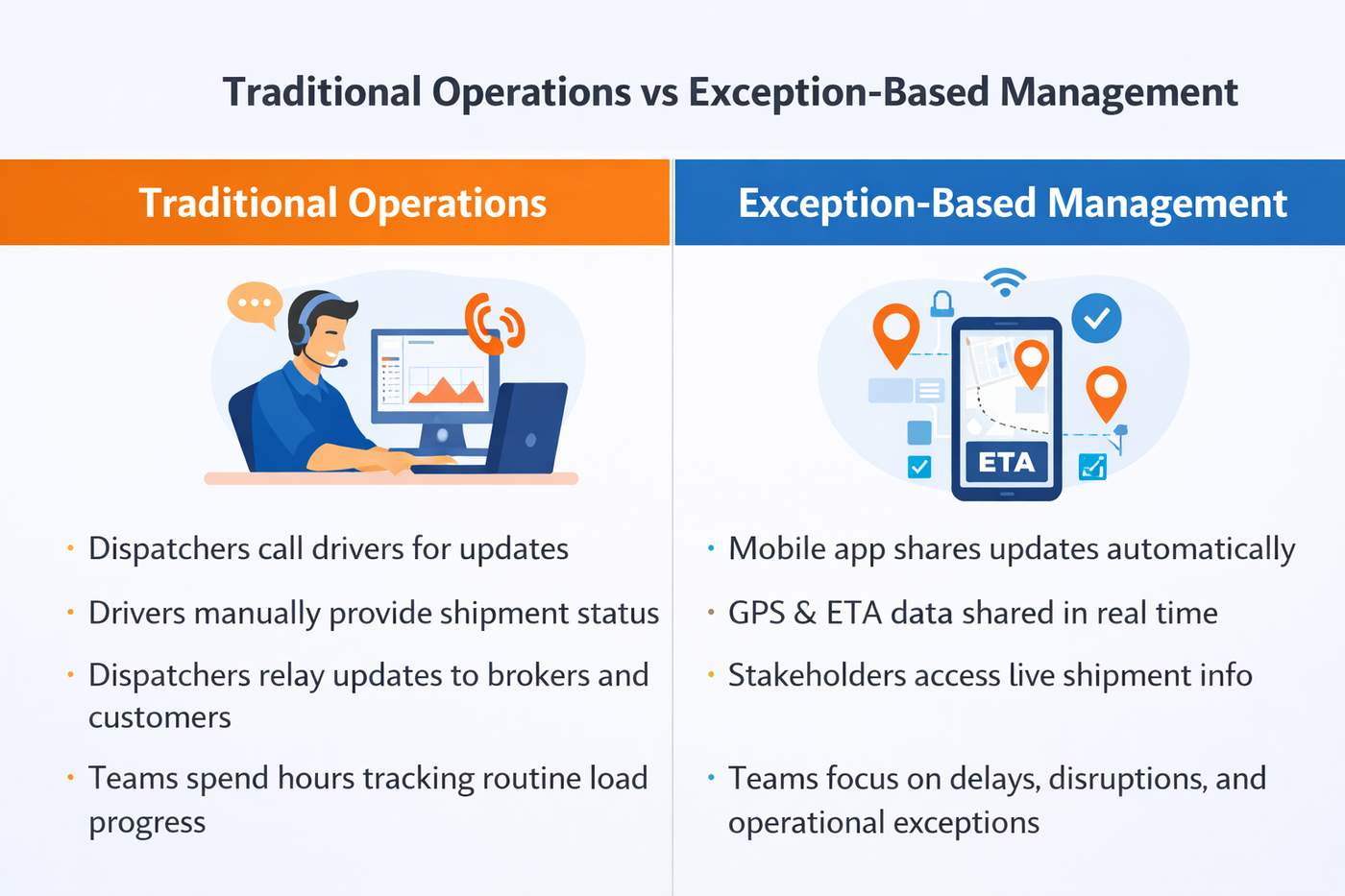
As routine communication decreases, dispatchers spend more time solving problems, supporting drivers, and improving customer service. Instead of chasing updates, they manage exceptions that directly impact operational performance.
Conclusion
For many carriers, check calls are a symptom of limited shipment visibility rather than an operational necessity. When routine updates rely on phone calls, valuable time is lost to repetitive communication instead of higher-value operational work.
A driver mobile app helps close this visibility gap by automating GPS tracking, ETA updates, arrival notifications, and digital Proof of Delivery (POD). As routine shipment updates become automated, dispatchers can focus on managing exceptions, improving customer service, and supporting more efficient fleet operations.
The greatest benefit isn't simply fewer check calls. It's creating a more connected, scalable operation where real-time visibility improves communication, reduces administrative effort, and helps carriers grow with greater confidence.
Ready to Reduce Check Calls?
Before investing in a new solution, evaluate how much time your team spends on routine check calls and manual shipment updates. If communication is slowing your operations, it may be time to explore how a driver mobile app can improve visibility and reduce unnecessary workload.
Solutions like Fast Forward TMS combine real-time GPS tracking, automated status updates, digital Proof of Delivery (POD), and centralized dispatch tools to help carriers streamline operations. Backed by 18+ years of transportation technology expertise, 1,500+ carriers, and SOC 2 Type II compliance, it's built to help growing fleets improve efficiency and scale with confidence.
Frequently Asked Questions
Can a driver mobile app eliminate all check calls?
No. A driver mobile app automates routine updates such as GPS location sharing, ETA updates, arrival notifications, and Proof of Delivery (POD). Operational exceptions like accidents, equipment failures, or route changes still require direct communication.
How quickly can carriers reduce check calls?
Results vary based on fleet size, driver adoption, existing workflows, and system integration. Carriers that consistently use automated tracking and status updates typically see the greatest reduction in routine check calls.
Is a driver mobile app only suitable for large fleets?
No. Small and mid-sized carriers can also improve shipment visibility, reduce dispatcher workload, and streamline communication. Even modest reductions in routine check calls can deliver meaningful operational savings.
What's the biggest benefit beyond reducing check calls?
The greatest long-term benefit is improved operational efficiency. By automating routine shipment updates, dispatchers spend less time tracking loads and more time managing exceptions, supporting drivers, and improving customer service.

Introduction
As transportation operations grow, managing dispatch through spreadsheets, phone calls, emails, and paper records becomes increasingly difficult. As fleets expand and customer expectations increase, transportation companies are investing in digital solutions that improve visibility, efficiency, and operational control.
What may work for a small fleet can quickly create inefficiencies when shipment volumes increase and customer expectations rise.
Manual dispatch often leads to communication delays, data entry errors, limited visibility, and time-consuming administrative work. These challenges not only affect dispatchers and drivers but can also impact customer satisfaction and overall profitability.
To overcome these limitations, many carriers are adopting Transportation Management System (TMS) software. A TMS centralizes dispatch operations, automates routine tasks, improves fleet visibility, and helps transportation companies operate more efficiently.
However, a successful transition requires more than simply purchasing software. Carriers need a clear plan to evaluate their processes, prepare their teams, and implement the system effectively. This guide outlines the key steps involved in moving from manual dispatch to TMS software and how transportation companies can make the transition with confidence.
What Is Dispatch Software?
Dispatch software is a digital solution that helps transportation companies manage loads, drivers, vehicles, routes, and customer communications from a centralized platform. Instead of relying on spreadsheets, phone calls, emails, and paper records, dispatch teams can access real-time information and coordinate operations more efficiently.
Modern dispatch software often includes features such as load management, driver communication, fleet tracking, document management, billing support, and reporting tools. Many transportation companies use Transportation Management System (TMS) software to automate routine tasks, improve visibility, and streamline daily operations.
As fleets grow and operations become more complex, dispatch software helps carriers reduce manual work, improve decision-making, and maintain greater control over their transportation processes.
Why Manual Dispatch Is Holding Transportation Companies Back
Manual dispatch processes often develop naturally as transportation businesses grow. Dispatchers rely on familiar tools such as spreadsheets, emails, phone calls, and handwritten notes to manage daily operations. While these methods may seem manageable at first, they can create significant challenges as fleets, drivers, and shipment volumes increase.
Lack of Real-Time Visibility
One of the biggest limitations of manual dispatch is the lack of real-time visibility. Information is often scattered across multiple files, communication channels, and team members. As a result, dispatchers may struggle to quickly determine the status of a load, the location of a driver, or the availability of a vehicle. This limited visibility can slow decision-making and make it difficult to respond to unexpected changes.
Increased Risk of Human Error
Manual processes depend heavily on data being entered and updated correctly. A simple mistake such as entering incorrect load details, assigning the wrong driver, or missing an important update can create operational disruptions. As the volume of shipments grows, the likelihood of errors increases, making manual systems less reliable.
Slower Communication and Decision-Making
Dispatchers act as the communication hub between drivers, customers, and internal teams. When updates are shared through phone calls, emails, and text messages, valuable information can be delayed or overlooked. This slows response times and makes it harder to coordinate operations efficiently, especially when unexpected issues arise.
Limited Ability to Scale Operations
Many transportation companies reach a point where manual dispatch becomes a barrier to growth. Adding more loads often means adding more administrative work, which can overwhelm dispatch teams and reduce productivity. Instead of supporting expansion, manual processes can create bottlenecks that limit a company's ability to take on new business.
As these challenges become more noticeable, transportation companies often begin looking for solutions that can improve efficiency, increase visibility, and support long-term growth. This is where Transportation Management System software starts to make a significant difference.
What a Transportation Management System Changes
A Transportation Management System (TMS) does more than replace spreadsheets and manual processes. It creates a centralized environment where dispatchers, drivers, fleet managers, and office staff can access the information they need from a single platform. This improves coordination across the organization and reduces the administrative burden associated with manual dispatching.
Centralized Dispatch Operations
Instead of managing load information across multiple spreadsheets, emails, and documents, a TMS stores operational data in one place. Dispatchers can quickly view load details, driver availability, equipment status, and shipment progress without switching between different tools. This helps improve efficiency and reduces the risk of missing critical information.
Automated Workflows
Many tasks that traditionally require manual effort can be automated through a TMS. Load assignments, status updates, document management, invoicing, and reporting can be streamlined, allowing dispatchers to spend less time on administrative work and more time managing operations.
Improved Communication Across Teams
A TMS helps keep drivers, dispatchers, and office staff connected through real-time updates and shared information. Instead of relying solely on phone calls and emails, teams can access the latest load and delivery information instantly, helping reduce communication delays and misunderstandings.
Better Visibility and Control
Real-time tracking and reporting capabilities provide transportation companies with greater visibility into their operations. Managers can monitor fleet performance, identify inefficiencies, and make informed decisions based on accurate data rather than assumptions.
The benefits of a TMS are clear, but achieving those benefits requires a structured implementation process. Before selecting a platform or migrating data, transportation companies should first understand how their current dispatch operation works and where the biggest opportunities for improvement exist.
Step-by-Step Process for Moving from Manual Dispatch to TMS Software
Step 1: Assess Your Current Dispatch Workflow
Before implementing a TMS, evaluate how your dispatch process currently operates. Review how loads are assigned, how drivers receive updates, how documents are managed, and how billing information flows through the business. This assessment helps identify inefficiencies and establishes a baseline for measuring future improvements.
Step 2: Identify the Biggest Operational Bottlenecks
Every transportation company faces unique challenges. Some struggle with communication delays, while others deal with manual data entry, limited visibility, or invoicing issues. Identifying these bottlenecks helps prioritize the features and capabilities your new TMS should provide.
Step 3: Define Your TMS Requirements
Once challenges are identified, determine what your business needs from a TMS. Consider dispatch management, fleet tracking, driver communication, billing automation, reporting, compliance tools, and integration requirements. A clear list of priorities makes software selection much easier.
Step 4: Choose the Right TMS Platform
Selecting the right solution requires more than comparing prices. Look for software that aligns with your operational goals, supports future growth, and offers a user-friendly experience. Strong customer support, reliable onboarding, and scalability should also play an important role in the decision.
Step 5: Prepare and Organize Existing Data
Successful implementation depends on accurate data. Before migration, review customer records, driver information, vehicle details, and load history. Cleaning outdated or duplicate records helps ensure the new system starts with reliable information and minimizes future issues.
Step 6: Train Dispatchers, Drivers, and Staff
Technology adoption is often the biggest challenge during implementation. Provide role-specific training and allow employees to become comfortable with the system before full deployment. Effective training improves user confidence and helps maximize the value of the software.
Step 7: Roll Out the System Gradually
Rather than switching everything at once, consider a phased rollout. Start with a specific team, fleet, or workflow and gather feedback during the process. This approach allows businesses to identify potential issues early and make adjustments before expanding implementation.
Step 8: Monitor Performance and Optimize
Implementation is only the beginning. Track key metrics such as dispatch efficiency, driver utilization, delivery performance, and billing turnaround times. Continuous monitoring helps identify new opportunities for improvement and ensures the system continues to support business growth.
Common Challenges During the Transition and How to Overcome Them
Moving from manual dispatch to TMS software can deliver significant benefits, but the transition is not always without challenges. One of the most common obstacles is employee resistance to change. Dispatchers and drivers who are comfortable with existing processes may be hesitant to adopt new technology. Clear communication, hands-on training, and ongoing support can help ease concerns and improve adoption.
Data migration is another challenge. Inaccurate, incomplete, or outdated records can create issues during implementation. Taking time to review and clean data before migration helps ensure a smoother transition.
Some companies also expect immediate results after deployment. While a TMS can quickly improve visibility and efficiency, teams often need time to adapt to new workflows. Setting realistic expectations and focusing on continuous improvement can help organizations achieve long-term success with their new system.
How to Measure TMS Implementation Success
The success of a TMS implementation should be measured using clear performance indicators. Transportation companies often track metrics such as dispatch turnaround time, on-time delivery rates, driver utilization, and billing cycle efficiency. Improvements in these areas can demonstrate the value of the new system.
Customer satisfaction is another important indicator. Faster communication, improved shipment visibility, and more accurate delivery updates often lead to stronger customer relationships. Regularly reviewing performance data helps businesses identify additional opportunities to optimize operations and maximize their return on investment.
The Future of Dispatch Management
The future of dispatch management will be driven by automation, real-time visibility, and data-driven decision-making. As transportation operations become more complex, carriers are increasingly adopting modern TMS platforms to improve efficiency and reduce manual work.
Solutions like Fast Forward TMS are helping fleets adapt to this shift by combining dispatching, tracking, billing, and driver management in a single platform. Backed by 18+ years of transportation industry expertise, trusted by 1,500+ carriers, and designed specifically for carrier-focused operations, the platform helps transportation companies streamline dispatching, tracking, billing, and driver management from a single system.
As technology continues to evolve, carriers that invest in digital dispatch solutions will be better positioned to improve service quality, increase productivity, and stay competitive in a rapidly changing industry.
Conclusion
Manual dispatch processes may be familiar, but they often become inefficient as transportation operations grow. Limited visibility, communication delays, and administrative workloads can prevent carriers from operating at their full potential. By following a structured transition process, transportation companies can successfully move to TMS software and unlock greater efficiency, accuracy, and scalability.
The journey requires careful planning, employee engagement, and ongoing optimization, but the long-term benefits can be substantial. As transportation operations become increasingly data-driven, adopting the right TMS can help carriers improve efficiency today while preparing for the demands of tomorrow.
Introduction
The trucking industry operates on tight margins, where every mile driven and every gallon of fuel consumed directly impacts profitability. Rising fuel costs, increasing customer expectations, and ongoing driver shortages have made operational efficiency a top priority for carriers of all sizes.
Among the many factors that influence a fleet's success, driver performance and fuel efficiency stand out as two of the most important. Productive drivers help ensure on-time deliveries and customer satisfaction, while efficient fuel usage keeps operating expenses under control. However, achieving both goals can be challenging when carriers rely on manual processes, disconnected systems, and limited operational visibility.
This is where a Carrier Transportation Management System (TMS) makes a significant difference. By centralizing dispatching, communication, tracking, reporting, and workflow management, a Carrier TMS helps trucking companies improve driver productivity, optimize fleet operations, and reduce fuel consumption.
Key Takeaways
A Carrier TMS improves communication between dispatchers and drivers.
Automated dispatching reduces driver downtime and increases productivity.
Route optimization helps lower fuel consumption and unnecessary mileage.
Reduced idle time contributes to better fuel efficiency and lower operating costs.
Performance analytics help carriers continuously improve driver performance.
Better load planning increases fleet utilization and operational efficiency.
Improved productivity and fuel savings contribute directly to higher profitability.
What Is a Carrier TMS?
A Carrier Transportation Management System is a software platform designed to help trucking companies manage transportation operations more effectively. It serves as a centralized hub for dispatching, driver communication, load management, tracking, billing, reporting, and compliance activities.
Instead of relying on spreadsheets, phone calls, emails, and multiple disconnected tools, carriers can manage daily operations through a single platform. This creates greater visibility across the organization and enables teams to make faster, more informed decisions.
As transportation operations become increasingly complex, a modern Carrier TMS provides the technology foundation needed to improve efficiency, reduce costs, and support long-term growth.
Why Driver Performance and Fuel Efficiency Matter More Than Ever
Driver performance and fuel efficiency are closely connected to the financial health of a trucking company. High-performing drivers complete deliveries on time, follow optimized routes, communicate effectively, and make better use of available resources. Fuel efficiency, meanwhile, directly affects one of the largest operating expenses within any fleet.
Without the right technology, carriers often struggle with communication delays, inefficient routing, excessive idle time, and limited visibility into driver activities. These challenges can lead to increased fuel consumption, reduced productivity, and lower profitability.
A Carrier TMS helps eliminate many of these operational inefficiencies by providing real-time visibility and automated processes that support better decision-making across the fleet.
How a Carrier TMS Enhances Driver Performance
Real-Time Communication Creates Faster Decision-Making
Clear communication is essential for keeping transportation operations running smoothly. When dispatchers and drivers rely on phone calls, text messages, or multiple communication channels, delays and misunderstandings can occur.
A Carrier TMS provides a centralized communication platform where dispatchers can instantly share load assignments, route updates, delivery instructions, and operational changes. Drivers receive accurate information in real time, allowing them to respond quickly and avoid unnecessary disruptions.
This streamlined communication process helps improve coordination, reduce delays, and create a more productive working environment for drivers.
Automated Dispatching Reduces Driver Downtime
Manual dispatching often creates delays that leave drivers waiting for assignments instead of moving freight. These delays reduce productivity and can negatively impact revenue generation.
A Carrier TMS automates dispatching by matching available drivers with suitable loads based on location, equipment availability, schedules, and operational requirements. This allows carriers to allocate resources more efficiently and reduce unproductive waiting time.
As a result, drivers spend more time transporting freight and less time waiting for instructions, helping improve overall fleet performance.
Digital Workflows Eliminate Administrative Delays
Many drivers spend a considerable amount of time handling paperwork, submitting documents, and updating shipment information manually. While these tasks are necessary, they often reduce productive driving hours.
Modern Carrier TMS platforms replace paper-based processes with digital workflows. Drivers can access trip information, submit proof of delivery, upload documents, and update shipment statuses directly from mobile devices.
By reducing administrative burdens, carriers enable drivers to focus on transportation activities while improving operational accuracy and efficiency.
Performance Analytics Support Continuous Improvement
Improving driver performance requires access to reliable data. Without measurable insights, it becomes difficult to identify strengths, address weaknesses, or track progress over time.
A Carrier TMS provides detailed performance metrics related to productivity, on-time delivery rates, route adherence, utilization levels, and operational efficiency. Fleet managers can use these insights to recognize top-performing drivers and provide targeted coaching where improvements are needed.
This data-driven approach encourages continuous improvement and helps build a more efficient transportation operation.
How a Carrier TMS Improves Fuel Efficiency
Route Optimization Minimizes Unnecessary Miles
Route planning has a direct impact on fuel consumption. Even small inefficiencies can result in significant fuel expenses when multiplied across an entire fleet.
A Carrier TMS helps carriers identify more efficient routes by considering delivery schedules, available resources, geographic constraints, and operational requirements. Optimized routing reduces unnecessary mileage and helps drivers complete deliveries more efficiently.
Over time, these improvements contribute to lower fuel costs and stronger operational performance.
Reduced Idle Time Leads to Lower Fuel Consumption
Excessive idle time remains a common source of fuel waste in the trucking industry. Drivers often spend valuable time waiting at customer facilities, warehouses, or distribution centers with engines running.
A Carrier TMS provides greater visibility into transportation workflows, helping dispatchers identify delays and improve scheduling accuracy. Better coordination between drivers, dispatchers, and customers helps minimize unnecessary waiting periods.
Reducing idle time not only lowers fuel consumption but also helps reduce engine wear and maintenance expenses.
Better Load Planning Maximizes Fleet Utilization
Inefficient load planning can result in partially utilized trailers, additional trips, and unnecessary fuel expenses. These inefficiencies increase operating costs while reducing overall fleet productivity.
A Carrier TMS improves load planning by providing visibility into available capacity, shipment requirements, and fleet resources. This enables carriers to maximize equipment utilization and move more freight with fewer trips.
Improved load planning supports both fuel efficiency and operational profitability.
Driver Behavior Monitoring Encourages Fuel-Efficient Driving
Driving habits significantly influence fuel consumption. Behaviors such as speeding, aggressive acceleration, hard braking, and excessive idling can increase fuel usage and operating costs.
A Carrier TMS helps managers identify performance trends and monitor operational data that may indicate inefficient driving practices. With access to these insights, carriers can implement coaching programs that encourage safer and more fuel-efficient driving habits.
Over time, these improvements contribute to measurable fuel savings across the fleet.
Additional Benefits Beyond Fuel Savings
While driver productivity and fuel efficiency are major advantages, a Carrier TMS delivers value throughout the organization. Enhanced visibility allows carriers to provide more accurate shipment updates, improve customer service, and respond quickly to operational issues.
Automation reduces manual workloads for dispatchers, fleet managers, and administrative teams, enabling them to focus on strategic activities rather than repetitive tasks. Centralized reporting also improves decision-making by providing access to accurate operational data.
These benefits help carriers operate more efficiently while maintaining a higher level of service.
Why Growing Carriers Are Investing in Modern TMS Solutions
The transportation industry continues to evolve as customer expectations increase and competition intensifies. Carriers that rely on manual processes often struggle to maintain efficiency and profitability as their operations expand.
Modern Carrier TMS solutions provide the visibility, automation, and operational intelligence needed to support sustainable growth. By improving resource utilization, reducing inefficiencies, and enabling data-driven decision-making, these platforms help carriers remain competitive in a rapidly changing market.
For many trucking companies, investing in a Carrier TMS is no longer simply a technology upgrade. It is a strategic investment that supports long-term operational success.
Choosing the Right Carrier TMS for Long-Term Success
Not all transportation management systems are designed specifically for carriers. When evaluating a TMS, trucking companies should look for a solution that supports dispatching, driver communication, fleet visibility, billing, reporting, and workflow automation.
Carrier-focused platforms like Fast Forward TMS are built to help fleets operate more efficiently through automated dispatching, real-time truck tracking, driver mobile access, integrated billing and payroll, and fuel management tools. Trusted by over 1,500 transportation businesses and backed by 18+ years of industry expertise, Fast Forward TMS helps carriers reduce manual workloads, improve operational visibility, and make smarter decisions.
As operations grow, investing in the right Carrier TMS can help companies improve productivity, control costs, and build a stronger foundation for long-term success.
Conclusion
Driver performance and fuel efficiency play a critical role in the success of any trucking operation. Improving these areas can lead to lower operating costs, stronger customer satisfaction, and increased profitability.
A modern Carrier TMS provides the tools carriers need to achieve these goals. Through better communication, automated dispatching, optimized routing, improved load planning, and data-driven performance insights, transportation companies can create more efficient and productive operations.
As the trucking industry continues to embrace digital transformation, carriers that leverage advanced TMS technology will be better positioned to improve performance, control costs, and build a foundation for long-term growth.
Running a successful trucking operation requires more than simply moving freight from one destination to another. As fleets grow, so do the challenges associated with dispatching, driver communication, compliance management, invoicing, and operational visibility. For many small and mid-sized carriers, managing these responsibilities manually can quickly become time-consuming and difficult to scale.
This is where a Carrier Transportation Management System (TMS) can make a significant difference. The right platform can help streamline operations, improve efficiency, and provide greater control over daily activities. However, with numerous options available in the market, selecting the right solution can feel overwhelming.
To make the decision easier, fleet owners should focus on their operational needs, growth objectives, and the features that will deliver the greatest long-term value. This guide outlines the key factors to consider when choosing a carrier TMS and how to identify a solution that supports both current operations and future growth.
Key Takeaways
Start by identifying the operational challenges your fleet needs to solve.
Choose a carrier TMS that is easy for dispatchers, drivers, and office staff to use.
Prioritize features such as dispatch management, real-time visibility, billing automation, and compliance support.
Compare providers based on scalability, support, and long-term business value rather than price alone.
Avoid solutions that only meet your current needs and cannot support future growth.
Carrier-focused platforms like Fast Forward TMS can help streamline operations while providing tools designed specifically for trucking fleets.
Why Small and Mid-Sized Fleets Need a Carrier TMS
As trucking operations grow, managing dispatches, drivers, compliance, invoicing, and customer communication becomes increasingly challenging. What may work for a small operation can quickly become inefficient as load volumes increase and administrative demands grow.
A carrier TMS helps centralize these workflows, giving fleets greater visibility, better operational control, and the ability to scale more efficiently. For many growing carriers, the right TMS becomes the foundation for long-term success.
A Step-by-Step Guide to Choosing the Right Carrier TMS
Choosing a carrier TMS is not simply about comparing features or pricing. Small and mid-sized fleets should evaluate software based on operational needs, future growth plans, usability, and overall business value.
Ease of Use
The best TMS is one that your team will actually use. Dispatchers, drivers, and office staff should be able to navigate the platform without extensive training. A user-friendly system improves adoption and helps teams become productive faster.
Dispatch Management
Dispatching is at the center of every trucking operation. Look for a platform that makes it easy to assign loads, manage schedules, and maintain visibility across daily activities. Efficient dispatching can improve productivity and reduce operational delays.
Real-Time Visibility
Access to real-time information allows fleet managers to monitor truck locations, load statuses, and operational performance. Better visibility leads to faster decision-making and improved customer service.
Driver Communication
Strong communication tools help keep drivers and dispatchers connected throughout the transportation process. Faster information sharing reduces delays and improves coordination.
Billing and Settlements
A quality TMS should simplify invoicing, settlements, and payment tracking. Automated financial workflows help reduce manual work while supporting healthier cash flow.
Compliance Support
Compliance remains a critical responsibility for trucking companies. The right system should help organize records, track important deadlines, and support regulatory requirements.
Reporting and Analytics
Data-driven decisions are essential for growth. Reporting tools provide insights into fleet performance, helping managers identify opportunities to improve efficiency and profitability.
Scalability
A TMS should support not only your current operation but also your future growth. As fleets expand, a scalable platform helps avoid costly software changes and operational disruptions.
How to Compare Carrier TMS Providers
Once you have identified your requirements, the next step is comparing providers. Look beyond feature lists and marketing claims to understand how each platform fits your operational workflows.
Consider factors such as implementation support, customer service, scalability, integrations, and overall ease of use. Product demonstrations and trial periods can provide valuable insight into how the software will perform in real-world operations.
Common Mistakes to Avoid When Choosing a Carrier TMS
One of the most common mistakes is selecting software based solely on price. While affordability matters, choosing a platform that cannot support future growth often leads to higher costs later.
Another mistake is overlooking user experience. If dispatchers, drivers, and office staff struggle to use the platform, adoption becomes difficult and the software delivers less value. Carriers should also evaluate onboarding and customer support to ensure a smooth implementation process.
A Real-World Example of a Carrier-Focused TMS
Fast Forward TMS is a carrier-focused transportation management platform designed to help small and mid-sized fleets manage dispatching, fleet visibility, driver communication, billing, compliance, and reporting from a single system. Backed by 18+ years of transportation industry expertise and trusted by more than 1,500 companies, the platform is built to support the day-to-day needs of growing carriers.
One of its standout features is Load Offer Negotiation, which allows carriers to negotiate freight rates directly within the platform. Combined with real-time tracking, driver mobile tools, payroll management, and analytics, Fast Forward TMS helps fleets reduce manual work, improve operational efficiency, and support long-term growth.
Conclusion
Selecting a carrier TMS is not just about adopting new technology. It is about choosing a solution that supports your fleet's day-to-day operations while preparing your business for future growth. The right platform should simplify workflows, improve visibility, enhance communication, and reduce administrative burdens across the organization.
By focusing on your operational needs, evaluating providers carefully, and prioritizing long-term value over short-term cost savings, small and mid-sized fleets can make a more confident software investment. A well-chosen carrier TMS can help create a more efficient, scalable, and competitive trucking operation for years to come.
FAQs
What is a carrier TMS?
A carrier TMS is a transportation management system designed specifically for trucking companies. It helps manage dispatching, driver communication, billing, compliance, tracking, and other day-to-day transportation operations.
How do I choose the right carrier TMS for my fleet?
Start by identifying your operational challenges and business goals. Then evaluate platforms based on ease of use, dispatch capabilities, visibility, scalability, customer support, and long-term value.
What features should small fleets look for in a carrier TMS?
Small fleets should prioritize dispatch management, real-time tracking, driver communication, billing automation, compliance support, and reporting capabilities.
Why is scalability important when selecting a TMS?
As fleets grow, operational complexity increases. A scalable TMS can support additional trucks, drivers, customers, and loads without requiring a complete system change.
Is a carrier TMS different from fleet management software?
Yes. Fleet management software primarily focuses on vehicle tracking and maintenance, while a carrier TMS is designed to manage transportation operations such as dispatching, load management, billing, settlements, and driver communication.
Introduction
The trucking industry continues to face rising fuel costs, increasing compliance requirements, driver shortages, and growing operational complexity. At the same time, carriers are expected to improve delivery efficiency, reduce operational expenses, and maintain profitability in a highly competitive transportation market.
Many trucking companies still rely on spreadsheets, phone calls, manual dispatch coordination, and disconnected operational systems. These outdated workflows often create scheduling delays, communication gaps, excessive paperwork, billing inaccuracies, and operational inefficiencies that increase overall transportation costs.
Dispatch software helps trucking companies reduce operational costs by automating transportation workflows, improving fleet visibility, streamlining communication, and centralizing dispatch operations. As freight operations continue scaling, modern dispatch technology has become essential for improving operational efficiency and long-term business performance.
Key Takeaways
Dispatch software reduces manual operational tasks across trucking workflows.
Automated dispatching improves scheduling accuracy and operational coordination.
Route optimization helps reduce fuel costs and unnecessary mileage.
Real-time tracking improves fleet visibility and delivery management.
Digital workflows reduce paperwork and administrative overhead.
Centralized communication improves coordination between dispatchers and drivers.
Carrier-focused dispatch platforms help trucking companies scale operations more efficiently.
What Is Dispatch Software in Trucking?
Dispatch software is a transportation management solution that helps trucking companies manage freight operations, load assignments, driver communication, route planning, truck tracking, documentation, and billing workflows from a centralized platform.
Instead of relying on manual coordination, dispatch software automates operational processes and improves visibility across transportation operations. Modern dispatch platforms help carriers simplify daily workflows while improving efficiency across dispatch management and fleet coordination.
Why Operational Costs Are Increasing in Trucking
Operational expenses continue rising for many trucking businesses because of inefficient workflows, limited operational visibility, and excessive manual coordination.
Manual Dispatch Operations
Dispatchers manually assigning loads through spreadsheets, emails, and phone calls often experience slower workflows, scheduling conflicts, and operational delays that negatively affect overall efficiency.
Fuel Inefficiencies
Poor route planning, excessive idle time, and unnecessary mileage significantly increase fuel-related operational expenses across trucking operations. Even small reductions in empty miles and idle time can create noticeable savings for growing carriers operating multiple trucks daily.
Administrative Burden
Paper-based workflows for invoicing, settlements, freight documentation, and compliance records increase administrative workload while slowing operational efficiency. Manual processing also increases the chances of documentation errors and delayed payments.
Communication Challenges
Lack of centralized communication between dispatchers and drivers can create missed updates, delivery delays, and operational confusion during freight movement.
Limited Fleet Visibility
Without real-time tracking, carriers often struggle to monitor truck movement, delivery timelines, operational bottlenecks, and driver activity effectively.
How Dispatch Software Reduces Operational Costs
Automates Dispatch Workflows
Dispatch software reduces the amount of time dispatchers spend coordinating loads manually, updating schedules, and communicating operational changes.
Automated workflows improve scheduling efficiency, load assignment accuracy, freight coordination, and dispatch responsiveness. This allows trucking companies to manage growing freight volumes without significantly increasing administrative staffing requirements.
Helps Reduce Fuel Expenses
Fuel remains one of the largest operational expenses in trucking operations.
Dispatch software improves route planning, reduces unnecessary mileage, minimizes idle time, and helps dispatchers make faster operational decisions through real-time tracking and operational visibility.
Better route optimization directly supports lower transportation costs and improved profitability across day-to-day trucking operations.
Reduces Administrative Overhead
Manual paperwork and repetitive operational tasks consume significant time across trucking businesses.
Dispatch software helps streamline freight documentation, settlements, invoicing, billing workflows, and compliance management through centralized digital processes.
Reducing paperwork improves operational speed, lowers processing errors, and helps transportation teams operate more efficiently without adding unnecessary administrative complexity.
Improves Fleet Utilization
Real-time operational visibility helps carriers use trucks, drivers, and transportation resources more effectively.
Improved fleet utilization allows trucking companies to optimize load planning, improve delivery coordination, reduce downtime, and increase operational productivity without dramatically increasing operational expenses.
More efficient fleet usage also helps carriers maximize revenue opportunities from existing operational resources.
Minimizes Operational Errors
Manual dispatch workflows often create operational mistakes such as duplicate load assignments, scheduling conflicts, missed deliveries, incorrect paperwork, and billing inaccuracies.
Dispatch software centralizes operational data and reduces human errors that negatively impact profitability, customer satisfaction, and overall workflow efficiency.
Improves Driver Coordination
Drivers perform more efficiently when communication is centralized and operational updates are easier to access.
Modern dispatch platforms improve driver coordination through mobile dispatch access, digital paperwork, real-time updates, and simplified communication workflows.
Improved driver productivity helps reduce delays, improve delivery consistency, and support smoother transportation operations.
The Importance of Real-Time Fleet Visibility
Real-time tracking provides dispatchers with better control over transportation operations and delivery coordination.
With centralized fleet visibility, carriers can monitor truck locations, identify delays earlier, improve delivery accuracy, reduce unnecessary stops, and make faster operational decisions when unexpected issues arise.
Better operational visibility helps reduce transportation inefficiencies while improving customer service reliability and operational accountability.
How Centralized Dispatch Platforms Improve Operational Efficiency
Many trucking companies use disconnected systems for dispatching, communication, billing, settlements, and fleet management. This fragmented operational structure often creates unnecessary complexity and operational inefficiencies across transportation workflows.
Modern carrier-focused dispatch platforms help centralize operations, improve dispatch visibility, reduce paperwork, and simplify coordination between dispatchers and drivers.
Solutions backed by 7+ years of transportation software experience and deep trucking industry expertise often provide more scalable operational workflows, stronger dispatch coordination, and improved operational control for growing carriers.
Signs Your Trucking Business Needs Dispatch Software
Your trucking business may benefit from dispatch software if you regularly experience dispatch confusion, delayed invoicing, excessive paperwork, poor fleet visibility, high fuel expenses, communication gaps with drivers, settlement delays, or operational challenges while scaling freight operations.
As trucking businesses grow, manual operational workflows often become barriers to profitability and operational efficiency.
Future of Dispatch Technology in Trucking
The trucking industry continues moving toward automation, digital transportation operations, and real-time operational visibility.
Modern dispatch software is evolving through AI-powered route optimization, predictive operational analytics, cloud-based transportation management, automated workflow systems, and mobile-first dispatch coordination.
Carriers adopting modern dispatch technology are better positioned to improve operational efficiency, reduce transportation costs, and remain competitive in an increasingly technology-driven trucking industry.
Conclusion
Dispatch software plays a critical role in helping trucking companies reduce operational costs and improve transportation efficiency. By automating dispatch workflows, improving route planning, centralizing communication, reducing paperwork, and increasing fleet visibility, carriers can streamline operations while improving profitability.
As freight operations continue becoming more complex, modern dispatch technology has become essential for carriers looking to improve operational control, scalability, and long-term transportation performance.
Carrier-focused transportation management platforms such as Fast Forward TMS help trucking companies simplify dispatch workflows, improve fleet coordination, and reduce operational inefficiencies through centralized transportation management systems.
The trucking industry operates on tight margins, rising fuel costs, increasing customer expectations, and constant operational pressure. For carriers, managing freight efficiently is no longer only about moving loads from one location to another. Success now depends on visibility, data-driven decisions, and operational performance tracking.
Many trucking companies still struggle with disconnected spreadsheets, delayed reporting, manual dispatch coordination, and limited operational visibility. Without accurate performance data, carriers often face problems such as higher operational costs, lower fleet utilization, delayed deliveries, increased empty miles, and inconsistent driver productivity.
This is where a modern Transport Management System (TMS) becomes essential.
A Transport Management System helps carriers centralize dispatch operations, improve freight visibility, automate workflows, and track critical operational metrics in real time. These performance metrics, commonly known as Key Performance Indicators (KPIs), help carriers identify inefficiencies, improve profitability, and make smarter operational decisions.
Tracking the right KPIs allows carriers to optimize fleet performance, reduce operational waste, improve customer service, and scale operations more efficiently.
Key Takeaways
KPI tracking helps carriers improve operational visibility and decision-making.
A Transport Management System centralizes freight, dispatch, and performance data.
Real-time KPI monitoring helps reduce operational inefficiencies and delays.
Fleet utilization tracking improves truck productivity and revenue generation.
Deadhead mile analysis helps reduce unnecessary fuel expenses.
On-time delivery metrics improve customer satisfaction and service reliability.
Driver performance tracking supports safer and more efficient operations.
Fuel efficiency monitoring helps carriers control rising operational costs.
Modern TMS platforms help carriers make data-driven operational improvements.
Why KPI Tracking Matters in Modern Trucking Operations
The transportation industry has become increasingly competitive. Carriers are expected to deliver freight faster while managing rising operating costs, driver shortages, maintenance expenses, fuel volatility, and tighter delivery windows.
Without measurable operational data, carriers often rely on assumptions instead of real performance insights. This makes it difficult to identify operational bottlenecks or improve dispatch efficiency.
Tracking KPIs through a Transport Management System gives carriers better visibility into daily operations, fleet performance, freight movement, and driver productivity. Instead of reacting to problems after they occur, carriers can proactively identify inefficiencies and make operational adjustments in real time.
For growing trucking companies, KPI tracking is critical for improving scalability, profitability, and long-term operational performance.
What Is a KPI in Transportation Management?
A Key Performance Indicator (KPI) is a measurable value used to evaluate operational performance. In trucking and logistics, KPIs help carriers monitor how efficiently freight operations are being managed.
These metrics provide insights into dispatch performance, delivery timelines, fuel usage, driver productivity, route efficiency, maintenance planning, and overall fleet utilization.
A modern Transport Management System automatically tracks and organizes these operational metrics, helping carriers access real-time performance data through centralized dashboards and reporting tools.
Instead of manually collecting information from multiple systems, carriers can monitor operational health from one platform.
Top 7 KPIs Every Carrier Should Track
1. On-Time Delivery Rate
On-time delivery rate measures how consistently shipments are delivered within the scheduled delivery window.
This is one of the most important KPIs for carriers because delivery reliability directly impacts customer satisfaction, broker relationships, and long-term freight opportunities.
Frequent late deliveries can lead to customer complaints, financial penalties, and reduced carrier credibility.
A Transport Management System helps carriers track pickup schedules, route progress, delays, and estimated arrival times in real time. This improves dispatch coordination and allows operations teams to respond quickly when delays occur.
Carriers with strong on-time delivery performance often build stronger customer relationships and improve freight retention.
2. Fleet Utilization Rate
Fleet utilization measures how effectively trucks and drivers are being used during operations.
Low fleet utilization often indicates operational inefficiencies such as poor dispatch planning, excessive idle time, scheduling gaps, or underused equipment.
A Transport Management System provides better visibility into truck availability, driver assignments, route scheduling, and freight movement. This helps dispatchers assign loads more efficiently and maximize truck productivity.
Improving fleet utilization allows carriers to increase revenue without expanding fleet size unnecessarily.
3. Deadhead Miles
Deadhead miles refer to the distance trucks travel without carrying freight.
High deadhead mileage increases fuel expenses, reduces operational efficiency, and lowers profitability. For many carriers, reducing empty miles is one of the fastest ways to improve operational performance.
A Transport Management System helps dispatchers identify nearby freight opportunities, optimize route planning, and improve load coordination based on driver location and truck availability.
Smarter freight planning reduces unnecessary empty trips while improving fuel efficiency and truck productivity.
4. Fuel Efficiency
Fuel costs represent one of the largest operational expenses in trucking.
Tracking fuel efficiency helps carriers identify inefficient routes, excessive idling, aggressive driving behavior, and operational waste that increases fuel consumption.
Modern Transport Management Systems provide real-time fleet tracking, route visibility, and operational reporting that help carriers improve route planning and monitor fuel-related performance trends.
Better fuel efficiency directly improves profit margins while supporting more sustainable fleet operations.
5. Load Acceptance Rate
Load acceptance rate measures how frequently drivers accept dispatched freight assignments.
Low acceptance rates can indicate problems such as poor communication, unrealistic schedules, inefficient pricing, or operational dissatisfaction among drivers.
A Transport Management System improves load coordination by centralizing dispatch communication, driver availability tracking, and freight visibility. This allows dispatchers to assign loads more efficiently while improving communication with drivers.
Higher load acceptance rates help carriers reduce delays, improve dispatch consistency, and maximize freight movement.
6. Driver Performance Metrics
Driver performance tracking helps carriers monitor operational behavior, safety performance, delivery consistency, route efficiency, and productivity.
Monitoring driver performance allows carriers to identify coaching opportunities, improve safety compliance, reduce operational risks, and support more efficient driving habits.
A Transport Management System can help carriers monitor:
delivery consistency
route adherence
idle time
communication response times
operational efficiency
safety-related performance trends
Improved driver performance contributes to safer operations, lower costs, and better customer service.
7. Freight Cost Per Mile
Freight cost per mile measures how much carriers spend to move freight across operational routes.
This KPI helps carriers evaluate profitability by analyzing expenses such as fuel, maintenance, labor, tolls, and operational overhead against freight revenue.
A Transport Management System centralizes operational cost tracking and reporting, helping carriers identify inefficient routes, unprofitable freight lanes, and cost-heavy operations.
Tracking freight cost per mile allows carriers to make smarter pricing, routing, and operational decisions that improve profitability.
How a Transport Management System Improves KPI Visibility
Many carriers struggle to track operational performance accurately because data is spread across multiple systems, spreadsheets, phone calls, and manual reporting processes.
A modern Transport Management System centralizes operational data into one platform, giving carriers real-time visibility into dispatch operations, fleet activity, freight movement, and driver performance.
With automated reporting and live operational dashboards, carriers can:
monitor operational trends in real time
improve dispatch visibility
identify inefficiencies faster
optimize route planning
improve communication workflows
support data-driven decision-making
This creates a more scalable and organized operational environment for growing fleets.
How Fast Forward TMS Helps Carriers Track Operational Performance
Fast Forward TMS helps carriers improve operational visibility through centralized dispatch management, real-time tracking, reporting tools, and smarter freight coordination workflows designed specifically for trucking operations.
The platform helps carriers monitor critical operational metrics such as fleet utilization, freight movement, delivery performance, driver coordination, and dispatch efficiency from one centralized system.
With 18+ years of transportation technology expertise and 1,500+ companies trusting the platform, Fast Forward TMS helps carriers reduce manual workload, improve operational organization, and make faster data-driven decisions through real-time operational visibility.
For growing trucking fleets, centralized KPI tracking helps improve efficiency, scalability, and long-term operational performance.
Final Thoughts
Modern trucking operations depend heavily on operational visibility and performance optimization. Carriers that fail to track key operational metrics often struggle with rising costs, lower productivity, delayed deliveries, and inefficient dispatch coordination.
Tracking the right KPIs through a Transport Management System helps carriers identify operational inefficiencies, improve fleet performance, reduce costs, and make smarter business decisions.
From reducing deadhead miles to improving on-time delivery performance, KPI monitoring allows carriers to create more efficient, scalable, and profitable trucking operations.
As the transportation industry continues evolving, data-driven decision-making will become increasingly important for carriers looking to stay competitive and improve operational efficiency.
Frequently Asked Questions
What Are KPIs in Transportation Management?
KPIs in transportation management are measurable performance metrics used to evaluate operational efficiency, freight movement, fleet productivity, delivery performance, and operational costs.
Why Is KPI Tracking Important for Carriers?
KPI tracking helps carriers identify operational inefficiencies, improve decision-making, reduce costs, optimize fleet performance, and improve customer service through real-time operational visibility.
What Is the Most Important KPI for Trucking Companies?
Several KPIs are important, but common high-priority metrics include on-time delivery rate, fleet utilization, fuel efficiency, deadhead miles, and freight cost per mile.
How Does a Transport Management System Help Track KPIs?
A Transport Management System centralizes operational data, automates reporting, provides real-time visibility, and helps carriers monitor performance metrics through dashboards and analytics tools.
How Can Carriers Reduce Deadhead Miles?
Carriers can reduce deadhead miles by improving load planning, optimizing routes, using real-time fleet visibility, and assigning nearby freight more efficiently through a Transport Management System.
Why Is Fleet Utilization Important?
Fleet utilization measures how effectively trucks and drivers are being used. Higher utilization helps carriers improve productivity and generate more revenue from existing fleet resources.
Can Small Trucking Fleets Benefit From KPI Tracking?
Yes. Small fleets can use KPI tracking to improve operational visibility, reduce inefficiencies, optimize dispatch workflows, and support long-term business growth.
How Does Fast Forward TMS Help Improve Operational Visibility?
Fast Forward TMS helps carriers centralize dispatch operations, monitor fleet activity, track freight movement, improve communication workflows, and access real-time operational reporting through one platform.
Introduction
The logistics and trucking industry is undergoing a major transformation. Traditional systems that relied heavily on manual processes, spreadsheets, and fragmented tools are no longer sufficient. As freight volumes grow and operational complexity increases, carriers are turning to smarter technologies.
This is where Artificial Intelligence (AI) and data analytics are reshaping modern Carrier Transportation Management Systems (TMS).
Today’s TMS platforms are no longer just operational tools. They are becoming intelligent systems that help carriers make faster decisions, reduce costs, and scale efficiently.
What is a Modern Carrier TMS?
A Carrier TMS is software designed to manage daily trucking operations such as dispatching, load management, driver communication, billing, and compliance.
Modern TMS platforms go beyond basic functionality by integrating:
Automated workflows
Data-driven decision making
Predictive insights
The addition of AI and analytics turns these systems into powerful decision engines rather than just management tools.
Role of AI in Carrier TMS Software
1. Intelligent Load Matching
AI helps match loads with available trucks more efficiently by analyzing:
Location
Driver availability
Route optimization
Historical performance
This reduces empty miles and improves asset utilization.
2. Predictive Demand Forecasting
AI can analyze past shipment data, seasonal trends, and market demand to predict future load requirements.
Benefits include:
Better planning
Reduced downtime
Improved capacity management
3. Automated Dispatching
AI-powered dispatch systems can automatically assign loads based on predefined rules and real-time conditions.
This reduces:
Manual effort
Human errors
Dispatch delays
4. Risk Detection and Fraud Prevention
AI can identify unusual patterns in invoices, payments, or operations.
It helps in:
Detecting fraud
Flagging inconsistencies
Improving financial security
Role of Analytics in Carrier TMS
1. Real-Time Visibility
Analytics dashboards provide a clear view of:
Fleet performance
Delivery timelines
Driver productivity
This allows businesses to respond quickly to operational issues.
2. Performance Tracking
Carriers can track KPIs such as:
Cost per mile
On-time delivery rates
This helps identify areas for improvement.
3. Data-Driven Decision Making
Instead of relying on guesswork, analytics enables:
Better pricing strategies
Smarter route planning
Efficient resource allocation
4. Financial Insights
Advanced analytics provides clarity on:
Revenue trends
Profit margins
Payment cycles
This improves cash flow management and financial planning.
Key Benefits of AI and Analytics in Carrier TMS
Improved Operational Efficiency
Automation reduces repetitive tasks and speeds up workflows.
Cost Reduction
Better routing and load planning lower fuel and operational costs.
Faster Decision Making
Real-time insights allow quicker and more accurate decisions.
Scalability
Businesses can handle higher volumes without increasing manual workload.
Better Customer Experience
Improved tracking and timely deliveries enhance customer satisfaction.
Challenges in Adoption
While AI and analytics bring significant benefits, there are challenges:
Initial implementation cost
Data integration from multiple sources
Training teams to use advanced systems
Resistance to change from traditional workflows
However, the long-term benefits outweigh these challenges.
Future of AI in Carrier TMS
The future of Carrier TMS will be even more intelligent and automated.
We can expect:
Fully autonomous dispatch systems
Advanced predictive maintenance for fleets
AI-driven pricing models
Deeper integration with financial and supply chain systems
As technology evolves, carriers that adopt AI early will gain a strong competitive advantage.
Conclusion
AI and analytics are no longer optional in modern Carrier TMS software. They are becoming essential for efficiency, scalability, and profitability.
Carriers that continue relying on manual systems risk falling behind in a highly competitive industry. On the other hand, those embracing intelligent systems can unlock better performance, smarter decision-making, and long-term growth.
The shift is already happening. The question is not whether to adopt AI in TMS, but how soon.
Introduction
In modern fleet operations, communication is no longer just coordination. It directly influences delivery timelines, compliance accuracy, and overall profitability.
However, many small and mid-sized fleets still operate with disconnected systems where driver updates, dispatch instructions, and compliance workflows are not synchronized in real time. This lack of alignment creates operational friction across the entire load lifecycle, from dispatch to final delivery.
For fleets managing high load volumes, even minor communication gaps can lead to delayed execution, compliance risks, and measurable revenue loss.
A mobile driver app addresses this challenge by introducing a unified, real-time communication layer that connects drivers with dispatch and compliance systems. It ensures that every instruction, update, and document is captured, tracked, and accessible instantly.
This shift enables fleets to move from fragmented, manual processes to a more structured, real-time operational model, resulting in improved coordination, stronger compliance control, and more predictable performance.
Key Takeaways
A mobile driver app connects drivers, dispatchers, and back-office teams through a single, real-time communication system, reducing delays and improving coordination.
It replaces fragmented communication methods with a structured, centralized workflow, ensuring clarity across every load and activity.
Digital document capture and automated records make compliance more accurate, consistent, and audit-ready.
Real-time updates and status tracking provide better operational visibility, enabling faster and more informed decision-making.
Standardized communication and workflows significantly reduce errors, miscommunication, and execution delays.
Automation of routine tasks minimizes manual effort, improving both driver productivity and back-office efficiency.
Faster document processing supports quicker invoicing cycles and improved cash flow.
A mobile-first approach enables fleets to scale operations efficiently while maintaining control and consistency.
Explore the Driver Mobile App >https://fastforwardtms.com/features/truck-driver-app/
Why Fleet Communication & Compliance Matter
Even small gaps in communication or compliance can lead to delivery delays, billing issues, and regulatory risks.
For growing fleets, these challenges compound quickly, impacting customer satisfaction, operational efficiency, and revenue predictability.
A connected, real-time system is no longer optional. It is essential for maintaining control, consistency, and scalability in modern fleet operations.
What Is a Mobile Driver App in Fleet Management?
A mobile driver app is a driver-facing interface connected to a Carrier TMS Software that enables real-time coordination between drivers, dispatchers, and compliance teams.
It functions as the execution layer of fleet operations, where drivers receive instructions, update trip status, and submit documents directly from the field, ensuring all activities are captured and synchronized instantly.
Core Capabilities of a Mobile Driver App
Real-Time Dispatch & Load Visibility
Drivers receive load assignments, route details, and updates instantly through Dispatching Software within the app. This ensures they always operate with the most current information, reducing delays caused by manual coordination.
In-App Communication
All communication between drivers and dispatch is centralized within a structured environment. Messages are linked to specific loads, ensuring clarity and maintaining a consistent communication record.
Digital Document Capture
Drivers can upload Proof of Delivery (POD), invoices, and receipts directly through the app. This eliminates paperwork delays and makes documents immediately available for billing and verification.
Status Updates & Tracking
Trip progress is updated in real time through simple status changes, integrated with Truck Tracking Software, giving fleet managers continuous visibility into operations and enabling faster response to disruptions.
Compliance Data Capture
Driver activities, timestamps, and document submissions are automatically recorded, creating a reliable audit trail and reducing manual compliance effort.
How Driver Mobile App Fits Into Modern Fleet Operations
A mobile driver app connects dispatch, communication, and compliance into a single, streamlined workflow.
This ensures real-time data flow across operations, helping fleets improve efficiency, maintain compliance, and scale without increasing operational complexity.
How a Mobile Driver App Improves Fleet-Wide Communication
Real-Time Dispatch & Instant Updates
A mobile driver app ensures that load assignments, route changes, and delivery instructions are delivered instantly to drivers.
This removes dependency on calls and manual follow-ups, allowing drivers to act on updated information immediately and reducing delays across operations.
Centralized & Context-Driven Communication
Instead of scattered conversations across multiple channels, all communication is managed within a single system.
Messages are linked to specific loads, ensuring that drivers always have clear, context-specific instructions and a complete communication history for reference.
Reduced Miscommunication & Execution Errors
Clear, structured communication minimizes the risk of incorrect pickups, missed instructions, or delivery delays.
Standardized workflows ensure that drivers receive consistent information, improving accuracy across the entire load lifecycle.
Faster Issue Reporting & Response
Drivers can instantly report delays, breakdowns, or route issues through the app.
This allows dispatchers to take immediate action, adjust plans, and communicate proactively with customers, reducing operational disruption.
Improved Coordination Across Operations
A mobile driver app aligns drivers, dispatchers, and back-office teams through real-time updates and shared visibility.
This improves coordination across all stages of execution, ensuring smoother workflows and more reliable delivery performance.
How a Mobile Driver App Strengthens Fleet Compliance
Digital Document Submission
A mobile driver app enables drivers to capture and upload Proof of Delivery (POD), invoices, and receipts directly from their device.
This ensures documents are recorded in real time, reducing dependency on physical paperwork and eliminating delays in verification and processing.
Real-Time Compliance Tracking
Fleet managers can monitor document status, driver activity, and workflow completion through a centralized system.
This allows teams to quickly identify missing information or incomplete steps, ensuring compliance requirements are consistently met without last-minute follow-ups.
Automated Record Keeping & Audit Readiness
All driver actions, including timestamps, status updates, and document submissions, are automatically logged.
This creates a structured digital record that simplifies audits, improves traceability, and reduces the risk of missing or inaccurate data.
Reduced Compliance Risk
Manual compliance processes often lead to errors, delays, and gaps in documentation.
By standardizing workflows and capturing data in real time, a mobile driver app helps fleets maintain consistent compliance and avoid penalties or operational disruptions.
Business & Operational Benefits of a Mobile Driver App
Faster Billing & Improved Cash Flow
Real-time document submission and instant Proof of Delivery capture allow fleets to initiate invoicing without delays.
This shortens the gap between delivery and payment, improving cash flow with better insights from Analytics Software and financial predictability.
Higher Driver Productivity
y reducing manual reporting, calls, and paperwork, supported by Easy Onboarding, drivers can focus more on driving and deliveries.
Clear instructions and streamlined workflows minimize downtime and improve overall driver efficiency.
End-to-End Operational Visibility
Fleet managers gain continuous insight into load status, driver activity, and execution progress.
This enables faster decision-making, better planning, and proactive handling of disruptions.
Reduced Administrative Workload
Automated updates and centralized communication eliminate the need for constant follow-ups.
Back-office teams spend less time managing manual tasks and more time on strategic operations.
Scalable & Standardized Operations
As fleets grow, maintaining consistency becomes critical.
A mobile driver app standardizes workflows, communication, and data capture, allowing fleets to scale efficiently without increasing operational complexity.
Best Practices for Implementing a Mobile Driver App
Prioritize Ease of Use
Driver adoption depends on simplicity. A clear interface and minimal steps ensure consistent usage without operational friction.
Integrate with Core Systems
The app should connect seamlessly with dispatch, billing, and compliance systems to ensure a unified workflow and avoid data silos.
Standardize Workflows
Define consistent processes for communication, document submission, and status updates to maintain operational accuracy across all drivers.
Monitor Key Performance Metrics
Track indicators such as response time, document turnaround, and compliance rates to continuously improve efficiency and control.
The Best TMS Driver Mobile App
Choosing the best TMS driver mobile app is essential for maintaining efficient communication, compliance, and operational control across modern fleets.
While the core capabilities and implementation practices have been discussed earlier, selecting the right solution requires bringing these elements together into a single, practical framework.
A high-performing mobile driver app, such as Fast Forward TMS, combines real-time dispatch visibility, centralized in-app communication, and digital document capture to eliminate delays and manual effort. It also supports live status tracking and automated compliance recording, ensuring accurate audit trails and complete operational transparency.
To ensure successful adoption, fleets should focus on a simple and driver-friendly interface, seamless integration with dispatch, billing, and compliance systems, and standardized workflows across operations. Continuously tracking key performance metrics such as response time, document turnaround, and compliance rates further helps optimize efficiency and maintain control.
Ready to Improve Fleet Communication & Compliance?
Start adopting a mobile-first TMS approach to streamline operations, reduce errors, and scale your fleet with confidence.
👉 Book a Demo and See It in Action
Conclusion
Fleet operations are becoming increasingly real-time, data-driven, and compliance-focused. Relying on manual communication and disconnected systems is no longer sustainable.
A mobile driver app enables fleets to:
Improve communication across teams
Strengthen compliance through structured workflows
Gain real-time visibility and operational control
By adopting a mobile-first approach, fleets can build more efficient, scalable, and predictable operations.
Modern fleet platforms support this transition by integrating communication, compliance, and execution into a single connected system. Many fleets already report measurable improvements, with up to 95% experiencing smoother dispatch workflows and over 1,500 companies adopting such systems to scale their operations effectively.
For modern fleets, this is not just an upgrade, it is a competitive advantage.
FAQs
What is a driver mobile app in fleet management?
A mobile driver app is a driver-facing application connected to a Transportation Management System (TMS) that enables real-time communication, load updates, document submission, and compliance tracking across fleet operations.
How does a mobile driver app improve fleet communication?
A mobile driver app improves fleet communication by centralizing interactions between drivers and dispatch, enabling real-time updates, and ensuring all instructions are clearly documented and accessible within a single system.
How does a mobile driver app help with compliance?
A mobile driver app supports compliance by capturing documents digitally, recording driver activities, and maintaining structured audit trails, reducing manual errors and ensuring consistent regulatory adherence.
Can small and mid-sized fleets benefit from a mobile driver app?
Yes, small and mid-sized fleets benefit by improving coordination, reducing manual workload, and gaining real-time operational visibility without adding complexity.
What features should a mobile driver app include?
A mobile driver app should include real-time dispatch updates, in-app communication, document capture, status tracking, and automated compliance recording to support efficient fleet operations.
How do modern fleet platforms support mobile driver apps?
Modern fleet management platforms integrate mobile driver apps with dispatch, billing, and compliance systems, ensuring real-time data flow and enabling more efficient, connected operations.
About the Author
Dr. Nitin Shankar is a logistics technology strategist and Product Owner at Fast Forward TMS, with over 18 years of experience in transportation management systems, carrier finance, and SaaS platform development.
He specializes in building cloud-based solutions for freight carriers and fleet operators, with a focus on dispatch automation, real-time visibility, compliance workflows, and financial optimization. His work helps small and mid-sized fleets improve efficiency, streamline operations, and scale effectively.
Dr. Shankar holds a Ph.D. in Finance and has a background in banking and trade finance, bringing a unique blend of financial and operational expertise to modern fleet management.
Introduction
Fleet efficiency today is no longer limited to moving trucks from point A to point B. In modern fleet operations, success depends on visibility, speed, and data-driven decision-making.
Real-time fleet tracking improves efficiency by providing live visibility, enabling faster decisions, and reducing operational inefficiencies.
One of the most transformative technologies enabling this shift is real-time tracking.
For carriers and fleet operators, real-time tracking is not just a feature. It is a strategic capability that improves operational control, reduces costs, and enhances customer experience at scale.
Key Takeaways
Real-time tracking improves fleet efficiency through live visibility and faster decision-making
It reduces fuel costs, optimizes routing, and improves asset utilization
Traditional tracking systems limit efficiency due to delayed updates and lack of visibility
Integrating tracking with a TMS like Fast Forward TMS enhances operational control and automation
Effective implementation leads to improved profitability, scalability, and long-term performance
What Is Real-Time Tracking in Fleet Management?
Real-time tracking in fleet management refers to the use of GPS and connected systems to monitor the live location, movement, and operational status of vehicles.
It provides fleet operators with continuous visibility into on-road activities, enabling faster and more informed decision-making.
With real-time fleet tracking systems, fleets can:
Track vehicle location instantly
Monitor route progress in real time
Receive live updates on delays or disruptions
Communicate seamlessly with drivers
This level of visibility replaces outdated systems that rely on manual updates and assumptions, creating a more accurate, efficient, and responsive operational environment.
Limitations of Traditional Fleet Tracking Approaches
Before real-time tracking became standard, many fleet operations relied on manual and delayed processes that limited visibility and control.
Traditional fleet tracking systems reduce efficiency because they depend on delayed updates, fragmented communication, and limited real-time visibility into operations.
In many logistics environments, this results in:
Manual check calls for status updates
Delayed or inconsistent communication between drivers and dispatch
Limited visibility into vehicle movement and driver activity
These challenges often lead to inefficient routing, increased fuel consumption, missed delivery windows, and poor customer communication.
As a result, fleet operators are forced to make reactive decisions instead of proactive ones, directly impacting operational efficiency and overall performance.
Key Ways Real-Time Tracking Improves Fleet Efficiency
In today’s logistics landscape, even small inefficiencies can significantly impact performance and profitability. Across modern fleet operations, real-time fleet tracking improves efficiency in several measurable ways by eliminating guesswork and enabling faster, data-driven decisions.
1. Complete Operational Visibility
Fleet managers gain a live view of all vehicles, routes, and activities, enabling better coordination and faster responses to disruptions.
2. Smarter and Faster Dispatch Decisions
Dispatchers can assign loads based on real-time vehicle location using dispatching software and availability, reducing idle time and improving asset utilization.
3. Reduced Fuel Costs and Optimized Routing
By identifying inefficient routes, minimizing idle time, and avoiding traffic disruptions, fleets can significantly reduce fuel expenses with better fuel management.
4. Improved Driver Accountability and Performance
Real-time tracking provides insights into driving behavior, route adherence, and idle time, encouraging safer and more efficient operations.
5. Enhanced Customer Experience
Accurate ETAs and proactive updates allow businesses to provide reliable delivery timelines and better customer communication.
6. Faster Issue Detection and Resolution
Operational issues such as delays or route deviations can be identified instantly and resolved before they impact delivery performance.
Real-World Impact of Real-Time Tracking
In real-world fleet operations, the impact of real-time tracking is both measurable and immediate. Carriers that adopt real-time fleet tracking systems consistently report improvements in efficiency, cost control, and delivery performance.
For example, a mid-sized carrier managing a fleet of approximately 50 trucks implemented real-time tracking integrated with dispatch and load management operations. Within a short period, the company achieved:
15 to 20 percent reduction in fuel costs
Over 25 percent improvement in on-time deliveries
Increased load utilization without expanding fleet size
By identifying idle time, optimizing routes, and enabling faster decision-making, the carrier improved overall productivity while operating with the same resources.
This example highlights how real-time tracking transforms operational efficiency into measurable business outcomes.
Financial Impact: How Real-Time Tracking Improves Profitability
While operational improvements are visible on a daily basis, the financial impact of real-time tracking becomes more evident over time.
Real-time fleet tracking improves profitability by reducing unnecessary costs, increasing efficiency, and enabling better resource utilization.
Across modern fleet operations, it enables businesses to:
Reduce fuel and operational expenses by minimizing idle time and inefficient routing
Increase asset utilization and maximize load efficiency through better load planning and negotiation
Complete more deliveries within the same timeframe
Avoid penalties caused by delays or missed delivery windows
These improvements contribute to stronger margins, improved cash flow, and more predictable financial performance.
By turning operational visibility into actionable insights, real-time tracking helps fleet operators build a more sustainable and scalable business model.
Risks of Operating Without Real-Time Tracking Today
In today’s fast-paced logistics environment, operating without real-time tracking creates significant operational and competitive risks.
Without real-time fleet tracking, businesses lack the visibility needed to make timely and informed decisions.
As a result, fleets may face:
Limited visibility in time-sensitive operations
Inability to respond quickly to delays or disruptions
Reduced competitiveness in high-demand logistics markets
Poor customer experience due to inaccurate delivery updates
These challenges not only impact daily operations but also limit long-term scalability and growth.
As customer expectations and operational complexity continue to increase, the absence of real-time visibility can become a critical disadvantage.
The Role of Modern TMS in Real-Time Tracking
Real-time tracking delivers its full value when integrated into a centralized transportation management system. In modern logistics operations, integrated TMS platforms have become essential for managing complex, multi-vehicle workflows efficiently.
Carrier-focused platforms such as Fast Forward TMS combine real-time tracking, dispatch, billing, and analytics into a unified system, enabling better coordination, visibility, and operational control.
By integrating real-time tracking within a TMS, carriers can:
Manage operations through a single, centralized dashboard
Automate dispatch and reduce manual workload
Gain actionable insights from real-time operational data
Improve communication between drivers and dispatch teams
As a result, fleets can eliminate disconnected tools, streamline workflows, and scale operations more efficiently with a unified system.
How to Maximize Fleet Efficiency With Real-Time Tracking
To fully leverage real-time tracking, carriers must go beyond basic implementation and focus on optimizing how the system is used across daily operations.
In modern fleet environments, the following practices help maximize efficiency and long-term value:
Choose a solution that integrates seamlessly with existing workflows and systems
Train dispatchers and drivers to effectively use real-time tracking tools and mobile applications
Continuously monitor key performance metrics such as fuel usage, idle time, and delivery timelines
Use real-time data insights to optimize routes, dispatch decisions, and overall fleet performance
By combining the right technology with structured processes and continuous optimization, carriers can unlock the full potential of real-time tracking and achieve sustained operational improvements.
Conclusion
Real-time tracking has become a foundational component of modern fleet management. It provides the visibility, control, and intelligence required to operate efficiently in a competitive logistics environment.
By enabling faster decision-making, reducing inefficiencies, and improving customer experience, real-time tracking transforms daily fleet operations into a more scalable and predictable system.
Carrier-focused platforms such as Fast Forward TMS further strengthen these capabilities, with 95% of carriers reporting smoother dispatch workflows and over 1,500 companies relying on such systems to manage their daily fleet operations.
In an industry driven by speed, precision, and transparency, adopting real-time tracking is no longer optional. It is a strategic advantage that defines long-term success.
Introduction
Small and mid-sized fleets are operating in a logistics environment where speed, visibility, and cost control directly impact profitability. Customers expect real-time tracking, faster deliveries, and seamless communication, while competition continues to rise across the transportation industry.
Despite this shift, many fleets still rely on manual dispatch processes such as spreadsheets, phone calls, and disconnected tools. These outdated workflows often lead to delays in load assignments, lack of real-time truck tracking, inefficient driver coordination, and increased administrative effort.
Modern dispatching software is addressing these challenges by bringing dispatch operations, driver communication, and load management into a single, unified system. With capabilities such as real-time tracking, driver mobile access, and centralized load handling, fleets can operate with greater efficiency and control.
More importantly, dispatch automation is not just about improving operations. It delivers measurable financial impact. By reducing manual workload, optimizing resource utilization, and enabling faster execution, fleets can significantly improve their return on investment (ROI).
Key Takeaways
Dispatch automation reduces manual work and operational inefficiencies
Improves fleet efficiency through faster load assignment and coordination
Lowers operational costs, including fuel and administrative expenses
Enhances driver productivity with real-time communication and visibility
Speeds up billing cycles, leading to better cash flow
Enables data-driven decisions with real-time insights and analytics
Helps small and mid-sized fleets scale without increasing headcount
Creates a strong competitive advantage in a fast-moving logistics market
What Is Dispatch Automation?
Dispatch automation is the use of technology to manage load assignments, driver communication, and real-time tracking in a more efficient and structured way.
Instead of relying on manual processes like calls or spreadsheets, fleets use dispatching software to automatically assign loads, coordinate drivers, and monitor operations from a single system.
Modern solutions also integrate driver mobile apps, load management, and truck tracking, enabling faster decisions and better visibility across the fleet.
In simple terms, dispatch automation replaces manual coordination with a connected system that improves speed, accuracy, and operational control.
The Hidden Costs of Manual Dispatch
Manual dispatching may seem manageable in the early stages, but as fleet operations grow, it creates inefficiencies that directly impact profitability.
Relying on spreadsheets, calls, and disconnected tools slows down decision-making and increases the risk of errors in load assignments and scheduling.
Some of the most common hidden costs include:
Time lost in repetitive communication and coordination
Incorrect or delayed load assignments
Lack of real-time truck tracking and visibility
Inefficient route planning leading to higher fuel costs
Increased administrative workload for dispatch teams
These issues not only reduce operational efficiency but also limit a fleet’s ability to scale. Over time, small inefficiencies compound into significant financial losses.
In contrast, automated dispatch systems eliminate these bottlenecks by streamlining workflows and improving accuracy across operations.
How Dispatch Automation Drives ROI
Dispatch automation improves profitability by streamlining operations, reducing costs, and increasing overall fleet efficiency. By replacing manual coordination with connected systems, fleets can operate faster, make better decisions, and utilize resources more effectively.
Here are the key areas where dispatch automation creates measurable ROI:
1. Increased Operational Efficiency
Automated dispatching software reduces the time required to assign loads and coordinate drivers, allowing dispatchers to manage more loads with less effort. It minimizes delays, reduces dependency on manual processes, and ensures smoother day-to-day operations.
2. Reduced Operational Costs
Automation improves route planning and execution, which helps reduce fuel consumption and avoid unnecessary expenses. It also lowers administrative workload and minimizes costly errors that often occur in manual dispatch systems.
3. Improved Driver Productivity
With driver mobile apps and real-time communication, drivers receive instant updates and clear instructions. This reduces idle time, improves turnaround efficiency, and ensures better utilization of driving hours.
4. Faster Billing and Cash Flow
By connecting dispatch operations with billing systems, automation enables faster and more accurate invoice generation. This reduces delays, improves payment cycles, and strengthens overall cash flow.
5. Better Visibility and Decision-Making
Real-time truck tracking and integrated analytics provide complete visibility into fleet operations. Fleet managers can monitor performance, identify inefficiencies, and make data-driven decisions to improve profitability.
Measuring the ROI of Dispatch Automation
To evaluate the impact of dispatch automation, fleets should track key performance metrics before and after implementation. ROI is reflected in improvements across efficiency, cost control, and overall productivity.
Key metrics include:
Dispatch time per load
Cost per mile
Driver utilization
Loads per dispatcher
Billing cycle time
By monitoring these indicators, fleets can clearly identify performance gains. In most cases, automation leads to faster operations, lower costs, and the ability to handle more loads without increasing resources.
Why Small and Mid-Sized Fleets Benefit the Most
Small and mid-sized fleets often operate with limited resources, smaller teams, and tighter margins. This makes efficiency and cost control critical to maintaining profitability.
Unlike large enterprises, they cannot afford operational delays, manual errors, or inefficient workflows. Even small inefficiencies in dispatch, driver coordination, or load management can have a significant financial impact.
Dispatch automation helps level the playing field by enabling these fleets to operate with the same level of efficiency and visibility as larger, technology-driven competitors. With streamlined dispatching, real-time tracking, and better coordination, fleets can handle more loads without increasing overhead.
It also reduces dependency on manual processes, allowing teams to focus on growth rather than day-to-day operational challenges.
As a result, small and mid-sized fleets can scale faster, improve service quality, and compete more effectively in a highly competitive logistics market.
Common Challenges in Implementing Dispatch Automation
While dispatch automation offers clear benefits, fleets may face some initial challenges during adoption, especially when transitioning from manual processes.
One of the most common challenges is resistance to change. Teams that are used to traditional dispatch methods may take time to adapt to new systems and workflows.
Training is another key factor. Dispatchers and drivers need to understand how to use new tools such as dispatching software and mobile applications effectively.
Fleets may also face integration concerns, particularly when connecting automation tools with existing billing, tracking, or operational systems.
Additionally, some businesses hesitate due to perceived upfront costs, even though the long-term ROI often outweighs the initial investment.
However, these challenges can be minimized by choosing user-friendly, scalable solutions and implementing them with proper onboarding and support.
How to Choose the Right Dispatch Automation Solution
Choosing the right dispatch automation solution is key to achieving real ROI. Fleets should focus on systems that are easy to use, quick to implement, and require minimal training.
Real-time capabilities such as truck tracking, centralized dispatching, and instant driver communication are essential for smooth operations. The solution should also integrate with billing, payroll, and other systems to reduce manual work.
A driver-friendly mobile app improves coordination, while scalability ensures the system can support future growth without added complexity.
Carrier-focused platforms like Fast Forward TMS bring these capabilities together in a single system, helping fleets streamline operations and improve efficiency.
Conclusion
Dispatch automation has become a critical investment for small and mid-sized fleets looking to improve efficiency, control costs, and scale operations effectively.
By replacing manual processes with connected systems, fleets can streamline dispatching, improve driver coordination, and gain real-time visibility into their operations. These improvements directly contribute to faster execution, better resource utilization, and stronger financial performance.
More importantly, the ROI of dispatch automation is not limited to cost savings. It extends to increased load capacity, improved service quality, and the ability to compete with larger, technology-driven fleets.
As the logistics industry continues to evolve, fleets that adopt automation early will be better positioned to grow, adapt, and maintain a competitive edge.
-
1
Hi Vishwajeet, this is a fantastic deep dive into fleet automation. You nailed the "Hidden Costs of Manual Dispatch"—those repetitive phone calls and spreadsheets are absolute silent killers of margin for mid-sized fleets.
I’m a solo dev building PRIZM, and I’ve been focusing on the same problem from a slightly different angle: The Annualized P&L Translation. While your TMS provides the operational efficiency, I’ve realized that many decision-makers still struggle to connect "faster billing cycles" or "fuel efficiency" to a concrete 12-month net profit impact in real-time.
I launched a logic engine on PH last week (2 upvotes—tough market!) that helps founders "autopsy" their growth and operational metrics into annualized financial results. I’ve seen that showing a fleet owner a red "-$150k" due to manual dispatching is 10x more powerful than just promising "better visibility."
I’d love to hear your thoughts on whether a "Financial Control Layer" like this would help your clients justify the investment in Fast Forward TMS even faster. I’m not here to sell, just looking for a veteran's perspective on bridging the gap between "Operations" and "CFO-level P&L."
My profile has the logic if you're curious. Keep building!

Comment