
Get Map Leads
Find local businesses without a website, close them.
This is going to sound extreme but hear me out.
My sales team and my delivery team cannot talk to each other inside Get Map Leads. At all. There is a hardcoded communication wall between the two roles. Sales Members see the pipeline, the leaderboard, their leads, their commission. Delivery Members see projects, task threads, client progress, internal chat. Neither side can see the other's workspace.
And it was the single best product decision I made.
Here's why I built it this way.
When I was running my web agency doing cold outreach to local businesses, my biggest operational problem wasn't finding leads. It wasn't even closing deals. It was what happened after the close.
My callers would sell a project. Then they'd walk over to my developer and start giving instructions. "The client wants it blue." "They said they need it by Friday." "Can you add a chatbot?"
My developer was taking direction from the person who sold the deal instead of the project manager who scoped it. Requirements were being modified in Slack DMs. Scope was creeping through verbal promises. The caller was accidentally managing the project while also trying to close the next deal.
Both sides got worse at their jobs. My SDRs were distracted by delivery problems. My developers were confused about who was actually in charge.
The fix wasn't a policy document. The fix was architecture.
In the agency operations module inside Get Map Leads, Sales Members and Delivery Members operate in completely separate environments. When a deal closes and a project is created, it moves from the sales world into the delivery world. The project manager assigns developers. Daily task threads track progress. The automated weekly client progress summary generates every Friday from actual logged work — not from what the caller thinks is happening.
The caller goes back to calling. The developer goes back to building. Nobody crosses the line because the system doesn't let them.
If you're running a web agency with more than two people, the sales-delivery bleed is probably costing you more than you realise. Not in money — in focus.
Get Map Leads. getmapleads.io. The crm for web designers that keeps your sales pipeline and your delivery pipeline in separate rooms.
Anyone else dealt with this problem? How do you keep your sales team out of your delivery team's workflow?

March last year. End of the month. Commission day.
I had three SDRs doing cold outreach to local businesses from Google Maps. One of them — I won't use his name — logged four closes that month. Four web design clients at our standard rate. His commission came to just over $800.
I paid it. Because the spreadsheet said Closed.
Two weeks later, the first client emailed asking why we hadn't started. I called them. They told me they had spoken to my SDR twice but never agreed to anything. Never signed. Never paid a deposit.
The second "closed" client didn't answer my calls at all. The third had explicitly said "not yet" on the last call, and somehow that became Won in column F.
The fourth was real. One out of four.
I didn't fire anyone that day. I fired the system. A spreadsheet that lets anyone type Closed in a cell and trigger a commission payout is not a web agency crm. It's a trust exercise with no verification.
This is why Get Map Leads has sale verification built into the core of the commission calculator. Here's how it works:
When an SDR logs a close, it doesn't go into the numbers. It goes into a verification queue. I get an email — one click to approve, one click to reject. If I don't respond within four days, a reminder fires on day three. If I still don't respond, it auto-approves on day four, so my team isn't waiting on me.
Only verified closes count toward the leaderboard. Only verified closes trigger commission calculation. Only verified closes show up in monthly reports.
The SDR who inflated his numbers? He would have been caught on day one under this system. Not on day fifteen when the client emails asking what happened.
If you run a sales team doing b2b lead generation through cold outreach — especially in an environment where you're paying commission on closes — the verification step isn't optional. It's the difference between running a business and running on blind trust.
Get Map Leads. getmapleads.io. Seven-day free trial. No credit card.
Have you ever paid commission on a deal that turned out to be fake or exaggerated? How did you find out?
I started sharing our Search Console data publicly because I couldn't find anyone else doing it honestly for early-stage SaaS. So here's ours.
Get Map Leads launched with zero domain authority, zero backlinks, zero organic history. A completely fresh domain. Here's what happened in the first 30 days of doing things properly.
Week 1: Zero. As expected.
We submitted the sitemap. Requested manual indexing on all pages. Created listings on 20+ platforms to build backlinks. Published the first blog posts targeting keywords like crm for web design agency, Google Maps scraper for leads, and web agency crm. Nothing showed in Search Console for the first five days. That is completely normal.
Week 2: First impressions appear.
182 impressions in 7 days. 19 unique search queries. The site was appearing in results for searches like scraping Google Maps for businesses, website audit ai, local business leads, and Google Maps scraper for leads. Zero clicks. But appearing.
The number that surprised me: average position 6.7.
On the page targeting Google Maps lead scraper keywords — position 6.7 on Google US results. That's page one. Week two of indexing. One page, one query cluster, but it confirmed the approach was working faster than I expected.
What drove it:
20+ directory listings creating backlinks from high-authority domains (Capterra, G2, Crunchbase, IndieHackers)
Blog posts written after reading what competitors ranked for and identifying the specific gaps they missed
FAQ Schema markup on every blog post — Google uses this for rich results and it increases click-through rate
Internal linking connects every blog post to at least two or three others
What didn't work yet:
Organic Social — 10 sessions, but a 2-second average engagement time. People clicking from social and bouncing immediately. The landing page needs better alignment with what social content promises
The 404 pages — 47 sessions hitting broken URLs. Being fixed this week
We're now doubling content output. Four blog posts per week instead of two. All targeting the keywords already showing impressions in Search Console — the shortest path from appearing to clicking is writing more content around what Google is already showing you for.
I'll share the next 30-day update in the same format.
The lesson so far: early SEO signals tell you what to double down on. Act on them within days, not months.
Anyone else sharing Search Console data publicly at this stage? Would love to compare notes.

Nobody publishes real cold call data for web agencies. Everyone talks about it in theory. Here's what it actually looked like for me.
I was doing cold outreach to local businesses — plumbers, salons, restaurants, electricians — using Scrape Google Maps as my primary lead source. No paid lists. No databases. Just Google Maps, a phone, and a spreadsheet that I later came to hate.
Here's the honest breakdown of what the numbers looked like:
Answer rate on business hours calls: 35–45%
Local business owners answer their own phones. No gatekeeper. No receptionist. This is the biggest advantage of calling local businesses without websites over B2B enterprise outreach, where you hit a switchboard 80% of the time.
Interest rate on pre-qualified lists: 8–12%
This is on lists where I had already filtered for no-website businesses. When I called unfiltered lists — businesses that already had websites — this dropped to under 3%. The no-website filter is the single variable that changes the conversion more than anything else, including the script.
Close rate on second contact with audit sent: 28–35%
The callback where the prospect had already received a website audit AI report before I called performed dramatically better than callbacks where I called cold. Specific findings beat a generic pitch every single time.
Calls to close ratio: 1 client per 60–80 dials
On a focused two-hour session, 40 to 60 dials. One to two interested prospects per session. One closes every one to two weeks at that pace. Consistent and predictable once the system is running.
The most important thing these numbers taught me: the b2b lead generation problem for web agencies isn't volume. It's a qualification. Calling 300 random businesses produces worse results than calling 100 pre-qualified businesses with no website and strong review counts.
The tool I built — Get Map Leads — is designed specifically around these numbers. Google Maps scraper for leads that filters for no-website businesses in one click, sorts by review count automatically, and manages the follow-up reminders so warm leads never go cold.
Because the numbers are only good if the system captures them properly.
Anyone else running cold outreach to local businesses? What are your numbers looking like? Genuinely curious whether mine are typical or outliers.
I'm going to be honest about something most Pakistani founders don't say publicly.
Building a product for a global market from Pakistan is not just a time zone challenge. It is a credibility challenge, a payment infrastructure challenge, and occasionally a confidence challenge.
Here's what actually happened when I started trying to sell Get Map Leads — a Google Map Extractor and crm for web design agencies — to web agencies in the US and UK:
The accent thing.
I was told early in my freelancing career that my accent would be a problem for cold calling US and UK clients. I cold-called businesses in Manchester, Birmingham, and New York anyway. My accent didn't stop a single deal. What stopped deals was a bad script and unqualified lists. The moment I started calling local businesses without websites, specifically businesses with a visible, specific problem I could reference, the accent became irrelevant. Specificity builds credibility faster than a native accent.
The payment problem.
Stripe works in Pakistan now, but it didn't always. Setting up a US LLC to accept international payments was not optional — it was the only path to being taken seriously by US buyers. Lead Lock Systems LLC is our registered entity. That single decision removed more friction from the sales process than any amount of marketing copy.
The 'are you real' problem.
A US agency owner landing on getmapleads.io for the first time has no way of knowing whether this is a real company or a fake tool. This is why we listed on Capterra, GetApp, G2, AlternativeTo, IndieHackers, Crunchbase, Trustpilot, and 12 other platforms before we did anything else. Third-party verification is what makes you real to a buyer who has never heard of you.
The time zone advantage nobody talks about.
Pakistan Standard Time puts us 5 hours ahead of the UK and 10 hours ahead of the US East Coast. That means when UK agency owners start their day, we have already been working for 5 hours. Support queries that arrive during UK business hours get answered before they finish their morning coffee. That responsiveness, consistently delivered, builds more trust than any badge or certification.
None of this is a complaint. It's context.
We built a lead generator and pipeline tool that solves a real problem for real web agencies. The fact that we built it from Karachi rather than San Francisco doesn't change whether it works.
What it does change is how hard you have to work to be taken seriously before the product gets a chance to speak for itself.
We did that work. The product is speaking now.
Anyone else building from a market that's not the US or UK? What was the hardest thing to figure out?
Tuesday. Two in the afternoon.
I'm on a call with a plumber in Manchester. He's got 74 Google reviews, no website, and he's genuinely interested. We speak for eight minutes. He says he's busy this week, but call him back on Friday, he wants to move forward.
I open my spreadsheet. Column H. I type: CB Fri.
Friday comes. I'm working through a new batch of local business leads I'd scraped from Google Maps the night before. The list is 200 businesses long. There's a row somewhere in there that says CB Fri. I don't find it.
Monday, I call back. He picks up and tells me he already hired someone else last week.
That was a warm lead. That was money. Lost not because my service was wrong. Not because my pricing was off. Because a spreadsheet cell has no idea what day it is.
Here's the thing about using a spreadsheet as your web agency crm:
It doesn't fire reminders. Ever.
It doesn't show you who to call this morning before you start dialling.
It doesn't tell you what you said on the last call.
It doesn't separate your hot leads from your cold ones in one click.
It doesn't send you a notification an hour before a scheduled callback.
A spreadsheet is a storage tool. It is not a sales system. And when you treat it like one, the cost isn't the subscription price — it's the deals that disappear between the rows.
The follow-up problem is where most cold outreach for web agencies breaks down. Not the first call. Not the script. The follow-up. Because follow-up emails after no response and missed callback management are things that need a system, not a column header.
I built Get Map Leads specifically around this. The moment you log a Call Back Later, the system schedules it. Fires you a reminder at the start of the day. Fires again one hour before the call. You don't have to remember anything. You just have to answer when the reminder arrives.
The plumber in Manchester was one of at least six warm leads I lost that year to the same problem.
Six deals. Because of a spreadsheet.
Free doesn't mean cheap when it's costing you clients.
How many warm leads have you lost to a follow-up that never happened? Be honest.
I thought I had figured it out.
Preferred Freelancer on Freelancer.com. Top Rated Plus on Upwork. Top-rated on Fiverr. Three platforms. Three years. Real clients. Real revenue. I was doing everything myself — the cold outreach, the client acquisition, the b2b lead generation, the follow-ups, the delivery. All of it.
And it was working until it wasn't.
One difficult client. One dispute. One review I couldn't remove or respond to in any meaningful way. My ranking dropped overnight. Not because my work got worse. Because an algorithm made a decision about my business without asking me.
Here's what three years on freelancing platforms actually looked like when I was honest with myself about it:
My clients weren't my clients. They were the platform's clients.
My ranking wasn't based on quality. It was based on whatever the algorithm decided that week.
My pipeline wasn't mine. It was rented.
I had zero control over something I had spent three years building. That realisation didn't come slowly. It came in one afternoon when I watched my ranking change and couldn't do anything about it.
In December 2025, I shut down all three accounts. Not dramatically. Just clearly.
I had five clients. I had a team. I had spent enough time watching my income depend on someone else's review system.
My biggest problem during those three years wasn't finding web design clients. It was managing them. Missed callbacks on a spreadsheet. Local business leads are going cold because I forgot to follow up. No system. No reminders. No pipeline that actually worked at any kind of volume.
So I built one.
Get Map Leads — a Google Maps Lead Scraper and CRM for web designers built specifically for agencies doing cold outreach to local businesses. The tool I wished existed when I was losing deals to a cell that said 'CB Thu' and nothing else.
We built it in one month. Fully tested. Live.
I now have one rule about platforms.
Use them. But never build your business on top of them.
The moment your livelihood depends on someone else's algorithm, you have a job, not a business.
Have you ever built something on a platform you didn't control? What happened when the rules changed?
-
1
The part that stands out is not the review or the algorithm, it is the line about missed callbacks on a spreadsheet and leads going cold because a follow up got forgotten. That is not really a platform problem, the same thing happens on owned pipelines the moment nobody but you is watching them. Get Map Leads solves the front end of that well, more leads with reminders built in from the start. FounderFlow is your AI Executive Chief of Staff. It watches your business, identifies what matters, protects your revenue, and tells you exactly what to do next, aimed more at what happens after the lead becomes a client and the business still runs on memory. We are onboarding the first 30 founding members personally right now, if any of this sounds familiar.

Open any lead generation guide in 2026 and you'll find the same advice: build a HubSpot funnel, run LinkedIn ads, use Apollo.io to find enterprise contacts, warm up your email domain.
This is a legitimate playbook. For a SaaS company selling $30,000 contracts to corporate procurement teams.
It is almost entirely irrelevant for a web design agency selling £1,500 websites to local business owners.
The problem isn't that web agencies don't do lead generation. The problem is they apply the wrong framework to the wrong market and wonder why nothing works.
The Core Mismatch
Standard B2B lead generation assumes your prospect is a corporate decision maker who reads cold emails, uses LinkedIn daily, and participates in a multi-stakeholder buying process.
Your prospect is a sole trader who answers their own phone, makes decisions in a single conversation, and has never heard of Apollo.io.
Here's what that actually means for your approach:
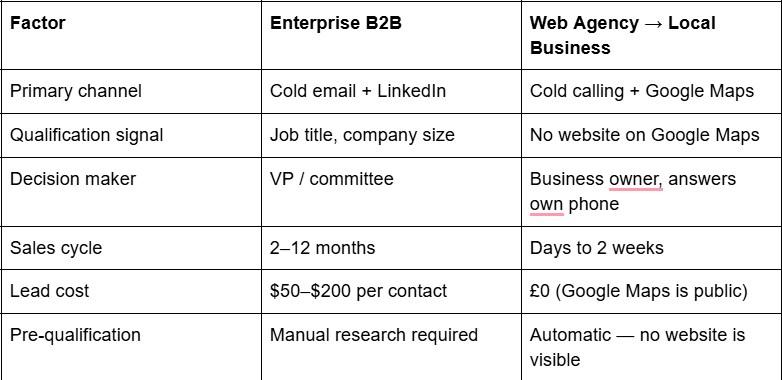
Understanding this table is not just academic. It determines which tools to invest in, which channels to prioritise, and which tactics will produce clients this month versus which ones will produce nothing for six months.
The Four Channels Worth Your Attention
1. Google Maps cold outreach (primary) The highest-converting channel for web agencies. Pre-qualified leads, publicly listed phone numbers, zero data cost, and a qualification signal — no website — that's visible before you make a single call. Produces clients within days of starting.
2. Referrals from existing clients (secondary) The highest-quality leads — pre-sold by a trusted recommendation. Can't be your primary channel when starting out, but should be systematically cultivated as your client base grows. Active asking beats passive hoping every time.
3. LinkedIn outreach (secondary) Works for agencies targeting slightly larger local businesses — accountants, solicitors, consultants — who are more active on LinkedIn. Lower volume than Google Maps but useful as a supplementary channel for professional services niches.
4. SEO and content inbound (supporting) Takes 3 to 6 months to produce meaningful traffic but compounds indefinitely. Blog posts targeting web design agency keywords bring in prospects who are already searching for what you offer. Not a short-term solution, but not optional either.
Your allocation at this stage should be roughly: 70 percent of acquisition effort on Google Maps cold outreach, 20 percent on systematically asking existing clients for referrals, and 10 percent on building the SEO foundation that produces inbound leads later.
The Google Maps System — Step by Step
This is where clients actually come from. Everything else is supporting infrastructure.
Step 1 — Choose one niche and one city. Not "local businesses." One business category, one city. Plumbers in Manchester. Hair salons in Birmingham. The discipline of starting narrow gives you consistent talking points, relevant case studies, and a calling rhythm that compounds with every conversation.
Start with trades. No-website rates in plumbing and electrical run 60 to 70 percent.
Step 2 — Scrape Google Maps. Search your niche and city. Use the Get Map Leads Chrome extension to capture every listing directly into your pipeline — business name, phone number, address, review count, and website status — in under two minutes. No CSV. No spreadsheet. 200 to 400 leads captured while you'd still be on page three manually.
Step 3 — Apply the no-website filter. One click. Every business with no web presence surfaces instantly. Your raw list of 300 businesses becomes 120 to 200 pre-qualified prospects who demonstrably need what you're selling.
You don't need to convince them they need a website. You call with a specific, visible reason. That changes the entire conversation.
Step 4 — Sort by review count. A business with 80 recent Google reviews is active, has budget, and will pick up the phone. A business with 3 reviews from two years ago may not be. Call the top 20 percent first. That's where 80 percent of closes come from.
Step 5 — Call, log, follow up. After every call, log the outcome in one tap. Set every callback with a specific date and time. Send the AI audit before every callback. Most closes happen on the second or third contact — the follow-up system is where your pipeline converts.
Building a Referral System That Runs Itself
Most web agencies treat referrals as passive. They do good work, hope the client mentions them to someone, and occasionally receive an enquiry months later. That's not a referral system — that's luck.
Three components make it systematic:
Ask at the right moment. Immediately after a client expresses satisfaction — when they first see the finished site, or when they tell you their own customers have commented on it. Their enthusiasm is at its peak. Ask directly: "I'm really glad you're happy with it. Do you know any other [business type] owners who might benefit from the same thing?"
Make the referral easy. Don't ask them to "spread the word." Give them a short paragraph they can paste into a WhatsApp message, your portfolio link, your phone number. Less friction means it actually happens.
Follow up on every referral within 24 hours. A referred name that sits uncontacted for a week loses most of its warmth. Call the same day when possible.
The Channel Hierarchy Is Simple
Google Maps cold outreach gets you clients this week. Referrals get you clients this month. SEO gets you clients in six months and then keeps going. Run all three, weighted toward outreach at the start, and you'll have a lead generation system that doesn't require you to figure out a new approach every quarter.
Get Map Leads is a Google Maps lead scraper and CRM built specifically for web development agencies doing cold outreach to local businesses. Start your free trial →
Comment