
ListingRVA AI
Your E-commerce Store Deserve High Selling Photos
Adding a single new item to an online store's inventory used to be a simple, straightforward task. Today, the expansion of multi-channel commerce has turned catalog management into a complex operational challenge. E-commerce teams are discovering a hidden operational bottleneck: one product image is never actually just one image.
The moment a product enters a catalog, it triggers a fragmented content loop. It needs clear, white-background hero shots to meet strict marketplace rules. It requires rich, contextual lifestyle creatives for storefronts. It demands technical infographics, dimension layouts, and multi-format sales copy. Because every selling channel enforces distinct layout standards and structures, managing this content creates massive operational friction.
The real bottleneck is not the creative spark of designing a single asset. The true drain on resources comes from the hours spent manually reshaping, resizing, and rewriting that asset to fit everywhere. This is precisely why modern digital brands are moving away from traditional studio setups and restructuring their workflows around high-utility AI product photography.
The Architecture of the 3-Tier Asset Pipeline
To solve this fragmentation, enterprise tech workflows are abandoning disconnected toolsets—like using one application for text, one for basic background removal, and another for formatting. Instead, platforms like ListingRVA AI are standardizing what engineers call an opinionated, unified asset pipeline built entirely around contextual AI product photography.
Rather than relying on unpredictable text-to-image prompts that frequently hallucinate product features or warp logos, modern digital studios use a structured three-tier system:

By binding spatial awareness to specific retail templates, this system avoids the common flaws of generic AI art apps. The engine recognizes the exact boundaries of the object, ensuring the AI product photography outputs place the product naturally inside complex environments—like seasonal ad spaces, detailed spec sheets, or clean e-commerce mockups—without warping its shape.
Syncing Creative Assets with Store Infrastructure
Creating high-quality content only solves half the problem. If an e-commerce team has to download massive ZIP archives, unpack images, and copy-paste text manually into a dashboard, the operational loop remains broken.
The standard for modern catalog tools has shifted toward deep catalog syncing. By utilizing secure OAuth pipelines, the creative dashboard connects directly to the core databases of dominant global marketplaces, including Shopify, Amazon, WooCommerce, Etsy, Flipkart, BigCommerce, and Magento.
This cloud-to-cloud connection turns generation into a direct distribution pipeline. Instead of local file handling, a team can run their source images through the AI product photography pipeline, review the outputs, and push the fully formatted listings directly to active channels with a single command.
Building Guardrails into Automated Workflows
Automation in digital retail brings its own set of business risks, particularly regarding quality control and unpredictable API usage costs. Because processing rich visual data demands significant computing power, software operators have had to rethink standard billing designs.
To address this, modern platforms use a distinct "Value-First" billing loop. Rather than charging a flat fee for every generation request—which penalizes users if an image lacks the correct framing—credits are locked on the ledger and only deducted when a human operator manually reviews, approves, and saves the final result.

This structural safeguard ensures that automated AI product photography acts as a reliable tool for scaling up store operations, rather than an unpredictable drain on marketing budgets.
Operational Analysis: Frequently Asked Questions
Q: How does AI product photography keep product dimensions from looking distorted?
A: Unlike basic filters or art generators that guess what an object looks like, purpose-built AI product photography engines isolate the exact edges and proportions of the physical item. The system locks those core visual markers in place, changing only the surrounding background environment to protect the true appearance of the product.
Q: How do multi-channel tools handle different copywriting rules for different sites?
A: The copywriting layers use specific templates mapped to each marketplace's backend requirements. For example, when generating an Amazon listing alongside your AI product photography, the system automatically builds five benefits-focused bullet points and an HTML-ready layout. When switching to a Shopify setup, it modifies the output to produce punchy descriptions and search hashtags instead.
Q: How do teams maintain visual consistency when relying on automated rendering?
A: Platforms address this by using a centralized Brand Kit. Teams save their distinct color palettes, official brand fonts, and high-resolution logo files directly in the software. The rendering engine pulls from this asset kit whenever it creates complex layouts, infusing your exact brand guidelines into every automated graphic.
Q: What happens to unused generation credits at the end of the month?
A: Subscription plans run on recurring billing cycles where monthly allotments refresh and do not roll over to the next month. However, to accommodate seasonal spikes in inventory, any standalone top-up packs bought outside the main subscription remain open indefinitely, rolling over until your team uses them.

Hey Indie Hackers! 👋
A lot of the discussion around AI wrappers focuses on tools that do just one thing: they generate text or they edit images. However, when you talk to actual users—especially solo e-commerce founders and small brands—you quickly realize that their biggest bottleneck isn't just writing or just photography. It is the sheer volume of fragmented micro-tasks required to launch a single product online.
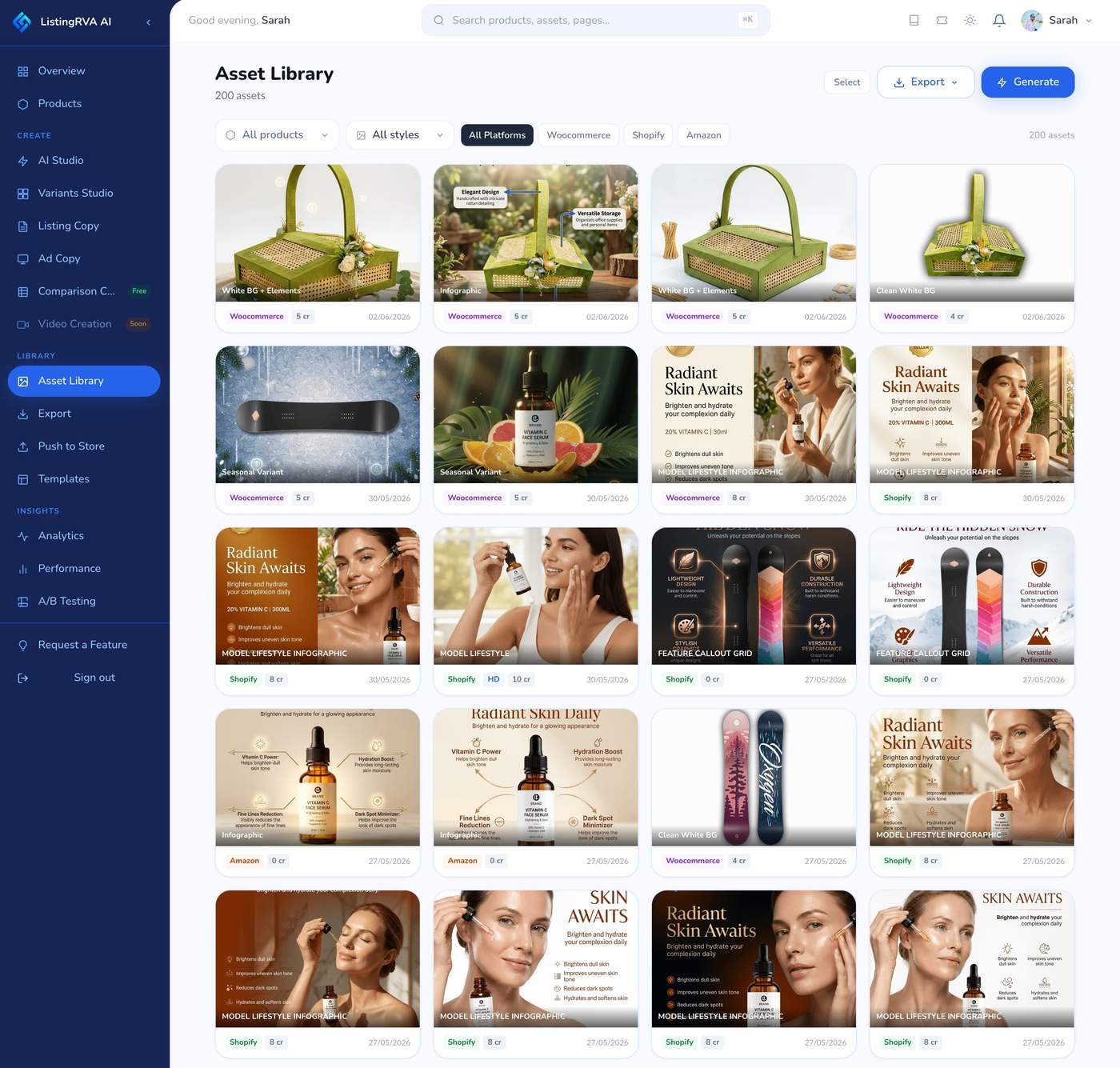
My team and I at Codrva Digital wanted to see if we could build a unified workflow that handles everything at once. We built ListingRVA AI, a SaaS platform that takes one raw product photo and converts it into a marketplace-ready listing (16 background styles + fully formatted SEO copy) in under 60 seconds.
Here is how we approached the build, the technical challenges we ran into, and why integrations became our core focus for growth.
1. The Core Problem: The E-Commerce Content Bottleneck
Traditional product launches usually look like this:
Hire a photographer or spend hours setting up lighting and backdrops ($300–$3,000 per shoot).
Wait 3–7 days for post-processing and editing.
Hire a freelance copywriter or spend hours researching keywords on Amazon/Shopify.
Manually copy, paste, format, and upload everything across multiple store channels.
For large enterprises, this is just the cost of doing business. For a solo indie hacker or a small brand, this process destroys momentum. We realized that if we could consolidate computer vision (background removal and contextual style generation) with large language models (SEO generation), we could completely eliminate this friction.
2. The Architecture & Feature Breakdown
Instead of overwhelming users with prompt engineering, we decided to restrict the UI to an opinionated, high-utility workflow:
Contextual Image Generation: The AI analyzes the actual dimensions and edges of the product rather than just slapping it onto a generic background. It allows users to export across 16+ pre-configured styles, including Amazon-compliant pure white hero shots, lifestyle settings, feature infographics, and dimension specs.
The Dual-Engine Credit Model: One of our biggest monetization hurdles was figuring out how to charge for asymmetrical API costs (images cost significantly more to generate than text). We designed a flexible credit system where 1 credit = 1 standard generation. High-resolution upscaling (e.g., 1500px or 2000px) adds a predictable surcharge.
The "Value-First" Billing Hook: To build trust in an era of AI-fatigue, we instituted a strict policy: credits are only deducted when a user explicitly approves and saves an asset. If the AI generation isn't what they wanted, they can regenerate without burning through their monthly balance.
3. Engineering the Integration Layer
If there is one major takeaway from our build, it's this: Your tool is only as good as its place in the user's existing workflow.
Initially, we expected users to generate assets, download the files, and upload them to their stores. User testing quickly showed that downloading zip files of images and copy felt like homework.
To solve this, we focused heavily on building a robust REST API and webhook architecture. We built native pipelines directly into 7 major storefront ecosystems:
Amazon
Shopify
WooCommerce
Etsy
Flipkart
BigCommerce
Magento
By allowing users to authenticate their storefronts via standard OAuth, they can click "Publish" inside our dashboard, and our backend pushes the assets directly to their live inventory via webhooks—no local downloads required.
4. Our "Trojan Horse" Marketing Strategy (Free Utilities)
As bootstrappers, we don't have a massive ad budget. To drive organic top-of-funnel traffic, we built and deployed standalone mini-tools that live on our public domain outside the app wall:
A free Amazon Listing Quality Checker that grades existing text-based elements.
A free Shopify Product Description Generator.
These tools give value upfront without requiring an account. Once users see the quality of the text, they naturally sign up for the free tier (which gives 50 credits with no credit card required) to unlock the image generation features.
5. Frequently Asked Questions (FAQ)
Q: Who exactly is ListingRVA AI built for?
A: It is built for e-commerce store owners, Amazon FBA sellers, dropshippers, and digital marketing agencies who want to launch products faster without spending thousands on professional photoshoots and copywriting.
Q: How does the free trial work?
A: When you sign up, you get 50 free credits automatically. You do not need to enter a credit card to try the platform.
Q: What is the refund or credit policy if the AI image doesn't look right?
A: We use a "Value-First" billing model. Credits are only deducted from your balance when you choose to approve and save an image or description. If you do not like the generation, you can tweak your settings and try again without losing credits.
Q: Can I use my own brand assets?
A: Yes. The platform includes a Brand Kit feature where you can upload your own logos, color palettes, and custom typography to keep your generated infographics and model shots perfectly aligned with your brand image.
Q: Do I have to download the images and text to upload them to my store?
A: No. You can link your store (Shopify, Amazon, WooCommerce, etc.) directly to the app via OAuth. Once authorized, you can publish your generated assets directly to your store with a single click.
1 Comment
The product idea is strong, but I think the current message is carrying too much architecture too early.
The buyer probably does not wake up thinking about a unified asset pipeline, OAuth, or contextual AI product photography.
They wake up with a simpler pain: “I have products to list, but every new SKU turns into photos, copy, resizing, formatting, and uploading across channels.”
That is the sharper promise: one raw product photo to a publish-ready listing.
The integrations matter, but only after the buyer first feels the operational pain of launching products slowly.
I’d be careful not to make ListingRVA sound like a technical AI studio when the stronger angle may be SKU launch speed for small ecommerce teams.
Happy to put the tighter launch/message angle in writing if useful.