
mindPick
Ask without guilt. Help without burnout.
Then OpenAI adopted MCP, and we wondered what would happen if we went where the questions already are.
We just submitted mindPick to ChatGPT's app marketplace. Here's what we learned, including the things we had to figure out ourselves.
What is MCP?
Model Context Protocol. A standard that lets any app connect with AI assistants. Anthropic created it, and OpenAI adopted it.
You develop one server that uses MCP. Now ChatGPT, Claude, Cursor, and eventually others can call your app when it's relevant.
Why this matters for indie hackers:
ChatGPT has over 200 million weekly users. You can't buy that reach. You can't SEO your way there.
But you can integrate for free.
The barrier isn't money. It's knowing this exists and building the connector.
What we built:
- MCP server: a small backend explaining what our app can do
- Three tools ChatGPT can call: search, fetch, start_question
- Widget: displays expert cards inside the chat
Build time: about one to two weeks. Stack: React, Vercel, Xano. Cost: $0.
What the docs don't tell you:
You need both search and fetch tools. If you miss either one, you get a "search action not found" error. This isn't clear from the MCP spec; it's a ChatGPT-specific requirement.
Developer Mode is hidden. Go to Settings, then Connectors, then Advanced, and finally Developer Mode. It took us 20 minutes to find it.
Docs are scattered. The MCP spec lives on Anthropic's site. ChatGPT-specific requirements are on OpenAI's site. You need information from both.
Tool descriptions serve as your "SEO." ChatGPT decides when to call you based on matching your tool descriptions to user intent. There is no documentation on the algorithm. We treat it like writing meta descriptions, focusing on specific problems rather than generic features.
Security is crucial. OpenAI warns that "custom connectors are not verified. Malicious developers may attempt to steal your data." If you work with real data, treat this project's security seriously.
The catch we're still figuring out:
Being integrated doesn't mean being surfaced. There is a cold-start problem. If ChatGPT calls us and we return no relevant expert, that's a poor experience. It might learn not to call us again.
Where we are now:
- ChatGPT marketplace: in review
- Cursor marketplace: live (proving the MCP spec is portable)
- Claude Desktop: ready
We have no idea if this drives meaningful traffic yet. We will report back with data.
If you want to try this:
- MCP spec docs
- OpenAI's integration guide
- Our integration page: mindpick.me/integrations
Questions:
Has anyone else built MCP integrations? What made ChatGPT actually surface your app, and what didn't work?
And for those who tried and gave up: what was the blocker?


I spent over 70 hours last year giving free advice and tracked the results. The outcome was disappointing: almost no one took real action. Then, I found Francesca Gino's research at Harvard Business School on how people accept advice. It explained everything, and it’s not what you might think.
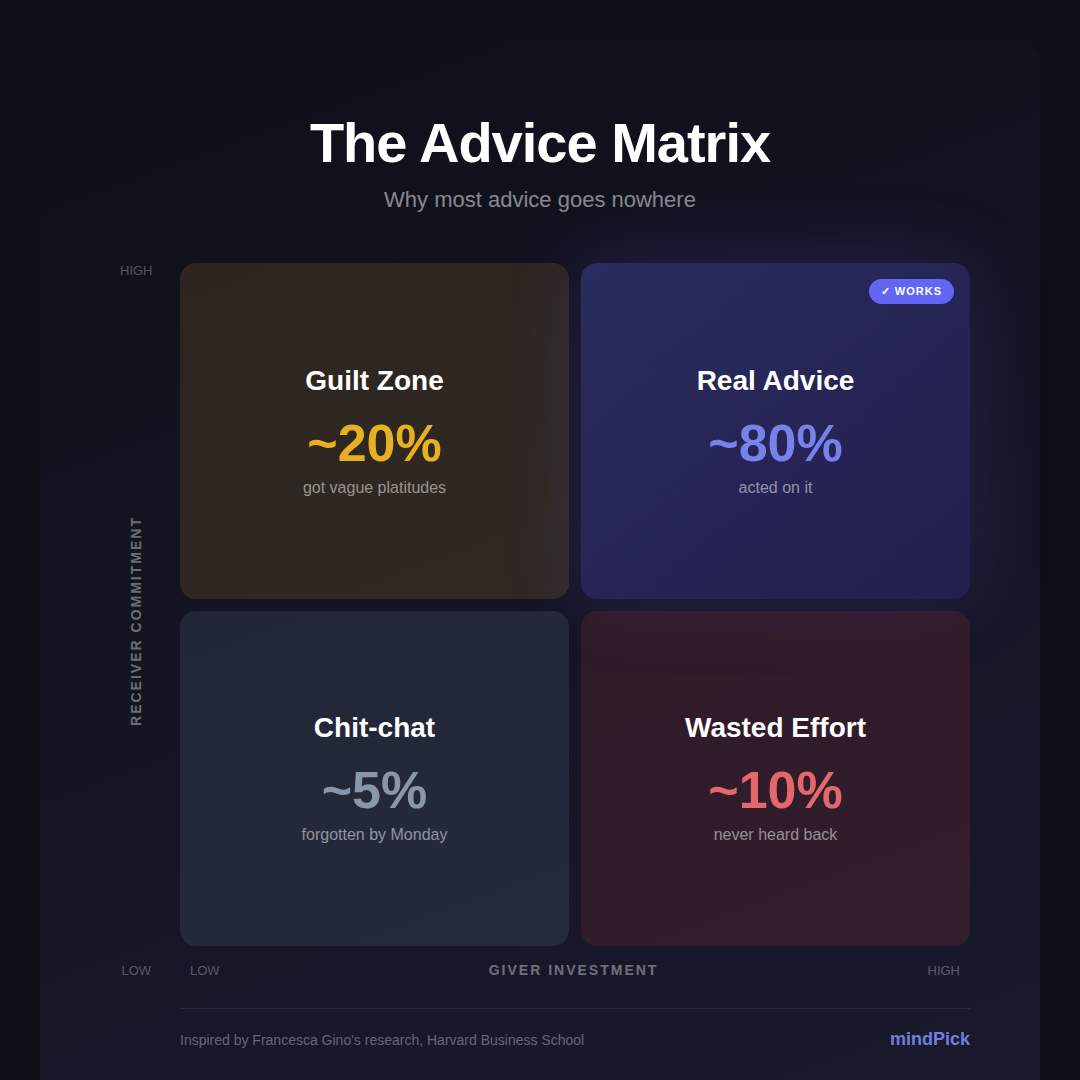
Two axes are important:
Giver investment - How much effort did the person giving advice put in?
Receiver commitment - How much is the receiver invested?
Here are the quadrants:
Chit-chat (low/low) - About 5% is forgotten by Monday. These are casual coffee chats. They are pleasant but unhelpful.
Guilt Zone (low giver/high receiver) - Around 20% receive vague responses. Someone wants help, but you deliver a quick answer. They feel guilty for pushing for more, and you feel guilty for not providing enough.
Wasted Effort (high giver/low receiver) - About 10% never reply. You spend an hour crafting a thoughtful response, but they asked casually. It remains unread in their inbox.
Real Advice (high/high) - About 80% take action. Both sides are invested, and this is where real change occurs.
The surprising finding is that adding friction—time, money, or effort—for the receiver increases the chance they will actually use the advice. Free advice seems valuable to give, but it is rarely valuable to receive.
I’m building something around this insight at mindpick.me, but honestly, this framework has changed how I view knowledge transfer, whether paid or not.
Question for IH: Where do most of your advice conversations fall on this matrix?

Follow-up on mindPick (async Q&A for professionals).
Last post I talked about the repositioning - charging actually makes MORE people ask, not fewer.
Now about the other problem we tried to resolve.
The reality we can't ignore:
Before anyone pays $XY to ask an expert a question, they're going to ask ChatGPT first. That's just how it works now.
They'll get a generic answer. Maybe it's enough. Usually it's not, because ChatGPT doesn't know their specific context, industry nuance, or what actually works vs. what sounds good in theory.
But by then, the moment's passed. They've moved on. Or they've convinced themselves the generic answer is "good enough."
Our thinking:
What if that first AI conversation happened on OUR platform - with the expert's actual knowledge built in?
Not generic ChatGPT. An AI trained on the expert's real answers, opinions, frameworks. The stuff they'd actually say.
Asker explores with AI first (free or cheap). If they need the real human - the nuance, the judgment call, the "here's what I'd actually do" - they escalate. Expert gets paid. Asker gets what they really needed.
The funnel becomes:
AI exploration → "Actually, I need the real person for this" → Paid question
Instead of:
ChatGPT → "Good enough I guess" → Gone forever
What we're betting on:
AI gives information. Experts give insight. We're not replacing the expert - we're capturing the moment before people give up and accept a generic answer.
Question for founders here:
Has ChatGPT killed a sale for you? What was the product — and did you change anything after?
Thank you for any fresh pair of eyes on this problem :)

Building an async Q&A platform for professionals with my co-founder. Been wrestling with positioning for months.
Started with the obvious angle: "Experts are overwhelmed by 'pick your brain' requests. Let them charge."
Made sense. We're both operators with 20+ years experience. I tracked it once — 70+ hours of free advice in a year. Maybe 10% of people did anything with it.
But the "monetize your expertise" pitch wasn't landing.
Talked to dozens of people. Then heard something that flipped it:
"I wanted to ask you something months ago but didn't want to bother you."
"I didn't know if you'd even be open to questions."
"Honestly, I'd rather pay €50 than feel like I'm begging for a favor."
That last one broke my brain.
We'd been focused on expert pain: "Stop giving away free advice."
But there's equal pain on the asker side: "I want to ask but I don't know if they're open. Asking for free feels like imposing."
The two-sided problem:
→ Expert: "I want to help but can't say yes to everyone. Need a filter that doesn't make me a jerk. And I can't give everyone an hour of my calendar."
→ Asker: "I want to ask but don't know if they're open. Don't want to feel like I'm begging. And I feel bad asking for their time."
The insight: two things remove the friction.
Price — not about the €50. It's a signal. For experts: "I'm open." For askers: "You're welcome to ask." Clears the social awkwardness.
Async — no scheduling, no calendar tetris. Expert answers when they have 10 minutes. Asker doesn't feel guilty taking an hour of someone's day.
Together: easy to ask, easy to help.
Still early, still figuring it out. But this reframe changed everything.
Question for founders here: ever discovered you were solving the right problem but telling the wrong story?
Building this at mindpick.me - async Q&A, no scheduling. Would love feedback from anyone who's dealt with this problem on either side.
-
3
This aligns with what I’ve seen too. Charging often acts as a seriousness filter — people come in more prepared and more willing to act.
Free advice tends to attract curiosity, while paid advice attracts intent.
Did you notice any change in the quality of questions once you introduced pricing?
-
1
Yes - but not in the way I expected. The questions didn't get more "sophisticated." They got more specific. Free questions tend to be broad: "How do I improve retention?" Paid questions come with context: "We're at $2M ARR, 15% monthly churn, mostly in the first 60 days. Here's what we've tried..." My theory: when someone pays, they feel entitled to a real answer. So they put in the work upfront to make sure they GET a real answer. With free advice, there's almost a politeness problem - people don't want to "take too much" so they keep it vague. Payment removes that guilt and gives them permission to be specific. Still early data, but the pattern is pretty consistent so far.
-
-
3
This matches what I’ve seen too. Charging often acts as a clarity and intent filter — it signals value and tends to attract people who are more serious about acting on the advice rather than just consuming it casually.

Comment