
PhotoG
Transform the product into an attractive visual effect withi
Introduction
Artificial intelligence is reshaping how brands communicate, grow, and compete. Over the past two years, “AI + marketing” has moved from concept to implementation, becoming one of the most discussed topics in business communities worldwide. Whether it’s Silicon Valley unicorns, Southeast Asian cross-border e-commerce teams, or Chinese consumer brands, everyone is focused on the same question:
“Where are the growth opportunities when budgets keep tightening?”
More and more, the answer points to AI marketing—particularly AI marketing platforms and tools powered by generative AI.
According to Statista’s 2024 Global Marketing Automation Trends Report, the global marketing automation market has surpassed $5 billion and is expected to more than double by 2028, with an average annual growth rate of over 13%. Gartner’s CMO Budget Survey also shows that over 60% of marketing leaders plan to increase investments in AI content marketing, ad automation, and intelligent creativity within the next two years.
This means AI marketing is no longer just a vague vision of the future, but a critical tool for brands exploring ways to cut costs and improve efficiency.
I. The Rise of AI Marketing: Why Is Growth So Fast?
In recent years, AI marketing has become a must-have for digital transformation. From single-point tools to end-to-end platforms and now to “intelligent agents,” its development path mirrors the evolution of the entire industry. Its explosive growth is driven by three key forces:
1. From Content Overload to Intelligent Production
In the digital age, brands face an exponential surge in content demand:
E-commerce product images must be updated quickly for different markets.
Short video scripts and assets need to match the tone of platforms like TikTok, Douyin, and Xiaohongshu.
Ad copy and creative versions often require multiple rounds of testing before achieving conversions.
Social media posts must stay frequent, personalized, and engaging.
Traditionally, manual teams needed days or even weeks to create a complete content set—slowing down market responsiveness. Generative AI marketing tools change this entirely:
Dozens of copies, titles, and visuals can be generated within minutes.
Automatic multilingual output solves localization for cross-border e-commerce and international brands.
Multiple creative styles are supported, from professional to playful.
This allows brand teams to maintain diversity while drastically reducing labor and time costs, truly unlocking productivity.
2. From Single-Point Tools to End-to-End Intelligent Agents
Early digital marketing tools solved “partial problems”:
Ad optimization software focused on bidding and traffic allocation.
Data analytics platforms tracked metrics.
Content scheduling tools manage timing and channels.
But these tools were siloed, forcing teams to juggle platforms and fragment data.
New AI marketing SaaS platforms now emphasize intelligent agents:
They generate content and automatically distribute it based on audience and feedback.
They track campaign performance in real-time and iterate via algorithms.
They offer end-to-end solutions,from content creation to analytics.
This means companies can rely on one integrated platform to complete the growth loop instead of piecing together multiple tools.
3. Efficiency Demands in a Globalized World
Globalization makes marketing even more complex:
Luxury brands in Paris need visibility on Chinese social media.
Cross-border teams in Shenzhen must operate across U.S. and European e-commerce platforms.
Regional providers face language, cultural, and regulatory challenges.
The universal question becomes: “How can we scale growth more efficiently?”
AI marketing meets this need by:
Synchronizing multilingual execution without translation delays.
Running automated cross-time-zone campaigns for 24/7 operations.
Integrating channels to align social media, e-commerce, and websites.
For international brands, AI content marketing is not just about efficiency—it becomes a true engine for global expansion.
II. How to Do AI Marketing: Key Application Scenarios
When companies first encounter AI, the question is always: “How do we actually use it?”
AI marketing isn’t distant—it can be applied right away in measurable ways. Four core applications stand out:
1. Social Media Matrix Operations
Brands often need to manage accounts across Douyin, Xiaohongshu, Weibo, Bilibili, Instagram, TikTok, and YouTube—all with distinct tones and audiences. For manual teams, this is nearly impossible.
AI marketing tools solve this by:
Generating platform-specific content (titles, scripts, visuals, short videos).
Scheduling and distributing content automatically.
Tracking trending topics and recommending hashtags for better exposure.
Some brands now produce 100+ variations of social posts weekly with AI, massively boosting reach.
2. Cross-Border E-Commerce Advertising
E-commerce teams used to manually create country-specific ads—slow and inconsistent. AI platforms now:
Auto-generate copy in English, Spanish, French, Arabic, etc.
Optimize visuals for cultural and aesthetic differences.
Schedule campaigns across time zones for 24/7 performance.
For instance, a Shenzhen e-commerce team boosted ad conversion rates by 40% in three months using AI.
3. Information Feed Ad Optimization
Success in feed ads depends on rapid iteration. Traditionally, this relied on guesswork and high trial costs.
AI now:
Matches audiences using behavioral data.
Runs automated A/B tests, eliminating poor creatives.
Dynamically generates fresh versions.
Studies show AI-optimized ads increase CTRs by 25%+, with some seeing over 70% growth.
4. Full-Funnel Content Marketing
To scale systematically, companies need an end-to-end AI marketing system:
Generate copy, scripts, and designs.
Distribute via AI SaaS platforms.
Track CTRs, conversions, retention in real time.
Optimize strategies automatically in closed loops.
For example, one DTC brand doubled its ad ROI in two months using this model.
III. Case Studies: Global Exploration of AI Marketing Startups
Startups are rising fast in AI marketing, showing two traits: strong tech roots and precise market positioning.
Open-Source DNA & Tech Breakthroughs Many began in communities like Stable Diffusion, turning cutting-edge research into products. Collaboration and openness fuel their innovation.
Rapid Growth with Capital Support Investors are pouring in. Some Chinese startups raised tens of millions within a year, accelerating R&D and go-to-market.
Global Teams & Gen Z Insight Young, Gen Z-heavy teams understand cross-border commerce and new social ecosystems, giving them global adaptability. OranAI is one example, with an international team speeding up its global expansion.
Strategic Partnerships & Ecosystem Expansion By partnering with Tencent, LVMH, Kering, and Transsion, startups gain validation and iterate products across luxury, retail, and e-commerce.
From Tools to Intelligent Agents Startups are shifting from single-point generators (e.g., copy, images) to full AI agents managing the entire marketing chain.
This points to a future that is more platform-based, intelligent, and global.
IV. Are AI Marketing Platforms More Efficient Than Traditional Methods?
Yes. Compared with manual or single-tool approaches, AI platforms outperform in efficiency, precision, and global reach.
Content Efficiency: From “creative bottlenecks” to “mass generation.”
Ad Precision: From “experience-driven” to “data-driven.”
Multilingual & Cross-Cultural: From “manual localization” to “one-click globalization.”
Global Ops: From “manual scheduling” to “intelligent distribution.”
Preference for End-to-End Platforms: Businesses want complete loops—not fragmented tools.
V. FAQ
Q1: What’s the biggest difference between AI marketing and traditional digital marketing?
AI marketing is automated and intelligent—it not only executes but also optimizes dynamically.
Q2: How should companies choose the right AI marketing platform?
Match the platform’s strengths (social media, e-commerce, full-funnel) to your business needs—not just the one with the most features.
Q3: Are AI marketing case studies replicable?
They offer reference value but aren’t copy-paste. Companies should adapt practices based on their own industry, audience, and data.
VI. Conclusion
AI marketing is no longer hype—it’s an actionable growth strategy. It enhances efficiency and precision, enabling brands to achieve more with the same budget. Competition is shifting: the winners will be those who adopt AI quickly and flexibly. Teams that use AI will scale content, ads, and user engagement exponentially, while laggards risk being stuck in bottlenecks and high costs.
Importantly, success isn’t limited to global giants—agile startups like Orange Vision prove that small, fast teams can thrive globally.For executives, the challenge is selecting the right AI marketing solutions and partners. Done right, generative AI can unlock breakthrough growth.
In short, AI marketing has become the watershed of the new competition era:
Companies that embrace it will accelerate global expansion.
Those that don’t risk being marginalized.
Now is the best time for businesses to rethink their marketing systems and embrace AI-driven transformation.

Introduction: AI Marketing as a Growth Lever – But How to Make It Truly Work?
In 2025, as AI technology deeply penetrates every aspect of marketing, more and more companies are revisiting a crucial question: How can AI marketing truly drive growth?
From content creation to precision delivery, from user insights to automated optimization, AI is reshaping how brands communicate with consumers. However, challenges emerge as well—AI marketing tools and platforms are growing rapidly in number, with significant differences in capabilities, pricing ranges, and technical thresholds. This has left many companies confused: Which AI marketing platform best suits my business needs? Do I need an all-in-one automation system, or lightweight plug-and-play tools? Should my company invest in an AI Marketing SaaS platform to build a closed-loop system from content to data? One thing is certain: in the next three to five years, AI-driven content marketing will become the core engine for brand growth. Companies may have different needs for AI tools, but their goals are the same: improve content efficiency, reduce operational costs, and boost conversion results. Against this backdrop, choosing a truly business-aligned AI marketing platform has become a crucial differentiator in gaining competitive advantage.
This article takes a practical perspective, examining selection criteria, platform capabilities, and applicable scenarios to help you pick the right AI Marketing SaaS platform and design a more efficient, intelligent AI marketing strategy. Whether you're a small-to-medium brand, a cross-border DTC business, a regional service provider, or a retail group, this guide offers actionable insights to implement AI marketing effectively.
One. Why Are AI Marketing Platforms the New Infrastructure for Brand Growth?
As digital marketing enters an era of intelligence, AI marketing platforms are no longer just tools—they are foundational infrastructure for scalable content, automated marketing, and sustainable growth. In other words, they are the new infrastructure for brand growth.
In the past, marketing depended on manual planning, hand-crafted content, and labor-intensive delivery. Disjointed processes between creative and distribution often led to quality inconsistency, conversion inefficiency, and resource waste. Now, with end-to-end AI content marketing platforms, businesses can automate the entire cycle—from creative generation to production of visuals and copywriting, platform adaptation, smart distribution, and performance tracking. Specifically:
Content ideas no longer rely on creative inspiration AI can generate creative scripts and outlines aligned with brand tone, based on industry trends, audience preferences, and competitor data.
Copywriting becomes faster and more precise Whether it's short video titles, product pages, or social captions, AI can generate high-quality text tailored to different scenarios.
Automated production of visuals and videos AI image generators and video modules reduce design barriers and speed up content publishing.
Multi-platform delivery and real-time tracking AI adapts content based on each channel’s algorithm and feedbacks live data to optimize future content.
This means more than just improved efficiency—it means full upgrades across content quality, user conversion rates, and marketing ROI. Especially in a world where traffic peaks and user attention is scarce, AI empowers brands to reach their audience faster, cheaper, and more consistently.
Thus, AI Marketing SaaS platforms are no longer optional—they’re becoming mission-critical. The sooner a brand builds its AI marketing infrastructure, the sooner it gains strategic control of the next growth wave.
Two. What Are the Core Capabilities of an AI Marketing Platform?
Many businesses choose AI tools based solely on whether they can generate copy. But true AI Marketing SaaS platforms that drive growth must offer four core capabilities to build a systematic strategy:
Multimodal Content Generation
A quality platform should support input from text, image, voice, or video, and output various content types like visuals, short videos, livestream scripts, and posters. With a single product intro, you should be able to generate content sets adapted to different platforms (e.g., Weibo, Xiaohongshu, Instagram, TikTok).This not only boosts production efficiency, but solves the dual challenge of content volume and quality, meeting the real demands of diversified distribution and personalized formatting.
Automated Multi-platform Distribution
Great content needs to be distributed quickly and accurately.A key pain point for many businesses is that even when content production is fast, manual uploading slows things down. An ideal platform offers built-in multi-platform APIs that support “create once, distribute everywhere.” Whether it’s WeChat, Zhihu, TikTok,Facebook, or ecommerce pages, the system adapts content format and schedule to maximize exposure.
Accurate Audience Matching
Generic content no longer meets user expectations. True AI marketing requires personalization and recommendation logic. A good platform should combine user profiles, behavior data, and click history to dynamically match content to each audience—deciding what content, language, and visuals will best trigger interest and action. This hyper-personalization improves both user experience and marketing ROI.
Data Feedback & Intelligent Optimization
A great AI marketing platform doesn’t just generate—it advises and improves.Can it monitor performance metrics like CTR, conversion, and engagement? Can it recommend optimization strategies or automatically generate better iterations? Platforms with this closed-loop feedback are true AI marketing engines, turning each campaign into a learning cycle for the next.
Three. 5 Practical Criteria for Selecting an AI Marketing Tool
Choosing the right tool is the first step to a successful AI marketing strategy. Use these five dimensions as practical criteria:
Content Adaptability: Multi-style, Multi-language, Multi-scenario
Strong platforms should output:
Multi-style content: voice scripts, ads, soft articles, UGC, etc.
Multi-language support: critical for global brands.
Multi-scenario fit: social posts, product pages, video covers, etc.
This ensures localization, personalization, and market relevance beyond generic templates.
System Compatibility: Seamless Integration
An AI Marketing SaaS platform shouldn’t be isolated—it must integrate with your current systems:
CRM: for personalized content via user data.
Ecommerce: to generate product-based campaigns.
Ad platforms: for direct creative testing and delivery.
Higher compatibility means lower friction and better execution.
Brand Consistency Controls Brand tone is built over years. Does the platform support:
Uploading brand keywords and style guides?
Setting tone/language templates?
Review workflows for quality control?
Consistent branding ensures your AI content aligns with your identity.
Collaboration & Workflow Support
AI marketing is a team sport. Platforms should support:
Role-based collaboration (marketing, content, design, ops).
Version history and review tools.
Permission and approval systems.
Great platforms are not just tools—they are collaborative operating systems.
Full-process Automation: From Idea to Performance Loop
Most importantly, the platform must support:
Automated content generation: visuals, videos, copy.
Automated distribution: to social, ecommerce, ad platforms.
Real-time data loop: track metrics, optimize the next round.
This end-to-end intelligence is where AI marketing delivers its real value—less manual work, higher conversion.
Four. Common Pitfalls in AI Marketing Implementation
Even after choosing a great platform, companies often fall into these traps:
Pitfall: Focusing on Features, Ignoring Integration
Don't be dazzled by feature lists. If the tool can’t integrate with your CRM, ecommerce, or data backend, you’ll miss the full funnel.
✅Tip: Choose platforms with API support and SaaS interoperability to create a unified workflow.
Pitfall: Ignoring Brand Tone Consistency
Fast content isn’t enough. If style, tone, and brand message are inconsistent, it confuses users and hurts trust.
✅Tip: Use platforms that allow brand lexicons, tone settings, and style templates—like PhotoG, a content engine that ensures every output carries your brand DNA.
Pitfall: Skipping the Optimization Loop
Many companies still stop at “just doing AI marketing,” but without feedback, you’re missing growth.
✅Tip: Look for A/B testing, performance tracking, and audience insights to create continuous improvement.
Avoiding these pitfalls is key to unlocking the full value of AI tools and achieving sustainable content-driven growth.
Five. FAQ: Common Questions About Choosing AI Marketing Platforms
Q1: What’s the key difference between AI and traditional marketing tools?
A: AI platforms combine content generation, audience insight, and automated delivery with data-driven iteration—while traditional tools rely on manual execution.
Q2: What should I evaluate when choosing an AI tool?
A: Look at:
Multimodal output (text, video, audio)
Brand tone control
Integration with CRM/ecommerce/ERP
Real-time tracking and optimization
Usability across teams
Q3: Are AI tools suitable for small businesses?
A: Absolutely. Many SaaS platforms now offer lightweight, modular services ideal for SMBs to improve content and reduce trial-and-error.
Q4: How do I avoid AI content being generic or robotic?
A: Use platforms with brand dictionaries, tone templates, and style controls. Human-AI collaboration helps maintain authenticity.
Q5: Will AI replace human marketers?
A: No—it enhances them. AI handles repetitive, data-heavy tasks so humans can focus on strategy, creativity, and relationships.
Conclusion: Choose the Right Platform to Win the Content Race
AI marketing is not just a way to “save labor”—it’s a smart engine for executing your content strategy at scale. To truly benefit from an AI Marketing SaaS platform, you must choose wisely, plan systematically, and operate intelligently. Whether you're a startup or a mature brand, now is the time to build your AI content marketing foundation.
Start your platform trial today and take control of your brand’s future growth.
Introduction
The business world is undergoing an unprecedented transformation. In the past, a company’s competitive advantage largely depended on control of distribution channels, the scale of its workforce, and budget investment. The wider the channel and the larger the advertising spend, the greater the likelihood of securing a leading position in the market. However, this logic is now being disrupted. With the rapid development of artificial intelligence, AI marketing is gradually becoming a key force in reshaping the business landscape. Rather than simply being a new tool, AI marketing represents an entirely new business logic.
It not only helps companies achieve breakthroughs in efficiency and cost, but more importantly, it redefines the relationship between brands and consumers:
Consumers expect more personalized and immediate content responses;
Companies, in turn, need smarter and more automated growth engines to meet these demands.
Against this backdrop, AI marketing has shifted from being a “future trend” to a “present necessity.” It is no longer just a collection of AI marketing platforms or AI marketing tools, but a comprehensive practice that spans generative AI marketing, AI content marketing, AI marketing SaaS, and beyond. Whether you are a cross-border e-commerce company aiming to expand overseas quickly, or a traditional business striving to break through growth bottlenecks, the question is no longer “Can AI marketing be used?” but rather “Are you ready to make the best use of it in the shortest time possible?” Because in today’s market, those who master AI marketing strategies and successfully put them into practice are far more likely to become the protagonists of the next growth story.
One. The Rise of AI Marketing: From Tactical Tools to Strategic Engine
Over the past decade, digital transformation has driven the evolution of marketing practices. From intelligent recommendations on e-commerce platforms to targeted ads on social media, digitalization has improved efficiency. Yet, these processes still relied heavily on human teams for execution: execution: execution—creative production, ad design, distribution, and analytics—all limited in speed and scale.
The emergence of generative AI marketing now makes exponential growth possible. This transformation is not just about speed but about a fundamental shift in how marketing works.
The Iteration of AI Marketing Tools
Early AI marketing tools focused on single tasks, such as ad placement optimization. Today, companies are embracing AI marketing platforms that cover the entire chain—from content generation and cross-platform distribution to performance tracking.
Before: Companies had to combine multiple tools or agencies to run an integrated campaign.
Now: A single smart platform can complete the entire loop.
This evolution gives a clear answer to “How to do AI marketing?”—companies can now build their AI marketing strategies directly on SaaS platforms rather than piecing together scattered tools.
Scalable and Diverse AI Content Marketing
Content remains central to marketing, but production speed and scale have long been bottlenecks. What once took days for a team to create can now be done in minutes with AI content marketing:
E-commerce product images and detail pages.
Social media posts and short video scripts.
Multiple creative variations for ad campaigns.
Even more importantly, generative AI marketing supports multilingual, multi-style outputs. A cross-border e-commerce team can now launch localized content for North America, Europe, and Southeast Asia simultaneously—achieving true global synchronization.
The Rise of AI Marketing SaaS
Another key trend is the rapid adoption of AI marketing SaaS platforms. Previously, implementing AI required large budgets and technical teams to build in-house systems. Today, companies simply subscribe to ready-made AI marketing solutions:
Cost: Reduced from millions in R&D to affordable subscriptions.
Deployment: From months of system building to hours or even minutes of onboarding.
Usage: Plug-and-play—non-technical teams can operate with ease.
This makes recommended AI marketing companies and top-ranked AI marketing platforms much more accessible for businesses of all sizes, accelerating adoption across industries.
From Cost-Saving Tool to Strategic Growth Engine
Initially, companies used AI primarily for cost reduction and efficiency. But now, AI marketing has become a strategic engine that enables:
Breaking through content production bottlenecks.
Achieving multi-language, multi-market growth in parallel.
Building long-term brand advantages driven by data.
As a result, AI marketing is evolving from a tactical tool into a strategic driver of business transformation—a decisive factor in future competition.
Two. How to Do AI Marketing: Core Application Scenarios
When companies ask “How to do AI marketing?”, they quickly realize it is no longer a vague concept. It has already been widely applied across multiple business scenarios.
Social Media Matrix Management
Managing multiple accounts across platforms like Instagram, TikTok, Weibo, or Xiaohongshu requires unique content for each audience. Traditionally, this meant heavy manpower costs.
With AI marketing tools, brands can:
Generate multiple content variations quickly.
Adapt tone and style to fit each platform.
Automate scheduling and one-click publishing.
AI marketing case studies show this approach boosts engagement and builds long-term private traffic for brands.
Cross-Border E-Commerce Advertising
Cross-border businesses face language and time zone challenges. Generative AI marketing solves this by:
Automatically generating multilingual content.
Adapting visuals and copying to local preferences.
Scheduling campaigns across time zones for global synchronization.
This dramatically improves efficiency and explains why AI marketing platform rankings favor tools that support multi-language and multi-channel campaigns.
Information Feed Ad Optimization
Traditionally, ad optimization required manual audience targeting and A/B testing. AI marketing SaaS platforms now:
Analyze user behavior in real time to match audiences.
Auto-generate multiple creatives and test them.
Iteratively optimize campaigns for higher ROI.
Some AI marketing success stories show brands doubling ROI by adopting AI-powered ad optimization.
End-to-End AI Marketing Solutions
Many companies are moving beyond single-task tools to adopt end-to-end solutions that cover the entire marketing cycle: creative generation → content production → distribution → performance analysis → data-driven iteration.
These intelligent systems act as a company’s “second brain”, which is why AI marketing tool comparisons often show preference for platforms that provide holistic solutions.
Industry Practices and Success Stories
These application scenarios are not confined to theory but have already yielded a wealth of verifiable results. For example:
Some DTC brands have achieved significant increases in click-through rates and conversion rates through AI content marketing;
Cross-border e-commerce companies, leveraging AI marketing platforms, have doubled their ROI in a short period of time;
Certain startup teams, with their open-source foundations and international mindset, have built end-to-end AI marketing agents that helped well-known brands upgrade the entire chain of content production and advertising optimization.
These AI marketing tutorials and practical experiences demonstrate that whether for large enterprises or small and medium-sized teams, AI marketing is no longer an “option” but a core capability that must be strategically planned in advance.
Three. Efficiency Comparison: AI Marketing vs. Traditional Methods
If digital transformation was the first step for enterprises to improve efficiency, then AI marketing represents a qualitative leap in both efficiency and effectiveness. Compared with traditional methods, the efficiency advantages of AI marketing have already been validated across multiple industries and proven AI marketing cases.
Content Production Efficiency: From “Labor-Intensive” to “Instant Generation”
In traditional teams, producing a single advertising creative often requires collaboration among multiple roles such as copywriters, designers, photographers, and video editors. The production cycle can take several days, if not weeks. Under a generative AI marketing model, however, companies only need to input simple commands to generate usable copy, short video scripts, or ad posters within minutes. This “instant response” capability means teams can test more creative versions simultaneously, significantly enhancing the flexibility and experimentation capacity of AI content marketing.
Advertising Precision: From “Experience-Based Decisions” to “Intelligent Optimization”
Traditional ad optimization often relies on the subjective judgment of media buyers, a process that is time-consuming and prone to error. In contrast, AI marketing SaaS platforms leverage massive user data to automatically complete audience segmentation, interest matching, and creative testing. Several AI marketing success stories have shown that companies using AI-powered ad optimization tools typically achieve a 30%–50% improvement in click-through rates (CTR) and conversion rates (CVR). This efficiency gap enables businesses to achieve results faster and manage budgets more effectively.
Multilingual Support: From “Translation Teams” to “One-Click Generation”
Cross-border e-commerce and international brands used to rely on professional translators and localization teams to manage multilingual marketing content. This approach was not only costly but also susceptible to cultural misinterpretations. Today, AI marketing tools can instantly generate multilingual and multi-style copy, automatically adapting to the linguistic nuances of target markets. This greatly reduces localization costs and enables enterprises to enter new markets faster.
Global Adaptability: From “Manual Scheduling” to “Intelligent Orchestration”
The execution of cross-time-zone marketing campaigns traditionally required teams to manually schedule activities around the clock to ensure simultaneous launches across regions. AI marketing platforms, however, can automatically handle scheduling and cross-platform distribution, enabling “24/7 global presence.” For cross-border e-commerce and overseas businesses, this translates into more efficient global operations and parallel growth across multiple markets without additional manpower.
Why Intelligent Platforms Are Preferred
It is precisely because AI marketing delivers such disruptive efficiency gains that enterprises increasingly favor end-to-end, intelligent platforms. A comparison of AI marketing tools reveals that while point solutions may solve isolated problems, they fail to cover the entire process—from creative generation and content distribution to data review and performance analysis. Intelligent, integrated AI marketing solutions, on the other hand, enable businesses to connect the full chain, achieving continuous growth from content production through to ad optimization.
Four. Case Observation: Startup Agility and Industry Trends
Amid the wave of AI marketing, beyond the deep investments made by large corporations, an increasing number of startups are also rising rapidly, demonstrating astonishing iteration speed and market adaptability. Compared with traditional enterprises, these younger teams often possess sharper technological sensitivity, a global perspective, and the execution power to experiment quickly and learn from failures. This allows them to leap from “technical exploration” to “commercial deployment” in a very short time. A common trait among many of these teams is their open-source DNA, enabling them to stay close to the research frontier and swiftly transform breakthroughs into market-ready product capabilities. The capital market is also actively fueling this sector’s growth, with many startups securing significant funding in their early stages, accelerating their exploration in R&D and international expansion.
At the product level, the industry is undergoing a shift from “tools” to “intelligent agents.” These intelligent agents are not only capable of automatically generating multilingual marketing assets and copy but also support cross-platform distribution and scheduling while continuously optimizing advertising performance through data feedback. Such product forms directly address the core demand behind the question “How to do AI marketing?”—not merely solving isolated tasks but providing a complete AI marketing solution that spans ideation, execution, and review. This trend is emerging not only domestically but also gaining strong traction in overseas markets, proving that generative AI marketing tools are already feasible for large-scale application. It further validates the industry’s future trajectory:
Open technology and continuous innovation are the keys to breakthroughs;
A global mindset combined with localized execution helps teams replicate success more rapidly;
Intelligent-agent upgrades will become a critical standard when enterprises choose an AI marketing platform.
From the growth paths of these startups, we can see that AI marketing is accelerating the reshaping of the industry landscape. For any enterprise aiming to stay competitive, learning from the mindset and practices of these pioneers offers far more value than simply “purchasing tools.”
Five. FAQ: Common Questions About AI Marketing
Q1: Which businesses are AI marketing tools suitable for? AI marketing tools are suitable for cross-border e-commerce, global brands, local service providers, and any company needing multilingual, multi-platform content distribution. Both startups and large enterprises can benefit.
Q2: What should companies keep in mind when using AI marketing? Businesses should define goals, choose tools wisely, ensure data compliance, and balance AI automation with human creativity. Over-reliance on tools risks homogenized content.
Q3: What do AI marketing case studies teach us? From DTC brands to cross-border sellers, generative AI marketing has proven effective in boosting CTR and ROI. But success comes not just from tools—it depends on aligning AI capabilities with brand strategy.
Six. Conclusion: The Next Inflection Point Has Arrived
AI marketing is not an empty concept or hype, but a growth strategy that is already executable in practice. With the rise of generative AI marketing tools and AI marketing SaaS platforms, more and more enterprises are beginning to treat AI as a new strategic engine, rather than just a tactical tool for “cost reduction and efficiency improvement.” The competition of the future will no longer be about who has the larger budget, but about who can embrace AI marketing solutions faster and more intelligently. Whether it is cross-border e-commerce, DTC brands, or traditional enterprises undergoing digital transformation, the key question is: how can AI be integrated into daily operations and unleash its value across the full marketing chain?
It is worth noting that AI marketing success stories have already proven that large corporations are not the only winners. Small and agile teams can also achieve breakthrough results in this field, which shows that agility and technological foresight are becoming new competitive advantages. Therefore, the real question enterprises need to answer is not “Can AI marketing be done?” but rather “How to choose the right AI marketing company recommendation, evaluate AI marketing tool comparisons, and select an AI marketing solution that fits their business needs?”
The answer is already clear:
If you cling to traditional methods, your company may stagnate amid content bottlenecks and growth anxiety;
If you actively embrace generative AI marketing and leverage intelligent-agent solutions, you have the opportunity to break through the limitations of cost and efficiency and achieve leapfrog growth.
It is foreseeable that in the next 3–5 years, AI marketing will become the critical dividing line determining whether enterprises can break through growth bottlenecks and expand into global markets. Is your business ready?
Introduction: In the Era of Intelligent Transformation, Where is AI Marketing Headed?
As digital marketing enters a phase of intelligent transformation, "Generative AI Marketing" is becoming the new engine for brand growth. It is not merely a set of tools, but a comprehensive strategy spanning from content planning to execution. So, what exactly is Generative AI Marketing? How is it different from traditional AI marketing? And how can brands apply it effectively?
One. What is Generative AI Marketing?
Generative AI marketing refers to an integrated marketing model that uses generative artificial intelligence (such as GPT, DALL·E, Stable Diffusion, etc.) to automatically produce various types of marketing content (such as copy, images, videos, web pages, etc.), which can then be embedded into marketing workflows for intelligent distribution, optimization, and review.
The biggest difference from traditional AI marketing is the upgrade from “assistive analysis” to “proactive creation.” It no longer just helps identify user preferences—it can “write for you, design for you, even edit for you.”
Generative AI marketing utilizes technologies like GPT, Diffusion, and Transformer models to automatically generate marketing content tailored to target user preferences. Deeply integrated with AI marketing platforms, it enables an upgraded, unified approach to both content creation and marketing execution. Beyond improving efficiency, intelligent algorithms offer creative strategies, copy suggestions, and platform adaptation advice, helping brands stand out in competitive markets.
Key features of Generative AI Marketing include:
Content-driven and creativity automation: Automatically produces ad copy, e-commerce images and text, short video scripts, social media posts, etc.
Highly personalized and data-driven: Content generation based on user behavior, interest profiles, and browsing paths significantly boosts CTR and conversions.
Rapid response time: Content refresh and creative testing cycles are shortened from days to mere hours or minutes.
Multi-platform synchronization: Supports one-click content distribution to major platforms (e.g., TikTok, Xiaohongshu, Facebook, Instagram).
In short, Generative AI Marketing is not just a tool—it is the key engine driving AI content marketing, fundamentally reconstructing the “creative-distribution-feedback” core marketing workflow.
What can it do?
Typical use cases include:
Automatically writing social media copy, e-commerce titles, and ad scripts
Generating product images, event key visuals, short videos, and promotional posters
Producing multilingual content for localized expression
Building complete marketing landing pages, email templates, or AI chatbot scripts
Generating personalized recommendations and audience segmentation in real time using big data
All of this moves AI content marketing from “assisting creativity” to “automated production.”
Two. How Does Generative AI Integrate Into the AI Marketing Workflow?
Generative AI is profoundly reshaping traditional marketing. It not only generates content efficiently but also embeds deeply into every key stage of the marketing process, enabling a closed-loop AI marketing system—from data insights to precision delivery. Here's a standard AI marketing workflow suitable for brands, platforms, e-commerce, and B2B enterprises:
Data Input & Insight Modeling: The “Source” of Content
AI marketing doesn’t start with writing—it starts with data. With AI marketing tools, companies can input structured and unstructured data across multiple dimensions, such as:
User behavior data (browsing paths, click frequency, conversion records)
Product attributes (SKU, pricing, promotions)
Market dynamics (competitor copy, trending keywords)
Historical marketing performance (CTR, conversion rate, ROI)
Using this input, the AI marketing platform leverages machine learning and semantic modeling to build behavioral profiles and content preferences for target audiences—guiding more precise content generation.
With AI SaaS tools, this stage often supports automatic data capture and labeling for more accurate and efficient content production.
Creative Content Generation: A “Translator” from Strategy to Assets
Once data modeling is complete, the AI can “understand” user and market needs and begin core content generation. Based on marketing goals and data insights, generative AI can quickly produce multimodal materials such as:
Marketing copy (slogans, selling points, CTA copy)
Product visuals (image generation aligned with product features)
Promo videos (automated scripting, subtitles, voiceovers, editing)
Product detail pages (structured text and images, scenario descriptions)
Social posts (platform-adapted, culturally relevant content)
For example, PhotoG supports automatic generation of images, videos, and 3D models based on input data—allowing one-click output of a complete content bundle, drastically shortening the campaign timeline.
Multi-Platform Publishing & Smart Distribution: From “Great Content” to “Great Reach”
Great content must be delivered to the right audience. Generative AI can adapt content for multiple platforms, including but not limited to:
Social platforms (Weibo, Xiaohongshu, Instagram)
E-commerce sites (Taobao, JD, Amazon)
Ad networks (TikTok Ads, Google Ads, Facebook Ads)
AI marketing tools can recommend targeting strategies based on user profiles and behaviors—deciding what content, where, when, and to whom. This not only boosts efficiency but also enhances personalization and accuracy in ad placements.
Many AI SaaS platforms also offer A/B testing, automatically generating and deploying multiple content versions to identify the top-performing one.
Real-Time Analytics & Performance Tracking: Closing the Loop
AI marketing isn’t “set and forget”—it’s an ongoing optimization cycle. Through AI models and tracking algorithms, companies can:
Monitor real-time metrics (CTR, conversion, time-on-page)
Perform multi-dimensional analysis (content × audience × platform)
Trigger automated feedback (poor performers flagged or replaced)
Receive iteration suggestions (AI recommends next-gen content strategies)
Generative AI not only creates content—it identifies what works and what doesn’t, fueling a continuous feedback loop of content → data → optimization → regeneration.
Case Study: One-Stop AI Marketing Workflow for an E-commerce Brand
A typical workflow might look like this:
Data input: SKU details, audience tags, promo info
Content generation: AI creates product visuals, video scripts/edits, detail pages, banners, ad copy
Smart delivery: Syncs content to Tmall, TikTok, Xiaohongshu, with custom targeting
Performance tracking: Real-time metrics for each SKU, with optimization suggestions
Content iteration: Based on A/B test results, the system adjusts visuals and copies automatically
From concept to execution, the full cycle can be completed within hours—drastically improving responsiveness and ROI.
Three. How Can Different Types of Businesses Deploy Generative AI Marketing?
Generative AI marketing is not an exclusive privilege of big enterprises. SMBs and cross-border brands can also benefit. Here are tailored recommendations:
Startups: Begin with social content. Use tools like ChatGPT for copy and Canva AI for visuals to quickly build brand awareness.
E-commerce brands: Leverage platforms like PhotoG to bulk-generate main images, detail pages, and promo videos, increasing SKU efficiency.
Cross-border teams: Combine multilingual AI tools like DeepL Write or Lokalise for localization, boosting overseas conversion rates.
Large B2B enterprises: Focus on automating lead-gen and customer nurturing using HubSpot AI, Apollo, etc., for scalable outreach.
Most tools are SaaS-based with flexible pricing, allowing businesses to mix and match according to stage and needs.
Four. Three Key Criteria for Choosing the Right Generative AI Marketing Tools
Choosing the right tool or platform is critical to implementing a successful AI marketing strategy. The effectiveness of the system depends on:
Content Scenario Compatibility: Fit Drives Efficiency
Content formats and distribution channels vary. Brands relying on images and text (e.g., e-commerce) need tools for product visuals, detail pages, and promo banners. Others may focus on video or structured documents (e.g., B2B brands need PPTs, whitepapers, email templates).
Choose tools that match your content type and output format. For example:
Need text + image? Choose tools that integrate writing and image generation.
Focused on video? Pick platforms with AI video editing and voiceovers.
Want full content workflow? Look for SaaS platforms supporting integrated output and customizable templates.
A truly practical tool shouldn’t just work—it should work for your business.
Data Integration Capability: A Closed Intelligent Loop
Generative AI's power lies not just in creation—but, but in embedding into the full marketing loop. Top platforms offer:
Multi-source data access (user profiles, conversion rates, sales trends)
Data-driven generation (based on prediction, not gut feeling)
Performance tracking (auto-monitoring exposure, clicks, conversions)
Optimization & regeneration (via A/B testing, feedback loops)
Only with data input + content generation + performance tracking can AI marketing tools serve as a true "growth engine" for your business.
Collaboration & Human-AI Co-Creation: Enhance, Not Replace Creativity
Despite automation, creativity remains core in branding. The best AI strategies enable human-AI collaboration, not full replacement.
Look for features like:
Editability: Manual control to retain tone, style, structure
Team collaboration: Support for planners, designers, media buyers, operators
Customization: Brand lexicons, style templates, content approval flows
PhotoG, for instance, supports team-based collaboration and creative control—ensuring content aligns with brand strategy, not random AI output.
Five. FAQ: What You Need to Know About Generative AI Marketing
Q1: Is generative AI content too "template-like"? A: No. Most platforms now support brand tone, industry background, and audience preferences as input, producing varied, brand-specific outputs.
Q2: Is generative AI suitable for SMBs? A: Absolutely. Most tools use SaaS pricing with free trials or starter plans. SMBs can begin with simple use cases like social content or e-commerce detail pages.
Q3: How do I measure effectiveness? A: Use data from publishing platforms (CTR, conversion), user engagement (comments, dwell time), and sales outcomes. Some platforms also offer real-time analytics and auto-optimization.
Conclusion: Reshape Your Content Productivity with Generative AI
From lightweight plugins to full-stack SaaS platforms, AI marketing tools come in all forms. But the best one is the one that solves your specific problem. When choosing, forget the buzzwords—focus on:
Does it fit your business use case?
Does it integrate with your workflow?
Does it support your team?
A great AI marketing platform isn’t just a content engine—it’s a force multiplier for execution and creativity. Choosing right is the first step toward high-quality AI marketing practices.
Generative AI marketing is no longer a futuristic concept—it’s a practical growth tool. Whether you're cutting creative costs, expanding globally, or scaling content, now is the time to build intelligent content capabilities. Early adopters will win the next wave of brand competition.
Introduction: AI Marketing – From Frontier Concept to Essential Productivity Tool
In today’s fast-evolving digital landscape, Artificial Intelligence Marketing (AI Marketing) is no longer a niche concept confined to the tech world. It has become an integral part of everyday marketing workflows for businesses. Whether you're a B2C brand, cross-border e-commerce platform, or B2B service provider, you can’t ignore the transformative impact of AI in reducing costs, enhancing efficiency, and delivering personalized experiences. Especially in 2025, as digital transformation reaches deeper levels, AI marketing platforms, tools, and SaaS solutions are rapidly becoming essential for brands aiming for low-cost, precision-based operations.
So, how exactly should you implement AI marketing? What does the full process look like? This article walks you step-by-step through the typical AI marketing process to help businesses strategically plan and adopt the right tools for a full-chain, intelligent transformation from strategy formulation to automated deployment.
One. Core Structure of the AI Marketing Process
A comprehensive AI marketing workflow typically includes the following five key stages:
Data Input & Audience Modeling
The first step in AI marketing is to “understand people.” By integrating CRM systems, social media behavior, and past campaign data, AI models can build user profiles and identify audience characteristics—laying the foundation for content creation and strategy development.
Intelligent Content Generation (Core of AI Content Marketing)
Based on modeling results, AI content marketing tools can automatically generate various content types such as ad copy, product pages, video scripts, and multilingual translations. Platforms like PhotoG support one-click generation of product visuals and product descriptions, automatically adapting content based on user preferences to greatly improve production efficiency.
Multi-Channel Intelligent Distribution
Once content is created, AI marketing SaaS tools can automatically publish it across platforms like Facebook, Instagram, Xiaohongshu, and TikTok, adjusting dimensions, posting times, and tagging strategies in line with each platform's best practices.
Real-Time Monitoring & Feedback
AI platforms continuously track key post-deployment metrics such as click-through rates, engagement, and conversions, creating a real-time feedback loop. With machine learning, the system identifies effective content and recommends strategic iterations.
Strategy Optimization & Intelligent Iteration
Based on performance feedback, AI systems can automatically reallocate budgets, optimize keyword combinations, and tweak content formats—achieving a growth flywheel of “the more you invest, the more effective; the more you do, the easier it gets.”
Two. AI Marketing Panorama: The Closed-Loop Path from Creative Generation to Data Feedback
The essence of AI marketing lies in automation driven by artificial intelligence. It replaces manual, repetitive tasks with intelligent modules that work in sync—content creation, distribution, user interaction, and data analysis—creating a smart growth engine.
This process can be divided into six major stages:
Goal Definition & Data Input: Starting with “What Do You Want to Do?”
AI needs clear inputs to function. Before using AI, companies should define:
Core value proposition of the product or brand
Target user group
Target platforms (e.g., Xiaohongshu, TikTok, Instagram)
Available historical data or user feedback
The quality of inputs determines the quality of outputs—the clearer the prompt, the more accurate the result.
Content Creation & Creative Planning: One-Stop AI for Copy, Images, and Video
AI content marketing tools like ChatGPT, Copy.ai, and PhotoG allow businesses to quickly generate:
Multilingual product descriptions and ad copy
Posters, thumbnails, and video scripts
Viral content ideas for TikTok or Reels
Tools like PhotoG can generate complete content sets (images, videos, product descriptions) with one click—ideal for brands with frequent product launches.
Multi-Platform Distribution & Optimization Suggestions: Efficient Delivery via AI
Once content is ready, AI-powered platforms or SaaS systems use behavioral data, trending keywords, and geo-targeting to intelligently prioritize ad delivery.
For example:
Instagram/Meta Ads: AI tests various creative combinations
Google Performance Max: Uses past conversion data for automatic optimization
TikTok Ad Library: AI identifies top-performing video formats
Dynamic combinations and real-time adjustments significantly boost delivery efficiency with minimal manual input.
Behavior Tracking & Insight Analysis: Turning Every Click into a Signal
Beyond content generation, AI tools track user interactions—clicks, time spent, conversions—via:
CRM/CDP systems with embedded AI (e.g., HubSpot, Salesforce AI)
Behavior-based tagging frameworks
Machine learning to analyze user interest graphs
AI then responds with:
Most effective content formats
User lifecycle stage predictions
Timing and type of next interaction
Automated A/B Testing & Process Optimization: Let the Data Speak
Traditional A/B testing is slow, but AI enables automated version generation, deployment, and result analysis. For instance:
Test 5 taglines + 3 visuals + 2 audience groups
Auto-update top-performing combinations based on conversion data
This significantly increases execution power and enables data-driven creative iteration.
Full Automation: Building the Intelligent Growth Flywheel
A mature AI marketing system isn’t just about execution—it’s a self-learning, continuous optimization loop. By integrating content generation, distribution, customer feedback, and sales leads, companies achieve end-to-end smart workflows.
Examples:
A user browses a product page → AI tracks behavior → pushes a relevant video → drives conversion
High volume of comments → AI analyzes & categorizes → generates FAQ responses → reduces manual workload
This is the essence of AI marketing SaaS: a 24/7 “intelligent marketing brain.”
Three. Three Typical Paths to Implement AI Marketing in Enterprises
Faced with numerous tools and platforms, companies should choose their AI marketing approach based on goals and available resources. Below are three practical paths:
Path 1: Content-Driven Marketing Upgrade (For Content-Intensive Brands)
When content needs are high and user touchpoints are widespread, building an automated AI content marketing workflow is key. Start with modules like product imagery, short videos, and copywriting scripts.
Recommended tools: PhotoG, Copy.ai, Runway ML
Key focus: Define content style & structure, use templated outputs to ensure both efficiency and brand consistency
Path 2: Data-Driven Ad Optimization (For E-Commerce & Growth-Focused Companies)
These businesses usually have a data foundation and aim to boost ROI. AI SaaS tools link user behavior data with ad delivery, optimizing budgets, testing content, and intelligently selecting channels.
Recommended tools: Madgicx, Revealbot, Google AI Campaigns
Key focus: Enable data feedback loops, use AI to identify high-potential audiences and top creatives
Path 3: Automated Lead Conversion System (For Service & B2B Enterprises)
For sales-driven companies, the core challenge is automating the lead conversion process. Combine CRM systems with AI for customer profiling, automated follow-ups, script generation, and interaction tracking.
Recommended tools: HubSpot AI, Lusha + ChatGPT, Zoho AI
Key focus: Set up customer segmentation and tagging to allow AI to determine conversion stage and assign appropriate content/follow-up
Four. Use-Case-Based AI Marketing Implementation
AI marketing isn’t a one-size-fits-all tool—it’s a systemic approach built around content, channels, and customer operations. Companies can gradually construct a full AI marketing solution through three major modules: content hub, distribution system, and lead funnel.
Scenario 1: Build an AI Content Hub for Automated Content Production
Best for: Brands with heavy content demand, e-commerce, and social media teams Objective: Organize ideas, visual assets, and video content into a modular system for one-click, consistent output
Suggested tools:
Copywriting: Copy.ai, Writesonic
Visual content: PhotoG, Canva AI
Video content: Runway ML, Pika Labs
Steps:
Standardize content structure (titles, selling points, use cases)
Use templates for generating content bundles for various channels
Implement review workflows and human-AI collaboration for quality control
Scenario 2: Build an AI-Driven Intelligent Distribution System
Best for: E-commerce, app marketing, and DTC brands focused on ad efficiency Objective: Automate the loop from content generation to testing, delivery, and budget control
Suggested tools:
Channel management: Madgicx, Revealbot, AdCreative.ai
Creative testing: Vidon.ai, PhotoG
Budget/performance analytics: Google Ads AI, Facebook Advantage+
Steps:
Create a "creative asset library" with multiple versions of visuals and copy
Use AI platforms to match content with target audiences and placements
Optimize creatives and bidding strategies in real time via AI feedback
Scenario 3: Build an AI + CRM Lead Conversion & Client Operations System
Best for: Service, education, SaaS, and B2B companies Objective: AI-assisted lead generation, auto-scoring, and smart follow-up to increase conversion efficiency
Suggested tools:
AI CRM: HubSpot AI, Zoho CRM AI
Email follow-ups and sales scripts: Jasper AI, Lavender
Lead discovery & social data integration: Apollo.io, Lusha AI
Steps:
Set up customer lifecycle labels (e.g., new contact / in follow-up / high intent / converted)
Use AI to bulk-generate personalized scripts and email templates
Integrate with CRM to trigger next steps and automate lead nurturing
No matter your industry, you can find an entry point through the three core scenarios: content → distribution → conversion. AI tools won’t replace humans—but they will save time, boost efficiency, and deepen insight—helping you build a smarter, more controlled, and more scalable AI marketing platform.
Five. FAQ: Common Questions About Building an AI Marketing Workflow
Q1: What are the key stages of the AI marketing process? A: Typically includes six stages—data collection → audience insights → content generation → multi-channel distribution → real-time optimization → performance evaluation. Start with the most critical stage for your business, such as content generation, and expand from there.
Q2: How are AI marketing SaaS tools different from traditional marketing systems? A: Traditional platforms focus on execution; AI SaaS tools emphasize intelligent insights + auto-optimization, offering A/B testing, real-time algorithms, and automatic content creation—especially useful in dynamic market conditions.
Q3: Can small businesses implement AI marketing independently? A: Absolutely. Many tools are modular and low-threshold. For instance, PhotoG can auto-generate product visuals and videos, and with platforms like Buffer or Zapier, you can build a simple marketing loop starting with social content creation.
Q4: Can AI-generated content truly reflect brand identity? A: Yes—with human-AI collaboration. Leading platforms allow brand tone setup, target audience input, and content type selection. With brand voice, visual style, and keyword guidelines in place, AI outputs can align closely with brand standards.
Q5: How do you evaluate if an AI marketing platform is worth the investment? A: Focus on three areas:
Custom workflows and third-party integrations
Core functions (content, distribution, analytics)
Measurable ROI—test during trial for improvements in efficiency and performance
Conclusion: AI Marketing is Not Just an Efficiency Revolution, But a Cognitive One
AI marketing isn’t a universal formula—it’s a key capability for agile and precise decision-making in a digital era. You don’t have to revamp your entire workflow all at once. Start with one high-frequency or high-value area. Let AI evolve from an assistant into a growth engine.As technology matures and tools become more accessible, AI marketing will shift from an "option" to basic infrastructure. For any business looking to improve efficiency and break growth bottlenecks, now is the window to start AI content marketing and intelligent distribution.
The value of AI marketing lies not only in “saving time” but in helping brands adopt a systems-thinking approach for intelligent upgrades across content, audience targeting, and data loops. Choosing the right tool won’t solve everything—but at key points, it can become your growth multiplier.Whether you're a startup or global brand, the AI marketing window is open. The only question is: Will you take the first step?

You want your marketing to be smarter and faster in 2025. To do this, you need the best ai marketing tools. Many businesses are starting to use these tools. Almost 80% of companies now use ai in some way. About 67% of small businesses use ai for content marketing and SEO.


You can see these results everywhere. AI helps campaigns work better and saves time. It also helps you make smarter choices. With the right tools, you can make your work easier. You can get better results and stay ahead in marketing.
Key Takeaways
AI marketing tools help you do your job faster. They also help you work smarter. These tools can do boring tasks for you. They can also make your campaigns better.
There are many kinds of AI tools. Some help with content creation. Others help with analytics or social media. Some tools help with email or advertising. There are also tools for automation, design, and video.
Using AI tools can help you get better results. You can get more people to interact with your work. You can make things more personal for each person. You can also make more sales.
Pick AI tools that match your goals. Make sure they fit your budget. Your team should know how to use them. Check if they work with your current systems.
Use AI in a fair way. Keep customer data safe. Try not to let bias happen. Be open about how you use AI. This helps people trust you and keeps your brand strong.
AI Marketing Tools Overview
Zoom image will be displayed

Image Source: unsplash
What Are AI Marketing Tools
You might wonder what makes ai marketing tools different from regular marketing software. These tools use ai, like machine learning and natural language processing, to help you with your marketing tasks. You do not need to be an expert to use them. They fit right into your daily work and make things easier.
Here are the main categories of ai marketing tools you will see in 2025:
Digital marketing tools: Help you run big campaigns online.
Sales tools: Make your sales process faster and smarter.
Content marketing and copywriting tools: Write and improve your marketing content.
Social media marketing tools: Create posts, schedule them, listen to your audience, and check your results.
Automation tools: Take care of boring, repetitive tasks for you.
Content creation tools: Make new content quickly and keep your brand voice.
Personalization tools: Give your customers a unique experience.
Analytics tools: Show you what is working and what is not.
Customer engagement tools: Help you talk to your customers and answer them faster.
Video editing and ad creation tools: Make videos and ads without needing special skills.
Tip: These tools can save you time and help you do more with less effort.
Why Use AI in Marketing
You want your marketing to stand out. Ai can help you do that. With ai marketing tools, you can create content, find your audience, and run campaigns faster than ever. These tools learn from data and help you make better choices.
Some of the most common ways people use ai tools for marketing include:
Writing emails, social media posts, and blogs.
Planning email campaigns.
Making posts for Facebook and LinkedIn.
Building marketing plans.
Summarizing reports and insights.
Creating graphics and images.
Ai marketing tools do more than just save time. They help you get better results. For example, companies like Adidas saw a 30% jump in conversions by using ai to personalize ads. Netflix saved a lot of money by using ai to keep customers happy. Many marketers say ai helps them improve their return on investment and respond to trends much faster.
You do not have to worry about ai taking over your job. These tools work best when you use them to support your ideas and creativity. They help you focus on what matters most — connecting with your audience and growing your business.
Best AI Marketing Tools 2025
You want to make your campaigns smarter in 2025. The best ai marketing tools help you do this. Let’s look at the top tools by category. This way, you can pick what fits your needs.
Content Creation
You need new content quickly. The best ai tools for content creation make this simple. Here are some top picks:
Zoom image will be displayed

Tip: Jasper AI and ChatGPT are popular ai writing generators. They help you write faster and keep your brand voice strong.
Zoom image will be displayed

These ai writing tools help you work faster. You get smart ideas for every piece you make.
Analytics
You want to know what works and what does not. The best ai marketing tools for analytics give you clear answers.
Zoom image will be displayed

AI works like a team member who never gets tired. It does data jobs, helps you learn, and lets you share results. You can use predictive analytics to guess what customers will do. This helps you plan better and improve your ROI.
AI does boring data jobs, so you can plan.
It helps you find new ways to look at data.
You can work better with teams because AI makes data easy.
AI tools give you real-time answers for smart choices.
Social Media
Social media changes fast. You need ai social media tools to keep up and get more engagement.
Zoom image will be displayed

Zoom image will be displayed

Brands using these tools see big results. Buffer users see 30% more engagement. Hootsuite helps companies like Coca-Cola get 25% more engagement. These tools also cut content creation time by half.
Note: AI chatbots in social media tools help you reply to customers faster and keep them happy.
Email still works well. The best ai marketing tools for email make your messages smarter and more personal.
Zoom image will be displayed

AI tools like Mailchimp and ActiveCampaign help you send the right message at the right time. SuperAGI clients saw 25% more opens and 15% more conversions. Personalized emails get 29% more opens and 41% more clicks.
AI email tools split your audience and make content personal.
They pick the best time to send emails.
You can automate follow-ups and nurture leads with less work.
Advertising
You want your ads to reach the right people and save money. The best ai marketing tools for advertising help you do this.
Zoom image will be displayed

AI uses programmatic advertising to buy and place ads fast. It looks at user actions and trends to target the right people. Google’s Performance Max spreads your ads across channels and changes targeting as needed. This saves money and boosts ROI.
AI tests ad types and messages to see what works.
It checks click rates and conversions for better budget use.
You can automate campaign management and focus on planning.
Automation
You want to save time on boring tasks. The best ai automation tools do the busywork for you.
Zoom image will be displayed

You can automate emails, social posts, and reports. AI chatbots like Drift and Tidio answer questions all day and night. These tools let you focus on creative work and planning.
Automate email campaigns and lead nurturing.
Schedule social posts and check engagement.
Use AI chatbots to qualify leads and help customers.
Design
Great visuals get attention. The best ai design tools help you make cool graphics without design skills.
Zoom image will be displayed

Marketers like Canva because it is easy and has many templates. Jasper AI and DALL-E 2 are popular ai image generators. They turn words into images for ads and posts. Adobe Sensei and Firefly help pros automate design and make new visuals fast.
Use ai image generators for quick, good graphics.
Automate banner, logo, and video creation for campaigns.
AI design tools help you test visuals and see what works best.
Video & AI Assistants
Video gets attention online. The best ai video generators and assistants make video creation easy.
Zoom image will be displayed

AI video generators like Synthesia and Runway let you make videos from text. You can use AI avatars and voices for training or ads. Descript makes editing easy by removing filler words with one click. Canva now has AI video features for branded content.
AI video generators save time and lower costs.
You can reuse content for different platforms.
AI assistants like ChatGPT help you brainstorm and plan.
Note: AI chatbots and assistants are always ready to help you with research, planning, and customer support.
Choosing the Best AI Tools
Define Goals
Before you pick any ai tool, you need to know what you want to achieve. Set SMART goals — these are Specific, Measurable, Achievable, Relevant, and Time-bound. For example, you might want to increase your marketing email open rates by 20% in three months. Make sure your goals match your bigger business plans. Decide which key numbers matter most, like conversion rates or customer cost. Check if your team understands ai and feels ready to use new tools. Always look for tools that fit your skills and help you reach your targets.
Set clear goals that you can measure.
Pick key numbers (KPIs) to track your progress.
Make sure your team is ready for change.
Integration
You want your ai tools to work well with your current systems. Good integration means your data flows smoothly and you get better results. Sometimes, you might face problems like old software or messy data. Here’s how you can handle these:
Start with small test projects before using ai everywhere.
Choose ai tools that connect easily with your other marketing platforms.
Train your team so they feel comfortable with new systems.
Keep checking if everything works well together.
If you plan well, your ai tools will help your marketing run faster and smarter.
Budget
Think about how much you want to spend on ai tools. Free plans let you try basic features, but paid plans give you more power and options. Here’s a quick look at what you might pay:
Zoom image will be displayed

Free tools work for small tasks or testing. Paid tools help you scale up and get better results. Always check if the features match your needs and if the price fits your budget.
Usability
You want ai tools that are easy to use. Look for simple designs and clear instructions. Many marketers test tools with free trials before buying. Peer reviews can help you see what works for others. Make sure the tool fits with your current marketing setup and does not make things harder. Training and support matter, too. If your team gets help fast, they will use the ai tools more. Always check for strong data privacy and security. Pick tools that help you work smarter, not harder.
Tip: Try out a few ai tools before you decide. This way, you find what feels right for your team and your marketing goals.
Future of AI in Marketing
Zoom image will be displayed

Image Source: pexels
Trends
You will see ai change marketing in big ways over the next few years. Ai is not just a trend. It is becoming a normal part of your daily work. Here are some of the biggest trends shaping the future:
Ai automation will handle more routine marketing tasks. You will save time and focus on creative ideas.
Personalization will get smarter. Ai will predict what your customers want before they ask. This means you can offer personalized experiences that feel natural.
Ai-powered decision-making will help you make better choices. You will get ai-driven insights from huge amounts of data in seconds.
New ai tools will give you data-driven insights for every campaign. You can see what works and change your strategy fast.
Human and ai teamwork will matter more. You will use ai for research and planning, but your ideas and creativity will still lead.
Ai will help you create branded content, run ads, and even design graphics with just a few clicks.
Here is a quick look at how emerging ai technologies will transform your marketing:
Zoom image will be displayed

Tip: Ai will not replace you. It will help you work faster and smarter, so you can focus on what matters most.
Ethical AI
You need to use ai in a way that builds trust. People care about how you use their data. They want to know that ai is fair and safe. Here are the main ethical concerns you should watch for:
Privacy and data protection. Ai needs lots of data, so you must keep it safe.
Algorithmic bias. Ai can make unfair choices if you do not check for bias.
Transparency. People want to know when ai makes a decision.
Manipulation and misuse. Ai can target people in ways that feel wrong.
Security risks. Hackers may try to steal data from ai systems.
Deepfakes and fake content. Ai can create things that look real but are not.
To use ai ethically in marketing, follow these best practices:
Protect user privacy. Only collect what you need and keep it safe.
Check your ai for bias. Use diverse data and review results often.
Be open about how you use ai. Tell people when content is ai-generated.
Give users control. Let them choose how you use their data.
Avoid using ai for things that need a human touch, like crisis messages.
Train your team to spot problems and fix them fast.
Note: When you use ai the right way, you build trust and keep your brand strong.
When you use ai marketing tools, your campaigns get better.
You finish tasks faster because ai does the boring work.
Ai helps you send the right message to each person. It uses real-time data to help you make smart choices.
You see better results, make more money, and your customers are happier.
If you keep learning about ai trends, you stay ahead. Try out new ai tools and see what works for you. Share your good ideas or ask questions if you need help.
If you have problems, remember to use ai to help your own ideas. Always check what ai makes and keep customer data safe.
Ai lets you grow, change, and be a leader in marketing.
FAQ
What is the best AI marketing tool for beginners?
If you are just starting, try Canva or Mailchimp. Both have easy interfaces and lots of tutorials. You can make graphics or send emails without much effort. These tools help you learn fast and see results quickly.
Can AI tools replace my marketing team?
No, AI tools help your team work faster and smarter. You still need people for ideas and strategy. AI handles boring tasks, but you make the big decisions. Think of AI as your helpful assistant, not your replacement.
How do I know if an AI tool is safe to use?
Look for tools with strong privacy policies and good reviews. Always check if the company protects your data. If you see clear rules and support, you can trust the tool more. Ask questions if you feel unsure.
Do AI marketing tools cost a lot?
Some AI tools are free or have free plans. Paid versions give you more features. You can start with free options and upgrade when you need more power. Always check if the price fits your budget.
Can I use AI tools on my phone?
Yes! Many AI marketing tools have mobile apps or work in your browser. You can create posts, check stats, or reply to customers from your phone. This makes it easy to manage your marketing anywhere.
You see AI marketing tools everywhere now. Leading brands use them to get ahead and boost results. Check out these numbers:
Nearly 75% of marketers say AI gives them an edge.
79% of CMOs call AI essential for staying competitive in 2025.
AI marketing tools come in all shapes and sizes. You can find options for automation, content creation, and analytics. Try a few and see which ones fit your style best.
Key Takeaways
AI marketing tools help you save time. They do jobs like writing, posting, and looking at data. This lets you spend more time on creative work.
These tools help you make better content. They let you send messages that fit each person. They also help you talk to customers more. This can help you sell more.
AI marketing works in many areas. It helps with content creation, social media, email, ads, analytics, and project management.
Picking the best AI tool means you need to know your goals. You should try out the features. You must check if it works with your other tools. You also need to plan training for your team.
Using AI tools in a smart way makes your marketing better. It helps you keep up with others. It also makes your work easier and faster.
AI Marketing Tools
Zoom image will be displayed

What They Are
AI marketing tools are not like old tools. They use artificial intelligence to help you do more work in less time. These tools can write, make content, and manage campaigns. You can finish tasks faster and easier.
Here are the main types of ai marketing tools you will see in 2025:
Category Description / Example Tools
AI Automations Gumloop helps you connect apps and set up workflows without code.
Content Creation & Editing Jasper AI helps you write, while Grammarly and Hemingway App fix your writing. Crayo makes short videos, and Lexica Art makes thumbnails.
SEO Optimization Surfer SEO checks your content and keywords to help your marketing.
Chatbots Chatfuel makes chatbots that help customers.
Digital Advertising Albert.ai makes ads personal on Facebook, YouTube, and Google Ads.
Conversation Management Userbot.ai handles chats and learns from each talk.
Web Scraping Browse AI gets data from other sites so you can learn more.
Search & Recommendation Algolia helps people find things and get suggestions on shopping or streaming sites.
Media Monitoring Brand24 watches for your brand name online.
Influencer Marketing Influencity helps you run campaigns with influencers.
Productivity Enhancement Notion AI helps you manage projects and makes work faster.
You can pick free or paid ai tools for marketing. There is something for every budget.
Key Benefits
Using ai marketing tools gives you many good things:
You save time by letting the tools do boring jobs like reports, emails, and posting on social media.
AI tools find patterns in big data, so you learn things you might miss.
It is easier to send the right message to the right person. This can help you sell more, even up to 20% more.
You can change your campaigns quickly, so you stay ahead.
These tools help you make better content, ads, and videos.
AI for marketing lets you spend more time on ideas and less on small tasks.
The best ai tools help your team work better and reach goals faster.
Tip: Many marketers say using an ai marketing platform or ai-powered platform lets them automate about half their daily work. This gives them more time for creative ideas!
If you want to stay ahead, try some of the best ai tools and ai tools for marketers. You will see how much easier content marketing and campaign management can be.
Why Use AI Marketing Tools in 2025
Automation
AI marketing tools help you work smarter. They do boring jobs like writing emails and posting online. These tools also run campaigns for you. You get more time to think of new ideas. AI marketing automation changes fast, so you keep up with trends. You can focus on big plans while the tools handle small stuff. Teams using these tools see up to 42% more conversions from personalized calls-to-action. This means you get better results with less work.
Tip: Otter.ai and Google Workspace AI save you hours each week by taking notes and writing reports for you.
Personalization
Personalized marketing helps you connect with customers. AI tools for marketers look at lots of data. They show you what your audience likes. You can send the right message at the right time. AI marketing tools split your audience into groups and make buyer personas. They even change website content based on what people do. This leads to 35% more purchases and a 21% higher order value. Brands using ai tools for marketing stand out from others.
Content Creation
Making new content every day is hard. AI content marketing tools help you write blog posts, ads, and social media updates faster. These tools help with writing, editing, and coming up with ideas. The Associated Press uses AI to write news stories, making hundreds each week. HubSpot’s GrowthBot helped get 30% more blog traffic. You get faster and better content, so your marketing stays ahead.
Company AI Tool Impact on Content Production Speed and Quality
The Associated Press (AP) Wordsmith Makes news articles automatically; hundreds each week; 12% higher earnings per share.
HubSpot GrowthBot Uses NLP for blog ideas and better posts; 30% more blog traffic.
Forbes Insights Gives fun topic ideas; people spend 7x more time on site.
Coca-Cola Albert Makes ad campaigns better; 50% higher return on ad spend.
Analytics
You need good data to make smart choices. AI for marketing looks at huge amounts of data and finds patterns. These tools help you make campaigns better by tracking what customers do and guessing trends. AI-powered analytics make decisions 78% faster and predict results 47% better. You get feedback right away, so you can change your ai-driven marketing plan quickly. Look at the chart below to see how AI helps with marketing, campaign results, and customer engagement.

Best AI Marketing Tools 2025

Content Creation Tools
You want your content to be special and save time. The best ai marketing tools for content creation help with this. These tools use artificial intelligence to make writing, videos, and music faster. You can make blog posts, ads, and videos without a big team.
Experts say GPT-based tools like ChatGPT and Google Gemini are top choices in 2025. They help you think of ideas, make outlines, and write drafts quickly. Grammarly and Jasper.ai help fix your writing and keep your brand voice strong. Runway Gen-2 and Synthesia let you make videos without a studio. Lexica Art helps you make custom images.
Here’s a quick look at the most useful content creation tools this year:
AI Tool Adoption Rate Description and Effectiveness
ChatGPT 66% Makes outlines, drafts, and helps when you get stuck. It is fast and works for many things.
Google Gemini 32% Connects with Google Search for up-to-date info and trending topics.
Grammarly 16% Fixes grammar, tone, and clarity. Makes your writing better.
Copy.ai 7% Makes quick marketing content for ads and social posts.
Jasper.ai 5% Focuses on SEO and makes audio or video content.
Writer 5% Keeps your writing on-brand and follows rules.
NotebookLM 5% Summarizes and organizes big research documents.
Claude 4% Helps with research and deep searches.
Perplexity.ai 4% Gives quick answers and short summaries.

These tools help you make content in half the time. Many marketers use ai marketing tools and human editing together for the best results. Try free ai tools like Grammarly or Copy.ai to see how much faster you can work.
Tip: Mix AI drafts with your own ideas for better content.
AI Writing Tools
AI writing tools help you write faster and better. You can use them for blog posts, emails, scripts, and long reports. These tools have smart features that make writing easier.
Some top features are:
Work together in shared spaces and track changes.
Change creativity, length, and format as you need.
Connect with other apps to automate your work.
Check readability and get SEO tips.
Handle long documents with big context windows.
Learn your brand’s style and voice.
Use briefs, outlines, or voice commands to start.
Check tone for the same message every time.
Popular ai writing tools in 2025 are Type.ai, Grammarly, Copy AI, Jasper, Sudowrite, and ChatGPT. Type.ai lets you upload research and use templates. Grammarly checks grammar and tone in Google Docs or Word. Jasper gives you marketing templates and a Chrome extension. ChatGPT helps with project management and flexible input, so many teams like it.
These tools help you keep your writing sharp and on-brand. You finish projects faster and make fewer mistakes.
Social Media Tools
Social media changes quickly. You need the best ai marketing tools to keep up and get more engagement. AI-powered social media tools help you plan, schedule, and check posts on different platforms.
Here’s how some top tools help you:
Tool Engagement Enhancement Scheduling Efficiency
Buffer Suggests best times to post, checks engagement, and gives ideas. Lets you schedule posts and manage many accounts together.
Hootsuite Watches how people interact and helps you change your plan. Schedules posts so you never miss the best times.
SocialBee Puts posts into themes for a balanced feed. Schedules and reuses your best content automatically.
CoSchedule Combines social media and project scheduling for smooth work. Schedules and manages projects together.
ChatGPT Makes catchy captions and post ideas fast. N/A
AI tools like Sprout Social listen to trends and what people think. Feedhive and Planable tell you the best times to post. You can automate posting, reuse your best content, and keep your brand voice steady. These tools help you grow engagement and save hours each week.
Email Marketing Tools
Email is still a great way to reach people. AI-powered email marketing tools make your campaigns smarter and more personal. You can use them for better personalization, predictions, and automated tasks.
Best ways to use them:
Personalize content, timing, and offers for each person.
Predict the best time to send emails for more opens.
Automate welcome emails, follow-ups, and reminders.
Connect email with CRM, chatbots, and social media for a smooth experience.
Brands using these tools see big results. Online stores report a 25% jump in sales from personal emails. Agencies using tools like Seventh Sense get 50% more engagement by sending emails at the right time. Most companies now use AI for email, and the market keeps growing.
Note: AI email marketing tools help you connect with people in a personal way, not just send messages.
Analytics Tools
You need data to make smart marketing choices. The best ai marketing tools for analytics give you real-time insights and predictions. These tools use machine learning to find trends, guess what customers will do, and show what works.
Check out these top analytics tools:
AI Analytics Tool Key AI Capabilities How It Provides Actionable Insights for Marketers
Sprout Social Social listening, sentiment analysis Shows what people think and suggests best posting times.
Google Analytics Predictive analytics, machine learning Finds patterns, guesses actions, and gives smart tips.
Tableau Predictive modeling, natural language queries Lets you ask questions and spot trends with dashboards.
Microsoft Power BI Data modeling, Azure integration Shows data from many places and makes reports.
Salesforce Einstein Analytics Machine learning algorithms Predicts sales, personalizes campaigns, and helps use resources.
SAS Visual Analytics
Predictive models, automation
Finds hidden trends and guesses customer behavior.
Qlik Natural language processing, machine learning Finds links and trends in your data.
SuperAGI and QuantumLeap Analytics use AI to guess what customers will do and help with budgets. PredictiveEngage and ConversionOracle help you personalize content and guess sales in real time. Most companies now use predictive analytics to get more sales and keep customers interested.
Advertising Tools
AI advertising tools change how you run campaigns. You can make ads faster, spot trends, and change budgets right away. These tools use machine learning to improve PPC campaigns, automate bids, and make ads personal for each user.
Key benefits over old platforms:
Make content and set up campaigns faster.
Spot trends and get alerts in real time.
Change bids and budgets automatically.
Keep making ads better for more clicks and lower costs.
Target the right people with smart budgets.
Spend less on labor and have more time for creative work.
AI PPC campaigns often cost 28% less per click and get 45% more clicks. You can also get up to 22% better ROI and more good leads. The best results come from using AI tools and your own marketing skills together.
Automation Tools
AI automation tools do boring marketing jobs so you can focus on big plans. These tools handle emails, make content, schedule social posts, and chat with customers.
Here’s how they help:
Automate welcome emails, follow-ups, and reminders.
Make content for blogs, social posts, and videos faster.
Schedule social posts at the best times.
Use chatbots to answer questions and find leads fast.
With ai marketing automation, you can start campaigns up to 75% faster. Teams like Function Growth now spend 30% more time on creative work. These tools help you do more with less effort.
Personalization Tools
Personalization makes your marketing feel special for each person. The best ai marketing tools use machine learning to give custom experiences everywhere. You can show the right product, message, or offer at the perfect time.
New features in 2025 include:
Super-personal experiences on websites, email, and social media.
Real-time content and product suggestions based on what people do.
Automated journey maps and self-improving campaigns.
Predictive targeting to guess what customers want.
AI-made images and graphics for personal touches.
Messaging on many channels that changes right away.
Tools like Adobe Target and Braze use AI to personalize every step. 11x’s AI agents and Albert.ai split audiences and improve campaigns by themselves. Social media helpers like Flick’s Iris and Quuu help you find the best content for your brand.
Project Management Tools
Managing marketing projects is easier with AI. The best ai marketing tools for project management automate tracking, scheduling, and reports. You can keep your team on track and spot problems early.
Here’s how AI helps your work:
Updates tasks and follows up, so there are fewer delays.
Matches the right people to the right jobs.
Uses analytics to guess risks and suggest fixes.
Supports teamwork in real time and with meeting notes or translation.
Makes dashboards and task lists just for you.
Works with your other tools for smooth work.
AI project management tools like Wrike, Notion AI, and Asana help you finish projects faster and make fewer mistakes. You can focus on creative work while AI does the busy tasks.
Tip: Try a free ai tool for project management to see how much time you save.
Now you have a full set of the best ai marketing tools for 2025. These platforms help with writing, content, analytics, automation, and more. Pick the ones that fit your needs and watch your marketing results grow.
Choosing AI Marketing Tools
Identify Needs
Before you pick any AI marketing tool, you need to know what you want to achieve. Start by setting clear business goals. Think about your team’s skills, your budget, and what problems you want to solve. Make a list of must-have features and nice-to-have extras. Involve your team in the process so everyone feels comfortable with the new tool. Always check the reputation of the vendor and make sure the tool follows important rules and standards. Test the tool with real tasks and set clear ways to measure success. Plan for training and keep checking if the tool helps you reach your goals.
Check your team’s readiness and budget.
List your main needs and features.
Involve your team in testing.
Review vendor reputation and compliance.
Decide if you want a broad or specialized tool.
Test with real tasks and measure results.
Plan for training and ongoing checks.
Evaluate Features
Look at what each tool can do. Some tools help you score leads, segment your audience, or personalize content. Others offer predictive analytics or content optimization. You might want chatbots that use natural language processing for better customer chats. Compare pricing plans and see which features fit your team size.
Evaluation Criteria Key Features to Consider
Architecture & Data Compatibility Works with your customer data platform, supports cloud, and connects with other tools.
AI Models Offers models for predictions, churn prevention, and intent analysis.
Activation & Orchestration Integrates with CRM, automation, and ad platforms; supports privacy-compliant actions. Compliance & Privacy
Follows GDPR/CCPA, keeps data safe, and provides clear documentation.
Measurability & AI Governance Tracks performance, supports A/B testing, and monitors models over time.
Tip: Make sure the tool matches your main use cases, like content creation, analytics, or customer engagement.
Integration
You want your new AI tool to work well with what you already use. Sometimes, old systems make this hard. Data quality is key — bad data leads to bad results. Invest in tools that help clean and connect your data. Start with small projects to test how the tool fits. Cloud-based tools often make integration easier and cheaper. Always train your team and keep communication open.

Scalability
As your business grows, your AI tools should keep up. The best tools help you do more work without losing quality. For example, some tools support many languages or help you create more content quickly. AI-powered chatbots can handle more customer questions as you get more users. Look for tools that help you scale up your marketing without extra stress.
ROI
You want to know if your AI tool is worth the money. Set clear goals and track your progress. Measure things like revenue, time saved, and customer engagement. Compare costs before and after using the tool. Use dashboards to see your results. Keep checking and improving your process to get the best return.
Support & Security
Pick tools that keep your data safe. Look for end-to-end encryption and role-based access. Make sure the tool follows privacy laws like GDPR. Choose tools that check for bias and explain how AI makes decisions. Good support means you get help fast if something goes wrong. Regular security checks and clear plans for problems help protect your business and your customers.
You have seen how AI marketing tools can make your work faster and smarter. These tools help you save time, find better insights, and connect with customers in new ways. Look at what AI can do for businesses:
Benefit Real-World Example
More Revenue Amazon’s AI brings in 35% of its sales
Better Engagement Sephora’s AI boosts customer happiness
Higher Retention Salesforce AI keeps more customers coming back
Try new tools and keep learning. Many marketers say experimenting with AI helps them stay creative and get better results. Want to share your favorite tool or tip? Drop it in the comments! 🚀
FAQ
What are AI marketing tools?
AI marketing tools help you do your marketing work faster. You can use them to write, plan, and check your results. These tools use smart technology to make your job easier.
How do I choose the right AI marketing tool?
Start by thinking about what you need. Look at your goals and your team. Try free versions first. Pick a tool that fits your budget and works with your other apps.
Can AI tools replace my marketing team?
No, AI tools help your team, but they do not replace people. You still need creative ideas and human touch. AI tools just make your work faster and easier.
Are there AI tools for research and data analysis?
Yes! You can use ai research tools to find trends, study your audience, and learn what works. These tools help you make smart choices and improve your marketing.
Introduction: AI Marketing Tools Are No Longer Optional – They Are Essential for Growth
As digital marketing enters a new era of intelligence, more and more businesses are recognizing the importance of AI technologies in marketing. However, when facing the overwhelming variety of AI marketing platforms and SaaS tools on the market, many still hold misconceptions: the more tools, the better? The higher the price, the stronger the features? In reality, the opposite is true. Choosing AI tools that match your business model and content workflow is the most efficient and cost-effective decision.
This guide will break down the main types, capabilities, and application strategies of AI marketing tools and provide actionable recommendations based on enterprise development stages and marketing needs.
One. The Essence and Real Value of AI Marketing: Why It Matters
AI marketing refers to the application of artificial intelligence technologies to automate and optimize marketing processes. These include content creation, audience insights, channel optimization, A/B testing, customer engagement, and more. The goal: achieve brand awareness, customer conversion, and sales growth at lower costs and higher efficiency.
Compared with traditional marketing, AI marketing offers three distinct advantages:
AI-Powered Content Creation With text, image, and video generation technologies, brands can quickly build a broad range of content assets, enabling mass production and quality control of marketing materials.
Data-Driven Decision Making AI marketing platforms analyze real-time user data, create behavioral models, and optimize based on feedback—eliminating guesswork from decision-making.
Multi-Language, Multi-Channel Reach Particularly valuable for global brands and cross-border e-commerce, AI can automatically generate localized content to support culturally relevant and effective global campaigns.
AI marketing is not just a technical upgrade—it represents a fundamental shift in marketing paradigms. If you're unsure where to start, begin with a small tool trial and gradually kick off your brand’s intelligent transformation.
Two. Categories of AI Marketing Tools: Full-Funnel Support from Content Creation to Automated Distribution
AI marketing tools fall into four major categories, each with unique strengths and scenarios. When choosing tools, businesses should adopt a problem-oriented mindset: identify the biggest current bottleneck, then use AI to address it precisely.
1. Startups: Build Content Capabilities from 0 to 1
Common Challenges: Limited team, no dedicated content staff, high demand for exposure across platforms. Tight timelines and tighter budgets demand high-efficiency, low-cost content generation tools.
Recommended Stack:
ChatGPT – Generate brand intros, product copy, and social content with ease.
Canva AI – Even without designers, you can create professional visuals via templates and AI image tools.
Buffer – Schedule and automate posts across social platforms to save time.
Focus: Use AI to quickly produce foundational content—e.g., 10 product descriptions, 3 slogans, one week of social posts. Achieve structured output from zero-creative resources using template-based generation and automated scheduling.
2. E-Commerce: Scale Visual and Ad Content Efficiently
Common Challenges: Large SKUs mean a constant demand for updated promotional images, product videos, and ad creatives. Manual production is costly, slow, and bottlenecks the ad cycle.
Recommended Stack:
PhotoG – Generates product images, text, and descriptions at scale, supports bulk processing.
PhotoG – Converts copy into short videos tailored for e-commerce promotion.
Google Ads AI – Suggests optimal ad creative combinations based on performance predictions.
Focus: Embed AI into product launches, campaign planning, and creative production for a seamless pipeline of generation + optimization + automation. This improves content throughput and reduces delays in large-scale promotions.
3. Global Brands: Localize at Scale
Common Challenges: Language and cultural gaps. Manual translation is expensive, slow, and often lacks contextual relevance—making it hard to maintain multi-market synchronization.
Recommended Stack:
Writesonic – Generate multilingual ad copy, landing pages, and product descriptions.
DeepL Write – High-quality AI translation with context-aware polishing.
Lokalise – Manage translation workflows and localization versions across teams.
Focus: Create an integrated "generate → translate → localize" pipeline. Generate drafts with AI, polish with smart translation tools, and coordinate versioning via Lokalise. This ensures local relevance while avoiding literal translation pitfalls.
4. B2B Enterprises: Automate Lead Management and CRM Workflows
Common Challenges: Long sales cycles, slow lead conversion, complex CRM workflows. Manual outreach leads to missed opportunities and low operational efficiency.
Recommended Stack:
HubSpot AI – Lead scoring, behavioral tracking, and automated email workflows.
Apollo – Intelligent lead generation and outbound email automation.
Jasper – Auto-generate personalized emails, proposals, and sales scripts.
Focus: Build a "content + behavior tracking + auto outreach" B2B growth engine. Let AI handle touchpoints from lead discovery to email follow-ups, freeing sales teams from manual tracking and inconsistent outreach.
Three. Choosing the Right AI Marketing Tools: 5-Step Selection Strategy
Don’t just look at feature lists—evaluate tools based on fit and scalability. Here’s a 5-step method:
Define Your Use Case
Need better content productivity, or improved ad conversion?
Is it daily operations or campaign-specific?
Assess Team Capabilities
Do you have content creators? Analysts?
Does the tool support multilingual use, collaboration, and permission control?
Compare Pricing Models
Charged by content volume, module, or users?
Free trial? Flexible upgrade paths?
Check Data Integration
Does it connect with existing CRM, ad platforms, mini-programs?
Can it track end-to-end marketing performance?
Evaluate Long-Term Extensibility
Is the tool regularly updated? API-compatible?
Is there dedicated customer support?
Matching Tools to Business Types:
Startups: Try Copy.ai + AdCreative.ai for quick content and ad testing—great for lean, efficiency-focused teams.
E-Commerce Teams: Use PhotoG by OrangeView—a one-stop platform for AI content generation (image, video, 3D modeling) and smart distribution. Perfect for “one-person marketing teams.”
Global Companies: Combine Jasper.ai, Writesonic, and HubSpot. Excellent for multilingual content and automated CRM.
B2B Brands: Use Salesforce AI + ActiveCampaign to combine CRM insights with automated outreach and lead tracking.
Local Service Providers: Pair PhotoG with WeChat tools and lightweight analytics plugins for hyperlocal engagement and closed-loop data analysis.
Four. The Future of AI Marketing Tools: Customizable, Modular, and Accessible
Key trends to watch:
From Tools to Platforms: More vendors are offering full-stack solutions for content + ads + analytics.
Vertical-Specific Solutions: Industry-specific tools are emerging (e.g., for education, real estate, automotive).
Lower Usage Barriers: Visual interfaces, prompt-guided workflows, and AI assistants are becoming standard.
Brand Tone Training: More platforms now support brand voice training with historical content input to ensure consistent messaging.
These trends are lowering entry barriers. Even small businesses can now benefit from AI marketing.
Five. FAQ: Common Questions About AI Marketing Tool Selection
Q1: Will AI-generated content match my brand tone? A: Many platforms allow tone training and keyword configuration. You can upload past content for style reference and consistency.
Q2: Will using AI tools marginalize my team? A: No. AI is a collaborator, not a replacement. It frees up creative time and helps teams focus on strategy and optimization.
Q3: I only use WeChat or Xiaohongshu—do I still need AI tools? A: Absolutely. AI tools are perfect for high-frequency updates and help small teams produce content at scale.
Conclusion: The Right AI Marketing Tools Are the First Step Toward Growth
AI marketing tools are not all-in-one magic boxes. Instead, they act as tactical amplifiers, helping brands execute strategy faster and more effectively. It’s not about how many features a tool has—it’s about using the right tools well, aligned to your brand’s stage and goals. We are now in the golden window of AI-powered content and intelligent ad deployment. Whether you’re a DTC brand going global, a regional service provider, or a new local consumer brand, using the right AI tools will dramatically improve efficiency and ROI.
By embracing intelligent content generation and data-driven distribution, brands can lower customer acquisition costs and increase conversion rates—ultimately creating a predictable, scalable growth loop. Adopting AI marketing is not just a trend—it's a strategic move toward sustainable and resilient business growth. The right tools, used wisely, will open up new market opportunities and drive long-term success.
AI marketing tools can really change how you do campaigns in 2025. You see brands everywhere using these tools. They help make messages personal, automate jobs, and help people make better choices. Just look at these numbers:
90% of businesses use AI to stay ahead
73% of U.S. companies use AI in their work
You might wonder what this means for your results. See how much AI can help:
Metric Improvement Description
Conversion Rates 25% increase AI-driven personalization and targeting
Click-Through Rates 41% increase Better ad targeting and content relevance
Time Spent on Site 40% increase Improved user experience with AI personalization
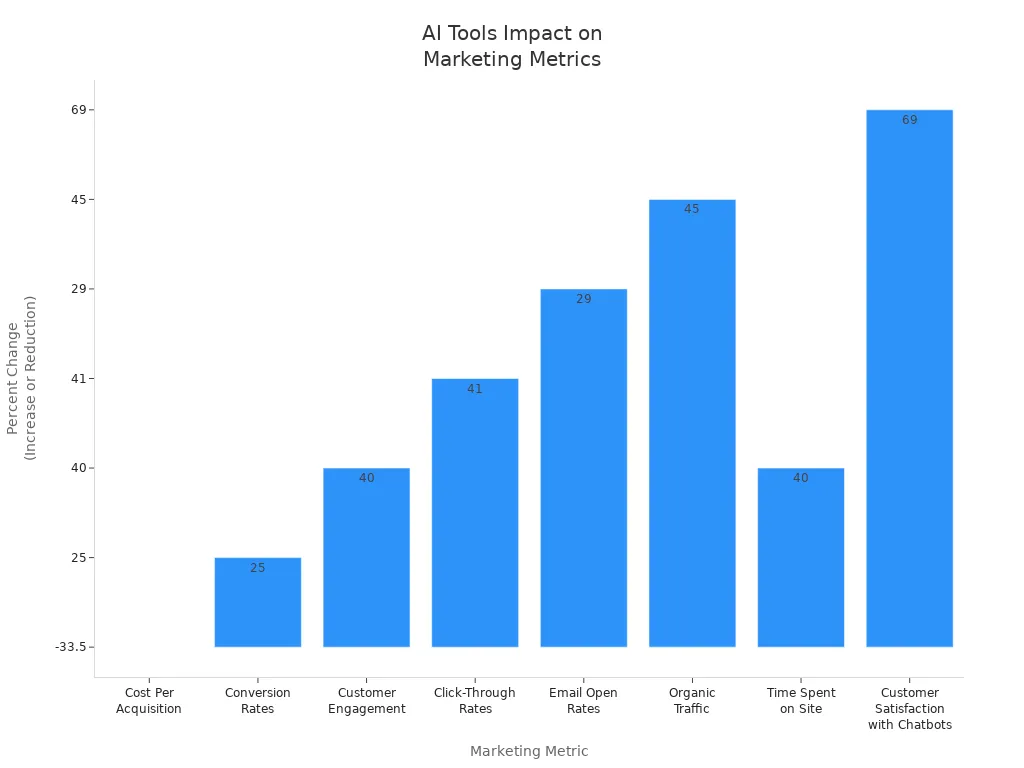
Think about getting these results for your next campaign.
Key Takeaways
AI marketing tools save you time by doing simple jobs for you. They also help your campaigns do better with smarter targeting and personalization. Using AI can make important numbers like conversion rates and click-through rates go up a lot. It can also help you get more people interested in what you offer. Start using AI by making clear goals that you can measure. Make sure these goals fit what your business needs. Pick tools that match your goals. Good data and a ready team are very important for AI marketing to work well. Clean data and training your team often help AI do a better job. Choose AI tools that are simple to use and work well with your other systems. Make sure they have good support and strong security. Try small projects first to see how AI tools work. Check the results fast and slowly use AI more as you learn. Watch your campaigns closely by looking at important numbers. Use what AI tells you to keep making your marketing better. Solve problems like data privacy, AI bias, and missing skills by making clear rules. Use both AI and human thinking together. Spend time teaching your team new things.
Why Use AI Marketing Tools
Key Benefits
You want your marketing to stand out and get results. That’s where AI marketing tools come in. These tools help you understand your customers better, predict what they want, and send them messages that feel personal. You can use them to analyze huge amounts of data in seconds. This means you can spot trends and make smart choices faster than ever.
Here’s what you get when you use AI marketing tools:
Do more with fewer people. You save money on hiring and agency fees.
Grow faster by creating more content and reaching more people.
Make smarter decisions with instant reports and predictions.
Get live optimization and automated testing for stronger campaigns.
Free up your time by letting AI handle 80% of routine tasks, so you can focus on creative ideas.
Tip: Let AI handle the boring stuff. You get more time to brainstorm and connect with your audience.
Check out how these benefits show up in real life:
Benefit What Happens for You
Time saved on repetitive tasks You spend less time on boring work, more on strategy
Workflow efficiency Your team works faster and gets more done
Lead generation You get more leads through chatbots and smart tools
SEO improvement Your content ranks higher and gets seen more
Personalization Your messages hit the right people at the right time
AI marketing tools also help you run campaigns across many channels at once. You can personalize emails, ads, and even website content for each visitor. This leads to higher engagement and better results.
Modern Marketing Challenges
Marketing today moves fast. You face new problems every day. Maybe you worry that AI will take away creativity, or you feel pressure to learn new tech. Sometimes, you might get wrong info from AI or struggle to keep up with all the changes.
Here are some common challenges:
Feeling like you need to learn AI or get left behind.
Spending extra time learning how to use AI well.
Not having clear processes for using AI in your team.
Worrying about data privacy and security.
Getting poor quality or inaccurate content from AI.
Fearing that AI might replace jobs.
But you can tackle these challenges. Start by using AI as a helper, not a replacement. Always double-check AI-generated content. Work with your team to set up clear rules for using AI. Stay open to learning, and remember, most marketers say AI helps them grow their careers.
Note: AI works best when you combine its power with your creativity and experience. Use it to boost your skills, not replace them.
Types of AI Marketing Tools

Content Automation
You want to make more content in less time. AI-powered content automation tools help you do this. These tools can write blog posts, emails, and social media updates. They also make product descriptions, images, and videos. You give them a topic or some keywords. The tools do most of the work for you.
Here’s a simple look at what these tools can do:
AI Capability What It Does How It Helps You
Grammar Correction Fixes grammar and spelling mistakes automatically Saves time and improves accuracy
Style Adjustments Changes tone to match your brand (formal, casual, etc.) Keeps your voice consistent
Predictive Text Suggests sentences or paragraphs as you type Speeds up writing
Content Summarization Shortens long articles into easy-to-read summaries Makes content more accessible
Translation Translates content for global audiences Expands your reach
Voice-to-Text Turns audio or video into written text Saves time and adds new content formats
You can use Shopify Magic for product descriptions. Klaviyo AI helps with email campaigns. These tools let you make content much faster and save money. They also help you avoid mistakes, so your brand looks good.
Tip: Let AI do boring jobs like tagging images or typing out videos. You will have more time for fun and creative work.
Predictive Analytics
Predictive analytics tools help you guess what will happen next. They look at old data and find patterns. You can use them to see which products might sell best. They also show which customers may buy soon or what content will get clicks.
These tools use smart algorithms that learn from your data. Amazon uses predictive analytics to suggest products. This helps them sell more and keep customers happy. You can also use these tools to spot trends and plan your next steps.
Machine learning models like decision trees and neural networks get smarter over time.
They help you guess what customers will do and make your marketing personal.
You can mix numbers with real feedback to make better guesses.
When you use predictive analytics, you make better choices. Your campaigns get better results.
Audience Segmentation
Audience segmentation tools help you find the right people for your ads. Instead of showing everyone the same ad, you can target groups. You can pick groups by what they like or how they act on your site.
AI marketing tools gather data from many places. They make profiles for each customer. These tools find patterns and group people into useful segments. For example, you can target shoppers who spend a lot or people ready to buy.
AI matches visitors to your best customer profile using past data and buyer intent.
It guesses who will buy by looking at things like repeat visits and session length.
You can send these groups to ad platforms for better retargeting and lookalike ads.
With AI segmentation, you spend less on ads and reach people who care about your brand. Some companies get up to four times better results by using these tools.
Note: AI segmentation works right away, so your targeting stays good even when customers change.
Lead Scoring
You want to spend time on leads who might buy soon. AI-powered lead scoring helps with this. These tools look at your leads and sort them by how ready they are. You do not have to guess who to contact first. The system checks things like website visits and email opens. It also looks at what people bought before. Each lead gets a score from the tool.
AI marketing tools help you find good leads faster. Your sales team spends less time on leads who are not interested. They spend more time closing deals. You get alerts when a lead’s score goes up. This helps you act at the right time.
Look at these numbers to see how much AI-powered lead scoring helps:
Metric Measurable Impact (%) Source / Example
Increase in sales conversion rates 25-30% Forrester, Salesforce Einstein
Increase in sales productivity 32% Forrester, SuperAGI
Reduction in sales cycle length 21% MarketsandMarkets, SuperAGI
Increase in revenue 15% MarketsandMarkets, SuperAGI
Lead scoring accuracy 90% SuperAGI
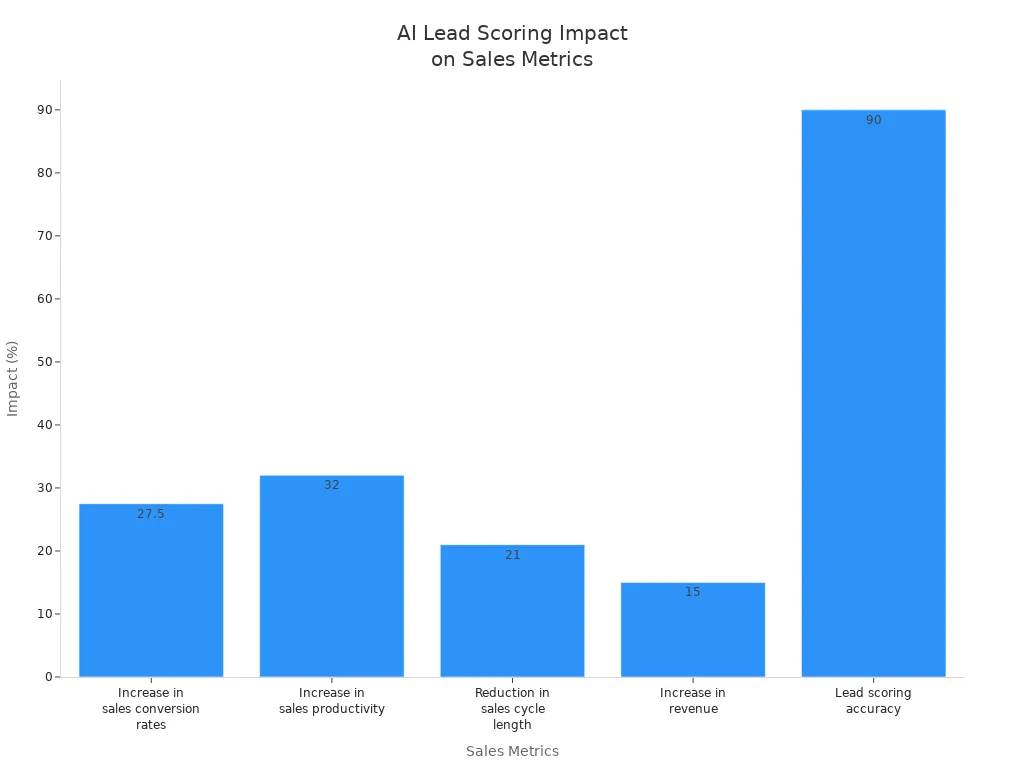
You can see that AI lead scoring helps you close more deals. You work faster and make more money. You also waste less time on leads who will not buy. This is good for your whole team.
Tip: Make your lead scoring rules fit your business goals. Check them often to keep your scores right.
Personalization
Personalization helps your customers feel important. AI marketing tools let you show the best message to each person. You can use these tools to suggest products or send special emails. You can even change your website for every visitor.
When you use AI for personalization, you see big changes. Customers get offers and content they like. They stay on your site longer and visit again. You also get more sales and better reviews.
Here is what happens when you use AI-driven personalization:
Metric / Outcome Impact / Improvement Example / Source
Customer engagement increase Up to 30% increase Sephora’s Beauty Insider program
Customer retention improvement Up to 35% higher redemption rates Fashion retailer personalized emails
Churn reduction Up to 35% lower churn rates AI-driven predictive analytics
Customer lifetime value (CLV) 20% to 40% increase General AI personalization studies
Conversion rates 15% to 80% increase Companies using AI personalization
Sales increase Up to 25% increase Various companies implementing AI
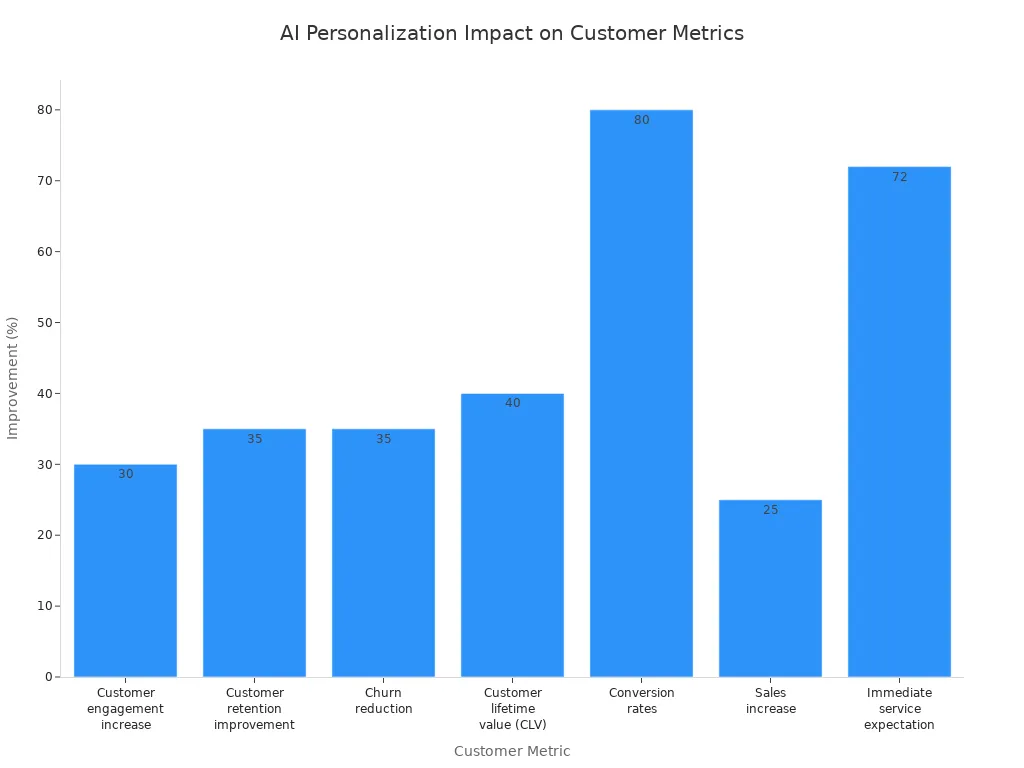
You can use personalization in emails, ads, and chatbots. Customers notice when you remember what they like. They trust your brand more and feel special.
Note: Start small with personalization. Try different messages and see which ones work best.
Setting Campaign Objectives
Defining Goals
You want your campaigns to work. That starts with clear goals. Before you use any new tool, ask yourself what you want to achieve. Do you want more leads? Maybe you want to boost sales or keep customers coming back. Pick one or two goals to focus on first. Trying to do everything at once can make things messy.
Here’s a simple way to set your goals:
Write down what you want to improve. For example, “Increase leads by 20% in three months.”
Choose numbers you can track. Use things like lead generation rates, customer acquisition costs, or sales conversions.
Make sure your goals match your business needs. If you want more sales, track revenue per customer.
Use dashboards to see your progress. Many tools show you real-time results.
Check if your investment pays off. Compare the cost of your tools to the extra money or time you save.
Don’t let the computer do everything. Always review what the system creates and keep an eye on your campaigns.
Tip: Start small. Test your ideas with a pilot project. You can always grow bigger once you see what works.
You can also use a table to keep your goals clear:
Goal Example KPI to Track Timeframe
Boost email signups Number of new subscribers 3 months
Lower ad costs Cost per click (CPC) 1 month
Improve customer retention Repeat purchase rate 6 months
Aligning AI Capabilities
Now, match your goals with what your tools can do. If you want to save time, look for tools that automate tasks. If you want better targeting, use tools that segment your audience or predict what customers want.
Start with a small project. Pick a campaign that matters, like a new product launch or a holiday sale. Set clear numbers to measure success, such as cost savings or more sales. Train your team so everyone knows how to use the new tools. If you need help, bring in an expert to get started faster.
Here’s a checklist to help you align your tools with your goals:
Define your main goal, like more website traffic or higher conversion rates.
Pick the right tool for the job. For example, use a tool that analyzes ad data if you want better ad results.
Set up your campaign with clear steps and KPIs.
Let the tool run, but check the results often.
Use what you learn to make your next campaign even better.
Note: Keep watching your numbers. Adjust your plan if you see something isn’t working. The best results come from mixing smart tools with your own ideas.
Data and Resource Audit
Data Quality
Before you jump into using AI, you need to check your data. Good data makes everything work better. Bad data can mess up your results and waste your time. So, what makes data “good” for AI? Here are some things to look for:
Your data should be accurate and up to date.
It needs to be complete. Missing pieces can cause problems.
Make sure your data is consistent. If you use different formats, AI can get confused.
Data should be relevant to your goals. Don’t collect things you don’t need.
Each record should be unique. Duplicates can throw off your results.
Keep your data well-structured. Organized data is easier for AI to use.
You need to be able to find and access your data quickly.
You also need to think about privacy and rules. Make sure you follow laws like GDPR or CCPA. Set up strong rules for how you collect and use data. This keeps your business safe and builds trust with your customers.
Here’s a table to help you check your data:
Assessment Dimension What to Look For
Data Quality Is it accurate, complete, and consistent? Are there gaps or errors?
Data Accessibility & Infrastructure Can you get to your data fast? Does your system handle lots of data without slowing down?
Governance & Compliance Do you follow privacy laws? Do you have rules for using data the right way?
Tip: Clean your data often. Fix mistakes, remove duplicates, and fill in missing info. This makes your AI results much better.
Team Readiness
You need more than just good data. Your team must be ready to use AI in marketing. Start by checking what skills your team has. Do they know how to work with data? Can they use new tools? Are they open to learning and trying new things?
Here’s a checklist to see if your team is ready:
Does your team know how to collect and clean data?
Can they use data analysis tools?
Are they good at testing and improving campaigns?
Do they think creatively and solve problems?
Is your team open to change and new ideas?
Do you have support from leaders and other departments?
Is there a plan for training and learning new skills?
Training is key. Give your team hands-on practice with AI tools. Set clear goals and show how AI fits into your business. Start small, track your progress, and adjust as you go. Make sure everyone knows the rules about privacy and data use.
Note: A team that learns together grows together. Keep learning, stay curious, and support each other as you try new things.
Choosing AI Marketing Tools
Selection Criteria
It can be hard to pick the best AI marketing tools. There are lots of options. You want tools that help you do your job better. The right tool should help you reach your goals. Here are some things to think about when picking a tool:
Check if the features fit your plan and daily work.
Pick tools that are simple to use. You should not spend a long time learning.
Make sure the tool works with your other software. This saves you time and trouble.
Choose tools that can grow as your business grows. This is important if you want to get bigger.
The tool should give you good data and clear reports.
Good support and training help you use the tool well.
Look for proof the tool works. Read reviews and stories from other users.
Make sure the tool keeps your data safe and follows privacy laws.
Tip: Try a tool on a small project first. This helps you see if it fits your team and goals.
You should also match the tool to your business goals. Set clear targets, like getting more leads or sales. Make sure your team is ready to use the tool. Check if the tool uses good data and follows safety rules. Test the tool with a small campaign and see the results. Training and support are important, too. The best tools help you track things like sales, costs, and time saved.
Top Tools
There are many AI marketing tools you can use. Some help with content, others with analytics, social media, or email. Here is a table to help you compare top tools for each job:
Marketing Category AI Marketing Tools Key Features and Benefits
Content Creation Buffer's AI Assistant, Typeface, Narrato AI Content Genie, HubSpot AI Social Media Caption Generator, Canva Make social posts, reuse content, design images, write captions, keep your brand voice the same
Analytics & Social Media Monitoring Mentionlytics, Meltwater Listen to what people say online, check feelings, watch competitors, find trends, spot influencers, get reports
Competitor Analysis Predis.ai, Rival IQ, Unmetric Study competitors, compare results, get ideas for social media, check hashtags, get alerts
Email Marketing (Check for new AI email tools in 2025—many platforms now add AI features for subject lines, timing, and personalization) Get more people to open emails, improve clicks, and send personal messages automatically
Let’s see how these tools work for real companies. BuzzFeed used generative AI to make quizzes and special content. They made ten times more content and got more page views. Starbucks used predictive AI to study orders, weather, and place. This helped them get more visits and sales. Sephora added an AI try-on app. Shoppers felt sure and bought more. Lexus used IBM Watson to write a commercial. They saw a 13% jump in people seeing them as creative and a 53% higher view-through rate.
Other brands like Farfetch and Unilever had big wins too. Farfetch used AI to write better email subject lines. They got up to 38% more clicks. Unilever used AI to make content faster and cheaper. They cut costs by 30% and finished campaigns 50% faster.
Note: Real companies get real results with the right AI marketing tools. Start with one tool, check your results, and grow from there.
Integration and Workflow
Implementation Steps
Getting AI into your daily marketing work can feel big, but you can break it down into simple steps. Here’s a clear path you can follow to make the process smooth and less stressful:
Spot the Right Tasks
Look at your current marketing work. Find jobs that take a lot of time or repeat often. These are perfect for AI. Talk with your team to see where you all spend the most effort.Check the Benefits
Think about how much time you could save. Will AI help you do things faster or better? Focus on the tasks where you see the biggest wins.Pick the Best Tools
Explore different AI options. Choose tools that fit your goals and are easy for your team to use. Make sure they work well with your other software.Start Small
Begin with a simple project. Try AI on a low-risk task first. This helps your team get used to the new way of working.Measure Results Fast
After you start, check how things are going. Look at the results in the first month or two. Ask your team what works and what needs fixing.Keep an Eye on Performance
Watch how the AI is doing. Collect feedback from your team. Use this info to make things better.Grow Step by Step
As you see good results, add AI to more parts of your marketing. Move at a pace that feels right for your team.
Tip: Always keep your data clean and up to date. Good data makes your AI smarter and your results stronger.
You might run into some bumps along the way. Here’s a table to help you spot common problems and how to fix them:
Challenge Description Solution
Choosing the right tool Hard to find tools that fit your needs and work with your systems Try free trials and demos. Pick tools that can grow with your business.
Lack of strategy No clear plan for using AI Set clear, measurable goals before you start.
Poor data quality Bad or old data hurts your results Clean your data often. Check for mistakes and fill in missing info.
Over-automation Too much automation feels cold to customers Mix AI with human touches to keep things personal.
Stale workflows Old routines make customers lose interest Update your workflows often. Use feedback and analytics to stay fresh.
Note: If you ever feel stuck, ask your team for ideas. Sometimes the best solutions come from people who use the tools every day.
Training and Adoption
You want your team to feel confident using new AI tools. Training makes all the difference. Here’s how you can help everyone learn and grow together:
Build a Simple Training Plan
Create lessons that mix basic ideas with real tasks. Show how AI works, then let your team try it out. Use real projects so learning feels useful.Use Different Ways to Teach
Start with a kickoff workshop to get everyone excited. Offer short lessons, webinars, and safe places to practice. Let your team play with the tools before using them for real work.Track Progress
Watch how your team improves. Check if they use the tools more, save time, or get better results. Ask for feedback and see what needs more practice.Make Learning Fun and Rewarding
Talk about the good things AI brings. Give easy guides and help when needed. Celebrate team members who try new things first.Keep the Momentum Going
Add AI steps to your daily work. Pick team champions who can help others. Share tips and stories in regular meetings. Update your training as tools change.
Tip: Hands-on practice helps the most. Let your team try real tasks, like writing a LinkedIn post or setting up an email, using AI.
Most teams use a mix of in-house classes, webinars, and one-on-one coaching. Let your team experiment and share what they learn. Use surveys and chats to see how everyone feels about the new tools. Bring in real examples and case studies to make lessons stick. Keep your training fresh and focus on both creative and technical skills.
Challenge Description Solution
Lack of information and data mix Data is scattered and AI tools seem confusing Bring your tools together and make sure your data is organized and easy to use
Trusting AI outputs People worry AI might make mistakes Always double-check AI work and let humans review important results
Privacy and compliance Rules like GDPR and CCPA can be tricky Be open about how you use data, get clear consent, and keep up with privacy laws
Confidence and budget Some team members feel unsure or worry about costs Offer training, show how AI saves money, and encourage everyone to keep learning
Note: People—not just tools—make change happen. Support your team, answer questions, and keep learning together.
Optimization and Monitoring
Performance Tracking
You want to know if your campaigns work. Tracking the right numbers helps you see what’s going well and what needs fixing. With AI, you can watch your results in real time and spot trends fast. Here are some important things to track:
Cost per acquisition (CPA): Shows how much you spend to get a new customer.
Engagement rate: Tells you if people like your content.
Click-through rates (CTR): Measures how many people click your ads or emails.
Conversion rates: Shows how many people take action, like buying or signing up.
Churn rate: Tells you how many customers leave.
Forecasting accuracy: Checks if your AI predictions match what really happens.
Response time: Measures how quickly you answer customers.
Mean Squared Error (MSE): Helps you see how close your predictions are to real results.
Customer sentiment: Shows how people feel about your brand.
Net Promoter Score (NPS): Tells you if customers would recommend you.
Tip: Set a baseline before you start. This way, you can see how much you improve over time.
You should also look at accuracy and precision. Accuracy tells you if your AI hits the mark. Precision checks if your messages reach the right people. Both help you avoid wasting money and make your campaigns stronger.
Here’s a table to help you remember what to track:
Metric What It Shows
CPA Cost to get a new customer
CTR How many people click
Conversion Rate How many people take action
Churn Rate How many customers leave
Forecasting Accuracy How close predictions are to real
NPS Customer loyalty and satisfaction
Continuous Improvement
You want your campaigns to get better every time. AI helps you do this by making changes fast and learning from results. You can use real-time data to tweak your ads, emails, or website. If something isn’t working, you can fix it right away.
AI lets you adjust your SEO, ads, and messages as soon as you see a change in the market.
You can test different headlines, images, or offers. AI will show you which ones work best.
Personalization gets easier. AI studies what your users do and sends them the right content.
You can use tools like HubSpot, Salesforce Marketing Cloud, or Mailchimp to automate and optimize your campaigns.
AI can move your budget to the best-performing ads, so you don’t waste money.
You can keep your message the same across all channels, making your brand stronger.
Note: Amazon cut cart abandonment by 25% in one month using AI to retarget shoppers with special deals. HubSpot boosted LinkedIn ad clicks by 40% with AI-powered targeting.
Keep an eye on your key numbers every day. Review what AI changes and make sure it matches your goals. Mix AI with your own ideas for the best results. When you spot something new, try it out and see if it works. Over time, your campaigns will get smarter and more effective.
Overcoming Challenges
Data Privacy
You want your customers to trust you with their information. Data privacy is a big deal in marketing today. When you use smart tools, you collect a lot of personal data. This can lead to problems if you are not careful. Some of the biggest risks include data breaches, misuse of information, and sharing data without permission. Sometimes, companies keep data for too long or use it in ways people did not expect.
Here are some common privacy concerns you might face:
Data breaches that expose personal details.
Using data for profiling or spreading wrong information.
Algorithms making unfair choices.
Storing data longer than needed.
Not getting clear consent from users.
Sharing data by accident.
Hackers trying to steal sensitive info.
You can protect your customers by following a few simple steps:
Set up clear rules for how you use and check your tools.
Run regular checks to make sure you follow laws like GDPR and CCPA.
Train your team on privacy best practices.
Build privacy into your tools from the start.
Watch for new risks all the time.
Use encryption and make data anonymous when possible.
Try privacy tools that spot and fix problems fast.
When you do these things, you keep your customers safe and build trust. You also avoid big fines and bad press.
Tip: Always tell your customers how you use their data. Clear and honest messages help people feel safe.
AI Bias
AI can sometimes make unfair choices. This happens when the data used to train the system is not balanced. For example, Amazon once used a hiring tool that picked more men than women because the data came from mostly male workers. Some online ads have shown more arrest records to people with African-American names. Other times, AI links women with art and men with science. These are real problems that can hurt your brand.
You can fight bias by:
Using special tools that look for bias before you launch a campaign.
Picking algorithms that focus on fairness, not just accuracy.
Testing your system with fairness checks, like demographic parity.
Having a team with different backgrounds review your results.
Making sure your AI decisions are easy to explain.
Setting up clear rules and training for everyone who works with AI.
Fixing bias is not just the right thing to do. It also keeps your brand strong and helps you avoid legal trouble.
Note: Always mix human judgment with AI. People can spot problems that machines miss.
Skills Gap
You might worry that your team does not have the right skills for new technology. This is a common problem. Only about 1 in 10 workers feel ready to use AI at work. Most employees want more training, especially on ethics and safety. If your team does not know how to use these tools, you could fall behind your competitors.
Here is a table to show the main issues and ways to fix them:
Challenge What You Can Do
Not enough skilled staff Offer workshops and certifications
Employees feel unprepared Give hands-on practice and real projects
Training takes too long Use no-code tools and short, focused lessons
AI fatigue Talk openly about how AI helps, not replaces jobs
Keeping skills fresh Set up mentorship and regular skill checks
You can also work with schools or other companies to help your team learn faster. Try to make learning part of your daily work. Give people time to practice and ask questions. When you invest in your team, you build a future-ready business.
Tip: Celebrate small wins. When someone learns a new skill, share it with the team!
System Integration
Getting your new AI tools to work with your old systems can feel like solving a big puzzle. You might run into problems that slow you down or make your work harder. Let’s look at what can go wrong and how you can fix it.
You may notice these common challenges when you try to connect new AI tools with your current marketing systems:
Old platforms might not “talk” to new tools. Some legacy systems don’t have APIs or use data formats that don’t match.
Data can get messy. You might have information in different places, with different formats, or missing pieces.
Switching between lots of platforms can break your workflow. You lose time and make more mistakes.
Sometimes, your team can’t get real-time data from all your tools. This makes it hard to make quick decisions.
AI models may not always work well together. Different versions can give you mixed results.
Security can become a headache. You need to keep data safe as it moves between systems and make sure only the right people have access.
Your old hardware might not be strong enough for new AI features. This can slow things down or even stop them from working.
Some team members may feel nervous about new tech. Change can be hard, and not everyone likes it at first.
You don’t have to let these problems stop you. Here are some ways to make integration smoother:
Start small. Try a pilot project before rolling out big changes.
Pick tools that work well with your current systems. Look for ones with good support and easy connections.
Use cloud-based platforms. These often make it easier to connect different tools and scale up when you need more power.
Run regular data audits. Clean up your data, fix errors, and make sure everything is in the right format.
Set up clear rules for who can see and use your data. Role-based access controls help keep things safe.
Train your team. Show them how the new tools work and why they matter.
Work with experts if you need help. Sometimes, outside advice can save you time and money.
Here’s a quick table to help you spot problems and find solutions:
Challenge What You Can Do
Old systems don’t connect Use compatibility layers or upgrade
Messy data Audit and clean your data regularly
Workflow interruptions Choose unified platforms
Security worries Centralize security and access controls
Team resistance Offer training and support
Tip: Change takes time. Celebrate small wins and keep your team involved. When everyone feels included, integration gets easier.
You can make your systems work together. Take it step by step, and soon you’ll see smoother workflows and better results.
You have the power to make your campaigns smarter and more personal. Start by setting clear goals, picking the right tools, and keeping your data clean. Try new ideas, watch your results, and keep learning.
Let AI help you understand your audience and predict what works.
Always check for privacy and fairness.
Ready to boost your marketing? Take the first step and see how far you can go!
FAQ
What is the easiest way to start using AI marketing tools?
You can start with a free trial or demo. Pick one tool that solves your biggest problem. Try it on a small project. Watch how it works and see if it helps you save time or get better results.
Do I need to know coding to use AI marketing tools?
No, you don’t need coding skills for most tools. Many platforms use simple dashboards and drag-and-drop features. You can follow step-by-step guides or watch short videos to learn quickly.
How much do AI marketing tools cost?
Prices vary. Some tools offer free plans with basic features. Paid plans can start at $20 per month and go up. You can compare prices and features in a table before you choose.
Plan Type Price Range
Free $0
Basic $20–$50/month
Pro $100+/month
Will AI replace my marketing job?
AI helps you do your job better. It handles boring tasks and gives you more time for creative work. You still need to plan, review, and add your personal touch. Think of AI as your assistant, not your replacement.
How do I keep my customer data safe with AI tools?
You should pick tools that follow privacy laws like GDPR or CCPA. Always use strong passwords and update them often. Train your team on privacy rules. Check your settings to control who can see or use your data.
Can AI tools really improve my campaign results?
Yes! Many marketers see higher open rates, more clicks, and better sales after using AI. You can track your results with built-in reports. Try A/B testing to see what works best for your audience.
What if my team feels nervous about using AI?
Start with a team meeting. Show how AI makes work easier. Offer short training sessions. Celebrate small wins together. Let everyone share tips and ask questions. When your team feels supported, they learn faster and enjoy the change.
Introduction: Why AI Marketing Is More Urgent Than Ever in 2025?
As we step into 2025, businesses are grappling with slowing market growth and tighter marketing budgets. At the same time, the digital marketing landscape is becoming increasingly fragmented, with user touchpoints multiplying and content demands surging exponentially.
This raises a critical question for every marketer: "In the face of growth anxiety, how can we reach target users faster, more accurately, and at lower cost?"
The answer is becoming clearer—AI marketing is rapidly emerging as a practical solution to content and efficiency challenges.
According to the 2025 AI Marketing Trends White Paper, over 70% of medium to large enterprises globally plan to implement AI technologies in their core marketing workflows within the next two years. More importantly, AI marketing platforms are moving from experimental use to essential business infrastructure, offering end-to-end support from content generation to delivery.
No longer just a tech buzzword, AI marketing has become an indispensable tool for many SMEs exploring ways to “reduce cost and increase efficiency”—especially in areas like content production, targeted advertising, and closed-loop marketing analytics. AI is reshaping traditional marketing logic with unprecedented speed and accuracy.
One.What Is AI Marketing and What Business Problems Does It Solve?
AI marketing is more than just integrating artificial intelligence into marketing—it’s about using algorithms and data-driven processes to redefine how brands interact with users. Powered by generative AI, natural language processing, and machine learning, it provides faster content creation, more precise targeting, and clearer growth paths.
In today’s performance-driven, budget-constrained environment, AI marketing tools are helping brands overcome three long-standing barriers to growth:
Rapid Market Changes, Manual Output Can’t Keep Up
In the digital era, “content is king” is not just a slogan—it’s a competitive advantage. But traditional teams are overwhelmed by increasingly fragmented content demands. A single campaign might require posters, videos, tweets, ad copy, email headers… The creative burden is intense.
AI marketing platforms leverage semantic understanding and multimodal content generation to rapidly produce content in multiple formats and styles, customized for various channels. For instance, a product launch campaign can be powered by a single prompt, and the AI will generate platform-specific assets for TikTok, Instagram, Xiaohongshu, and Google Ads—true multi-platform execution from one idea.
Limited Budgets, Low Conversion Rates
“High ad spend, low ROI” is a common frustration among SMEs. Traditional advertising relies heavily on manual targeting and lacks a feedback loop, often resulting in stagnant sales despite rising traffic.
AI marketing tools can segment users based on persona data and optimize ad delivery dynamically in real-time. For example, a fashion brand used an AI marketing SaaS to auto-switch ad creatives based on regional weather—promoting jackets during cold spells—significantly boosting click-through and conversion rates.
Opaque Delivery Process, Uncontrolled Outcomes
Many brands struggle to answer: “Why did this ad work—or not?” The culprit is usually a broken data chain and lacks attribution analysis.
Modern AI marketing platforms unify content creation, delivery, behavior tracking, and performance analytics into a transparent, real-time data loop. With visual dashboards, brands can evaluate copy effectiveness, audience preferences, and conversion paths—allowing fast iteration and strategic optimization.
A 2025 Nielsen report found that 68% of high-growth companies list “automated content + intelligent delivery” as a core goal—AI marketing is at the heart of this transformation.
Two.How to Implement AI Marketing: Finding the Right Use Cases
For companies to move from “awareness” to “adoption,” they must identify scenarios that match their business goals. Here are four high-impact areas where AI marketing is already proving its value:
Social Media Content Operations
AI can analyze platform tone (Weibo, Xiaohongshu, TikTok, Instagram) and auto-generate native content, titles, and visuals. It supports one-click scheduling and cross-platform publishing, significantly reducing repetitive manual tasks.
Cross-Border E-commerce & Multilingual Ads
AI platforms combine machine translation with cultural adaptation to generate localized ad copy across multiple languages. It’s one of the most effective AI marketing tools for e-commerce brands aiming to scale globally.
Programmatic Ad Optimization
AI continuously learns from user behavior to auto-generate multiple ad variations and run A/B tests—refining creative delivery with real-time feedback to ensure that every ad dollar counts.
Integrated Multi-Channel Campaigns
AI can now support the entire content lifecycle: ideation, asset creation, channel scheduling, ad pushing, and data tracking. Many enterprises are building AI-powered content hubs to enable seamless, end-to-end AI marketing strategies.
Three.Key Differences Between AI Marketing Tools and Traditional Methods
AI marketing isn’t about replacing humans—it’s about adopting a smarter work mode:
Faster Content Creation: Start with an idea, let AI draft, then fine-tune.
Smarter Ad Targeting: Algorithms analyze interest points and auto-match content.
Simplified Workflow: All-in-one platforms reduce tool-hopping and streamline teamwork.
Some intelligent content engines combine AI content marketing with automated distribution, helping brands achieve both creative consistency and delivery efficiency.
Four.Can SMEs Quickly Deploy AI Marketing SaaS?
Many businesses fear high technical barriers. In reality, today’s AI marketing SaaS platforms often feature low-code or visual interfaces. Even teams without tech or design expertise can launch a fully operational content workflow in hours.
Some tools offer ready-made templates, creator collaboration features, and asset management systems—allowing rapid deployment from creation to distribution. Even early-stage startups can achieve cross-language, multi-platform content output without heavy investment.
Simply define your campaign direction and upload a few assets—the platform handles the rest, dramatically cutting labor and time costs.
Five.FAQ: Common Questions About AI Marketing
Q1: What’s the key difference between AI marketing and traditional digital marketing? AI marketing is driven by intelligent decision-making and automation. Through machine learning and natural language generation, it automates content, targeting, and optimization—unlike traditional marketing, which relies on manual input. The result? More precision, speed, and cost-efficiency.
Q2: Can AI-generated content reflect our brand tone? Yes. Most AI content marketing platforms allow for tone customization—predefined vocabulary, visual style, and brand personality settings ensure alignment. Human review remains optional to refine personalization without sacrificing consistency.
Q3: How should a company begin using AI marketing? Start with automated content production—use and use AI to generate copy, product descriptions, short videos, etc., and see immediate gains. Then expand into ad optimization, multilingual expansion, and localization. Choose an intuitive, integrated AI marketing SaaS platform to scale efficiently.
Conclusion: AI Marketing Is Not a Gimmick—It’s the Most Practical Growth Engine of Our Time
AI marketing is no longer a futuristic idea on a PowerPoint slide. It’s being rapidly adopted and validated by businesses as a powerful driver of performance. From copywriting to content delivery, from targeting to analytics, it transforms how brands connect with their audiences.
Rather than replacing creativity, AI liberates it.
With the help of AI markrting tool PhotoG, businesses can free up time from repetitive tasks and invest in high-impact activities—like strategic planning, storytelling, and user lifecycle engagement. This marks a critical shift from “content mass production” to “content-driven growth.”
This isn’t just a tech evolution—it’s an organizational upgrade. In a world of global competition, private domain operations, and video commerce, "how to do AI marketing" is no longer optional—it’s core to growth.
For startups, AI marketing platforms help level the playing field—lowering costs and enabling fast go-to-market. For large brands, AI tools help build scalable, intelligent content systems and marketing engines for organization-wide synergy.
As Forrester noted in its 2025 AI Marketing Landscape report: “Leading brands are embedding generative AI into their operational backbone, positioning it as one of the top growth levers over the next three years.”
Whether you’re a local challenger or a global contender, now is the time to embrace AI marketing—and shape your next growth curve. Because in the intelligent era, the future won’t wait.
Comment