
Riffit
WhatsApp invoicing for Indian freelancers

https://www.youtube.com/watch?v=CFAO0KW9me4
Riffit is WhatsApp invoicing for Indian freelancers. This month had the best top-of-funnel numbers since launch and the same bottom line as every other month: zero recurring revenue.
What shipped this month
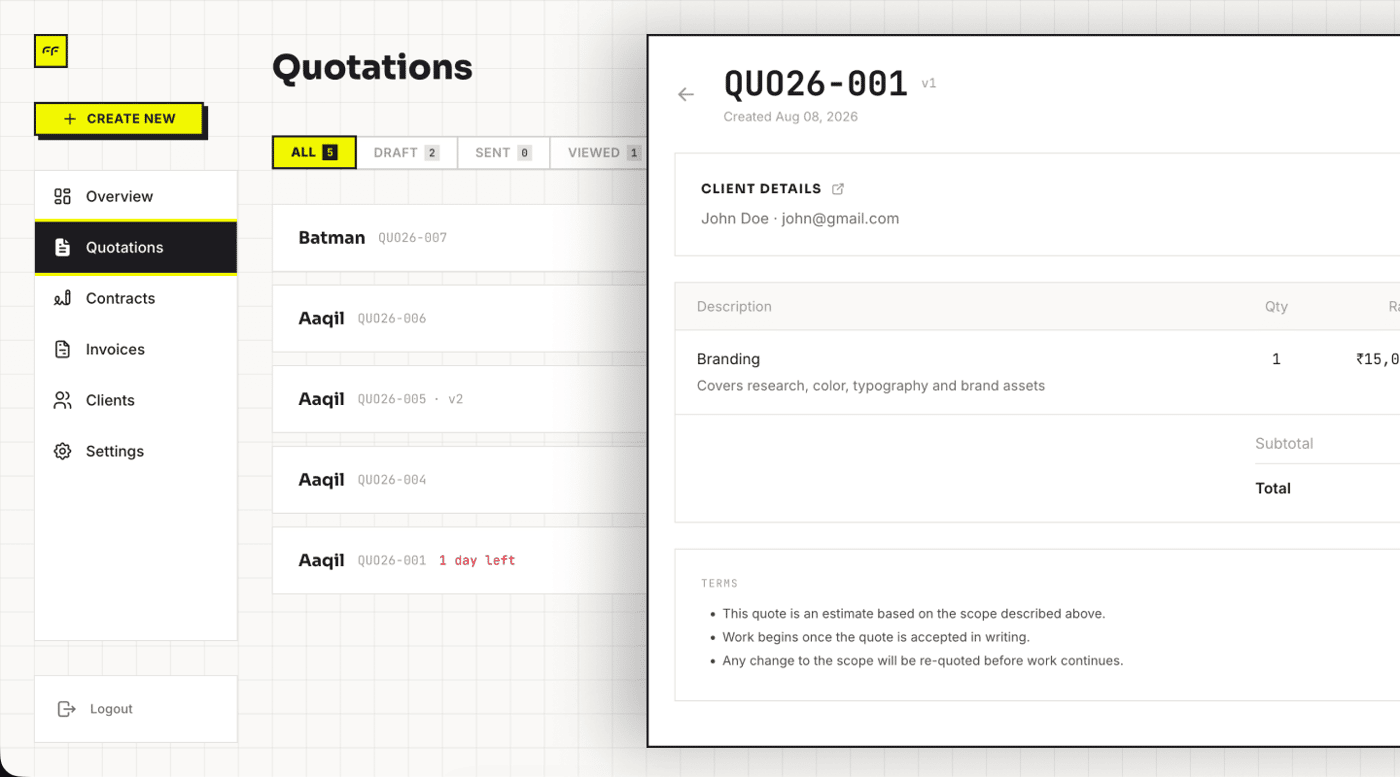
Last month I said quotations over WhatsApp were next. That shipped. You can now create a quotation from a WhatsApp chat the same way you create an invoice, and it joins the existing chain: quotation to contract to invoice.
The demo video is done. 1 minute 45 seconds, on YouTube as of today.
Started an Instagram account. Two posts.
The numbers
18 signups in August, the highest month so far. 62 since March, 57 once I remove my own test accounts.
Search is still the channel that compounds. August closed at 275 clicks and 30,073 impressions, against 158 and 13,692 in July. CTR is 0.9%. The revised quotation post sits at position 4 with 2,490 impressions and 3 clicks. I said last month this was a title problem. It still is, because I have not fixed the titles.
Now the part that matters. 21 people signed up since August 1. 16 finished onboarding. 6 started an invoice on WhatsApp. 3 created one anywhere. Six people in total have ever created 3 or more invoices.
Quotations got picked up quickly: 5 people created 19 in the first month, and the free quotation tool produced 6 more from people who never signed up.
Revenue: 13 trials expired in August, 14 upgrade prompts were shown, 0 converted. July's one paid conversion did not renew.
Instagram sent 4 visitors. ChatGPT sent 5, and one of September's signups came from it, the first user I can trace to an AI answer engine.
What I learned
Every piece of feedback this month said the same thing. People tried it, were impressed, and asked for more invoice templates. There is one. I promised more last month and built WhatsApp quotations instead, because quotations were on my roadmap and templates were not. Users were pointing at their list and I was reading mine.
The other lesson: I spent five months saying distribution was the bottleneck. This month distribution showed up and 3 of 21 people created an invoice. It was never only distribution.
On Meta: October pricing is published. Bot replies inside the 24-hour window are billed from October 1, first 1,000 a month per number free. Riffit's bot handled 75 inbound messages in August. I rebuilt the flow for a bill that does not exist yet. Right order, worth saying out loud.
What's next
Two things, both checkable in October's update: a second invoice template, and a personal WhatsApp message to each of the 17 people who signed up since August 1 and never created anything. October's post will have the reply rate.
Question for the IH community
Everyone who tried Riffit this month said they were impressed, asked for templates, and did not pay. For those who have been through this: was the feature request the real objection or the polite one, and how did you find out?

Riffit is WhatsApp invoicing for Indian freelancers. This month Meta changed how it charges for messages, and it exposed that I had built the most expensive interface possible.
What shipped this month
Quotations, with the part that actually matters: a quotation converts into a contract, and the contract converts into an invoice. One chain. You stop typing the same client details three times.
Two free tools went live as activation funnels, both with no signup. A payment reminder text generator and a quotation generator. The bet is that someone who just built a quotation is one nudge away from sending it on WhatsApp, and that nudge is the product.
The bigger change was invisible. I rebuilt the WhatsApp invoice flow from a step-by-step conversation into forms.
The numbers
51 signups. Search is the channel actually compounding: 158 clicks and 13,692 impressions in July against 49 clicks and 5,779 in June, and August is pacing slightly ahead at 56 clicks in the first nine days. Average position 6.7. One post sits at position 8 with 3,570 impressions and 4 clicks. That is a 0.1% CTR and it is entirely a title problem, not a ranking problem.
One paid conversion so far. It did not repeat.
The best growth this month came from a single WhatsApp message. I demoed to one person, he was blown away, he sent it to friends, and that produced more signups than the Instagram account and the Google Ads brand campaign I started the same month.
What I learned
Meta started charging for messages that used to be free. My step-by-step flow asked four questions and confirmed at the end. Every one of those was a billable message. It felt like good UX because it felt like a conversation. It was also the most expensive possible way to collect four fields.
I rebuilt it using forms and flows. Same data, a fraction of the messages.
The lesson I did not want: I had been designing the interaction as if the medium were free, and it never was. If your product lives inside someone else's platform, their pricing page is part of your architecture.
What's next
Quotations over WhatsApp, then contracts. Quotation first because it is the simpler flow and the free tool already tells me people want it. Plus more invoice PDF templates.
Question for the IH community
For anyone building on a platform you do not control, whether that is WhatsApp, Slack, Shopify or Stripe: when their pricing moved, what did you actually change structurally, and what did you just absorb and hope would not happen again?

I'm building Riffit, WhatsApp invoicing for Indian freelancers. Solo, designer by trade, no coding background. Last month I wrote that a lot had shipped and the funnel had not moved. This month one number finally did.
The first paying customer
Someone paid for Pro. ₹249 a month. After months of ₹0 MRR, that one line in Razorpay felt bigger than it should have.
He had already created a few invoices in Riffit and sent them to real clients before he ever looked at the paid plan, so the product had earned it. When he went to pay, he tried the annual plan first. Razorpay's checkout timed out on him. He waited, came back, and took the monthly plan instead. My first sale nearly died to a payment timeout, a humbling reminder that the checkout matters as much as the product.
Riffit has 22 real users now, up from 18 a month ago, so one paying customer barely moves the business. But 0 to 1 on revenue is a different kind of proof than 0 to 1 on activation. Someone valued the thing enough to put money on it.
What shipped
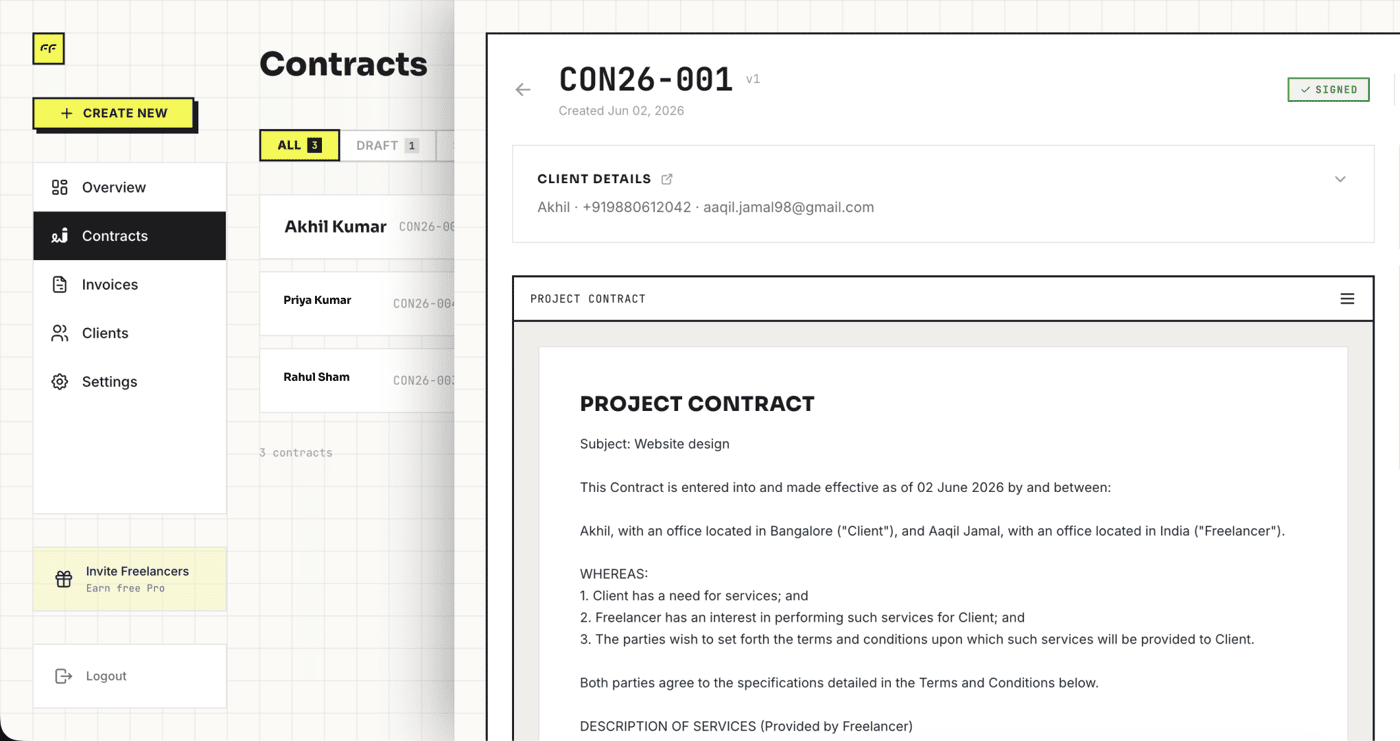
I closed the loop on the project contract by adding in-app signing. Both parties sign inside the app, and every signed contract produces an audit trail of who signed what and when. It is deliberately narrow, one contract type, while I learn how people actually use it.
The search numbers
Search is where the compounding shows. Over the last 28 days the site pulled 5,634 impressions, up from about 1,500 a month ago. Clicks went from 30 to 45. Average position held around 7.7. So impressions almost quadrupled and clicks barely moved, which means my click-through rate is now under 1 percent. I am getting seen and not clicked. Half the clicks are still people typing "riffit" by name. The non-brand engine is real now, but my titles and meta descriptions are leaving clicks on the table.
What I learned
Last month I committed to two things: personal WhatsApp messages to users stuck after one invoice, and UTM capture working end to end. UTM finally looks like it is capturing, which is a relief after months of blind attribution. The DMs I did not do properly. Invoice 1 to 3 is still the unsolved problem: 9 of my 22 real users have sent an invoice, and only one has ever sent three. A first paying customer is a nice surprise, but it does not change that.
What's next
Two things before the August update. Rewrite titles and meta on the five posts with the most impressions and the worst CTR, then measure whether clicks actually move. And send those WhatsApp messages to the one-invoice users this time, instead of just planning to.
Question for the IH community
For those of you past your first paying customer: what actually got you from one to ten? Did you lean into whatever produced the first sale, or treat that customer as noise and keep pushing top of funnel?
I'm building Riffit, WhatsApp invoicing for Indian freelancers. Solo, designer by trade, no coding background. A lot shipped this month. The numbers barely noticed. Here's both halves.
What shipped this month
Two product launches plus a distribution push. Contracts went live inside Riffit: I built 4 contract templates, then shipped just one, a standard project contract, to keep the surface small while I learn how people actually use it. Also live: a client content generator, plus a round of code refactors under the hood.
On distribution, the blog went from 13 to 24 live posts. 12 new articles in 30 days, plus title and meta rewrites on 7 older posts that were ranking on page 1 with broken click-through. To make that pace survivable on a 3 to 5 hour weekly marketing budget, I built a content operations system on top of Claude: 11 small skills that pull live Search Console data, decide between new posts or CTR fixes, and draft Reddit replies matched to a corpus of 23 of my real comments. Marketing compressed from write-everything to review-and-post.
The numbers
18 real signups now, up from 16 a month ago. 3 of those came in the last 30 days: one has already sent 2 invoices, the other two have sent none. Overall, 10 users have sent at least one real invoice, 16 real invoices total, and still exactly 1 user has crossed 3 invoices. ₹0 MRR. Search is the bright spot: 30 clicks and 1,578 impressions in the last 28 days at average position 7.2, up from roughly 21 clicks a month last quarter. Half of those clicks are people searching "riffit" by name, which is encouraging and also a reminder that the non-brand engine is still small.
What I learned
I made content production efficient and measurable, and the funnel barely noticed. Activation 0 to 1 works when people show up (median signup to first invoice has been about 7 minutes), but invoice 1 to 3 is where everything stalls, and no volume of blog posts fixes that. Also embarrassing: UTM capture is still broken. The database columns exist now, and the count of attributed signups sits at zero. Every channel decision I made this month was made blind.
What's next
Two specific things before the July update: personal WhatsApp messages to the 5 users who sent exactly one invoice and stopped, to find out why there was no second. And UTM capture working end to end, verified with one real attributed signup, before I write another content batch.
Question for the IH community
If you've solved a "first action works, second action stalls" gap: what actually moved the second-action number for you? Product nudges, personal outreach, or something else entirely?
-
1
The part that stood out to me is that you may be treating this as a traffic problem when the data is starting to look more like a repeat-usage problem.
You already proved someone can sign up and send the first invoice.
The expensive mistake now would be spending another month improving acquisition while the real bottleneck sits between invoice one and invoice three.
I wouldn't answer the product-vs-outreach question casually because the fix depends on why users stop after the first invoice.
Happy to put the tighter activation path in writing if useful. There is a real risk of collecting more users before understanding why the current ones stall.


Riffit is a WhatsApp-native invoicing platform for Indian freelancers. You describe the work in a WhatsApp message. You get a professional invoice PDF back. No forms, no laptop required.
Where things stand:
23 total signups (up from 3 last month). 33 invoices created. The interesting metric isn't the signup count, it's that people are actually creating invoices, not just signing up and bouncing. ~1.4 invoices per user.
What I shipped this month:
Most of the work was marketing experiments, not core product.
Built and launched Client Red Flag Bingo at riffit.in/bingo. A swipe-based viral game where Indian freelancers identify bad-client red flags they've lived through. Hinglish tiles, savage roast, five-tier identity system from Fresh to Certified Unhinged. 49 unique players, 31 shares in the first week.
Published two new blog posts: a comparison of Zoho Invoice vs Refrens vs Riffit, and a deep-dive review of Refrens specifically. Both targeting comparison/alternative keywords for the slow SEO compound play.
Updated the marketing strategy after some hard reflection. Cut the "post on every platform" plan. Now it's: blog (slow compounding SEO), one viral tool experiment per month, maintenance-only effort on Twitter/LinkedIn/Reddit.
Set up proper analytics. PostHog dashboards for product funnel, Bingo funnel, and client invoice interactions. Now I can actually see what's happening instead of guessing.
The honest challenge:
The Bingo tool didn't drive Riffit signups. 49 unique players, 31 shares, 0 attributable conversions via UTM.
But the qualitative reception was actually strong and that's what's making this experiment hard to read. People in design WhatsApp groups called it "crazy work" and "all my freelancing trauma summed up." One playtester texted: "we are celebrating high scores and crying in corners on why are we all scoring high." Another sent it to designer friends unprompted. A real engaged user found a real bug on Samsung M32 and reported it carefully enough that I could fix it the same day.
So this isn't a "the tool flopped" story. It's a "the content resonated but the conversion bridge didn't" story.
The lesson I'm taking: engagement isn't intent. People played because the content was relatable. They didn't sign up because the moment of laughing about bad clients isn't the moment of solving an invoicing problem. Same pain axis, different headspace.
So where did the 20 new users come from? Mostly slow stuff. Blog SEO finally clicking on long-tail searches. Personal outreach referrals. Compounding work, not viral spikes.
What's next:
Iterate on Bingo before walking away. The format worked at engagement. The post-game CTA didn't. Try a v2 with a tighter bridge something that meets players in their actual emotional state, not where I want them to be.
Ship a payment follow-up generator. Different angle, people searching "how to follow up on a late payment" are in problem-solving mode, not entertainment mode. Tighter fit by design.
Get 3 testimonials on tape so I can run a Product Hunt launch.
Push the Refrens comparison blog into Reddit comparison threads (organic, not promotional).
The question:
For solo founders here who've shipped a marketing experiment that landed at "audience loved it, conversion was zero" how did you decide whether to iterate the format or kill it? I'm tempted to do Bingo v2 with a tighter Riffit bridge, but also wondering if a viral roast game is just the wrong shape entirely for a B2B-ish product. Anyone been in this exact spot?

Riffit is a WhatsApp-native invoicing platform for Indian freelancers. You describe the work in a WhatsApp message. You get a professional invoice PDF back. No forms, no laptop required.
Where things stand:
The product has been live for a few weeks now. 3 users, 2 friends I asked to try it, 1 actual freelancer who found it organically. That's not a vanity metric. That's the honest number.
The core flow works end-to-end: WhatsApp bot creates invoices via a guided conversation, generates a professional PDF, tracks payment status, and sends reminders. There's also a full web dashboard for managing everything. Both interfaces have feature parity.
What I shipped this month:
Most of the work wasn't product features, it was go-to-market foundation. I set up social accounts (Twitter + LinkedIn), connected a scheduling tool, submitted to 5 directories (SaaSHub verified, Indie Hackers product page live, Capterra and SaaSWorthy pending), and started engaging on Reddit in freelancer communities.
I also built a 12-week content calendar and automated the weekly content workflow. As a solo founder with 3-5 hours/week for marketing, every minute I save on content production is a minute I can spend on outreach.
First blog post is live, targeting "WhatsApp invoice format India" as a low competition, high intent keyword.
Built a Puppeteer script that auto-generates blog share cards from post frontmatter and uploads to Supabase. One command, one PNG.
Connected Buffer's MCP server to Claude, weekly content now gets scheduled directly from the chat where it's written. No copy-pasting into a scheduling tool.
The honest challenge:
Distribution. The product works. But nobody knows it exists. I'm a designer, not a marketer. Learning to write content, engage on social, and build in public is a completely different muscle.
The other challenge: patience. With 3 users, every day feels like "is this working?" But the content strategy is a 4-8 month play. SEO doesn't deliver overnight.
What's next:
Personal outreach to 3 freelance designers I know, get them using it before asking for referrals
Continue Reddit karma-building (goal: 10 genuine comments before any product mention)
Fix a PostHog analytics bug so I can actually track what's happening
Week 2 blog: honest comparison of Zoho Invoice vs Refrens vs Riffit
The question:
For those of you who launched with near-zero audience, what was the single thing that got your first 10 real users? Not friends, not Product Hunt drive-bys. Actual users who stuck around.
Comment