WealthLogic
Premium financial utility suite designed with privacy
Hey IndieHackers! Just shipped three new features to WealthLogic.io (free financial calculator suite) and would love your feedback.
Market Context Header - Added a sticky header showing real-time market vitals (Inflation Rate, 10-Year Treasury Yield, S&P 500 P/E Ratio) with clickable tooltips explaining how each impacts Safe Withdrawal Rate. Gives users immediate market context when planning retirement.
Asset Sandbox - Extended Portfolio Architect to allow up to 10% "satellite" allocations (Gold/Commodities, Tech/AI Tilt, or Digital Assets) on top of the core Boglehead 3-fund model. Shows impact on portfolio resilience with visual distinction (dotted borders). Lets people experiment with tilts while staying mostly passive.
Learning Center - New page that auto-fetches curated highlights from top financial podcasts (Rational Reminder, Bogleheads, ChooseFI, etc.) via RSS feeds. Extracts key insights, refreshes weekly, and embeds everything directly on-page for privacy. No need to listen to full episodes to get actionable takeaways.
Check it out: https://wealthlogic.io - All free, no signup required.

In my last post, I shared how the Allocation Engine helps users figure out where their next dollar should go. The feedback was great, but it led to a predictable follow-up question: "Once the money is in my brokerage, what exactly do I buy?"
Most people don't want to become day traders; they just want a professional-grade starting point. Today, I am launching the Portfolio Architect on WealthLogic.io.
1. Moving from Triage to Architecture We have integrated a set of Model Portfolio Templates based on the industry-standard 3-fund strategy. Instead of complex stock picking, the tool asks for your age and risk tolerance, then generates a precise asset mix:
Domestic Equity: (Total US Market)
International Equity: (Total International)
Bonds: (Total Bond Market)
Shutterstock
2. The Logic: Heuristics over Hype We use a Waterfall Logic for these models. As a user moves from "Aggressive" to "Conservative," the tool automatically shifts the "ballast" from equities to bonds. It provides specific low-fee tickers (VTI, VXUS, BND) so a beginner can go from "I'm confused" to "I have a plan" in 60 seconds.
3. Privacy by Design (Still) The biggest challenge with portfolio tools is data security. Most platforms want to link your bank account. WealthLogic.io still has no backend database.
All portfolio math is calculated locally in your browser.
Your age and risk profiles never leave your device.
You can download a full Professional Audit Report that includes your new asset mix to discuss with an advisor.
The Goal: To give every beginner a "Model Portfolio" that matches their life stage without charging them 1% in management fees.
[Link to WealthLogic.io]
-
1
Question for the IH Community: When it comes to asset allocation, do you prefer the simplicity of a 3-fund portfolio, or do you find yourself drifting into "thematic" ETFs (Tech, AI, Crypto)?
Most financial tools tell you if you are successful, but they rarely tell you what to do today. After launching the first version of WealthLogic, the most common feedback from non-savvy users was: "I have an extra $500 this month. Should I put it in my 401k, pay off my car, or open a Roth IRA?"
A simple boolean flowchart wasn't enough. People don't live in "Yes/No" bubbles; they have multiple competing priorities. So, I built the Next Dollar Allocation Engine.
1. The Waterfall Logic Instead of arbitrary percentage splits, the engine uses a Waterfall Model. It mathematically ranks every dollar of your surplus based on the guaranteed rate of return.
Priority 1: The Employer Match (A 100% return you can't beat).
Priority 2: High-Interest Debt (Guaranteed returns by erasing 7%+ interest).
Priority 3: The Emergency Buffer (Risk mitigation).
2. Mobile-First Triage 75% of my traffic is mobile. I refactored the entire hero section into a 60-second wizard. You input your surplus, answer four quick questions, and get a specific dollar-for-dollar breakdown of your next move. No spreadsheets required.
3. Privacy & Trust as a Feature Beginners are rightfully protective of their data. I moved all logic to the client-side.
No Database: Your salary and debt numbers never leave your browser.
Referencable Audits: Every downloadable report now includes permanent URLs and a direct link to our Privacy Section, ensuring users know exactly how their "Compass" works.
The Goal: To take the "Analysis Paralysis" out of saving. By the time a user finishes the 60-second triage, they have a professional-grade plan for their next paycheck.
I am curious for the IH community: When you were starting out, what was the one "financial rule" that finally clicked for you?
[Link to WealthLogic.io]
-
1
I am curious for the IH community: When you were starting out, what was the one "financial rule" that finally clicked for you?
A few weeks ago, I realized my tool, Freedom Engine, was suffering from a classic founder mistake: it was built for people who already understood the math.
I was using jargon like SWR and asking users for "spending targets" they had not even calculated yet. I decided to strip it down and rebuild it for the 90% of people who just want to know: "Am I okay?"
Here is what changed in the new WealthLogic audit:
1. From Targets to Capacity Instead of asking "What do you want to spend?", the engine now leads with: "Here is your Safe Monthly Paycheck." It tells you exactly what your current assets can sustain right now. No more guessing.
2. The Neutral Audit Tone I removed the "Success" messages and celebratory emojis. Financial tools should be objective, not emotional. I replaced them with a Resilience Rating (1-10) and a RAG (Red-Amber-Green) status system. It feels like a professional diagnostic report, not a game.
3. Automated Insights & Benchmarks The tool now automatically benchmarks your health based on your age. If your score is low, it does not just show a red light—it gives you specific "Levers" to pull:
Fee Impact: Shows how much high fees are draining your monthly paycheck.
The Time Lever: A toggle to see exactly how much one more year of work increases your safe spend.
Standard Models: Compares your current mix to balanced ETF-based templates.
4. The Shareable PDF Report You can now generate a one-page "Financial Compass" report. It is entirely private (client-side) and includes professional disclaimers so you can use it as a baseline for discussions with your partner or advisor.
The Goal: To make the path to financial independence a cold, hard, and manageable set of numbers rather than a source of anxiety.
I would love your feedback: Does the "Safe Monthly Paycheck" approach make more sense to you than the traditional "Net Worth Goal" approach?
[Link to WealthLogic.io/freedom-engine]
realized recently that my users were struggling with Choice Overload and financial jargon. Even in the FIRE community, terms like SWR (Safe Withdrawal Rate) and Monte Carlo can feel like a black box.
I just shipped a major update to the Freedom Engine on WealthLogic with three specific goals:
1. Flipping the Math Instead of asking users "How much do you want to spend?" (which requires a budget they might not have), the engine now tells them: "Based on your savings, you can safely spend $X,XXX per month for life." It removes the homework and replaces it with a Safe Monthly Paycheck figure.
2. Stripping the "Cheerleading" I removed the success messages and the optimistic "Done" emojis. Serious financial tools should feel like a neutral audit, not a social media app. I replaced them with objective status labels:
High Sustainability (Green)
Moderate Sustainability (Yellow)
Low Sustainability (Red)
3. The Resilience Rating I rebranded the Portfolio Health Score to a Resilience Rating. It is a 1-10 grade based on math heuristics that tells a user how much of a Safety Buffer they have against market volatility.
The Result: By moving to a deterministic, neutral audit style, the "What-If" scenarios become much clearer. 75% of my traffic is mobile, so making these insights scannable and objective was the priority.
Question for the community: Do you prefer tools that "cheer you on" with positive reinforcement, or do you prefer a cold, hard look at the data?
[Link to WealthLogic.io/freedom-engine]
-
1
Do you prefer tools that "cheer you on" with positive reinforcement, or do you prefer a cold, hard look at the data?
Net worth is a vanity metric that often hides deep financial risks. While building WealthLogic, I realized that many people feel a false sense of security just because their balance is high.
I just launched two new resources to help solve this:
The Curiosity Gap: I wrote a deep dive on why an $800k portfolio with low fees and a 3.25% SWR is mathematically more resilient than a $1.2M portfolio bloated by 1.2% management fees and an aggressive withdrawal rate. Read the analysis here: wealthlogic.io/blog/why-800k-can-beat-1.2m
The Audit Tool: To help users see where they stand, I built a prominent Portfolio Health Score. It uses a 1-10 grading system based on financial heuristics to stress-test your strategy in 60 seconds. Get your score here: wealthlogic.io/portfolio-audit
The Goal: Stop focusing on the total sum and start focusing on the efficiency of the engine. Since 75% of my users are on mobile, I have designed these pages to be high-fidelity and friction-free. No signups, no data scraping, just pure logic.
I would love to hear your thoughts on the scoring logic. Does a 1-10 grade change how you view your retirement progress?
I recently realized that for my users, seeing a large bank balance is not enough to stop the Retirement Anxiety. A number like $1.2M is static and does not account for 2026 market volatility.
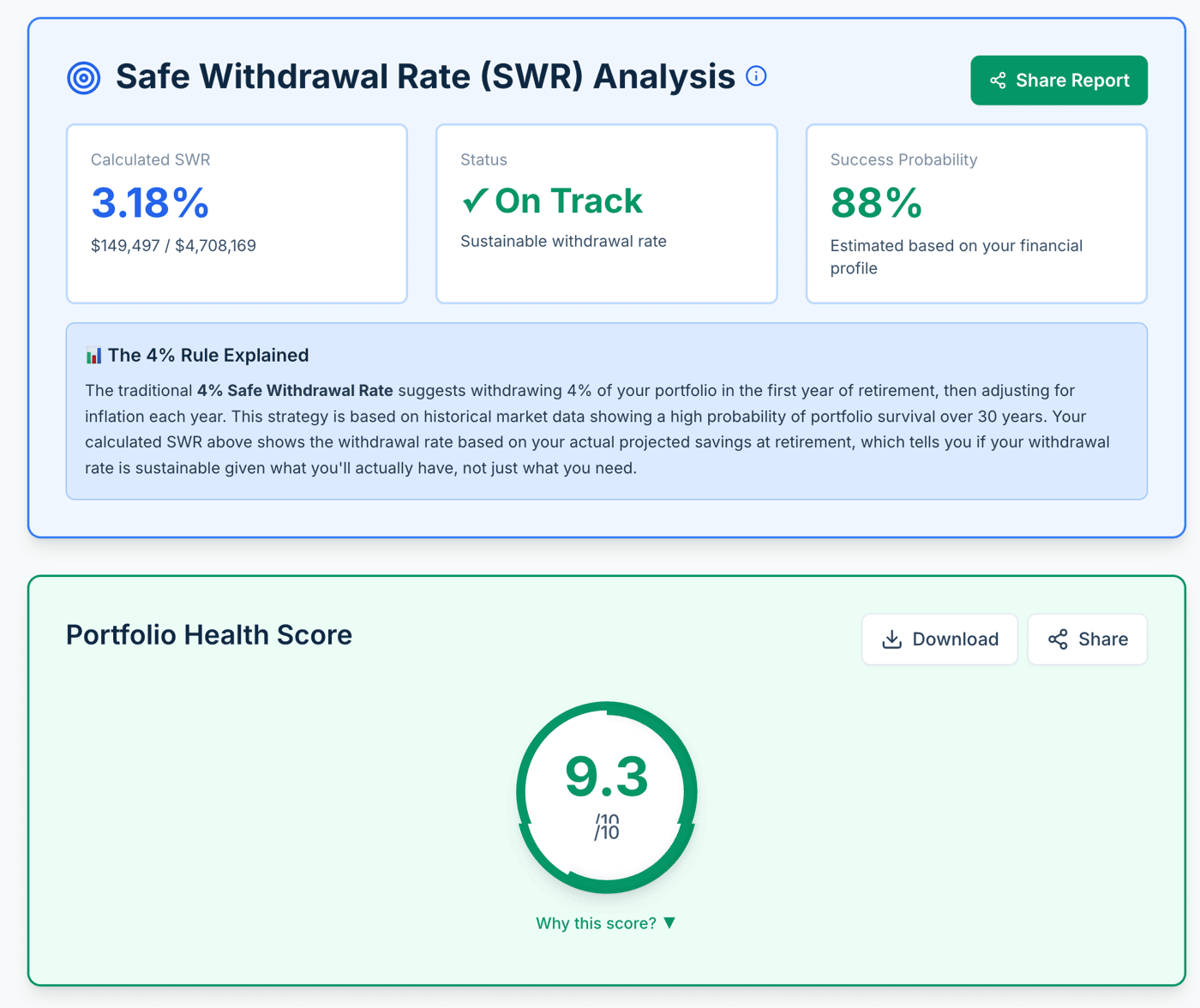
I just shipped a major UI pivot for WealthLogic:
The Hero Section: I added a Portfolio Health Score (1-10) as the most prominent section. It is a weighted grade based on SWR safety, Monte Carlo resilience, and income-to-expense ratios.
The Data Section: I moved the raw Portfolio Value and asset breakdown to a secondary section.
The Why: Users now get an immediate diagnosis (e.g., 8.4/10 - On Track) before they even look at their balance.
By leading with the score instead of the sum, the app now provides a Financial Audit rather than just a Net Worth Tracker.
Technical Note: I am optimizing the shareable mobile reports now. 75% of my users are on mobile, and I want them to be able to share their 9/10 health status directly to FIRE communities.
Fellow builders: How are you balancing data density vs actionable insights in your dashboards?
[Link to WealthLogic.io]
I recently hit a wall with my financial app, WealthLogic. I was providing users with their "Net Worth," but I realized that number is static—it doesn't answer the scary question: "Is this actually enough?"
To solve this, I just shipped two major updates:
Safe Withdrawal Rate (SWR) Engine: Instead of just showing a balance, WealthLogic now calculates the exact percentage you can safely spend. For example, a user might see a specific 4.58% SWR based on their unique portfolio and spending goals.
Monte Carlo Strategy: I moved away from "perfect world" projections. I implemented a Monte Carlo simulation that runs 1,000 "simulated lives" for each user, factoring in market volatility and sequence of returns risk.
The Result: Users now get an immediate financial health status. Instead of a vague number, they see "On Track" if their strategy is sustainable, or "Needs Review" if the SWR indicates they might outlive their money. Seeing a clear status is infinitely more valuable than just seeing a large bank balance.
The Lesson: In 2026, utility isn't enough. You have to provide Peace of Mind.
I am curious—for those of you building in the finance space, how are you handling "uncertainty" in your projections?
[Link to WealthLogic.io/freedom-engine]
-
1
Would love to hear your feedback.
I recently hit a milestone with WealthLogic. I was tired of "Platform Inflammation"—that bloat you get from apps like Personal Capital and Betterment where you're constantly dodging advisor calls and paying high AUM fees.
To solve this, I just shipped a dedicated Comparison Page and Shareable Graphs to help serious investors get clarity without the noise.
The Results:
Traffic is steady at 20-30 uniques/day.
Users are finally using the new graphs to visualize their trajectory.
I've fixed the input clearing bugs that were causing friction.
The Ask: I'd love for the community to check out my "vs" logic. Is the "no-bloat" positioning strong enough to make you switch from a big player?
[Link to your vs-personal-capital page]
-
1
Visualize how you manage retirement income and expenses with a concept of 'Die with Zero'.
The new version of the application has visual graphs, temporal expenses, living with different lifestyles during early years of retirement.
I just hit a major "Aha!" moment with WealthLogic.
I’ve been building on a large desktop monitor, assuming that serious financial tracking happens at a desk. But my analytics just slapped me with reality: 75% of my traffic is coming from mobile devices.
While the app was technically responsive from day one, I realized there were some "kinks" that only show up when you're actually using it on a phone—overflowing containers, graphs that were slightly too dense, and touch targets that weren't quite right.
What I have just optimized:
Graph Refinement: Scaled the new shareable graphs to be perfectly crisp on mobile without losing data density.
Container Surgery: Fixed those annoying "overflow" bugs where boxes were slightly wider than the screen.
Friction Removal: Tweaked the input fields to ensure that "clearing" and entering data is seamless even with one thumb.
The Lesson: > If you’re getting traffic from Reddit, LinkedIn or Organic Search, you are a mobile app first. I was treating mobile as a "equal channel," but it's actually my primary storefront.
I am currently at 30-50 uniques a day, and I am hoping these refinements turn more of those mobile "scrollers" into long-term "trackers."
I would love for you to pull up the site on your phone and tell me: does the mobile UI feel "clean" or is there still some clunkiness?
[Link to WealthLogic.io]
-
1
Would love to hear your feedback.
1 Comment
Would love feedback, especially on whether the Market Context header adds value or is just noise!