12 Best Image Submission Sites to Boost SEO in 2026
Images have become one of the most valuable assets in modern SEO. Whether you're running a blog, an eCommerce store, or a business website, sharing high-quality visuals on reputable Image Submission Sites can increase your online visibility, attract referral traffic, improve brand recognition, and support your overall off-page SEO strategy.
Although image submission alone won't guarantee top Google rankings, it complements other proven SEO techniques such as content marketing, guest posting sites, and quality link building. When optimized correctly with descriptive file names, alt text, and relevant descriptions, images can rank in Google Images and drive highly targeted visitors to your website.
In this guide, you'll discover the 12 best Image Submission Sites for 2026, learn how image submission benefits SEO, and explore practical strategies that help maximize your results while avoiding common mistakes.
What Are Image Submission Sites?
Image Submission Sites are online platforms where individuals and businesses upload, share, and organize images for public viewing. These websites allow search engines to discover visual content while helping users find relevant images through search.
Many of these platforms also allow profile links, image descriptions, tags, and website URLs, making them valuable for increasing brand awareness and generating referral traffic.
Some image-sharing websites focus on photography, while others cater to designers, marketers, bloggers, or businesses promoting products and services.
When used strategically, free image submission sites become an important part of an effective off-page SEO campaign.
Why Image Submission Matters for SEO in 2026
Search engines are becoming increasingly visual.
Google Images processes billions of image searches every day, and visual search technologies continue to improve with AI-powered recognition systems.
Submitting optimized images helps search engines understand your content while creating additional opportunities for people to discover your website.
Image submission also supports several SEO goals:
Builds brand visibility
Generates referral traffic
Improves content discoverability
Diversifies backlink sources
Supports image indexing
Increases engagement across multiple platforms
Rather than relying solely on backlinks from guest posting sites, combining guest posting with image submissions creates a more natural and diversified off-page SEO profile.
Key Benefits of Image Submission Sites
Improve Search Engine Visibility
Well-optimized images can appear in Google Image Search, giving your website another opportunity to attract organic visitors.
Instead of competing only in traditional search results, your visuals can rank independently.
Increase Referral Traffic
Many image-sharing platforms allow users to visit your website directly from your profile or image description.
This additional traffic often comes from users already interested in your niche, leading to better engagement.
Build Brand Authority
Publishing original, high-quality visuals consistently helps establish your business as an industry authority.
Over time, people begin recognizing your logo, design style, and visual identity.
Support Content Marketing
Every blog post can generate multiple pieces of visual content.
For example:
Infographics
Charts
Tutorials
Product images
Before-and-after comparisons
Custom graphics
These visuals can be distributed across multiple Image Submission Sites, extending the reach of a single article.
Strengthen Off-Page SEO
Image submission works best when combined with:
Content marketing
Social media promotion
Digital PR
Guest posting sites
Local citations
Business directories
Together, these strategies create a balanced SEO profile that appears more natural to search engines.
How Image Submission Works
The process is straightforward but requires proper optimization.
Step 1: Create Original Images
Unique visuals perform significantly better than stock photos.
Examples include:
Infographics
Custom illustrations
Product photos
Screenshots
Branded graphics
Step 2: Optimize File Names
Instead of:
IMG00045.jpg
Use:
best-image-submission-sites-2026.jpg
Descriptive filenames provide additional context for search engines.
Step 3: Compress Images
Large images slow loading times.
Use modern formats like:
WebP
Optimized JPEG
Optimized PNG
Fast-loading images improve user experience and support SEO performance.
Step 4: Write Keyword-Rich Descriptions
Include your primary topic naturally.
Example:
Discover the best Image Submission Sites for improving SEO, increasing visibility, and generating referral traffic in 2026.
Avoid keyword stuffing.
Step 5: Add Relevant Tags
Tags help users discover your images.
Example tags:
SEO
Digital Marketing
Image SEO
Content Marketing
Off-page SEO
Step 6: Link Back Naturally
If the platform allows website links, point users toward:
Related blog posts
Product pages
Service pages
Portfolio pages
Always prioritize relevance over excessive linking.
How to Choose the Best Image Submission Sites
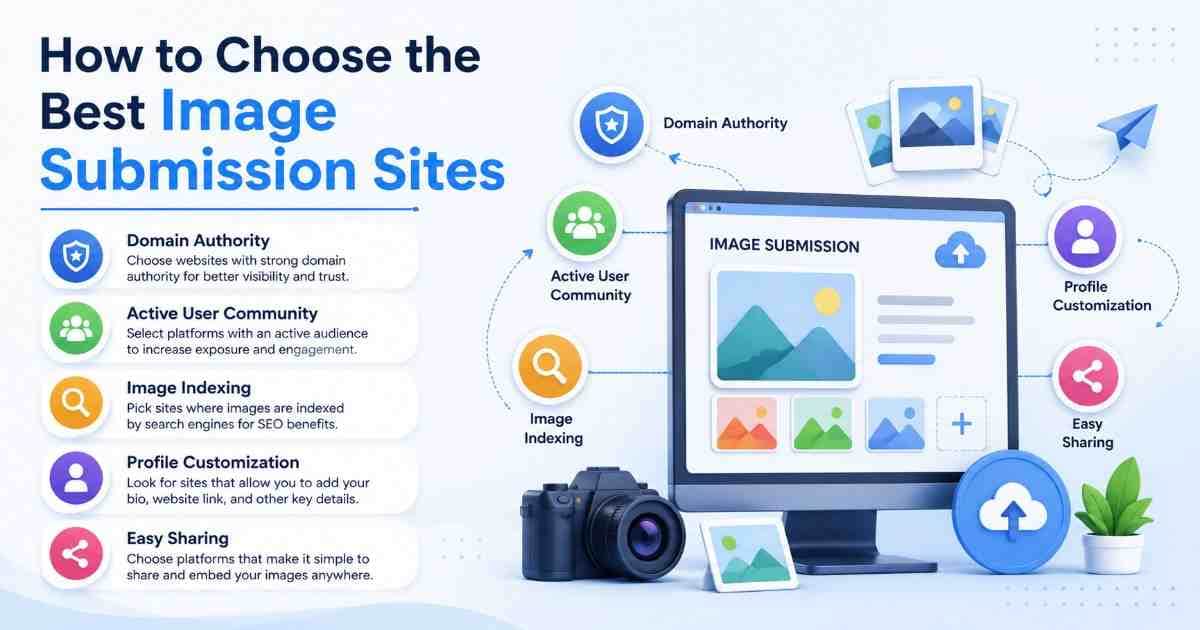
Not every platform provides equal SEO value.
When selecting websites, consider the following factors.
Domain Authority
Choose reputable websites trusted by search engines.
High-authority platforms generally offer better visibility and increased credibility.
Active User Community
Platforms with millions of active users provide greater opportunities for image discovery, engagement, and referral traffic.
Image Indexing
Select platforms where images are indexed by search engines.
Indexed content has a higher chance of appearing in image search results.
Profile Customization
Good platforms allow you to include:
Website URL
Business information
Portfolio
Brand description
These features strengthen your online presence.
Easy Sharing
Platforms with built-in social sharing features can significantly increase your content's reach.
12 Best Image Submission Sites
1. Pinterest
Pinterest remains one of the most effective Image Submission Sites for SEO and long-term traffic generation.
Unlike traditional social media platforms, Pinterest functions as a visual search engine where pins can continue driving visitors months or even years after publication.
Best Features
Massive global audience
Strong search functionality
Rich Pins support
Website verification
Long content lifespan
Best For
Bloggers
Affiliate marketers
eCommerce stores
Recipe websites
DIY creators
Travel blogs
SEO Tip
Design vertical images with compelling titles and keyword-rich descriptions to improve discoverability.
2. Flickr
Flickr has maintained its reputation as one of the largest photo-sharing communities.
It offers excellent visibility for photographers, businesses, and brands looking to showcase original images.
Best Features
High-quality image hosting
Albums and collections
Creative Commons options
Large photography community
Best For
Professional photographers
Travel bloggers
Designers
Businesses
SEO Tip
Include descriptive titles, optimized tags, and a complete profile linking back to your website.
3. Imgur
Imgur is widely known for viral images, memes, and community-driven visual content.
While it may not be a traditional SEO platform, engaging images can generate substantial referral traffic.
Best Features
Huge monthly audience
Easy image uploading
Community engagement
Fast image loading
Best For
Infographics
Tutorials
Memes
Educational visuals
SEO Tip
Focus on informative graphics that encourage sharing rather than promotional content.
4. DeviantArt
DeviantArt is one of the world's largest online communities for artists and digital creators.
Businesses in creative industries can use it to build brand recognition while showcasing unique visual work.
Best Features
Active creative community
Portfolio management
Artwork collections
Professional artist exposure
Best For
Graphic designers
Illustrators
Digital artists
Creative agencies
SEO Tip
Write detailed artwork descriptions with relevant keywords and maintain a complete profile for greater visibility.
5. Behance
Behance is one of the best platforms for showcasing creative work and building a professional portfolio. Owned by Adobe, it attracts millions of designers, marketers, and creative professionals worldwide.
If your business creates infographics, UI designs, branding projects, or marketing visuals, Behance is one of the most valuable Image Submission Sites to include in your SEO strategy.
Best Features
Professional portfolio creation
Adobe ecosystem integration
High-authority platform
Project-based image galleries
Large creative community
Best For
Graphic designers
Branding agencies
Digital marketers
UI/UX designers
Freelancers
SEO Tip
Instead of uploading a single image, create a complete project showcasing your work process. Include keyword-rich titles, detailed descriptions, and a link to your website where appropriate.
6. 500px
500px is a premium photography platform trusted by professional photographers and photography enthusiasts.
While its primary focus is photography rather than SEO, publishing original, high-quality images can increase brand visibility and drive qualified referral traffic.
Best Features
High-resolution image hosting
Photography licensing
Strong community engagement
Professional portfolios
Photography contests
Best For
Travel bloggers
Nature photographers
Product photographers
Tourism businesses
SEO Tip
Use descriptive image titles and detailed captions instead of generic filenames. Original photography performs significantly better than stock images.
7. Dribbble
Dribbble is one of the most respected communities for designers.
Creative agencies, SaaS companies, and startups often use it to showcase interface designs, illustrations, branding projects, and marketing graphics.
Best Features
Designer-focused audience
Portfolio management
Project showcases
Community interaction
Recruitment opportunities
Best For
Web designers
UI/UX designers
Logo designers
Branding experts
SEO Tip
Upload complete design case studies rather than isolated graphics. Detailed project descriptions improve engagement and credibility.
8. Instagram
Instagram remains one of the largest image-sharing platforms in the world.
Although most links are "nofollow," it still plays an important role in increasing brand awareness, generating referral traffic, and encouraging content sharing.
For businesses that regularly create visual content, Instagram complements traditional Image Submission Sites by expanding your reach.
Best Features
Massive global audience
Reels and Stories
Business profiles
Product tagging
High engagement
Best For
eCommerce stores
Bloggers
Agencies
Personal brands
Local businesses
SEO Tip
Use consistent branding, optimized captions, and relevant hashtags. Encourage users to visit your website through your profile link.
9. Tumblr
Tumblr combines blogging with image sharing, making it useful for publishing visual content alongside supporting text.
Unlike many image-sharing websites, Tumblr allows longer descriptions that provide additional keyword relevance.
Best Features
Blog-style publishing
Image galleries
Community sharing
Multimedia support
Best For
Bloggers
Creative businesses
Artists
Lifestyle brands
SEO Tip
Publish image collections supported by informative articles rather than uploading standalone images.
10. Pearltrees
Pearltrees helps users organize visual resources into collections.
Businesses can curate valuable industry content while promoting their own visual assets.
Best Features
Content organization
Visual collections
Collaborative sharing
Educational resources
Best For
Educators
Bloggers
Researchers
Digital marketers
SEO Tip
Organize your images into niche-specific collections to improve discoverability and user engagement.
11. PostImage
PostImage is a simple image hosting platform known for fast uploads and reliable image storage.
Although it lacks advanced community features, it is useful for sharing optimized images across websites and forums.
Best Features
Quick uploads
Free image hosting
Direct image links
No complicated setup
Best For
Bloggers
Forum users
Small businesses
SEO Tip
Only upload images that provide value and include meaningful filenames before uploading.
12. ImageShack
ImageShack has been a trusted image hosting service for years.
Businesses can use it to store, organize, and share high-quality images while maintaining a professional image library.
Best Features
Cloud storage
Image organization
High-resolution support
Secure hosting
Best For
Businesses
Agencies
Product catalogs
Marketing teams
SEO Tip
Keep your image library organized with descriptive folder names and optimized file names for easier management.
Best Practices for Image Submission Sites
Uploading images alone isn't enough. To maximize the SEO benefits of Image Submission Sites, follow these proven practices.
Create Original Images
Unique visuals consistently outperform stock photos.
Examples include:
Custom infographics
Data visualizations
Product photography
Before-and-after comparisons
Step-by-step tutorials
Original illustrations
Original content also strengthens your site's EEAT by demonstrating first-hand expertise.
Optimize Image File Names
Avoid default names like:
IMG_1024.jpg
Instead, use descriptive keywords:
image-submission-sites-guide-2026.jpg
This helps search engines understand your image before it is even indexed.
Write Meaningful Titles and Descriptions
Every upload should include:
A descriptive title
A concise summary
Relevant keywords
Natural language
Don't repeat the same keyword excessively. Write for users first.
Use Relevant Tags
Tags improve discoverability on most image-sharing platforms.
Example tags:
Image SEO
Digital Marketing
Content Marketing
Off-Page SEO
Visual Search
Blogging
Choose only tags that accurately describe your content.
Compress Images Before Uploading
Large images reduce loading speed and negatively impact user experience.
Recommended tools include:
TinyPNG
Squoosh
ImageOptim
Compressed images maintain quality while improving performance.
Maintain Consistent Branding
Use the same:
Logo
Brand colors
Website URL
Profile description
Social links
Consistency helps users recognize your brand across multiple platforms.
Publish Regularly
Uploading one image every few months won't produce meaningful results.
Create a publishing schedule, such as:
2–3 images per week
One infographic each month
New product images after every launch
Blog graphics for every published article
Consistency builds long-term visibility.
Common Mistakes to Avoid
Many businesses fail to achieve results because they overlook basic optimization.
Avoid these common mistakes.
Uploading Low-Quality Images
Blurry or poorly designed visuals reduce credibility and receive less engagement.
Always prioritize quality over quantity.
Ignoring Image SEO
Skipping optimized filenames, descriptions, and titles limits your visibility in search results.
Every image should be optimized before uploading.
Using Copyrighted Images
Only upload images you own or have permission to use.
Copyright violations can damage your reputation and even result in legal issues.
Keyword Stuffing
Adding the keyword Image Submission Sites repeatedly makes descriptions look unnatural.
Instead, write for users while incorporating keywords naturally.
Posting the Same Image Everywhere
Uploading identical content to every platform reduces uniqueness.
Consider creating:
Different sizes
Alternate titles
Unique descriptions
Platform-specific captions
This approach improves engagement and avoids repetitive content.
Practical Example: How Image Submission Supports SEO
Imagine you publish a blog post titled:
"Complete Local SEO Checklist for Small Businesses."
Instead of promoting only the article, you can also create:
An infographic summarizing the checklist
A comparison chart
A step-by-step workflow
A branded social media graphic
A statistics infographic
A visual checklist
Next, distribute these assets across multiple Image Submission Sites like Pinterest, Behance, Flickr, and Instagram.
Then support the same article by publishing content on relevant guest posting sites, linking back to your guide where appropriate.
This multi-channel strategy helps you:
Reach new audiences
Increase referral traffic
Build brand awareness
Earn natural backlinks
Improve content visibility
Rather than relying on a single promotion method, you're creating multiple pathways for users to discover your content.
Advanced Tips to Maximize Results
Once you've mastered the basics, these advanced techniques can further improve your performance.
Repurpose Every Blog Post
Turn each article into multiple visual assets instead of relying on text alone.
Use Infographics for Link Building
Well-designed infographics are frequently referenced by bloggers and journalists, increasing your chances of earning backlinks.
Monitor Referral Traffic
Use Google Analytics to identify which image platforms send the most visitors and focus your efforts there.
Refresh Older Images
Update outdated graphics with current statistics, improved branding, or new design elements to keep them relevant.
Combine Multiple Off-Page Strategies
The strongest SEO campaigns integrate:
Image Submission Sites
guest posting sites
Social media marketing
Business directory listings
Digital PR
Content marketing
A diversified strategy builds a more natural and resilient backlink profile.
Image SEO Statistics You Should Know
The following statistics highlight why visual content deserves a place in your SEO strategy:
Google Images accounts for a significant share of overall Google search activity, making image optimization an important traffic source.
Articles with original visuals generally receive higher engagement than text-only content.
Infographics are among the most shared forms of visual content because they present information in an easy-to-understand format.
Pages that include optimized images often experience better user engagement, including longer time on page and lower bounce rates.
Visual content is frequently reused by bloggers, journalists, and publishers, creating opportunities to earn natural backlinks when properly credited.
Takeaway: Image submission should support your overall SEO efforts—not replace them. When combined with valuable content and strategic promotion, it can increase visibility, referral traffic, and brand recognition.
Featured Snippet: What Are Image Submission Sites?
Image Submission Sites are online platforms where users upload and share images to increase their online visibility. For SEO, these websites help businesses promote visual content, attract referral traffic, improve brand awareness, and support image indexing in search engines when images are properly optimized with descriptive filenames, titles, and tags.
Featured Snippet: Do Image Submission Sites Help SEO?
Yes. Image Submission Sites can support SEO by:
Increasing brand visibility
Driving referral traffic
Helping images appear in Google Image Search
Supporting content marketing campaigns
Diversifying your off-page SEO strategy
Complementing backlinks earned through guest posting sites and other trusted sources
While they are not a direct ranking factor on their own, they contribute to a stronger overall digital presence.
Quick Checklist Before Uploading an Image
Use this checklist every time you submit an image:
✅ Create an original, high-quality image.
✅ Rename the file using descriptive keywords.
✅ Compress the image for faster loading.
✅ Write a clear, keyword-rich title.
✅ Add a helpful description.
✅ Include relevant tags.
✅ Use consistent branding.
✅ Link to a relevant page on your website (where allowed).
✅ Choose reputable free image submission sites.
✅ Track referral traffic and engagement.
Following these steps helps maximize the SEO value of every image you publish.
Frequently Asked Questions (FAQs)
1. What are the best Image Submission Sites for SEO?
Some of the most trusted platforms include Pinterest, Flickr, Behance, Imgur, DeviantArt, 500px, Dribbble, Instagram, Tumblr, Pearltrees, PostImage, and ImageShack. These websites offer strong visibility, active communities, and opportunities to showcase high-quality visual content.
2. Are free image submission sites effective for SEO?
Yes. Many free image submission sites have high domain authority and large user bases. When you upload optimized, original images with relevant descriptions, they can help improve brand exposure, referral traffic, and image search visibility.
3. How often should I submit images?
There is no fixed rule, but consistency matters. Publishing new images whenever you release a blog post, product update, or case study helps maintain an active online presence and keeps your visual content fresh.
4. Can image submission generate backlinks?
Some platforms allow you to include a website URL in your profile or image description. While not every link passes SEO value, image submissions can still drive referral traffic, increase brand awareness, and support a diversified off-page SEO strategy.
5. Should I use the same image on every platform?
It's better to adapt your content for each platform. You can use the same core image but customize titles, descriptions, tags, and dimensions to improve engagement and avoid repetitive content.
6. What image format is best for SEO?
WebP is generally recommended because it provides excellent image quality with smaller file sizes. Optimized JPEG and PNG files are also suitable, depending on the type of image.
7. Do Image Submission Sites replace guest posting?
No. Image Submission Sites and guest posting sites serve different purposes. Guest posting helps build authority and backlinks through written content, while image submission increases the reach of your visual assets. Using both strategies together creates a stronger and more balanced off-page SEO campaign.
8. What types of images perform best?
Original visuals tend to achieve the best results, including:
Infographics
Product photos
Custom illustrations
Step-by-step tutorials
Before-and-after comparisons
Data charts
Branded graphics
These formats are more engaging and are often shared more widely than generic stock photos.
Final Thoughts
Image Submission Sites continue to play an important role in off-page SEO by helping businesses expand their online visibility, attract referral traffic, and strengthen their brand presence. While they are not a shortcut to higher rankings, they work exceptionally well when combined with quality content, technical SEO, and other proven link-building methods.
To achieve the best results in 2026, focus on publishing original, optimized visuals rather than uploading large quantities of low-value images. Every image should provide value to users, include descriptive metadata, and align with the content it supports.
For long-term SEO success, combine image submission with content marketing, social media promotion, and guest posting sites. This integrated approach creates multiple opportunities for your audience to discover your brand while building a stronger and more sustainable online presence.
Why Trust Our Review
Our recommendations are based on thorough research, publicly available information, feature comparisons, user experience, device compatibility, pricing transparency, and overall usability. We strive to provide balanced, accurate, and regularly updated content that helps readers make informed decisions rather than promoting a single provider.
Author: Priyanshi Webix
Reviewed by: Editorial Team
Last Updated: July 13, 2026

