Gojek Clone: Why Indonesia Is Ideal for Multi-Service Startups
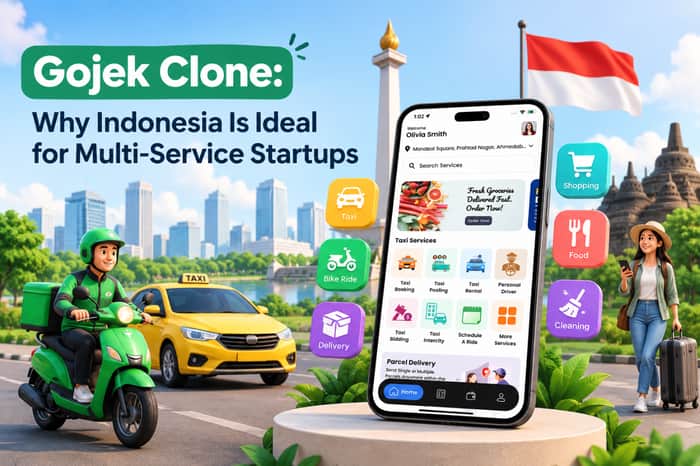
Indonesia has become one of Southeast Asia’s most interesting markets for digital businesses. A large population, growing smartphone adoption, expanding digital payments, and increasing demand for convenient services have created opportunities for startups across transportation, food delivery, grocery, home services, and local commerce.
But there is an important shift happening in how entrepreneurs approach these opportunities. Instead of launching separate apps for every service, many businesses are looking at a Multi Service App that can bring several everyday services together under one platform.
This is where a Gojek Clone becomes an interesting business model.
A Gojek-inspired platform allows entrepreneurs to build their own branded ecosystem where customers can access transportation, food delivery, grocery ordering, courier services, and other on-demand offerings from a single app. The goal isn't simply to copy an existing company. It is to create a localized platform that solves specific problems in the Indonesian market.
Why Indonesia Is a Strong Market for Multi-Service Startups
Indonesia's geography and population create an interesting environment for on-demand businesses. Customers in major cities often look for faster and more convenient ways to handle everyday tasks, while businesses need digital platforms to reach and serve these customers efficiently.
Transportation is one example. A customer may need a ride to work in the morning, order lunch during the afternoon, send a package later in the day, and buy groceries in the evening.
Traditionally, these activities could require different applications.
A multi-service platform brings them into one ecosystem.
For startups, this creates an opportunity to increase customer engagement. Someone who initially downloads an app for ride booking could later use the same account for food delivery or courier services.
That cross-service behavior can become one of the biggest advantages of the model.
What Makes a Gojek Clone Different From a Regular App?
A conventional taxi or food delivery application normally focuses on one primary service. A Gojek-style platform is broader.
The basic idea is to create a central application that can support multiple categories while maintaining a consistent customer experience.
Depending on the business strategy, an Indonesian Gojek Clone App could include:
- Ride-hailing and taxi booking
- Motorcycle or bike rides
- Food delivery
- Grocery delivery
- Parcel and courier services
- Pharmacy or healthcare delivery
- Home maintenance services
- Beauty and personal care
- Laundry services
- Local shopping
- Appointment-based services
A startup doesn't necessarily need to launch all these services on day one.
Starting with two or three categories that have strong local demand can be a more practical approach. Additional services can be introduced after the platform develops a customer and provider network.
Building the Right Experience for Indonesian Users
Localization should be a major part of Gojek Clone App Development.
A successful platform should not simply change its logo and launch in Indonesia. The product needs to reflect how local customers pay, book services, communicate, and interact with service providers.
For example, the platform can support multiple payment options, including digital payments and cash where appropriate. Location-based pricing can help businesses manage different operating areas, while Indonesian language support can make the application more accessible to local users.
Another important consideration is the diversity between cities.
The service demand in Jakarta may not be identical to demand in Surabaya, Bandung, Medan, or smaller cities. A flexible platform can allow businesses to activate different services, pricing rules, commissions, and providers according to individual markets.
This makes localization more than a translation exercise—it becomes a business strategy.
The Role of a Gojek Clone Script
For entrepreneurs who want to enter the market without building every component from scratch, a Gojek Clone Script can provide a ready-made foundation.
A typical solution may include customer and service-provider applications along with web-based administration tools. Instead of developing authentication, booking, payment management, notifications, tracking, and dashboards from zero, businesses can start with an existing architecture and customize it around their requirements.
However, the value of a clone script isn't simply speed.
The real advantage comes from customization.
The startup should be able to modify the branding, services, pricing structure, commission model, payment options, booking flow, and administrative controls. This allows the final product to become a distinct business rather than a generic copy.
Essential Features of a Multi-Service Platform
A strong platform needs more than a collection of services inside one application.
Customers should have a simple way to discover services, make bookings, track orders, communicate with providers, complete payments, and review their experiences.
Important features can include:
Real-time GPS tracking: Customers can monitor rides, deliveries, or service providers.
Instant and scheduled bookings: Users can request a service immediately or arrange it for a later time.
Multiple payment methods: Supporting different payment preferences can reduce friction during checkout.
Ratings and reviews: Feedback helps businesses monitor service quality and gives customers greater confidence.
Push notifications: Booking confirmations, driver arrivals, delivery updates, and promotional messages can keep users informed.
In-app communication: Customers and providers can communicate without leaving the platform.
Order and booking history: Users can easily review previous transactions and repeat frequently used services.
For administrators, the backend should provide centralized control over customers, providers, bookings, payments, commissions, pricing, promotions, and service categories.
Why Multi-Service App Development Can Create More Revenue Opportunities
One of the strongest reasons to consider Multi Service App Development is revenue diversification.
A platform can generate income from several activities instead of depending on one service.
For example, revenue streams could include:
- Commission from ride bookings
- Commission from food and grocery orders
- Delivery charges
- Service-provider subscriptions
- Platform fees
- Featured business listings
- Promotional placements
- Surge or dynamic pricing where appropriate
- Corporate or business accounts
This doesn't mean every monetization method should be introduced immediately.
A better approach is to identify which services have the strongest unit economics in the target city and build the business around them first.
As more providers join the platform, the business can introduce additional services and revenue channels.
Creating a Strong Supply Network
Launching an On Demand Multi Service App requires two sides of the marketplace: customers and service providers.
Getting customers without enough drivers, restaurants, stores, or professionals can result in poor experiences. The opposite problem can also occur—having many providers without enough customer demand.
This makes supply acquisition an important part of the launch strategy.
A startup could initially partner with local restaurants, independent drivers, courier operators, grocery stores, salons, technicians, and other service businesses.
Instead of trying to cover an entire country immediately, entrepreneurs can focus on a specific city or region. Once the platform achieves reliable service availability and repeat usage, expansion becomes easier to manage.
Technology and Scalability Matter From the Beginning
A multi-service business can become technically complicated as new categories are added.
The architecture needs to support different booking workflows while maintaining common systems for authentication, payments, notifications, location tracking, user accounts, and administration.
Scalability is particularly important when demand grows.
A platform that performs well with a few hundred users may require significant improvements when thousands or millions of users start accessing it simultaneously.
Features such as analytics, automated notifications, provider management, fraud monitoring, role-based administration, and API integrations can also become increasingly important as the business grows.
Starting Small Doesn't Mean Thinking Small
One mistake entrepreneurs can make is trying to launch every possible service at once.
A better strategy may be to start with a focused combination.
For example, a business could launch ride-hailing and food delivery in one city. After developing a customer base, it could introduce grocery delivery, courier services, or home services.
This approach makes testing easier.
The startup can measure which services attract customers, how frequently users return, where demand is strongest, and which categories produce sustainable revenue.
The platform then evolves based on actual market behavior rather than assumptions.
Is a Gojek Clone a Good Opportunity in Indonesia?
The opportunity isn't simply about launching another app.
The bigger opportunity is building a Multi Service App around a specific customer problem, city, or underserved service category.
Indonesia's diverse market gives entrepreneurs room to experiment with different combinations of services. A transportation-focused business might add deliveries, while a food delivery startup could expand into groceries and local commerce.
A well-planned Gojek Clone can provide the technological foundation for this expansion while allowing the business owner to develop an independent brand and operating model.
The important question is not, “Can I build an app like Gojek?”
It is:
“Which combination of services can I deliver better for a specific Indonesian audience?”
That question can shape everything from product design and partnerships to pricing and marketing.
Final Thoughts
Indonesia presents an attractive environment for entrepreneurs exploring on-demand and multi-service business models. Customers increasingly expect convenience, while local businesses need better digital channels to connect with them.
A customized Gojek-style platform can bring transportation, delivery, food, grocery, and other services together under one digital ecosystem.
With the right market research, local partnerships, scalable technology, and carefully selected services, Gojek Clone App Development can become more than a software project—it can serve as the foundation for a broader on-demand business.
The key is to start with a real market need, launch with a focused service mix, learn from customers, and expand when the numbers support it. For Indonesian startups, that combination could turn a simple app idea into a much larger multi-service marketplace.
