I built a tool that analyzes up to 500 App Store reviews to see where to improve.
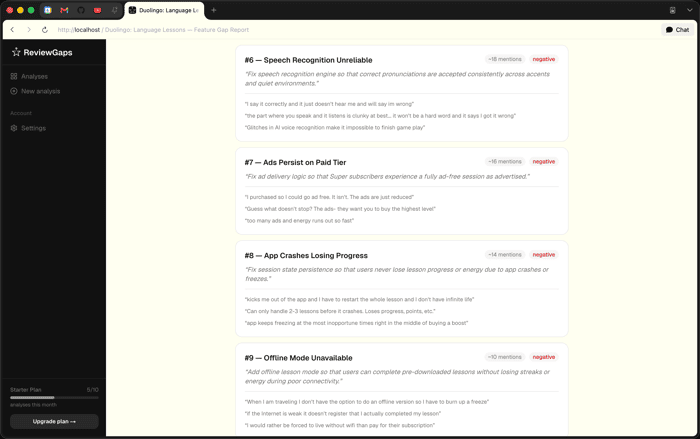
This app fetches up to 500 reviews on either iOS and Google Play Store, looks at the 1-3 star reviews, and uses AI to not only group up these negative reviews into their own themes, but gives solutions on how to each each issue.
This app idea came from me researching competitor apps to see if there were still pain-points customers of theirs had. Rather than looking at tens and hundreds of reviews, I created an app to handle the bulk of the work.
My question for y'all - what do y'all do to gather pain-points from customers or people online, and how do y'all retain customers who email or message you saying they have an issue with your app.
Any feedback on my app idea is welcomed.

Grouping the 1-3 star reviews into themes is where the gold is since the angry ones tell you exactly what to fix first. With my own iOS apps I reply to every bad review by hand and a lot of those people end up bumping the rating once they feel heard. Does your tool also pull the exact wording people use so you can reuse it in your store copy?
The competitor review mining angle is really smart — it's something I've done too while building an iOS productivity app. One thing I've noticed: 2-star reviews tend to be more actionable than 1-star ones. People leaving 1 star are often just venting, while 2-star reviewers are frustrated but still engaged enough to explain what they actually wanted. That's where the real product signal lives.
On retaining users who reach out: fast response is table stakes, but the bigger unlock is closing the loop after you fix it. If someone messaged you about a bug, email them back when you ship the fix and tell them "we fixed this because of your feedback." Those people will often update their review and become your most loyal users.
The approach of mining competitor reviews to find unmet pain points is one of the most underused forms of market research. It's faster than surveys and the signal is unfiltered — people writing 1-star reviews have already decided to be honest.
For gathering pain points from customers who contact you directly: the highest signal thing I've found is to create a simple tagging system for inbound emails/messages. Even manually tagging 50 messages per week into 5-6 categories starts revealing patterns quickly. You don't need a tool for the first few months — a shared spreadsheet is often enough to surface the top 3 complaints reliably.
On retention: responding to negative reviews personally (not with a template) tends to work disproportionately well. The 1-star reviewer who gets a thoughtful reply often becomes a more loyal user than someone who never had a problem, because you've demonstrated you actually care about the product.
On your actual question: the best pain-point source I've found isn't reviews — it's the gap between what people say they want and what they actually do.
Support tickets tell you what's broken. Reviews tell you what's missing. But session recordings tell you where people get stuck despite not complaining about it.
Most users won't email you about friction. They'll just leave. The silent drop-off is where the real signal is.
As for retaining users who message you — reply within an hour, fix the thing they mentioned, and tell them you fixed it because of them. That turns complainers into your most loyal users.
I like this because reviews usually contain much more than feature requests.
Have you found any patterns that consistently predict higher ratings?
Deceptive payment practices is a big complaint among apps. Especially if there's a expectation mismatch on what users will get in features on the free vs paid tiers of an app. An even when you pay for the paid version, there are some lack of deliverables on features.
That makes a lot of sense.
I've started noticing that a lot of low ratings aren't really about missing features. They're about broken expectations. If someone expects one thing and experiences another, even a technically good product can feel disappointing.I wonder how many teams spend months building new functionality when simply making the value proposition clearer would have a bigger impact on ratings.
This is a solid idea because it automates something people already do manually anyway — scanning low-star reviews for patterns.
The real value is not the review scraping, it’s the clustering of complaints into clear themes. That’s where you save time compared to reading hundreds of comments.
The “solutions for each issue” part is interesting, but also the risky one — it needs to be clearly separated as suggestions, not assumptions, otherwise it can feel unreliable.
On your question about pain-point collection: most teams don’t rely on one source. They combine app reviews, support tickets, churn reasons, and direct user feedback, then look for repeated patterns instead of individual complaints.
Retention-wise, the strongest approach is usually fast acknowledgment + clear fix updates. Users forgive issues if they see movement and communication.
Overall: good utility tool, especially for early-stage market research and competitor analysis.
Thanks my guy.
Curious on what you would recommend in terms of distribution channels to get this app out.
The part I'd be most interested in is what happens after the themes are identified.
Finding recurring complaints is valuable.
Figuring out which ones are actually worth building around feels like the harder decision. The loudest problem isn't always the one holding the product back.