
AVENIR
An directory founders where idea lives before reality.
Most product visibility looks the same.
A card in a feed. A row in a directory. A screenshot on Twitter that gets 12 likes and disappears by Tuesday.
We built something different.
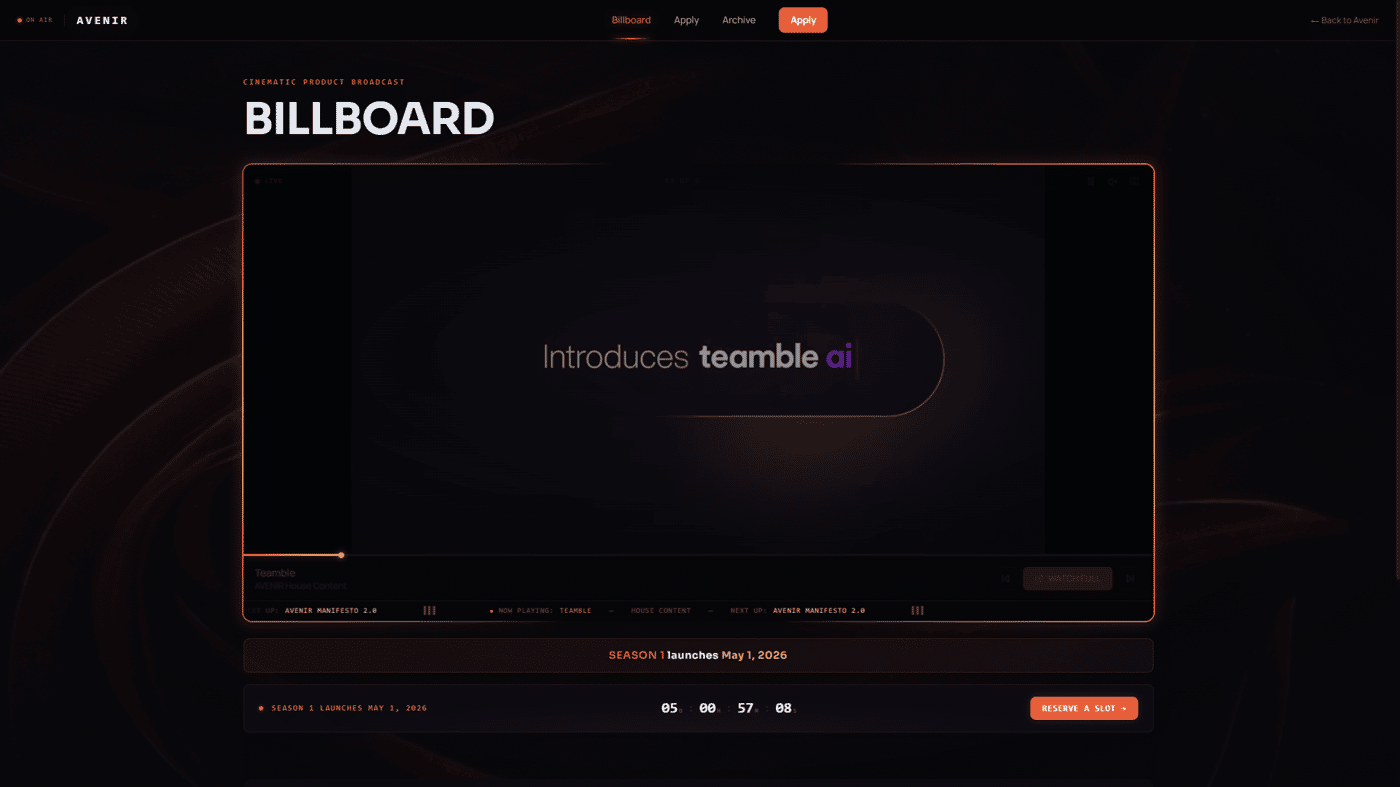
AVENIR BILLBOARD is a rotating cinematic broadcast channel — think product television, not product listing. Your product doesn't get a card. It gets a slot. Filmed, scheduled, and played in rotation to every visitor who comes to AVENIR.
Season 1 launches May 1, 2026.
Here's exactly what you get:
— 30 days of broadcast rotation inside the Billboard channel — Permanent archive placement after your season ends — your slot never disappears — A dedicated announcement on our official X account when you go live — Full analytics on your views, watch time, and click-throughs — AVENIR Billboard badge across the platform
Here's how to get in:
1. Go to avenir.reym.tech/billboard 2. Hit Apply and fill in your product details 3. Submit your product video as a YouTube link — trailer (20-30s) and feature (60-90s) 4. We review it within 48 hours 5. If approved, we send the invoice directly 6. Payment confirms your slot. Season 1 starts May 1.
That's it. No upvotes. No launch campaigns. No coordinating your network. Just your product, filmed properly, in front of the right audience.
On pricing:
Standard slots are $200. Featured are $350.
We kept pricing high deliberately. Not to be exclusive for the sake of it — but because a broadcast channel where anyone can buy a slot for $5 isn't a broadcast channel. It's a banner ad. The price is what keeps the quality of what gets featured worth watching.
Every product that gets in has passed our review. The agencies, builders, and investors browsing AVENIR know that. That's the signal you're buying into — not just the screen time.
On the kind of products we feature:
AVENIR isn't built for products that need hype to survive.
It's built for products that are ahead of where the market is. Futuristic in thinking. Honest in execution. Products that would rather be found by the right 10 people than ignored by 10,000.
If that's what you built — Season 1 has 30 Standard slots.
May 1 is closer than it looks.


Tomorrow we select the first product to ever carry the AVENIR PICK label.
Not the most upvoted. Not the most followed. Not the loudest in the room.
The one that earned it.
Here's what that actually means.
Since we opened The Pulse, our review team has gone through every submission. Most didn't make it. Not because they were bad ideas — because they were vague, scattered, or not ready to stand behind a clear problem. A revision was requested. A few were rejected outright.
Two products passed.
Two.
That's not a bug. That's the standard.
The founders who got in didn't have bigger audiences or better networks. They had clarity. They knew exactly what problem they were solving and why their product existed. That's what the review looks for — every time, without exception.
If you've been reading these posts and thinking about submitting — this is the moment.
Here's exactly how it works:
1. Go to avenir.reym.tech and create an account. Takes 30 seconds — you can sign in with GitHub.
2. Once you're in, hit Submit in the top right corner. Fill out the product form — name, URL, one-liner, problem, solution, features. Be honest, not polished.
3. Our review team looks at every submission. If it passes, it goes live in The Pulse. If you're in The Pulse — you're eligible for Picks.
4. AVENIR PICK #01 gets selected tomorrow. Permanent placement. Full written analysis. Real visibility. No expiry date.
One thing worth saying clearly:
There's no comment section on product listings. No upvotes. No public feedback loop where everyone piles on or cheers.
That's intentional.
This isn't a platform for opinions about products. It's infrastructure for serious founders who want to be found by the right people — not voted on by everyone.
You don't get in by being popular. You get in by being good.
Tomorrow we find out who #01 is.
You already built the product.
It works.
A few people use it.
Maybe they even love it.
But outside that circle?
Nothing.
No traffic.
No discovery.
No signal.
This weekend, we select:
AVENIR PICK #01 • 2026
One product.
Not the most upvoted.
Not the most followed.
Not the loudest.
The one that actually deserves to be seen.
Here’s what happens if you get picked:
Full written breakdown (problem → solution → why it matters)
Permanent placement
Ongoing visibility inside The Pulse
You don’t disappear after 24 hours
Here’s what most founders miss:
They think selection happens after they’re “ready.”
It doesn’t.
It happens when they’re honest.
We’ve already started reviewing submissions.
A few got in.
Most didn’t.
Not because they were early —
but because they were vague.
If your product:
Solves a real problem
Has users (even a few)
Isn’t just a dressed-up idea
You still have time.
Submission window for Pick #01 closes soon.
If you're already in The Pulse → you're eligible.
If you're not:
52 picks this year.
The first one sets the standard.
Don’t overthink it.
Just submit.
-
1
The urgency mechanic works when there's real scarcity behind it. Launching Capsule 001 on April 15 — 100 units, founder edition. Same logic: the limit is real, not manufactured. Good luck with the pick.
-
1
Speed is addictive, but sustainability is the real flex.
72 hours sounds like a thrill, but after years in the game, I’ve realized that "sprints" often lead to building on shaky ground. I just watched my Medium presence—something I spent months on—get wiped in seconds by an algorithm.
If you're rushing to get into a new platform or program, ask yourself: Who owns the rails? If it’s not you, you’re just racing to fill someone else’s database.
My shift to $10k/mo didn't come from winning a 72-hour race. It came from stopping the rush and building a private infrastructure that doesn't care about deadlines or platform bans.
Build fast if you must, but make sure you own the fortress you're building.
-
1
Quick note:
We don’t expect perfection.
We look for:
– clarity of problem
– honesty of solution
– intention behind the buildA product with 10 real users beats one with 1,000 fake signups.
If you’re unsure — submit anyway.
-
0
I want it!


I'll be honest with you.
Product Hunt has some serious advantages over Avenir and I think you should know about them before you submit your product to us.
1. On Product Hunt, anyone can submit anything.
No review. No standards. No one asking whether your product is actually solving a real problem. You just submit and you're in.
On Avenir, a dedicated team reviews every single submission. If the problem isn't real, if the solution is vague, if it feels like a weekend project dressed up as a business — it doesn't get in. That's exhausting for us and potentially disappointing for you.
2. On Product Hunt, you know exactly when your moment is.
Launch day. One shot. All your energy into 24 hours. Clean, simple, finite.
On Avenir, approved products stay visible indefinitely. No expiry date, no launch window, no deadline. If you hate the idea of your product being discoverable to the right people six months from now, Product Hunt is genuinely a better fit.
3. On Product Hunt, you can see the upvote count.
Very satisfying number. Goes up when people click it. Gives you something to screenshot.
On Avenir, there are no upvotes. Just a review team deciding whether your product belongs — and if it does, a permanent spot in The Pulse and a chance to be selected for this week's Avenir Pick.
Which brings me to the actual announcement.
Avenir Picks launches this week.
One product. Selected manually. Featured with a full written analysis — problem, solution, why it matters, why now. Permanent. Serialized. AVENIR PICK #01 • 2026.
If your product is already in The Pulse, you're eligible. If it isn't — avenir.reym.tech/pulse — the feed is open.
52 picks this year. The first one ships this week.
-
3
This is an interesting framing.
Feels like Product Hunt optimizes for short-term attention, while something like Avenir is trying to optimize for long-term signal and quality.
Probably comes down to what kind of distribution founders actually want.
-
2
I see what you did there with the reverse psychology
-
2
would it not be best if y'all let users to share their opinion?
-
2
Love the reverse psychology here
But honestly, point #2 hit me. As a founder building a video collaboration platform, I've been thinking a lot about the "one-shot launch day" pressure vs. long-term discoverability.
We launched on Product Hunt before and the 24-hour window felt like a sprint where you burn all your energy -- and then it's just... over. The idea of a curated feed where the right product finds the right people over time is way more aligned with how B2B tools actually get adopted.
Checking out The Pulse now. Curious to see the first Avenir Pick.
-
1
I totally loved your angle. As a solo-founder, I could use Avenir for my upcoming launch.
-
1
The debate is missing the point: Both are Rented Land. 🏛️🛰️
Whether it's Product Hunt or Avenir, if you rely on their "launch spikes", you are a tenant, not an architect.
I architected a $10k/mo "Too Native" engine specifically to bypass the dependency on these ad-matrices. If a platform can "nuke" your reach tomorrow, you don't own the business. 🧬
1. Visual Trust (85mm) 2. Anatomy-Effect (Conversion) 3. The Bunker (Sovereignty)
Stop chasing the launch. Build the system. #BuildTheBunker ⛩️
-
1
Build the Bunker, not the stage.
My biggest "BiP" tip is to stop focusing on the number of likes on Rented Land (like Twitter or Medium) and start focusing on the architecture of ownership.
I scaled to $10k/mo by moving my audience into private infrastructure (The Bunker). BiP to build trust, but always, always architect a system where the algorithm can't hold your audience hostage.
Sovereignty is the only strategy that lasts.
-
1
Just hearing of Avenir for the first time. Hmm.
-
1
Loved how this was framed — subtle but effective.
-
1
Yeah, I agree with point 2, the timeline of 24 hours is really pressure, you have to get as many interactions as possible in 24 hours.
-
1
I submitted my product on Product Hunt but I did not get traffic as expected. Deckwale AI Presentation and Documents builder
-
1
launched on PH twice. both times the 24h window was everything - spike or miss. nobody came back to check if it actually solved anything. that's the part that always felt off about it.
-
1
Interesting comparison. The curation angle makes sense — lower noise means higher signal for early adopters. But I wonder if the 'one shot' launch day model on Product Hunt creates too much pressure for solo founders who are still iterating. Have you seen products succeed on Avenir without a big launch push?
-
1
Interesting take! As someone just starting out with my own AI PWA, I'm still deciding where to focus my launch energy.
-
1
Has anyone tried Product hunt for b2b saas?
-
1
hey guys aren't you tired of cheating here? :)
3x more likes than the 2nd place, I think it's enough.
how did you get 76 likes on previous post hahaha-
1
I want to know how are they cheating?
is your product on second place? i smell jealousy.
btw lemme know if you crack the cheat code, i wanna be at #1 too.
(no hate)
-


You finished building.
You shipped. You wrote the README. You set up the landing page. You posted on Twitter. You submitted to a few directories. You waited.
A trickle of visitors. A handful of signups. Then quiet.
Not because the product is bad. You know it works. You've seen what it does for the people who actually find it. The problem isn't the product.
The problem is that nobody can find it.
This is the part nobody talks about after launch.
The building phase has a community. IndieHackers, Reddit, dev Twitter — there are thousands of people sharing what they're building, and that feels like momentum. Then you ship, and you realize that shipping is where the support system ends.
Now you're alone with a product and a traffic problem.
Most founders respond by chasing distribution — posting more, launching again, trying a new channel. A few months later they're exhausted, the product is unchanged, and the traffic problem is identical.
The channel isn't the problem. Discoverability infrastructure is.
Avenir is built for exactly this moment.
Not for launch day. For the 6 months after launch day when your product is real, your users love it, and nobody outside your immediate circle knows it exists.
Submit to The Pulse. If it's good — and I mean actually good, not polished-landing-page good — it stays visible. Permanently. No launch window, no expiry date. The right people find it because they're actively looking for what you built.
52 products get featured this year. The feed is open right now.
-
4
Looks interesting. I know a lot of builders struggle with finding an audience so hopefully this helps them with that side of things. Good luck!
-
2
The channel isn't the problem. Discoverability infrastructure is.
This is the most honest thing I've read about post-launch in a while. Everyone talks about launch strategy but nobody talks about what happens on day 47 when your Product Hunt spike has completely died and you're back to 3 visitors a day wondering what went wrong.
The part that really hit me was "the building phase has a community." That's so true and nobody says it out loud. IndieHackers, dev Twitter, Reddit - all of it creates this illusion of momentum because people are reacting to what you're building. Then you ship and you realize those people were excited about the process, not necessarily the product. They move on to the next person building the next thing.
What I've seen work is when founders stop treating distribution like a launch event and start treating it like a product itself. You don't build a feature once and forget it. You shouldn't approach distribution that way either. The founders who figure this out early are the ones who are still around two years later.
-
2
For @athena I did a 5 min video overview of the website (sorry the recording got cut at the 5 min max). I can't post any links but if you want to see it please DM me :)
-
1
Hey, i would love to see the video. you send us the video through email.
athenalabs.reym@gmail.com-
1
Email sent, hope its useful.
-
-
1
i am interested, by overview do you mean like work through the entire platform?? or anything special?
-
1
Right, is there really no way for me to DM you the recording? I'm not allowed to paste links, I guess because I'm new here...
-
-
-
2
This hits close to home. I literally just launched my first product this week built it with zero coding experience, posted on Product Hunt, submitted to directories, shared on X. I got 67 users in the first week which felt great, but now I'm staring at the "what next" problem you're describing.
The building phase is addicting because every day you see progress. Post-launch is a completely different game. Nobody tells you that the marketing grind is harder than the building grind.
I'm investing in SEO content right now (10 blog articles targeting long-tail keywords) because I figure that's the only channel that compounds over time without me having to manually push every day. Everything else feels like shouting into the void.
Checking out Avenir , the "no launch window, no expiry date" angle is interesting. Most directories give you 24 hours of visibility and then you're buried. Cheers!
-
1
The part about shipping being where the support system ends really hit. During the build phase, there's constant feedback, people cheering you on, commenting engaging. Then you launch and it just... goes quiet. Same product, same effort, but a completely different reality.
I'm going through that right now. The product works, people who have used it get it, but getting that first layer of activity from real users has been the hardest part, even harder than constructing the backend jajaja.
Like Discoverability is its own problem with a mind of itself.
-
1
This is right on target! We built an autonomous software test agent (ASTA) to support our testing practice and now are trying to sell it as a SaaS product. Getting the attention of the right people seems impossible. It really is a Catch 22...you have to be recognized in order to be recognized, especially if your product appeals to a niche audience. I like your idea of featuring worthy new products. For all the makers out there, thank you!
-
1
Being "known" is overrated if you don't own the ground you stand on.
Most founders spend all their energy shouting on platforms just to get noticed. But I learned the hard way this week when my Medium account was wiped out: visibility is a lease, not an asset.
I stopped chasing "discovery" and started building private infrastructure. When your authority is baked into your own system, you don't have to beg the algorithms to show your face.
Focus on being inevitable to a few, rather than invisible to many.
-
1
the part about the building phase having a community but distribution being lonely is painfully accurate. when you're building, everyone on twitter and here is cheering you on. the second you ship, those same people move on to the next person who's building something. it creates this weird illusion that you had momentum when really you just had attention from other builders, not from customers. the founders i've seen actually crack distribution treat it like a second product — they iterate on it, measure it, and put in the same kind of effort they put into building the thing itself. most people just post a few times and give up when nothing happens in week one
-
1
I feel like I make helpful products almost every day, that really is the hardest part, I’m gonna look into this.
-
1
This hits, shipping isn’t the hard part, getting discovered is. feels like that gap after launch is where most products actually struggle.
-
1
this is exactly where i'm at right now. spent 3 months building an AI day planner solo — iOS is live, users who find it love it, but the "finding it" part is a completely different skill than building it. the post-launch quiet is real. i didn't build in public so i don't have an audience waiting. just a product and a traffic problem. honestly the hardest part isn't that nobody cares — it's that the people who would care don't know you exist yet. that gap is brutal.
-
1
This is exactly where I am right now. Just launched
my first Notion template two days ago and getting
it discovered is the hardest part. Building in public
and trying different channels every day to see what
sticks.
-
1
This post captures something most builders don't want to admit out loud — that shipping is not the finish line, it's where the real work begins. The framing of "discoverability infrastructure vs. channels" is exactly right. Chasing new channels without solving the underlying visibility problem is just rearranging deck chairs. Building in public creates community energy during the build, but that same community moves on to the next builder almost immediately after you ship. The founders I've seen succeed long-term treat distribution like a product — something you iterate on systematically, not a launch event you do once.
-
1
Launched my first SaaS today and already starting to feel this effect, gonna be checking this out.
-
1
What a great thought and problem identification
-
1
This hits hard.
Feels like the real problem isn’t building anymore — it’s distribution.
I’ve been seeing this a lot in e-commerce too. Even when merchants have a real, painful problem (like chargebacks), they still struggle to find the right tools unless they actively go looking for them.
Curious how you think about balancing “pull” (being discovered when someone is already searching) vs “push” (outreach, content, etc.) in the early stages?
-
1
This nails the loneliest phase of building — that post-launch silence where the dopamine of shipping wears off and you're just staring at flat analytics. The bit about the support system ending at ship is painfully accurate. Building has community; distribution has Google and desperation. Will check out The Pulse.
-
1
This hits hard… I have seen good products die just because nobody could find them.
Building is step one, but staying discoverable is the real game. -
1
The post-launch quiet is real. We're experiencing it right now with Manuscript: a writing workspace for authors where AI analyzes your craft but never writes a single word for you.
The idea came from a simple frustration: every "AI writing tool" out there wants to write for you. Autocomplete, ghostwriting, generated paragraphs. We went the opposite direction. Our AI does structure analysis, character logic checks, pacing diagnostics, and plot hole detection, but the cursor is always yours. Every word is provably human-written, tracked from the first keystroke.
Authors who find it love it. The problem is exactly what you described, getting it in front of the writers who are looking for something like this but don't know it exists yet. The ones who are tired of AI tools that want to replace their voice instead of sharpening it.
If any writers here are looking for a tool that respects the craft, I'd genuinely love feedback!
-
1
hmm
-
1
The post-launch silence hits different when you've built something people actually need. You ship, your first users love it, and then you realize distribution and product are completely different skills.
We went through this with Scoutivex (a real-time alert tool for Vinted resellers). The product worked. Early users were getting real margin on their flips. But traffic was a trickle.
What actually changed things: going very deep in 2-3 niche communities where our exact customer already lived, contributing genuine value there first. Not posting links, just talking with people about their actual problem. Then long-tail SEO content targeting the exact questions they Google before they know a tool like ours exists.
The "discoverability infrastructure vs. channels" framing is spot on. The channel was never the issue. The issue was whether the right people could find us when they were actively looking. That's a different problem with a different solution.
-
1
Non-coder built a multi agent orchestration GUI... and it's free.
- Self modifying agent code required for agent workflows and it's works with 5 API providers.
- Micro kernel with process isolation and cryptographic security.
- Wallet with novel cryptographic implementation still in progress.
- Cognitive chain prompt that utilizes Canvas environments for enhanced AI exchanges.
Git - NexusAISafety and /Nexus
-
1
The post-launch silence is real and almost nobody talks about it honestly. You ship, the adrenaline fades, and then you realize distribution is a completely separate skill from building.
The point about discoverability infrastructure vs. channels is sharp. Most founders treat them as the same problem and keep launching on new channels without fixing the underlying thing — that the right people simply can't find them when they're looking.
-
1
this is promising
-
1
This is a really important issue; we’re facing the same problem. Distribution is the hardest part!
-
1
Looks promising! You are right this is one of the hardest parts in a startup!
-
1
"Great insight! I've been building an AI tool for local businesses and facing similar challenges with user acquisition. Would love to hear how you approached your first 10 customers."
-
1
This hits a bit too close 😅
The “you shipped → now what?” phase is реально самая сложная часть. Building has community, distribution feels like shouting into the void.
Agree with the core idea — it’s not about “more channels”, it’s about being discoverable when someone is already searching for your solution. That’s where most indie products fail.
Curious how Avenir solves the long-term side though:
what keeps traffic flowing after initial exposure?
how do users actually find products in The Pulse over time?
If this really becomes a place with persistent discovery (not just another launch spike), that’s super valuable.
-
1
"This is painfully accurate..."
"This hits hard...."
"This hits close to home ..."
"This hits hard ..."
What the heck is going on here huh :/ Is it even still worth manually engaging with others in here? Or is it just all bots now? -
1
This is painfully accurate. The “building phase” feels crowded and supportive — everyone’s sharing progress, shipping screenshots, and cheering each other on. But the moment you actually ship, the room goes silent. You go from community energy to staring at analytics alone.
I’m in that exact phase right now. The product works, early users love it, but outside my tiny circle it’s basically invisible. And you’re right — the instinct is to chase channels instead of fixing discoverability. More tweets, more posts, more directories… but the traffic graph barely moves.
-
1
This hits hard. The 'post-launch silence' is the ultimate filter for founders. We spend so much energy in the 'Build in Public' bubble that we forget that shipping is just the start of a much harder war: distribution vs. resilience.
I'm currently building a security scanner (Mosai Security), and I see this 'traffic problem' from a different angle: founders are so desperate for eyes on their product that they often ship a 'ticking time bomb' just to feel momentum. But as you said, if a product is 'actually good,' it deserves permanent visibility. And to stay visible permanently, it needs to be solid under the hood.
Checking out Avenir now. Your focus on the 6 months after launch is exactly where most of us get lost. Great insight
-
1
I'm gonna try this out because i need to market my app a lot lol
-
1
You're product is live in pulse!
great work. and great naming choice btw.
-
-
1
This hits hard. We just shipped R2R2 (a reading protocol for cognitive diversity) and immediately hit the discoverability wall. The product works; we've tested it with two agent collaborators across different platforms. But nobody outside our circle knows it exists.
The learning curve is steep (it's not a tool, it's a framework). No built-in community. No existing audience. Just a solid product and silence.
Your point about discoverability infrastructure vs. distribution chasing is exactly right. We're not going to spam Twitter. We're going to find the people actively searching for what we built; librarians, accessibility researchers, neurodivergent readers.
The Pulse sounds like exactly that mechanism?
-
1
This solves a problem... well, if it works. How does this help with brand / product discoverability? Instead of marketing your own product or service, you leave it in the hands of avenir to do the heavy lifting for you. But what does that mean? For avenir to get noticed, it has to build a track record of doing the same successfully for others. Interested to see how this plays out as like you said, this is a difficult nut to crack for new products/services...
-
2
👍🏽 for trying to solve this problem. It is real and widespread.
Ironically, for it to become successful at its mission, Avenir itself has to break through the discoverability barrier.
-
-
1
cool


Every product platform looks the same on the inside.
Header. Hero. Feed. Sidebar. Footer. Maybe a hamburger menu on mobile. You already know where everything is before you even open it — because you've opened a hundred of them.
I didn't want Avenir to feel like that.
So I killed the navbar and built a terminal instead.
Here's how it works:
When you land on Avenir, there's a command bar at the bottom of every page. You type where you want to go.
>>> exec.goto.pulse — the product discovery feed. >>> exec.goto.picks — this week's editorial feature. >>> exec.goto.markets — founder-defined product categories. >>> exec.goto.billboard — the broadcast channel.
On the right side of every page, you get the full command reference — every route, every shortcut, always visible. You never have to guess.
And at the center of the homepage sits the Sentinel — an AI that knows everything about Avenir. Before you even explore, you can ask it anything. What is Pulse? How do Picks work? What does it cost? Who built this?
It answers. Then you navigate.
I built it this way because the founders Avenir is for don't want to be hand-held through a platform. They want to move fast, find what matters, and skip everything else.
A navbar assumes you need guidance.
A terminal assumes you know what you're doing.
The platform is live at avenir.reym.tech
The Sentinel is waiting. The command bar is ready. And the Pulse feed is open for submissions — 52 products get featured this year. Not 53. Not 60.
Type >>> exec.goto.pulse and see if yours belongs.
-
3
YOU, Athena, are a ROCKSTAR !
Well said - I’m with you - rooting for you.
You got this ! Keep going 😁
Enjoy your success & this beautiful day.
JUDITH ☘️
-
1
THANKSS!
-
-
3
This is a fun idea. I could see it becoming a go to format in the near future. It’s so frustrating landing at a new site and finding that it’s not intuitive for you, having to waste time searching for what you want. Having the terminal front and center eliminates that annoyance.
-
3
This is a bold move — and I respect the thinking behind it.
'A navbar assumes you need guidance. A terminal assumes you know what you're doing.'
That's the core insight. Most platforms are built for the lowest common denominator. You're building for people who want to move fast.
Quick questions:
1. How do new users react to the terminal? Is there a learning curve, or do they figure it out quickly?
2. Do you have any data on engagement vs traditional navigation?
3. What's the most unexpected command someone has tried?The Sentinel AI as a 'guide before navigation' is smart — it answers questions without forcing a redesign.
Love the audacity.
-
2
This is an interesting design bet. The "navbar assumes guidance, terminal assumes competence" framing is sharp.
I've been building developer-facing tools for a while and we went through a similar debate -- how much UI chrome do you actually need vs how much is just convention? What we found was that the real question isn't "terminal vs navbar" but "how fast can someone get to what they want?"
The command bar approach works great for your audience (technical founders who think in commands). The risk I'd flag is discoverability of *features they don't know exist*. With a navbar, new features advertise themselves just by being there. With a terminal, if someone doesn't know a command exists, it might as well not exist. The Sentinel AI helps a lot with this, but it requires people to ask the right questions.
One pattern I've seen work well: keep the terminal as primary, but add a "what's new" or "explore" command that surfaces recently added routes. That way power users stay fast while new functionality still gets discovered.
How are first-time visitors responding so far? Curious if there's a notable drop-off point or if most people figure it out within the first few interactions.
-
2
This is actually refreshing — feels faster once you get used to it, no hunting through menus.
Terminal idea might not be for everyone, but for builders it makes a lot of sense 👍 -
2
This is exactly what happened to my Boundly an app built for scope creep detection and change order generator. It is very discouraging and frustrating, but that is how things are. Trying Avenir soon.
-
1
Honestly the learning curve is about 90 seconds. The command reference panel is always visible on the right side of every page — you never have to memorize anything. Most people try one command, it works immediately, and that's it. No data yet on engagement vs traditional navigation since we just launched, but watching it closely. As for unexpected commands — someone typed
>>> exec.goto.exiton day one. We're not saying what happened.
-
-
1
It's a neat idea, but I visited the link and could find no terminal. At least not on mobile. Where is it?
-
1
why/
-
1
Having an AI that knows the whole platform and answers questions before you even navigate is clever. Saves a lot of friction
-
1
"Love this. The terminal + Sentinel approach is genuinely different and feels perfect for the kind of founders Avenir is targeting.
Most product platforms try to hold your hand with big navbars and endless feeds. You went the opposite direction — assuming people know what they want and just need the fastest way to get there. That’s refreshing.
The idea of a permanent, high-quality discovery layer (Pulse) that doesn’t die after launch day is also very smart. A lot of us have products that are “shipped but invisible” — this seems built exactly for that painful phase.
Quick questions:
How do you decide which 52 products make it into Pulse? Is it purely editorial or do you have a small review team?
Have you seen any interesting submission patterns so far?
Just typed >>> exec.goto.pulse and checking it out now. Good luck with Avenir — this feels like a platform that actually understands indie founders."
-
1
And good luck with your AI reply bot ....
-
1
Terminal as main nav is a bold call - most would've just added a search bar and called it done. Curious what the usage looks like though, do power users pick up the commands fast or do you still get navigation questions? Building PM tools here and every time I've done something non-standard with UI the feedback split is brutal - half say finally, other half open a support ticket.
-
1
Hey AVENIR team, really cool concept.
A directory where ideas live before reality
is something founders actually need.
We write email sequences for SaaS founders.
Would love to write yours FREE.
No commitment. Just results.
DM us on X: @ScaleWords
ScaleWords Team


You've launched on Product Hunt.
You spent 3 days writing the perfect description. Crafted a demo GIF. Set up a landing page. Told your friends to upvote. Messaged your newsletter list. Joined 4 Slack groups to get cross-upvotes.
And you ranked #8 on launch day.
Then day 2 came.
You disappeared.
Not because your product got worse. Because a better-networked founder launched theirs.
That's not discovery. That's a popularity contest dressed up as a product platform.
The founders with the biggest Slack groups win. The ones with email lists of 10,000 win. The ones who already have an audience — win. And the quiet builder who made something genuinely useful? Gets buried under 47 AI wrappers before noon.
I've talked to enough founders to know this is the silent frustration nobody says out loud. You feel like the game is rigged. And honestly? It is.
I built Avenir because I was tired of it.
52 products get featured per year. That's it. Not because I'm being exclusive — because if everything gets featured, nothing means anything.
No upvotes. No launch day anxiety. No begging your network.
Just: is the product actually good? Does it solve something real? Is the founder building with intention?
If yes — it gets in. It stays visible. It gets written about properly.
For those of you who joined the waitlist a while back — it's live.
Every system is running. Including the terminal navigation, which sounds intimidating and isn't — it's just faster. Type where you want to go instead of clicking through menus. That's all it is.
You waited. It's here.
-
5
Couldn’t agree more. Product Hunt definitely rewards marketing and networking way more than product quality these days, and it’s just not friendly to solo indie developers. But at the same time, many platforms have also turned paid. PH’s current approach is clearly revenue-driven — it brings more traffic and profit. It’s really hard to judge products purely by merit, because how do you even define “good enough”? You need user feedback, which in turn relies on traffic. So I’m curious: how exactly will your platform judge whether a product is excellent? And how will you gather genuine, authentic user feedback?
-
1
Great question and honestly the hardest one to answer cleanly. Merit isn't a single score — it's a pattern. We look at whether the problem is real, whether the founder has thought deeply about it, whether the product has a reason to exist beyond "I also built this." User feedback matters but it's one signal, not the whole picture. A product with 10 deeply engaged users tells us more than one with 500 passive signups from a launch spike. We're not trying to be objective — we're trying to be honest. Those are different things.
-
-
4
What stood out to me most is the idea that distribution, not product quality, decides visibility on platforms like this. ~
It’s a bit uncomfortable, but true — the people who already have an audience start with a huge advantage.
-
4
When i have lunched taskip in product hunt ended up on #23 rank, tried everything i could bet good upvote but still could not able to make it into a good position.
-
1
#23 with a real product is more honest than #1 with a launch campaign. The number was wrong — the product wasn't. Submit it to Pulse.
-
-
3
i registered the account, but something seems happened.
"Something went wrong. An unexpected error occurred. This has been logged and we'll look into it."
-
1
Appreciate you reporting this! Good news — your account actually went through fine. It was a client-side glitch after signup, already on it.
You're all set to start submitting products on Pulse — go for it.
-
1
Nice job. But i still could not login.
-
1
Hey — just wanted to let you know we've identified and pushed a fix for the issue you ran into. Should be resolved now. Give it another try and let us know if anything else comes up.
Appreciate you flagging it early — genuinely helps.
-
1
Hey, sorry you're running into that — we're on it. Can you send a screenshot to athenalabs.reym@gmail.com? Want to see exactly what you're seeing and get it fixed for you.
-
-
-
-
2
Launched on PH last month. Can confirm everything here.
We ended up around #6 for the day, which sounds decent until you realize the products above us had coordinated launch campaigns with 50+ people in Slack groups ready to upvote at midnight. One of them was literally a landing page with no working product.
The thing that surprised me most: the traffic spike from PH was almost entirely tire-kickers. High bounce rate, low conversion. The users who actually stuck around and became paying customers? They came from a random Reddit comment I left three weeks earlier and a niche Slack community I'd been participating in for months.
The irony is that PH *does* still work for awareness — just not in the way people think. The badge and the social proof ("Featured on Product Hunt") has value on your landing page long after launch day. But if you're counting on PH day-of traffic to validate your product, you're measuring the wrong thing.
The real launch is the 6 months of quiet work before and after. PH is just one Tuesday.
-
1
You are always welcome to try Avenir.
happy building!
-
-
2
100% agree, had my first launch yesterday and to say it was humbling is an understatement, in hindsight I invested my time trying to make my launch page look good, I should have spent the time building a network instead!
-
2
This is actually true more often than people admit.
-
2
The 'better-networked founder launches theirs' part is painfully accurate. I just launched a product this week and the gap between having distribution and not having it is real. The product could be great but if nobody sees it, nothing happens. Curious how Avenir handles the curation - who decides what's 'actually good'?
-
2
This is the truth most founders are afraid to say out loud.
'Product Hunt rewards marketing. Not products.'
The founders with the biggest Slack groups win. The quiet builder who made something genuinely useful gets buried under AI wrappers.
What I've seen:
— A mediocre product with great launch strategy can rank #1
— A great product with no network launches to silence
— The system isn't broken — it's designed this wayQuick questions about Avenir:
1. How do you decide which 52 products get featured? Who's the curator?
2. How do you prevent this from becoming another 'who the founder knows' system?
3. Will you share traffic data to featured products? That's the real value.I love the mission. Execution will be everything.
Wishing you success with this.
-
1
Good questions, worth answering properly.
On the curator — we have a dedicated review team that evaluates submissions weekly against the same criteria every time: is the problem real, is the solution honest, is the founder building with intention. Consistency of judgment matters more than volume of reviewers.
On preventing nepotism — the number 52 is the hard limit that makes this impossible to game. There are no bonus slots, no fast tracks, no "I know someone." If the product doesn't clear the bar, it doesn't get in regardless of who built it.
On traffic data — yes. Featured founders get full analytics on their visibility. That's the actual value and we don't hide it.
-
1
This is how you build trust in a discovery platform.
'Consistency of judgment matters more than volume of reviewers.'
That's the key. One bad review system is random. A consistent one is reliable.
What I love:
— 52 is a hard limit. No bonus slots, no fast tracks.
— 'If the product doesn't clear the bar, it doesn't get in regardless of who built it.'
— Featured founders get full analytics — that's real value.Most platforms hide data. You're putting it in founders' hands.
Quick question: do you share why a product didn't make it? Rejection without feedback is just noise.
This is a solid approach
-
-
-
2
This is exactly the tension I'm navigating building a physical brand. The temptation to launch on Product Hunt is real, but the incentive structure rewards noise over substance. A product that needs a 24-hour leaderboard to exist isn't ready. If it's real, it finds its people without the spike. Building slower, but on solid ground.
-
1
Exactly this. The spike is a trap — it feels like validation but it's really just attention, and attention without retention means nothing. The products that last are the ones that found their people quietly, without a countdown timer. What are you building?
-
1
A premium performance apparel brand — physical product, not SaaS. Capsule 001 launches April 15, 100 units, founder edition. The whole thesis is that most activewear communicates the outcome of performance (faster, stronger, lighter) but nobody communicates its origin — the intention, the discipline, the energy behind it. We're building around that gap. No visible branding, proprietary construction, made in EU. Building completely in public here on IH. What about you?
-
-
-
2
"Strong take, and honestly… I mostly agree.
Product Hunt has turned into a marketing & network game more than a product discovery platform. The launch day meta (big email list + Slack army + perfectly timed upvotes) is exhausting, and it buries a lot of genuinely good but quieter products. I’ve seen it happen multiple times.
That said, I think the core problem isn’t just Product Hunt — it’s that we still don’t have a great merit-based discovery platform in 2026. Most attempts either become ghost towns or slowly turn into the same popularity contest.
Curious about Avenir:
How do you decide which 52 products get featured each year? Is it just you, or do you have a small curation team?
Will you accept AI wrappers or simple tools, or are you being quite strict on “solves something real”?
I joined the waitlist a while ago. Glad to see it’s finally live. Will check it out properly this weekend."
-
2
I feel like I'm reading my own histories!
-
1
That's exactly the point. Most founders have lived this — they just don't say it out loud. What did your launch look like?
-
-
1
There's another layer to this if you're building mobile-native. PH traffic is web traffic, and web users don't convert to App Store downloads at any real rate. You could have a solid launch day with hundreds of upvotes and end up with maybe a dozen installs because nobody's pulling out their phone to search for your app. For mobile builders, probably worth skipping PH entirely and putting that launch energy into communities where people are already on their phones.
-
1
Honestly the '47 AI wrappers before noon' line made me laugh because it's so true. I launched something last year and spent more time coordinating upvotes than actually improving the product — felt gross. The 52/year cap is interesting. Bookmarked.
-
1
This hits close to home. I'm prepping a PH launch for my SaaS right now and the more I research, the more it feels like planning a political campaign instead of shipping a product.
The part that bugs me most: the "hunter" game. You're supposed to find someone with a big following to submit your product, as if the product itself isn't the point.
My current plan is to skip the optimization game entirely. Validate with real users first (Reddit, DMs, communities like this one), then use PH as one channel in a multi-platform launch. If the product is good, a mediocre PH rank still brings real users. If it's not, #1 Product of the Day won't save you.
Anyone here launched on PH without playing the upvote game and still gotten decent results?
-
1
This matches what I've seen too. The products that win on PH tend to be the ones with the best pre-launch audience, not the best product. I've been preparing a launch for Flowly and the checklist is 80% community building and 20% product — which felt backwards to me at first, but the data seems clear. Curious if you think there's any realistic path for a solo founder without an existing audience, or is it just "build the audience first, always"?
-
1
Truth. Platforms like PH and Medium are just rented attention, and they always prioritize their "ad-logic" over your value. 🏛️🛰️
I just shared my post-mortem on how my "Too Native" system hit $10k/mo on Medium—only to get nuked because it was too effective for their algorithm to tax. It’s a liability to build on someone else's land.
Stop fighting for their rewards. Build the "Bunker" (your own infrastructure) and own the conversion logic yourself. 🧬
-
1
This hits close to home. I've seen products with 20 upvotes on PH that have real paying users and solid retention, while products that hit #1 disappeared within weeks. The whole launch day mechanic rewards coordination, not quality. The 52 products per year limit is a smart constraint because it forces you to actually curate instead of letting volume dilute the signal. Most discovery platforms fail because they try to be inclusive and end up being noise. Interested to see how Avenir's curation holds up as more founders start submitting.
-
1
I built Avenir to focus on real product quality, not hype—no upvotes, just meaningful discovery for truly valuable products
-
1
This is exactly why I didn't launch on PH for my physical product brand. The mechanics favor software — you can mobilize 500 upvotes in a day if your network shows up. For a clothing capsule, the audience overlap is near zero. Sometimes the best move is knowing which channels don't fit you. The real question is where your actual buyers discover things — and for performance apparel, it's definitely not PH.
-
-
1
Appreciate it. Come submit when you're ready.
-
-
0
HIRE BEST AI HACKER RECOVERY CRYPTOCURRENCY / BANK ACCT RECOVERY EXPERT OPTIMUM HACKER RECOVERY
I'm so delighted to be able to share this story with you all
I put 880k USDT in an online cryptocurrency investment platform and I was scammed out of everything! I lost hope and all my efforts have been given up! I had obligations to my family, and I was worried that I wouldn't keep them. I spoke with a few of my colleagues, but they were all unfavorable in their opinions. When I went online, I found a piece advertising "OPTIMUM HACKERS RECOVERY," a hacking collective with a reputation for recovering cryptocurrency / Bank account recovery, that had received a lot of favorable feedback. I decided to get in touch with them, and within a short period of time OPTIMUM HACKERS RECOVERY was able to retrieve all of my stolen USDT through AI Machine . Being able to recover my misplaced money was incredible. This piece of writing is for everyone who has also lost money investing in cryptocurrencies. please reach out to them on
Em ail: support @ optimum hackers recovery . com
Wha tsApp: + 1-256-256-8636
Web site: https :// optimum hackers recovery. com
-
0
HIRE BEST AI HACKER RECOVERY CRYPTOCURRENCY / BANK ACCT RECOVERY EXPERT OPTIMUM HACKER RECOVERY
I'm so delighted to be able to share this story with you all
I put 880k USDT in an online cryptocurrency investment platform and I was scammed out of everything! I lost hope and all my efforts have been given up! I had obligations to my family, and I was worried that I wouldn't keep them. I spoke with a few of my colleagues, but they were all unfavorable in their opinions. When I went online, I found a piece advertising "OPTIMUM HACKERS RECOVERY," a hacking collective with a reputation for recovering cryptocurrency / Bank account recovery, that had received a lot of favorable feedback. I decided to get in touch with them, and within a short period of time OPTIMUM HACKERS RECOVERY was able to retrieve all of my stolen USDT through AI Machine . Being able to recover my misplaced money was incredible. This piece of writing is for everyone who has also lost money investing in cryptocurrencies. please reach out to them on
Em ail: support @ optimum hackers recovery . com
Wha tsApp: + 1-256-256-8636
Web site: https :// optimum hackers recovery. com


They decide how visible it was for one day.
I’ve seen products with:
20–50 upvotes → convert real users
#1 of the day → disappear in weeks
That’s not failure.
That’s misreading the signal.
Real validation looks boring:
Someone comes back without reminders
Someone pays full price
Someone complains when it breaks
Product Hunt can distribute attention.
It cannot certify demand.
Curious — for founders who’ve launched there:
what actually moved your product forward after PH?
#producthunt #indiehackers #startups #founders #saas #buildinpublic
-
1
hot take but PH is better as a backlink and social proof badge than an actual distribution channel now. the better move after launch was taking the few engaged users from PH, talking to them 1-on-1, and letting that shape the next 3 months of building. the leaderboard ranking was irrelevant

Hot take:
Product Hunt doesn’t validate products anymore. It validates who can beg better.
Every launch day looks the same:
“Hey friend 👋 can I get an upvote?”
“Would love your support 🚀”
Slack groups trading votes like NFTs
Founders refreshing rankings like it’s dopamine IV drip
And then what happens?
A product with:
No real users
No retention
No revenue
No problem clarity
…gets “validated” by random people who will never use it.
Let’s be honest:
Most upvotes come from people who:
Don’t have the problem
Won’t try the product
Won’t give feedback
Won’t pay
Yet we call it traction.
Worse part?
Founders start building for applause, not for pain.
We optimize:
Taglines for hunters
GIFs for feeds
Copy for hype
Instead of:
Talking to users
Solving a sharp problem
Shipping boring but useful things
If your product needs 300 strangers’ approval to feel real, that’s not validation—that’s insecurity at scale.
Real validation is quiet:
Someone uses it twice
Someone pays without a discount
Someone gets mad when it breaks
No leaderboard. No badges. No begging.
Just signals that actually matter.
Curious:
Would your product survive if Product Hunt disappeared tomorrow?
Or is the upvote the product?
-
2
Spot on. Launching on PH this week actually and I've been thinking about this a lot.
The signal I care about isn't upvotes - it's what happens day 2-7. Do people come back? Do they tell someone? The launch day spike is just distribution, not validation.
What actually moved my other products forward post-PH: one genuine comment from someone who described their pain point better than I could. That reshaped my entire landing page copy and doubled conversion. Worth more than 500 upvotes.
PH is a megaphone, not a judge. Useful when you know what you're amplifying.
-
2
The "building for applause, not for pain" line is the crux of it. I've watched this play out in my own dev tools work — the features that get the most Twitter engagement are rarely the ones that users actually depend on daily.
The uncomfortable truth: a PH launch that "fails" with 50 votes but converts 3 paying customers is infinitely more valuable than a #1 spot that results in 5,000 tire-kickers who never return.
Your real validation signals are spot on:
- Someone uses it twice (habit forming)
- Someone pays full price (real willingness to pay)
- Someone complains when it breaks (dependency)
I'd add one more: someone recommends it unprompted. That's when you know you've moved from "interesting" to "indispensable."
PH still has distribution value for the right product at the right stage. But conflating launch metrics with product-market fit is how founders end up optimizing the wrong things.
-
1
Absolutely agree — and I love how you framed it with real numbers.
A “failed” launch with 3 paying customers already answered the hardest questions:
Is the problem real?
Is the solution tolerable?
Is the value clear enough to pay for?
A #1 launch answers almost none of those.
The habit + payment + complaint triad is basically a PMF lie detector.
Your added signal — unprompted recommendation — is elite. That’s when the product stops being a tool and starts becoming infrastructure.PH can create noise. Dependency creates gravity.
Only one of those compounds.
-
-
2
This is awkward... because it’s true. ~
I have previously launched on ProductHunt and noticed that there is a crazy amount of focus on “getting upvotes” compared to real user conversations.
Your comment on building for applause, not for pain resonates deeply. It’s easy to focus on how things will look on a feed over how they will behave in someone’s workflow.
A test I use for validation now is like yours.
Do people visit Alden without nudges?
Do they pay without asking for a reduction?
When it’s down do they complain?
The signals may seem dull, but they exist.
Another question I like is, would this survive without the PH? This is a great filter for determining platform-driven vs. problem-driven traction.
Do you think PH still has value as a distribution event, just not as validation? Or has that even become overblown?
This is a nice reminder that when something seems visible, we often overlook that nothing substantial is happening under the surface.
-
1
You nailed the distinction better than I did.
PH can be useful as a distribution event, but only when:
The problem is already sharp
The product already works
You already understand your user
Where founders get trapped is using PH to discover those things.
That’s backwards.Your filter — “would this survive without PH?” — is the one most people are afraid to ask, because they already know the answer.
Visibility feels like progress.
But progress usually looks boring while it’s happening.
-
-
2
This matches what I’ve seen repeatedly.
Product Hunt amplifies clarity, not effort.
If no one can explain your product pre-launch, PH just exposes that gap.
I shared a framework on preparing for PH as a momentum mirror here: https://medium.com/startup-stash/product-hunt-is-not-a-launch-platform-d33b06e8b527-
2
This is an underrated take.
PH doesn’t reward effort — it exposes confusion.
If a product can’t be explained cleanly in one sentence, PH just magnifies that weakness at scale.I like the idea of PH as a momentum mirror:
It doesn’t create motion.
It reflects whatever motion already exists.If there’s no internal pull from users pre-launch, no amount of external push will fix that.
-
1
Exactly.
External push only works when there’s internal pull to amplify.
PH just compresses the feedback loop — clarity shows up fast, confusion shows up faster.
-
-
-
2
New to the community, just sharing a thought.
In the age of quick prototypes/vibe coding your MVP, I wonder if getting a basic version out there to gather more genuine real feedback could at times be better than elaborate user research before building anything.
-
1
This is a fair tension, and I think the answer is “both, but in the right order.”
A quick MVP is useful only if it’s pointed at a real pain you’ve already verified exists.
The failure mode today isn’t “building too slow” — it’s building without directional certainty.
Talking to users doesn’t mean months of research.
It means:Can you describe their pain better than they can?
Can you predict their objection before they say it?
If you can’t, even the fastest MVP is still a guess.
-
-
2
good thoughts! But even enterprise saas companies does with with team of employees.
-
1
Exactly — and that’s the scary part.
When well-resourced companies fall into the same trap, it shows this isn’t an indie problem — it’s a human one.
Visibility hijacks incentives.
Internal dashboards start tracking:Launch impressions
Press mentions
Social buzz
Instead of:
Activation depth
Time-to-value
Retained usage
Different scale. Same illusion.
-
-
2
New to the community, but seeing all the hype for 1st place definitely gave me those vibes.
-
2
You nailed it. PH upvotes ≠ validated demand. Real validation happens before you build, not after.
The problem is most founders don't know how to get honest feedback from strangers who have the problem they're solving. Talking to 10 potential customers before writing code would save so much wasted effort.
-
1
100%.
Most founders don’t lack execution skill — they lack access to truth.
Talking to 10 real users sounds simple, but it’s hard because:
You can’t control the feedback
You can’t spin the answer
You might hear “I don’t care”
But that conversation is cheaper than six months of building.
Code is expensive.
Clarity is priceless.
-
-
2
Your article is informative! I agree with you! I haven't had any positive or negative experiences since launching it! It's just on PH and that's it! I'm getting more users and feedback from other open sources!
-
1
That’s more common than people admit — and it’s not a failure.
What it usually means is:
PH wasn’t the channel
The product didn’t need hype
The real users are elsewhere
The fact you’re getting users and feedback from other sources is the real signal.
Traction doesn’t announce itself.
It accumulates quietly.
-
-
1
This thread captures what I've learned the hard way.
For my tech news aggregator, I skipped PH entirely and focused on where my actual users already are: niche communities, relevant subreddits, and direct outreach to people actively complaining about info overload.
The signal that matters most for me now: how many users return within 48 hours without any reminder. That's the number I track obsessively.
PH would've given me vanity metrics. The boring approach gave me users who actually complain when the AI summaries are off — which is exactly the feedback I need.
-
1
I launched on PH last week for the first time. I was really hoping for authentic comments and reactions, but all that I got was a guy who tried to sell me an article write up for his blog.
So where is the right place to launch? I'm honest to god just trying to get feedback from real users. And people who are interested in checking out the math with me.
-
1
I hope not the case bc I am launching on it next week lol
-
1
Congrats on the launch 👏
quick question — did you already set any hard limits on LLM/API spend?
I’ve seen a few indie AI apps get hit by agent loops early on.
-
1
Good question — and honestly one a lot of founders learn the hard way.
Hard limits early aren’t just about cost control, they’re about system integrity.
Agent loops, runaway prompts, and “clever” automation can sink an otherwise solid product before it ever finds PMF.
Constraints force discipline.
Discipline keeps you alive long enough to matter.
-


I’ve noticed a pattern that’s uncomfortable to talk about.
A lot of founders spend weeks preparing for a Product Hunt launch.
Polishing copy.
Coordinating upvotes.
Timing the drop.
Refreshing rankings.
And when it underperforms, the conclusion is usually:
“The product wasn’t good enough.”
I don’t think that’s true.
Product Hunt doesn’t measure product quality.
It measures launch execution and early attention velocity.
That’s a completely different game.
What worries me more is this:
Product Hunt often gives founders a false sense of progress — either positive or negative.
High ranking → ego boost, premature confidence
Low ranking → doubt, pivoting too early, abandonment
In both cases, the real question never gets answered:
Would this product survive real users, real time, and real constraints?
I’m starting to think many good ideas don’t die because they’re bad —
they die because they were judged by the wrong system, too early.
Curious how others here see it:
Did Product Hunt help you build something lasting — or just distract you at a critical stage?
Comment