
best iptv
all in one iptv
Complete guide to IPTV Smarters Pro — features, Xtream Codes API vs M3U Playlist setup, device compatibility, and fixes for common errors.
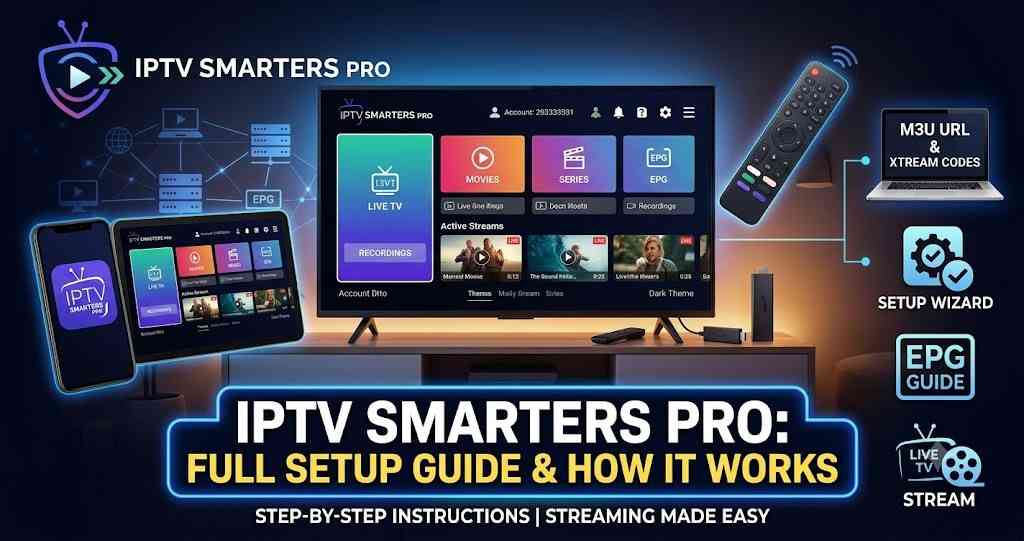
📺 Find a Compatible Provider:
📺 Find a Compatible Provider:
If you've subscribed to a legal IPTV service and gotten an email with a username, password, and server URL — or just an M3U link — and no idea what to do next, IPTV Smarters Pro is almost certainly the app you've been pointed toward. It's one of the most widely used IPTV player apps for a reason: it runs on nearly every device, handles both major connection methods, and doesn't require any technical background to set up.
This guide covers what IPTV Smarters Pro actually does, how to set it up with either an Xtream Codes API or an M3U Playlist, and how to fix the handful of issues that account for most setup problems.
What IPTV Smarters Pro Actually Is (and Isn't)
IPTV Smarters Pro is a media player, not a content provider. It doesn't host channels, movies, or shows — it's the interface that organizes and plays whatever your IPTV subscription gives it access to. You bring the subscription; Smarters Pro brings the EPG, the channel browser, the VOD library layout, and the playback controls.
This distinction matters because it means the app itself is content-neutral — it works exactly the same whether you're connecting it to a fully licensed streaming provider or anything else. The legality and reliability of what you watch depends entirely on the provider you subscribe to, not on the player. If you haven't picked a provider yet, our [best IPTV services guide] covers the licensed options worth considering.
⚙️ Compare IPTV Services
What makes the app popular specifically: it supports both major connection methods (more on that below), runs on Android, iOS, Windows, macOS, Fire TV, Android TV, and most Smart TV setups, and includes a built-in EPG, multi-profile support, and a multi-screen view that lets you watch several live streams on one screen at once — useful if you're tracking more than one game.
Xtream Codes API vs. M3U Playlist: Which Login Method to Use
When you subscribe to an IPTV provider, you'll typically get one of two credential types, and IPTV Smarters Pro supports both directly from its login screen.
Xtream Codes API is a server URL plus a username and password. This is generally the better option when your provider offers it — it pulls EPG data automatically, organizes VOD and series into proper categories instead of a flat list, and lets your provider update streams server-side without you touching your app settings. If your provider gives you a choice, choose Xtream Codes API first.
M3U Playlist is a single URL pointing to a text file listing your channels. It works perfectly well in Smarters Pro, but you'll usually need to add your EPG URL separately, and depending on your provider, playlist refreshes may be less seamless than with Xtream Codes.
In practice, both get you to the same place — a working channel list — and which one you use just comes down to what your provider issued. Don't worry if you only have an M3U link; the app handles it just as reliably, it just needs one extra setup step for the EPG.
How to Set Up IPTV Smarters Pro: Step by Step
1. Install the app. It's available on the Google Play Store (Android and Android TV), the Apple App Store (iOS and Apple TV), and as a standalone installer on the official Smarters website for Windows and macOS. Fire TV is the one exception — since it's not listed on Amazon's app store, you'll need to sideload it using the free Downloader app (search "Downloader" in the Amazon App Store, then enter the APK URL your provider supplies).
2. Open the app and add a new user. On first launch, you'll see a blank "My Users" screen with an "Add New User" button. Tap it.
3. Choose your login method. Select "Login with Xtream Codes API" if your provider gave you a server URL, username, and password, or "Load Your Playlist or File/URL" if you have an M3U link instead.
4. Enter your credentials exactly as provided. Typos and stray spaces are the single most common reason logins fail — if you copied your credentials, paste them into a plain text app first to check for hidden characters before entering them into Smarters Pro.
📋 Get the Setup Checklist
5. Let the app sync. Larger channel libraries can take 30-90 seconds to fully load. Once finished, you'll see separate sections for Live TV, Movies, and Series.
6. Set up your EPG if you're using M3U. Go to Settings → Select/Change TV Guide Source, and paste the XMLTV URL your provider sent you. If you used Xtream Codes, this usually loads automatically.
7. Set your time zone manually. This is an easy step to miss, and it's the most common cause of an EPG showing the wrong program times — the app sometimes defaults to UTC. Go to Settings → General Settings → Time Zone and set it explicitly to your local zone.
Fixing Common IPTV Smarters Pro Errors
"Authentication Failed" on login. This means the server rejected your credentials — almost always a typo, an extra space, or an expired/paused subscription. Re-enter everything manually rather than relying on autofill, and confirm with your provider that your account is active. If credentials are confirmed correct and the error persists, it can also be an IP conflict from a previous device still holding the connection slot.
Channels load but won't play, or show as offline. Refresh your playlist or Xtream Codes session from the app's settings — many providers rotate stream tokens periodically, and a stale session is the most common cause. If only specific channels fail while others work fine, the issue is usually on the provider's end with that particular stream, not your setup.
EPG times are wrong. Almost always a time zone mismatch (see step 7 above). Double-check the device's system clock and time zone are both set correctly, not just the app's internal setting.
Buffering and freezing during playback. Go to Settings → Select Player and try switching from the built-in player to an external one (VLC or MX Player on Android, ExoPlayer for Firestick 4K tends to perform especially well). Also check whether your device is using hardware or software decoding — hardware decoding offloads video processing to your device's dedicated chip and dramatically reduces buffering and battery drain compared to software decoding.
App crashes on launch. Clear the app's cache (Settings → Apps → IPTV Smarters Pro → Storage → Clear Cache on Android) and relaunch. If it persists, clear data entirely and re-enter your credentials, or reinstall the latest version.
Optimizing Playback Quality
A few settings make a noticeable difference once you're past initial setup. Use a wired Ethernet connection over Wi-Fi wherever possible — IPTV is far more sensitive to latency spikes and packet loss than to raw bandwidth, and a wired connection eliminates most of the interference that causes mid-stream buffering. If you're streaming 4K, aim for at least 25 Mbps of sustained bandwidth; for standard HD, 10-15 Mbps is generally sufficient. If multiple devices share your network, limiting simultaneous streams during peak viewing hours noticeably reduces buffering for everyone.
Frequently Asked Questions
Does IPTV Smarters Pro come with channels included? No. The app is purely a player — you need an active subscription from an IPTV provider, which supplies either Xtream Codes API credentials or an M3U Playlist URL. Without one of those, there's nothing for the app to load.
Is IPTV Smarters Pro free? The app itself is free to download and use. What you pay for is your separate IPTV subscription, which is what actually determines your channel lineup, pricing, and legality.
Can I use IPTV Smarters Pro on multiple devices? You can install it on as many devices as you want — the limit on simultaneous streams comes from your subscription plan, not the app. Most providers allow 1-5 concurrent connections depending on the tier.
Why won't IPTV Smarters Pro install on Fire TV from the app store? It's simply not listed on Amazon's app store, so it has to be sideloaded using the Downloader app instead of installed directly — this is normal and not a sign of anything wrong with the app or your device.
Xtream Codes API or M3U Playlist — which should I choose if my provider offers both? Choose Xtream Codes API. It generally loads EPG data automatically, organizes VOD and series more cleanly, and tends to handle provider-side stream updates more smoothly than a flat M3U list.

What is M3U IPTV? Learn how M3U playlists work, how to load one safely, and how to avoid scams, malware, and dead links in 2026.
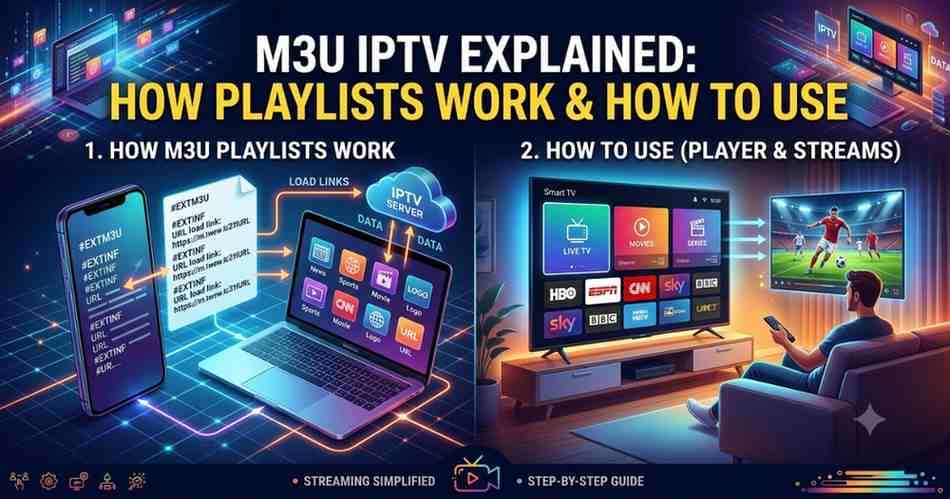
📺 Compare Legal IPTV Services:
📺 Compare Legal IPTV Services:
If you've started looking into IPTV, you've probably run into the term "M3U" within the first five minutes and had no idea what it actually meant. It sounds technical, but the concept is simple once you see it laid out — and understanding it will save you a lot of confusion (and a few bad downloads) once you start setting up an IPTV service.
This guide breaks down what an M3U file actually is, how M3U IPTV playlists work, how to load one into a real player, and — just as importantly — how to tell a safe source from one that's going to hand you malware or a dead playlist in 48 hours.
What Is M3U IPTV? (The Plain-English Version)
An M3U file is just a plain text document. That's it — no video, no audio, nothing fancy. It's a list of links, formatted in a way that a media player can read and turn into a channel guide.
When people say "M3U IPTV," they mean using that text file as the source for your live TV channels. Your IPTV player — VLC, TiviMate, IPTV Smarters Pro, whatever you're using — opens the file (or fetches it from a URL), reads through the entries one by one, and builds your channel list from it. Tap a channel, and the player connects directly to the stream URL listed next to that entry.
The format itself dates back to the mid-1990s, originally built for MP3 playlists (the name literally stands for "MPEG-1 Audio Layer 3 Uniform Resource Locator"). It got repurposed for IPTV because it's lightweight, universally supported, and doesn't require any proprietary software to read.
🔍 Find a Verified Provider
How M3U Playlists Actually Work
Here's the technical version, without the jargon overload.
An M3U file for IPTV uses an extended format, marked by #EXTM3U at the very top. Below that, each channel gets two lines: an #EXTINF line containing metadata (channel name, logo, category), and the actual stream URL on the line right after it. A simplified example looks like this:
#EXTM3U #EXTINF:-1 tvg-id="bbc1.uk" tvg-logo="https://example.com/bbc1.png" group-title="UK",BBC One https://example.com/stream/bbc1.m3u8
When you load this into a player, here's what happens step by step: the app sends a request to fetch the file, reads the #EXTM3U header to confirm it's a valid playlist, parses each #EXTINF line for the channel name and category, and stores the stream URL beneath it. Nothing is downloaded in advance — the player only connects to a specific stream URL when you actually select that channel.
This is also why M3U files are usually delivered as a URL rather than a file you download once. Your provider can update or swap stream links on their server, and your player picks up the change automatically the next time it refreshes the playlist — you never have to touch anything.
M3U vs. M3U8: What's the Difference
You'll see both extensions used interchangeably, and for most users, it genuinely doesn't matter which one you have. The difference is encoding: .m3u is the original format, while .m3u8 is the UTF-8 encoded version, built to handle non-English characters (accented letters, non-Latin scripts) reliably. Since most modern live streams use HLS (HTTP Live Streaming), which packages video in .m3u8-formatted chunks, the vast majority of current IPTV providers hand out .m3u8 links by default. Your player doesn't care which one you paste in — both load the same way.
M3U vs. Xtream Codes: Which Should You Use
If you've subscribed to an IPTV provider, you've likely been given a choice between two delivery methods, and it's worth understanding the tradeoff.
An M3U URL is the simplest option — one link, and your player builds the entire channel list from it. The downside: if your provider changes their stream URLs, you may need to manually refresh or re-add the playlist, depending on your player's settings.
Xtream Codes is a different delivery method that gives your player structured data instead of a flat list — separate categories for live TV, movies, and series, plus the ability for your provider to update streams on their end without you changing anything in your app. It typically requires a server address, username, and password instead of a single URL.
For day-to-day reliability, Xtream Codes generally edges out a plain M3U link, especially for larger channel libraries. But both work fine for most setups, and which one you use usually just comes down to what your provider issues you.
How to Add an M3U Playlist to a Player (VLC and Mobile Apps)
Getting an M3U playlist running takes about two minutes regardless of platform.
In VLC (desktop): open VLC, go to Media → Open Network Stream, paste your M3U URL into the field, and hit Play. VLC will parse the playlist and let you browse channels through its playlist panel. This is the fastest way to test whether a playlist URL is actually working before committing to a dedicated IPTV app.
In a dedicated IPTV app (TiviMate, IPTV Smarters Pro, GSE Smart IPTV): open the app, choose "Add Playlist" or "Add User," select M3U URL as the source type, paste the link, and give it a name. The app fetches the playlist and builds your channel list automatically, usually refreshing it each time you open the app.
On a Smart TV: most modern Smart TV platforms don't read M3U files natively through their built-in apps — you'll need to install a third-party player (TiviMate, IPTV Smarters) from the app store first, then load your M3U URL inside that app.
✅ Test Your M3U Link
Where M3U Playlists Actually Come From — and the Legal Line
This is the part most guides skip, and it's the one that matters most.
An M3U playlist is just a format — it says nothing about whether the channels inside it are legal to stream. The format is identical whether the streams belong to a fully licensed IPTV provider or someone illegally rebroadcasting cable channels they have no rights to. That distinction lives entirely in where the stream URLs actually originate, not in the file itself.
Legally, M3U playlists come from a few legitimate places. Licensed IPTV subscription providers generate an M3U URL (or Xtream Codes login) tied to your paid account, with your authentication embedded in the link. Some broadcasters and public media organizations publish official M3U links for their own free-to-air content. And open-source projects like iptv-org, hosted publicly on GitHub, aggregate links to channels that are already freely and legally available over the air or via official broadcaster streams — it's worth noting these directories explicitly exclude paywalled or pirated content and document the licensing status of what they list.
What you should be cautious of: random "free IPTV M3U" links circulating on forums, Telegram groups, or unofficial GitHub gists promising thousands of channels including premium cable and sports networks. These almost always rely on unauthorized rebroadcasts. Beyond the legal exposure, they're also just unreliable — links expire constantly, and several security researchers have found IPTV player apps tied to these lists requesting excessive permissions (location, device ID, SMS access) and transmitting data to third-party servers.
The rule of thumb: an M3U playlist offering free access to premium channels you'd normally pay your cable provider for is a red flag regardless of how it's packaged. A legitimate IPTV streaming provider charges a transparent subscription fee because they're actually paying for content licensing — that cost doesn't disappear just because it's delivered as a text file instead of a cable box.
Troubleshooting Common M3U Playlist Problems
Channels won't load or show as offline: Stream tokens embedded in many M3U URLs expire — some refresh every 24 hours. If a channel that worked yesterday is dead today, try reloading the playlist from your provider's URL rather than a saved local copy.
Logos aren't displaying: Usually caused by a broken or relative tvg-logo path in the #EXTINF line rather than a full working URL. Open the file in a text editor to check if the logo paths are complete.
Playlist loads but channels are mislabeled: This happens often with playlists compiled from multiple sources — a channel tagged "UK" might actually stream content from a different country entirely if whoever compiled the list mislabeled the metadata. Don't rely on filenames or folder labels; check the actual tvg-id and stream content.
Playback works in VLC but not in your IPTV app: Some apps are stricter about playlist formatting than VLC, which is fairly forgiving. If VLC plays a stream fine but your app rejects it, check that the file starts with #EXTM3U exactly and that each entry has its #EXTINF and URL line correctly paired with no extra blank lines between them.
Frequently Asked Questions
Is M3U IPTV legal? The M3U format itself is completely legal — it's just a text file. Legality depends entirely on whether the channels it points to are properly licensed. Using an M3U playlist from a licensed subscription provider is legal; using one built from pirated rebroadcasts is not, regardless of how the link was shared with you.
Can I create my own M3U playlist? Yes. M3U files are plain text, so you can open one in any text editor and add, remove, or reorder entries manually. Each channel just needs its #EXTINF metadata line followed by the stream URL on the next line.
Why do M3U links stop working? Most commonly because the embedded authentication token expired, the provider rotated their server URLs, or — for free public playlists — the original stream was taken down. Paid subscriptions are far more stable specifically because the provider maintains the links on your behalf.
How many devices can I use one M3U playlist on? That depends entirely on your subscription's connection limit, not the M3U format itself. Most paid IPTV plans allow 2-5 simultaneous connections; using the same playlist on more devices than your plan allows typically gets the account suspended.
Compare the best legal IPTV & streaming TV services for 2026. Pricing, channels, and features reviewed for freelancers, startups & home offices.
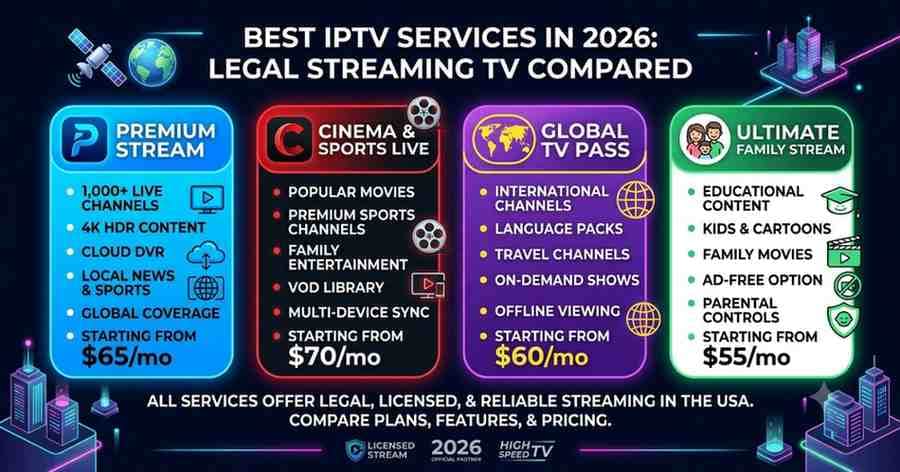
👉 Visit Site:https://bunnystream.com/clients/aff.php?aff=356
👉 Visit Site:https://bunnystream.com/clients/aff.php?aff=356
Both are unchanged from the original brief since the article content still matches that framing — let me know if you'd rather I tweak either to push the "premium IPTV service" phrasing in more directly now that it's woven through the body copy.
If you've searched "best IPTV," you've probably landed on a page promising 40,000+ channels for $17 a month with a free trial and a flashing "Click Here" button. Skip those. Most of them are reselling pirated cable feeds, and beyond the legal risk, they tend to die without warning, taking your money and your viewing history with them.
This guide covers the other kind of IPTV service: licensed live TV streaming subscriptions that deliver real channels — ESPN, CNN, your local ABC affiliate — legally, over the internet, with an actual company behind them you can call if something breaks.
What Is IPTV (and Why "Best IPTV" Searches Are Full of Misinformation)
IPTV just means "Internet Protocol Television" — TV delivered through your internet connection instead of a satellite dish or coaxial cable. That's it. Netflix is technically IPTV. So is YouTube TV. So is the cable box your landlord installed if it runs over fiber. A legitimate IPTV streaming provider operates exactly like Netflix or Hulu, just for live channels instead of on-demand video — you pay a transparent monthly fee, log into an app, and watch.
🔍 Compare Plans & Pricing
The term got hijacked over the last few years by a wave of resellers who buy stolen access to cable feeds and repackage them under brand names like "FluxtvLive" or "DigitaLine." They market themselves with the same playbook every time: a suspiciously huge channel count, a 48-hour free trial, payment via crypto or gift card, and zero mention of who actually runs the company.
Here's the tell. A real streaming provider — YouTube TV, Hulu + Live TV, Fubo — publishes its pricing on its own website, lists its corporate parent (Google, Disney, Fubo Inc.), and has a customer support line you can find in two seconds. If a site relies entirely on urgency ("act now," "limited spots") and vague claims instead of specifics, that's reseller marketing, not a TV service.
This matters practically, not just legally. Unlicensed IPTV services get shut down constantly because they're built on stolen streams. You lose your subscription with no refund, no notice, and no one to complain to. The services in this guide don't have that problem because they're not breaking anything to operate.
Who Actually Needs IPTV (Freelancer, Startup & Learner Use Cases)
The best IPTV streaming provider for you depends on why you're watching.
Freelancers working from home usually want something cheap and easy to background — a news channel running while you work, sports on in another tab during a lunch break. You don't need 200 channels for this. Sling TV's $45.99 Blue plan covers news, entertainment, and some sports without the overhead of a full cable-style bundle. (If you're setting up a full home workspace, our guide to [remote work setup essentials] covers the rest of the gear worth investing in.)
Startups and small offices often want a shared screen for a break room, a lobby TV, or pulling up a game during a team lunch. Here, device flexibility and simultaneous streams matter more than price — YouTube TV lets you run it across three screens at once, which is genuinely useful if your office has more than one TV or you want it on a laptop during setup.
📶 Check Your Internet Speed First
Small business owners with a waiting area (a salon, a repair shop, a clinic) usually want reliability above everything — something that just works every day without you troubleshooting it. DirecTV Stream's grid guide and DVR feel the most like traditional cable, which matters if you're not the one checking on it daily.
Learners and students searching for "best IPTV" are often after international news or educational programming a basic cable package doesn't carry. Several of these services let you add international channel packs (Sling in particular has strong Latino and international add-ons) without committing to a full international cable tier.
How We Evaluated the Best IPTV Services
We compared services on six things: whether they're actually licensed and legal, how transparent their pricing is (including hidden fees), how many devices they support at once, what's in the base channel lineup before add-ons, how good their DVR and support actually are, and whether you're locked into a contract.
One thing worth being upfront about: none of these services are perfect, and several have raised prices multiple times in the last few years. We're not going to pretend any of them are flawless — we'll call out where each one falls short, because that's the information actually missing from most "best IPTV" roundups.
Top Premium IPTV Service Providers Compared
Each of these is a fully licensed live TV streaming subscription — no shared logins, no sketchy checkout pages, no "credentials emailed after payment." Just an app, a monthly bill, and a real company behind it.
ServiceStarting PriceChannelsLocal ChannelsFree TrialYouTube TV$82.99/mo100+Yes (most markets)VariesHulu + Live TV$76.99/mo95+Yes (most markets)VariesSling TV$45.99–$60.99/mo30–50+Select markets onlyNoneFubo$85/mo100+Yes (most markets)VariesDirecTV Stream$89.99–$124.99/mo90–160+Yes (best rural coverage)Varies
Check current pricing and channel lineups directly on each provider's site before committing — promos and channel counts change monthly, and the numbers above can shift by the time you read this.
YouTube TV carries the "Big Four" local networks (ABC, CBS, FOX, NBC) in nearly every market, plus unlimited cloud DVR storage and three simultaneous streams. It's the most consistent pick if you want something that just works like cable did, minus the box. The catch: it's raised prices several times, and at $82.99/month it's not the budget option anymore.
Hulu + Live TV is the obvious choice if you already pay for Hulu's on-demand library — you get both for one bill. The live channel lineup is comparable to YouTube TV, but it's had more price increases historically (eight since 2019), so check current pricing before committing.
Sling TV is the budget pick. Splitting channels into "Orange" and "Blue" base packages keeps the entry price low, but you'll likely miss local channels unless you're in a select market, and DVR storage is capped at 50 hours unless you pay extra. Good fit if you mainly want cable channels and don't need your local news affiliate.
Fubo leans hard into sports, especially soccer and regional sports networks, which makes it the pick for sports-first households or a sports bar–style office TV. Its weak spot is gaps in Warner-owned channels (TNT, TBS), which matters during the NBA postseason specifically.
DirecTV Stream feels the most like traditional cable, with a cloud DVR and grid guide that mirror a satellite box experience. It also has the strongest regional sports and rural local-channel coverage. The tradeoff is price — the entry plan often runs $15–20 higher once regional sports and broadcast fees are added, and it's seen the most plan changes of any service on this list.
Pricing Breakdown — Monthly vs. Annual Plans
Most of these services bill monthly with no annual contract, which is the actual point of cord-cutting — you can cancel in a bad month and resubscribe later for football season. A few things to budget for beyond the sticker price:
Regional sports network (RSN) fees are the most common hidden cost. Fubo and DirecTV Stream both add these on top of the base price, and they can run $10–15/month extra if your local team has a regional broadcast deal. YouTube TV and Hulu dropped RSNs entirely a few years back, which is part of why their base price looks lower than it functions.
DVR storage caps matter more than people expect. Sling's base DVR is only 50 hours; bumping to unlimited costs an extra $5/month. If you're recording for a shared office screen or a household with kids, that fills up fast.
For freelancers and solo users, an affordable IPTV service like Sling or a skinny bundle (Philo, Frndly TV) covers basic entertainment for $9–45/month — a fraction of what YouTube TV or DirecTV Stream cost, and plenty for background viewing while working.
For small businesses, paying slightly more for a service with strong customer support (YouTube TV, DirecTV Stream) is usually worth it, since you don't want to be the one troubleshooting a frozen screen during business hours. (See our roundup of [small business subscription tools worth the extra cost] for more on where it pays to spend up.)
Device Compatibility & Setup
All five services run on the basics — Smart TVs, Fire TV Stick, Roku, Apple TV, Android/iOS phones, and a web browser on a laptop. Setup is genuinely simple: download the app, log in, and you're watching within a few minutes. There's no equipment shipped to you and no technician visit.
The real differences show up in simultaneous streams. YouTube TV allows three streams at once under one account; Hulu + Live TV allows two; Sling varies by plan (one to four depending on the tier you pick, and Orange and Blue together split differently than either alone). If you're setting this up for an office with multiple screens, check the simultaneous-stream limit before you buy — it's easy to assume "multi-device support" means unlimited screens, and it usually doesn't.
Is IPTV Legal? What to Check Before You Subscribe
IPTV as a technology is completely legal — it's just TV over the internet. What's illegal is streaming copyrighted broadcasts without the rights to redistribute them, which is exactly what the bargain "best IPTV" resellers are doing when they offer 40,000 channels for $15/month. No licensing deal explains that math.
Before subscribing to anything calling itself an IPTV service, check three things. First, can you find the company's actual name and where it's registered — not just a brand name on a landing page? Second, does the pricing page match what you're charged, with no "credentials emailed after payment" step that skips a normal checkout? Third, is there a real customer support channel, not just a Telegram group or a contact form that never replies?
If a service fails more than one of these checks, the risk isn't abstract. Unlicensed IPTV subscriptions get blacklisted and cut off with no warning, can expose your payment details to operators with no accountability, and in some jurisdictions, knowingly using a pirated stream carries its own legal exposure for the subscriber, not just the operator. (For a full breakdown of the legal distinctions, see our dedicated guide: [Is IPTV Legal? A Full Breakdown].)
Frequently Asked Questions
Is IPTV better than cable? Switching to an IPTV service beats cable on price and flexibility for most people — no equipment rental, no installation appointment, and you can cancel anytime. Where cable still wins is bundling internet and TV together, which can sometimes be cheaper if your provider offers a real discount for both.
Can I use IPTV for a business or shared space? Yes, but check the terms of service first. Most of these are licensed for personal/household use, and using one for a public-facing business screen (a waiting room, a bar) may need a commercial account — Fubo and DirecTV Stream both note this in their terms. Worth a quick read before you install one in a lobby.
What internet speed do I need for IPTV? 15 Mbps is a safe minimum for one HD stream; budget closer to 25 Mbps if you're running 4K or multiple devices at once. Buffering complaints are almost always a bandwidth issue, not a service issue.
Are free IPTV apps safe? Generally no. Free apps promising live cable channels are almost always pulling from unlicensed sources, and many bundle malware or require invasive permissions. If a streaming app is completely free and carries premium cable channels, that's the red flag, not the selling point.
Comment