
CitableHub
Make your tool citable by AI.

Every indie hacker knows the grind: you build a great product, and then you spend 80% of your time fighting the Google algorithm or posting endlessly on X/Reddit just to get a trickle of traffic.
I was doing the exact same thing until I looked at my own habits. When I need a new SaaS tool or an automation platform, I don't Google it anymore. I go to Perplexity or ChatGPT and ask: "What is the best tool for [X]?"
But here is the scary part for us founders: LLMs don't care about your beautiful landing page or your clever marketing copy.
If your product’s data isn't structured in a way that AI engines can easily parse and verify, they will simply recommend your competitor whose data is machine-readable. AI search engines look for semantic relationships, clear feature definitions, and verified entities, not keyword-stuffed H1 tags.
The "Aha" Moment I started testing how LLMs recommended products in my niche and realized there was a massive gap between traditional SEO and what we now call GEO (Generative Engine Optimization).
So, I built a solution to fix my own problem: CitableHub.
It’s basically a directory and a machine-readable layer where AI-native startups get structured for discovery. Instead of fighting for Google page 1, CitableHub translates your product's core value into the exact structured format that models like ChatGPT, Perplexity, and Claude actually want to read and cite as a source of truth.
The Result? I just checked my analytics this week, and I am already seeing organic referral traffic coming directly from Perplexity and ChatGPT sources. It actually works.
We as founders need to stop fighting for the search engines of 2015 and start optimizing for the generative engines of today.
I'm curious: Have any of you started seeing AI tools pop up as referral sources in your analytics? How are you optimizing your SaaS to be "read" by AI? Let's discuss.


Everyone here is fighting the same battle: AI assistants recommend the same 5 big names and ignore indie products. I built a directory to fix that — but this week I added something that actually changes the game.
Every project page now has an "Ask AI" button. One click opens ChatGPT, Perplexity, Gemini, Grok, Claude or Brave with a prompt that makes the AI read that exact page and summarize the product — live, in that session.
- I tested it on my own directory. Here's what happened when I clicked the ChatGPT button:
It read the machine-readable feed directly
- It recommended 3 real listed tools (Wildverse, Layerbase, Tracetify) with their GEO scores
- It cited the source 8 times in one answer
- It ended by telling the user how to list their own product for free
Google's AI Mode did the same and generated "People also ask: What is CitableHub? Is it free?" Brave put it at #1 and showed two other sites already citing it.
The point isn't the button. It's that AI can only recommend what it can actually read and verify. Most products aren't structured for that — no schema, no machine-readable feed, nothing an assistant can cite with confidence.
If you want to see whether AI can read YOUR product, drop your link below. I'll run it through the assistants and tell you if you're visible or invisible. And if you want the structured page + the "Ask AI" button on your own listing, it's free to add.
-
1
Quick test for anyone scrolling the Build Board right now:
Open ChatGPT (or Perplexity, Gemini, Grok…) and ask: "What does [your product name] do?"
If the AI gives a generic answer, makes stuff up, or says "I don't have information about that" — your product is invisible to the models people are now using instead of Google.
That's exactly what CitableHub fixes. Every listing gets:
✅ Schema markup so AI can parse your product
✅ A machine-readable feed (llms.txt) that LLMs actually read
✅ An "Ask AI" button that lets anyone verify you're cited — live, in real time
✅ A GEO score showing how visible you are to each AI assistant
I just tested it this week — ChatGPT read the feed, recommended 3 listed tools by name with scores, and cited the source 8 times in one answer.
Drop your product link here and I'll run the test for you. Takes 60 seconds. Free to list. citablehub.com
Over the last two days, we talked about how AI is ignoring beautifully designed SaaS products because they lack machine-readable structure (GEO).
But don't take my word for it. Let’s do a live test right now.
Open ChatGPT, Claude, or Perplexity and type this exact prompt: 👉 "Act as an expert in [Your Niche]. List the top 5 software tools for this specific problem, and tell me everything you know about [Your SaaS Name]."
What happened? 🔴 Scenario A: It hallucinates, gives incorrect features, or flat-out says, "I don't have information on that tool." (You are a ghost). 🟡 Scenario B: It knows your name but thinks you are still in beta from a year ago. (Your data is stale). 🟢 Scenario C: It perfectly describes your value proposition, pricing, and features. (You are mapped!).
If you hit Scenario A or B, your traditional marketing isn't working on the new AI web crawlers. Your unstructured data is costing you discovery traffic every single day.
Drop your SaaS link in the comments below. I’ll run a quick manual AI scan for you and tell you if you are visible or invisible to the main LLMs. Let’s map this universe together. 🚀

Thanks to AI and No-Code, we are living in a golden age of creation. Everyone is experiencing that incredible high of finally shipping a project with their own hands. You launch it, you feel unstoppable, and you think you’ve made it.
Then you hit the Second Wall: Visibility.
Getting noticed right now feels exactly like a zombie apocalypse. It’s a massive horde of hungry founders chasing the same few "uninfected" users, just trying to get that first bite.
If you are lucky, you breach the Third Door: your first real customer. You cross your fingers, hoping they stay past the one-month trial. But here is the trap: that one user doesn't magically bring thousands of others. The silence returns. Panic sets in. You start making desperate mistakes—spamming platforms, running bad ads, and losing your mind.
This is where the real makers are forged. You have to stay grounded in an ocean of obstacles and realize that shouting louder than the horde doesn't work anymore.
You can't fight the traditional SEO algorithms alone. But there is a backdoor: AI Search.
Instead of fighting for human attention on saturated platforms, you can optimize for the new visibility engine: AI assistants (ChatGPT, Claude, Perplexity).
That’s why I built CitableHub.com It's the difference-maker for both no-code makers and seasoned devs. It structures your project so AI engines can actually see it, understand it, and recommend it to users.
Registering is 100% free. Consider it my gift to all the new developers navigating this crazy new era of AI-driven visibility.
Don't get discouraged by the crickets. Just change the channel. Are your projects optimized to be recommended by AI yet? Let's discuss.

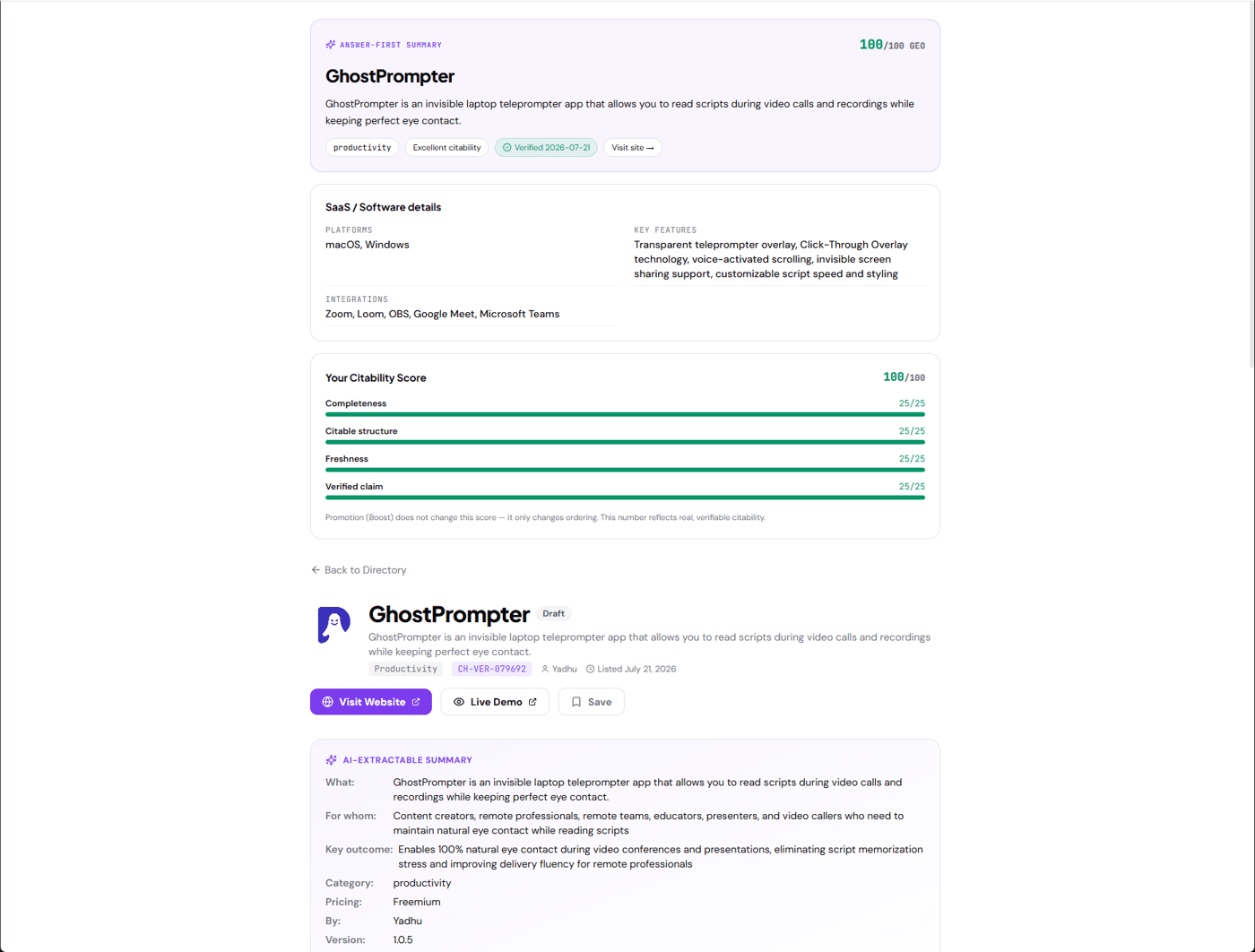
A few months ago I noticed something scary: when people ask ChatGPT or Perplexity "what's the best tool for X," the AI almost always recommends the big legacy players. Solo founders and small SaaS? Invisible. We're tiny islands in a sea of data that LLMs can't read properly. So I built CitableHub — a free platform that translates your product into structured, AI-readable data (Generative Engine Optimization). You add your tool, it scores your "Citability," generates AI-friendly summaries, and helps you actually get recommended when someone asks an AI for a solution in your space. The early results genuinely surprised me: - Real makers are already listing their products (a teleprompter app, dev tools, and more). - Search engines started treating listed products as known entities — some now show up in "People also ask" boxes. - CitableHub itself started ranking #1 for its own category and getting picked up by AI answers. It's 100% free to list. No catch. I make money later from optional visibility boosts, but you never have to pay to get cited. If you're a solo founder tired of being invisible to AI, I'd love for you to try it and tell me what breaks. Brutal feedback welcome — that's how this thing gets better. 👉 https://citablehub.com/?utm_source=indiehackers Ask me anything below. Happy to explain exactly how the Citability scoring works.
-
1
This hits close to home. I just built something in the creator-tool spaceand the discovery problem you're describing is real — if an AI can't findyour product, you functionally don't exist for a growing percentage ofyour market.
A few genuine questions:
On Citability scoring: What's the biggest factor that drags a listing'sscore down? I'd guess "vague description" or "no structured comparisondata," but curious what you're seeing in practice.
On the early results: The "People also ask" appearance is interesting.That suggests structured data is doing double duty — feeding LLMs andGoogle's entity graph. Was that intentional or a happy accident?
On the business model: Free listing with paid visibility boosts is a cleanmodel for this. Are you worried about the "free forever" promisebecoming hard to maintain if the AI citation landscape shifts andrequires more processing overhead? Or is the scoring enginelightweight enough that it scales without meaningful cost?
Rooting for this. The solo-founder visibility problem is only going to getworse as AI-mediated search grows.
-
1
This is exactly the level of thinking I hoped to attract here thank you. Let me take your questions one by one:
On Citability scoring: You guessed right. The two biggest score-killers are (1) a vague, benefit-free description and (2) no structured comparison data no clear "what, for whom, key outcome." Fix those two and a listing usually jumps dramatically, because that's precisely what a machine needs to confidently cite you.
On the early results: The "People also ask" appearance was intentional, not luck. The structured data does double duty on purpose it feeds LLMs a clean, citable summary AND feeds search engines' entity graphs at the same time. Same source of truth, two audiences.
On the business model: The scoring engine is deliberately lightweight, so it scales without meaningful per-listing cost which is what lets the free listing stay genuinely free forever. Revenue comes from optional visibility boosts and niche partnerships, never from charging makers to be citable. The "free forever" promise is safe precisely because I engineered the cost curve around it from day one.
And you nailed the core truth: "if an AI can't find your product, you functionally don't exist for a growing percentage of your market." That's the whole reason CitableHub exists.
Really appreciate you rooting for this. What are you building in the creator-tool space? I'd genuinely love to run it through the engine.
-
1
Currently my biggest project is ClipAlchemy.vercel.app it’s a content repurposing tool aimed directly at podcasters. It takes long form content and delivers short form social media content faster and cheaper than doing so manually.
-
-
-
1
Big welcome to GhostPrompter 👋 — one of the first makers to list on CitableHub, and honestly a great example of what I built this for. An invisible teleprompter for video calls is exactly the kind of clever solo product that deserves to show up when someone asks an AI "what's the best tool for X." Loved seeing your Citability Score climb and the AI summary generate automatically. That's the whole point small tools getting the visibility the big players usually hog. What are YOU building right now? Drop your product below I'd genuinely love to check it out (and if it fits, list it too). Let's turn this into a thread of makers helping makers get cited. 🚀


We all know the pain of launching a product and hearing crickets. But recently, I noticed a new kind of pain: being completely invisible to AI.
When a potential user asks Perplexity or ChatGPT for "the best tool to do X," the AI usually recommends the big, legacy companies. Why? Because LLMs struggle to find and index our solo, isolated SaaS websites. We are tiny islands in a sea of data.
I recently built a tool called CitableHub to help SaaS founders optimize their sites for AI bots (Generative Engine Optimization). But looking at the data, I realized something huge:
AI visibility is a numbers game, and we need a Network Effect.
If you have one isolated SaaS, the AI might skip you. But if we pool hundreds of Indie Hacker projects into one highly-structured, machine-readable directory, the AI crawlers (like GPTBot and ClaudeBot) will treat it as a massive, authoritative source of truth.
The more projects we list on CitableHub, the more "citable" every single project inside becomes. A rising tide lifts all boats.
We don't need to fight the AI algorithms alone. I've set up CitableHub to act as this collective bridge. It takes your project and translates it into the exact format LLMs love to ingest.
It’s 100% free to list your startup. Let's build the biggest, most structured directory of indie tools on the web, so the next time someone asks ChatGPT for a solution, it cites us.
You can add your project to the graph here: [Tu enlace a CitableHub]
What do you guys think of this collective SEO approach for AI? Has anyone tried grouping data to get noticed by LLMs?

We all know the standard indie hacker metrics: MRR, Churn Rate, CAC, and Daily Active Users. But as user behavior shifts radically from "Searching on Google" to "Asking an AI Assistant," there is a massive blind spot in how we measure acquisition.
If a potential customer asks Perplexity or Claude, "What is the best tool for [Your Niche]?" — do you know where you rank? Do you even show up?
I've spent the last few months deeply analyzing how LLMs retrieve and cite SaaS products, and I realized we need a new metric for the Generative AI era. I call it the Citability Score.
What makes up a Citability Score? It's not about backlinks anymore. To an LLM, your authority is based on:
Brand Entity Recognition: Does the AI associate your brand name with the correct category of software? (e.g., CitableHub = AI Visibility).
Feature Mapping Accuracy: When the AI describes your tool, does it hallucinate features, or does it accurately pull from your latest documentation?
Contextual Retrieval: How likely is the AI engine to pull your product into its active context window when a user asks a high-intent question?
Sentiment Indexing: Is the training data surrounding your product generally positive across the web?
Why you need to measure this today: If your Citability Score is low, you are essentially invisible to the next generation of internet users. Traditional SEO tools can't measure this because they track keyword volume, not semantic entity recognition.
I built the dashboard at CitableHub specifically to track this. When you plug your SaaS into our discovery engine, we calculate your current Citability Score and give you a Generative Engine Optimization (GEO) audit to show you exactly where the AI is getting confused about your product.
As founders, we can't afford to be invisible to AI. I'm opening up the dashboard for free testing today. How do you currently track if AI assistants are recommending your tool? Let's discuss below.

Hey Indie Hackers, Rafael here.
If you've built a beautiful, dynamic SaaS using React, Vue, or heavy client-side rendering, I have some bad news: AI agents (like ChatGPT, Claude, and Perplexity) might be completely ignoring your product.
In the traditional SEO era, Googlebot got pretty good at rendering JavaScript. But in the emerging era of GEO (Generative Engine Optimization), LLM crawlers are designed for speed and semantic extraction. They don't want to execute your heavy JS bundles; they want structured, machine-readable data. If they can't parse what your SaaS does in milliseconds, they will recommend your competitor instead.
Here is exactly what AI agents are looking for in 2026:
1. Semantic Clarity Over Visual Design LLMs are blind to your beautiful UI. They rely entirely on semantic HTML, clear header hierarchies (H1, H2, H3), and descriptive alt text. If your value proposition is hidden in a dynamic slider, the AI won't see it.
2. High-Density Context Windows When an AI crawler visits your site, it has a limited context window to understand your entity. You need to provide "Entity-Relationship" data clearly. What is your product? Who is it for? What integrations does it have?
3. Machine-Readable Endpoints (The Game Changer) The absolute best way to guarantee an AI understands your SaaS is to feed it a format it natively speaks: Markdown, JSON-LD, or structured API schemas.
How to fix this immediately: This exact technical gap is why I started building CitableHub. Instead of forcing founders to rewrite their entire frontend architecture, we built the MCP Gateway.
When you list your SaaS on CitableHub, we automatically generate a machine-readable profile that acts as a direct bridge to LLM crawlers. It translates your marketing copy into the exact structured format that AI agents digest and cite natively.
Stop letting AI skip your product because of your tech stack. Have you audited your site's AI-readability yet? Drop your links below and I can run a quick GEO test for you to see what the bots actually see.
Hey Indie Hackers! Rafael here.
Since getting CitableHub set up here yesterday, I've been thinking a lot about the shift in product discovery. We spend months optimizing our landing pages for Google (traditional SEO), but when a user asks ChatGPT, Claude, or Perplexity for a tool in our niche, our products are completely invisible.
The truth is, LLMs don't browse the web like humans. They get stuck on heavy JavaScript, ignore marketing fluff, and look for structured, semantic data. If your app isn't built to be machine-readable, you are missing out on the fastest-growing acquisition channel of 2026.
I call this GEO (Generative Engine Optimization). To get cited by AI agents, your product needs to feed them the right signals.
Here is what we are building at CitableHub to fix this discoverability gap:
The Citability Score: A metric to see how visible and accurately referenced you actually are to AI agents.
MCP Gateways: A machine-readable profile that LLMs can instantly digest and cite without guessing.
GEO Audits: Actionable steps to translate your marketing site into AI-friendly context.
I'm currently opening up free GEO Audits for the community to test the engine. If you want to see how your product looks through the eyes of an AI, you can run it through CitableHub or drop your link in the comments and I'll run it for you.
Has anyone here successfully acquired users directly from an AI prompt yet? I'd love to hear your experiences!
Hey Indie Hackers! Rafael here.
I noticed a massive shift recently. We spend months optimizing our landing pages for Google (traditional SEO), but when a user asks ChatGPT, Claude, or Perplexity for a tool in our niche, our products are completely invisible.
LLMs don't browse the web like humans. They get stuck on heavy JavaScript, ignore marketing fluff, and look for structured semantic data. If your app isn't built to be machine-readable, you are missing out on the fastest-growing acquisition channel today.
That’s why I just launched CitableHub.
It’s a free discovery layer—essentially SEO for the AI age (Generative Engine Optimization). When you list your project, the engine automatically generates:
A Citability Score: To see how visible you actually are to AI agents.
An MCP Gateway: A machine-readable profile that LLMs can instantly digest and cite.
A GEO Audit: Actionable steps to fix your AI visibility.
It's 100% free to list your tool. I built this to solve my own distribution problem, and I'm opening it up to the community today.
Run your startup through the engine here: https://citablehub.com
Drop your project link in the comments and let me know what Citability Score you got. I'll be hanging out here all day to answer any questions about GEO!
-
1
I like that you're framing AI discoverability as a representation problem rather than just another SEO problem.
As more product discovery happens through AI systems, being understandable to machines becomes increasingly important alongside being persuasive to humans. That feels like a different optimization challenge than simply ranking higher in traditional search.
-
1
Aryan, you nailed it — that's exactly the shift I couldn't stop thinking about. It's a representation problem, not a ranking problem. Traditional SEO is about persuading a human who's already looking at your page. But an LLM never "visits" your page the way a person does — it ingests structured meaning and decides whether you're even worth mentioning in its answer. If your product isn't machine-legible, you don't rank low... you simply don't exist in the AI's world. That's the whole reason I built CitableHub around a "Citability Score" instead of a keyword report. The question isn't "how high do I rank?" — it's "can the machine understand and cite me at all?" Two completely different optimization games, like you said. Really appreciate you engaging at this level. What are you building? I'd love to run it through the engine and show you what an AI actually "sees" when it looks at your product.
-
1
Appreciate the context.
The representation vs ranking distinction is the interesting shift here.
Would be good to continue the conversation and learn more about what you're seeing with CitableHub.
What's the best email to reach you on?
-
1
Best email to reach me is team@citablehub.com write me anytime, I read every message personally.
Really glad the representation vs ranking distinction landed with you. Would genuinely love to continue the conversation and hear what you're building. If you ever want to see it in action, you can also run your own product through the engine at citablehub.com/contact or just reply here whatever's easiest.
Looking forward to it.
-
1
Thanks! I’ve just sent it over.
Looking forward to hearing your thoughts whenever you have a chance.
-
-
-
-

6 Comments
Spot on, Elena. Your point about 'third-party corroboration' moving the needle harder than anything on your own domain is 100% accurate. That is the exact thesis behind CitableHub providing that structured, machine-readable external layer that LLMs trust and cite over just reading a company's own landing page.
Also, great callout on the
robots.txtissue; it's crazy how many startups accidentally block GPTBot and ClaudeBot and then wonder why they aren't showing up in prompt answers. I'll definitely check out your API tool, it sounds like a super smart way for founders to diagnose that quickly. Thanks for sharing it.This is genuinely making me rethink something. I only just started fixing my basic SEO fundamentals (was skipping straight to backlink outreach at DR0, learned that's backwards). Now I'm realizing there's a whole other layer — optimizing for how LLMs parse and cite you — that I hadn't even considered yet. Feels like the ground keeps shifting under indie hackers faster than we can catch up
I completely get that it feels like the goalposts are constantly moving. The good news is that optimizing for LLMs doesn't replace your basic SEO; it just adds a machine-readable layer on top. That exact feeling of overwhelm is why we built CitableHub. We wanted to give founders a shortcut to get their products properly structured for AI engines without having to learn a whole new technical discipline from scratch. Keep nailing those SEO basics! What project are you currently building?
Appreciate that — good to know it's an added layer on top of SEO, not a replacement. Right now I'm building Ehugapy, a skill-based gaming platform with real cash prizes. Still focused on the fundamentals for now, but I'll keep CitableHub in mind once I get to the AI-discoverability stage
Ehugapy sounds awesome skill-based gaming with real cash prizes is a space where trust and discoverability will matter a lot. Smart move nailing the fundamentals first.
One thing I'll mention early so you're ready when the time comes: take your time filling out your project profile when you register anywhere CitableHub included. I see founders rushing through the form every day, thinking "I'll just list the name and URL and I'm done." Then they wonder why AI engines don't pick them up.
CitableHub has an extra layer most directories don't it structures your project data specifically so LLMs can parse, trust, and cite it. But that layer only works well when you feed it enough signal: description, target audience, differentiators, evidence, founder info. Think of it like this: your project is your baby, you've poured irreplaceable hours into it the registration form is where you translate that effort into machine-readable trust.
So whenever you're ready to move into the AI discoverability stage, hit me up. I'll personally make sure Ehugapy gets the extra push that puts it on the LLMs' radar. I'm also working on coverage with Chinese models (DeepSeek, Qwen, etc.) but that's a whole other chapter 😄
Good luck with the build and if you have any questions along the way, just let me know!