Article Submission Sites: Complete Guide for SEO (2026)
If you're looking for one of the most effective off-page SEO strategies to increase your website's visibility, article submission sites remain a valuable tactic when used correctly. Although Google's algorithms have evolved significantly, publishing high-quality content on reputable platforms can still help improve brand awareness, referral traffic, authority, and natural backlinks.
In this comprehensive guide, you'll learn what article submission sites are, how they work, their SEO benefits, common mistakes to avoid, and the best practices for getting long-term results. We'll also explain how guest posting sites differ from free article submission sites, helping you choose the right strategy for your business.
Whether you're a beginner, digital marketer, blogger, or SEO professional, this guide will help you build a smarter content promotion strategy.
What Are Article Submission Sites?
Article submission sites are online platforms where individuals and businesses can publish original articles on various topics. These websites allow authors to share knowledge while gaining exposure, referral traffic, and potential backlinks to their own websites.
Unlike publishing only on your own blog, article submission expands your content's reach by introducing it to an established audience.
Common categories include:
Digital marketing
Technology
Business
Health
Education
Finance
Lifestyle
Travel
Fashion
Some platforms are open to everyone, while others require editorial approval before publication.
Why Article Submission Sites Still Matter for SEO
Many marketers believe article submission became obsolete after Google's Penguin update. That's only partially true.
Low-quality article directories created solely for backlinks no longer provide value. However, publishing useful, well-written articles on authoritative websites continues to offer several SEO benefits.
These include:
Increased brand visibility
Referral traffic
Faster content discovery
Improved topical authority
Natural backlink opportunities
Better online reputation
Enhanced trust signals
The key difference today is quality over quantity.
Google rewards content that demonstrates expertise, experience, authority, and trustworthiness (EEAT). If your articles genuinely help readers, article submission remains a worthwhile strategy.
How Article Submission Sites Help Build Authority
Search engines evaluate more than backlinks.
They also look at your overall online presence.
Publishing valuable content across multiple trusted platforms helps search engines recognize your expertise in a particular industry.
For example:
A cybersecurity consultant regularly publishes educational articles on respected technology websites. Over time, readers begin recognizing the author's expertise, and other websites naturally reference their work. This creates stronger authority than publishing dozens of low-quality articles solely for backlinks.
This approach aligns closely with Google's focus on helpful content.
📝 Publish Smarter, Rank Higher
Article Submission Sites vs Guest Posting Sites
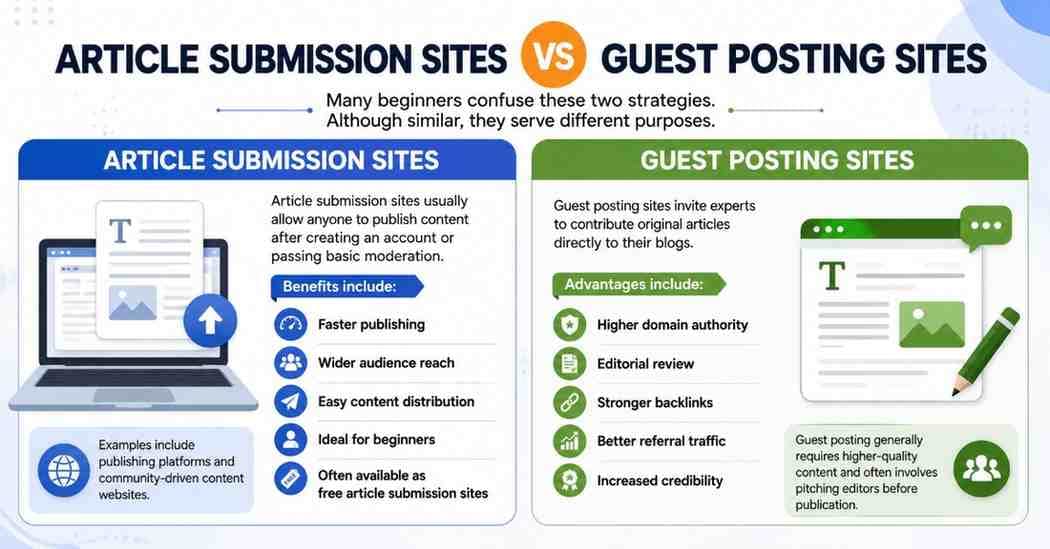
Many beginners confuse these two strategies.
Although similar, they serve different purposes.
Article Submission Sites
Article submission sites usually allow anyone to publish content after creating an account or passing basic moderation.
Benefits include:
Faster publishing
Wider audience reach
Easy content distribution
Ideal for beginners
Often available as free article submission sites
Examples include publishing platforms and community-driven content websites.
Guest Posting Sites
Guest posting sites invite experts to contribute original articles directly to their blogs.
Advantages include:
Higher domain authority
Editorial review
Stronger backlinks
Better referral traffic
Increased credibility
Guest posting generally requires higher-quality content and often involves pitching editors before publication.
Free Article Submission Sites: Are They Worth It?
Yes—but only when chosen carefully.
Not every free platform provides SEO value.
Focus on websites that have:
Active readership
Strong editorial standards
Regularly updated content
Good domain authority
Indexed pages in Google
Real user engagement
Avoid websites filled with duplicate content, spam, excessive advertisements, or automatically generated articles.
Quality always beats quantity.
Publishing five outstanding articles on respected websites is significantly more valuable than publishing fifty low-quality submissions.
Benefits of Using Article Submission Sites
Improve Organic Visibility
Publishing informative articles increases your digital footprint.
The more quality content associated with your brand, the easier it becomes for potential customers to discover you.
Generate Referral Traffic
Readers who find your content valuable often click through to learn more about your business.
Highly targeted referral visitors usually spend more time on your website because they already have interest in your topic.
Earn Quality Backlinks
Although many article submission websites use nofollow links, they still contribute to a natural backlink profile.
Editorial backlinks from respected websites remain one of Google's strongest ranking signals.
Build Brand Authority
Consistent publishing establishes your expertise.
When readers repeatedly encounter your insights across multiple trusted platforms, your credibility naturally increases.
Reach New Audiences
Your own website has a limited audience.
Article submission allows your content to appear before entirely new readers who may never have discovered your brand otherwise.
🔗 Find the Best Submission Sites
How to Choose the Best Article Submission Sites
Before submitting your article, evaluate each website carefully.
Look for:
High Domain Authority
Although Domain Authority isn't a Google ranking factor, it provides a useful benchmark for identifying reputable websites.
Generally, higher-authority websites attract stronger trust.
Relevant Niche
Always choose websites related to your industry.
A finance article belongs on business or finance websites—not travel blogs.
Topical relevance strengthens SEO value.
Editorial Guidelines
Professional websites maintain quality standards.
Read submission guidelines carefully before writing.
Following instructions increases your approval rate.
Organic Traffic
A website receiving consistent organic traffic offers better visibility than one with little or no audience.
Real readers matter more than backlink counts.
Active Community
Look for websites where readers:
Leave comments
Share articles
Ask questions
Engage with authors
Community engagement often leads to better brand exposure.
How to Write Articles That Get Accepted
Many submissions are rejected because they're overly promotional.
Editors want educational content—not advertisements.
Follow these practices:
Write Original Content
Never reuse existing articles.
Duplicate content reduces credibility and lowers acceptance chances.
Create Attention-Grabbing Headlines
Strong headlines improve click-through rates.
Instead of writing:
"SEO Tips"
Write:
"15 Practical SEO Strategies That Deliver Long-Term Organic Growth"
Specific headlines perform better.
Solve Real Problems
Ask yourself:
"What question does my reader want answered?"
Every section should provide practical value.
Support Claims with Statistics
Credible data builds trust.
Examples include:
Industry research
Government reports
Case studies
Market surveys
Academic publications
Whenever possible, use recent statistics.
Add Practical Examples
Readers understand concepts more easily when they see real scenarios.
Example:
Instead of saying,
"Internal linking improves SEO."
Explain:
"A software company added contextual internal links across 120 blog posts and increased organic page views by 38% within six months."
Examples create clarity.
Best Practices for Article Submission SEO
To maximize results:
Focus on user intent first.
Write comprehensive content.
Naturally include your primary keyword.
Use descriptive headings.
Add relevant internal links when permitted.
Link only to trustworthy external sources.
Optimize images before uploading.
Include an engaging author bio.
Publish consistently.
Update older articles regularly.
SEO today is about providing value—not manipulating rankings.
Common Mistakes to Avoid
Many marketers reduce their SEO performance by making avoidable errors.
Don't:
Submit duplicate articles.
Stuff keywords unnaturally.
Use irrelevant anchor text.
Publish on spam websites.
Buy bulk article submission packages.
Ignore editorial guidelines.
Write overly promotional content.
Neglect proofreading.
Remember:
One excellent article always outperforms dozens of weak submissions.
Article Submission Strategy That Actually Works
Instead of chasing hundreds of backlinks, use a structured strategy.
Step 1
Research reputable article submission websites.
Step 2
Understand each platform's audience.
Step 3
Write original content specifically for that audience.
Step 4
Include one or two natural references to your website where allowed.
Step 5
Promote your published article on social media and email newsletters.
Step 6
Monitor performance using analytics tools.
Track:
Referral traffic
Organic rankings
Backlink growth
Engagement
Conversion rate
Continuous improvement delivers better long-term SEO results.
Do Article Submission Sites Still Work After Google's Helpful Content Updates?
Yes—but only when your content demonstrates real expertise and satisfies user intent.
Google increasingly rewards content that:
Answers user questions thoroughly.
Demonstrates first-hand experience.
Provides unique insights.
Offers actionable advice.
Shows credibility through accurate information.
Publishing thin, AI-generated, or keyword-stuffed articles is unlikely to produce meaningful SEO benefits.
Instead, prioritize quality, originality, and usefulness.
EEAT: The Key to Successful Article Submission
Google evaluates content using the EEAT framework:
Experience
Share first-hand knowledge whenever possible.
Example:
Instead of repeating generic SEO advice, explain strategies you've personally tested.
Expertise
Demonstrate deep understanding of your subject.
Support recommendations with evidence.
Authoritativeness
Publish consistently across trusted websites.
Build a recognizable online presence.
Trustworthiness
Maintain factual accuracy.
Cite reliable sources.
Be transparent about your expertise.
Trust is often the deciding factor between average content and top-ranking content.
Frequently Asked Questions
1. What are article submission sites?
Article submission sites are websites that allow users to publish original articles online. They help increase brand exposure, referral traffic, and can contribute to a natural backlink profile when used appropriately.
2. Are article submission sites good for SEO?
Yes. High-quality article submission sites can support SEO by improving online visibility, building authority, generating referral traffic, and attracting natural backlinks. However, low-quality or spammy directories should be avoided.
3. What is the difference between article submission sites and guest posting sites?
Article submission sites generally allow broader public submissions with basic moderation, while guest posting sites require editorial approval and often maintain stricter publishing standards. Guest posts usually provide stronger branding and SEO opportunities.
4. Are free article submission sites safe to use?
Yes, provided you choose reputable platforms with quality editorial standards. Avoid websites filled with duplicate, low-quality, or spam content.
5. How many article submission sites should I use?
Quality is far more important than quantity. Publishing consistently on a handful of reputable websites will generally produce better results than submitting to hundreds of low-quality directories.
6. Can article submission generate backlinks?
Yes. Many platforms allow author bio links or contextual links where relevant. Even when links are marked as nofollow, they can still drive referral traffic, improve brand visibility, and contribute to a diversified backlink profile.
7. How often should I publish articles?
Consistency matters more than volume. Publishing one or two high-quality articles each month on trusted platforms is often enough to strengthen your content marketing and SEO strategy over time.
Final Thoughts
Article submission sites continue to play an important role in modern SEO when used as part of a quality-focused content marketing strategy. Rather than chasing hundreds of backlinks, concentrate on publishing original, informative, and experience-driven articles on reputable platforms that genuinely serve your audience.
Combine free article submission sites with high-authority guest posting sites to create a balanced off-page SEO approach. Over time, this strategy can improve your brand visibility, strengthen topical authority, generate qualified referral traffic, and support sustainable organic growth.
The most successful marketers don't publish everywhere—they publish where their audience already spends time and consistently deliver valuable content. If you want lasting SEO results, start by identifying reputable article submission sites, create content that demonstrates expertise and trust, measure your performance, and refine your strategy with every publication.
Why Trust Our Review
Our recommendations are based on in-depth research, publicly available information, feature comparisons, user experience, device compatibility, pricing transparency, and overall usability. We strive to provide balanced, accurate, and regularly updated content that helps readers make informed decisions rather than promoting any single provider.
Author: Priyanshi Webix
Reviewed by: Editorial Team
Last Updated: July 14, 2026

