I handed my content marketing to agents. 6 months later organic traffic is 34x.
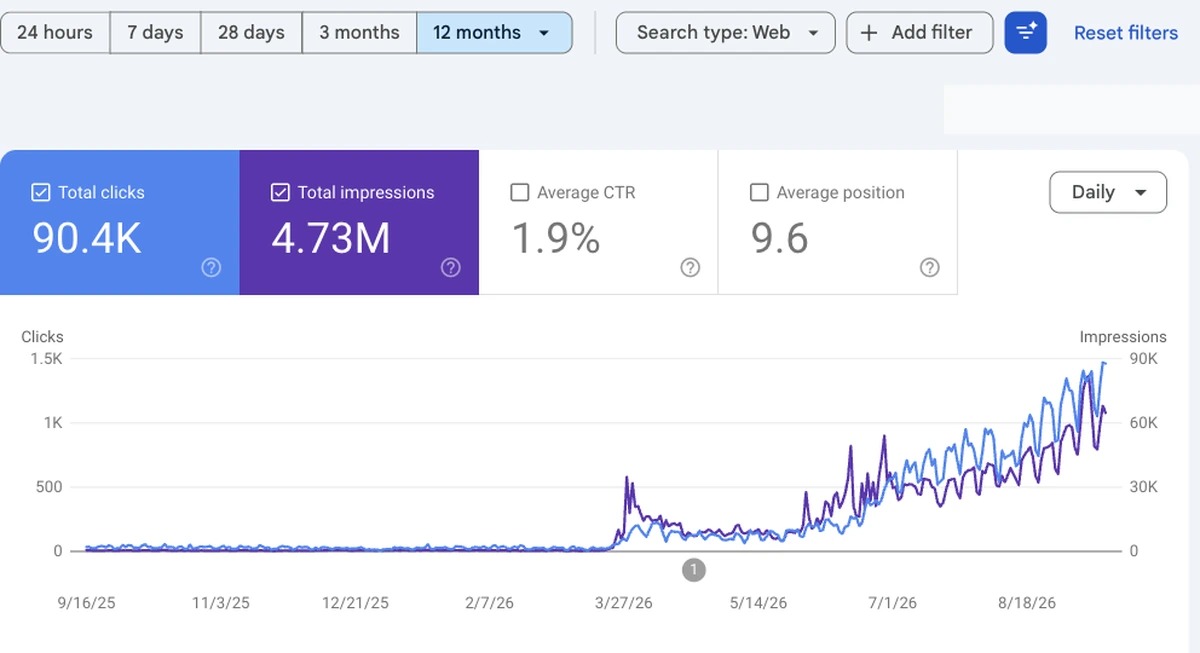
That's Search Console for the last 12 months on a site I've run for years. Everything flat on the left is before February.
I'm solo on this. I haven't written, researched or edited a single one of the articles that did it.
Here's what the six months actually looked like, including the two months I wasted.
What the setup is
The site publishes 200 articles a day now. It put out 200 today, and there are just over 23,000 live.
I've been doing SEO for 22 years, so the pipeline isn't anything clever. It's what I would do by hand for one article: pull market research from Google Ads data, settle on a keyword, fetch the top 10 results and read what they cover, then write something that covers all of it and adds what none of them bothered with.
The only change is who does it. That work now runs as agents, end to end.
The first two months were a write-off
Of everything published in April, 53% never got a single impression, even after 60 days. Researched, covered, shipped, and more than half of it might as well not exist.
My first guess was that Google could tell a machine wrote it. Wrong. I pulled index status on the dead pages and 66% were indexed normally. Not rejected. Indexed, and nobody was searching for them.
So I checked all 1,412 dead pages for any adjacent keyword doing 100 to 2,000 searches a month. Found one for 158 of them. Eleven percent. The rest were sitting in a vacuum.
The pipeline was fine. I'd pointed it at keywords that were too big. Cover the top 10 for a competitive term and you land at position 11, and position 11 gets you nothing. Doing that a thousand times doesn't change the arithmetic.
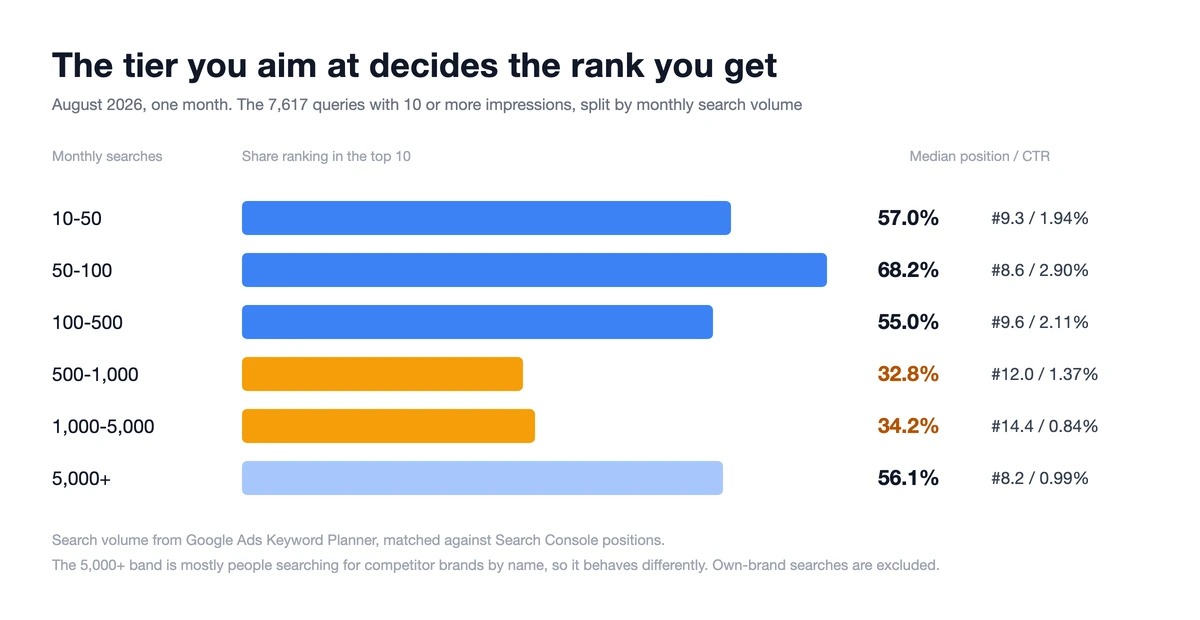
At 1,000 to 5,000 searches a month, my median position is 14.4 and only 34% of those queries reach the top 10. At 50 to 100 searches a month, median is 8.6, 68% are in the top 10 and CTR is 2.90%, the best of any band.
From June I kept every step and only moved the target down. Zero-impression rate went 53% in April, 35% in May, 25% in June. Same agents, same pipeline.
What that does to the business
With February as 1:
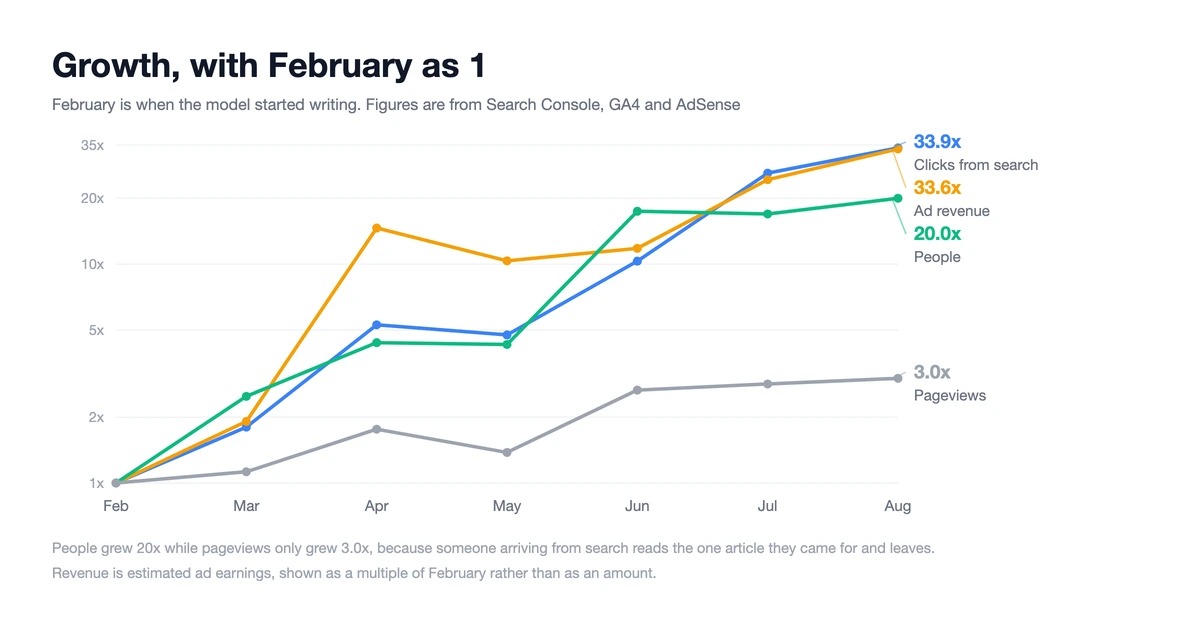
Clicks from search, 33.9x. Ad revenue, 33.6x. People on the site, 20.0x. Pageviews, only 3.0x.
Revenue tracked clicks almost exactly, so the value of a click held up while the volume went up 34 times. Nothing got diluted. September had passed the whole of August by the 16th.
The pageview line is the one founders ask about. People grew 20x and pages grew 3x, because someone arriving on a long tail query reads the one article they came for and leaves. The site went from 12.4 pages per person in February to 1.9 in August. This audience does not browse. That was fine, because each article answers exactly one question and the monetisation on it is relevant to that question.
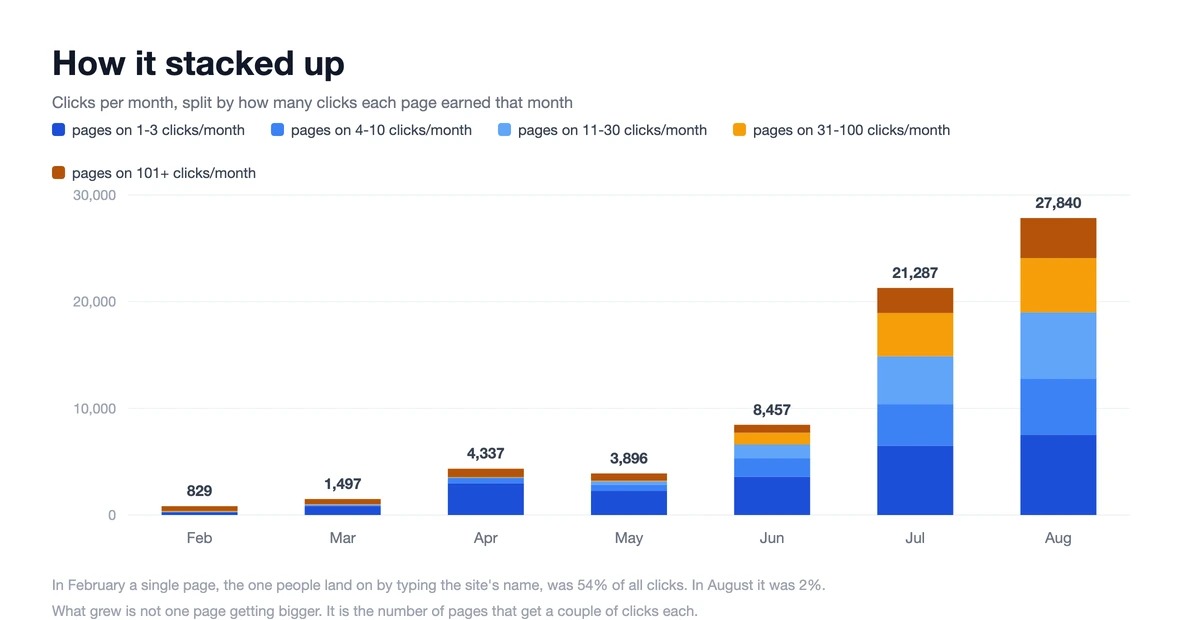
In February, 209 pages on the whole site got a click, the top 10 took 70.9%, and one page by itself, the one people land on by typing the site's name, was 54% of everything. All head, no body. By August, 6,839 pages got a click, the top 10 took 10.1%, and the biggest single page was 2%. If any one page vanished tomorrow I could not tell from the numbers.
The traffic number is not really the interesting bit to me. Nothing in it is load-bearing any more, which is a very different position to be in than having one page carry the site.
The thing I wasn't expecting
Up to March this site had never once had a link exchange request. Not one, in years.
Once the blog section existed and the articles piled up, they started coming in almost daily. I've never done outreach and I've never run a link building campaign. Adding a blog was the whole intervention.
And it's not who I'd have guessed. Companies much bigger than mine, listed companies, law and accounting firms, the kind of organisation that would not have taken my call a year ago. Almost nothing from the link farm end. Whatever a stocked blog signals, the people whose job is to vet a site before linking to it are reading it as legitimacy.
Half of this is deletion
Nobody talks about this part and I think it matters more than the publishing.
28 days with zero impressions and a script redirects the topic. 56 days and it sets the page noindex and drops it from the sitemap. That runs every morning without me. On August 19 it removed 1,601 articles in one pass and I found out from the log. (Correction: those 1,601 were later confirmed to be noindexed, not deleted.)
If you only ever add, the share of your site that is dead climbs forever, and that ratio is the thing a spam system can actually see. Raw volume tells it very little.
What my job is now
Choosing which tier to aim at, and signing off on what gets cut, is not automated and it isn't going to be. That part has to be argued out against the numbers, and an agent on its own has no stake in the answer.
In practice: every morning the agents report in. What got impressions. What has gone 28 days with nothing. What the retarget queue is holding, which is 2,418 articles as I write this. I read that against the KPIs, we talk through what it means, and I decide what the next batch is about.
So the job is one decision a day, off a report I did not compile, about work I am not going to do. It took a while to stop feeling like I was skiving.
Next thing I want to fix is that retarget queue. 2,418 is more than I am getting through and it has been growing for weeks, which means there are a few hundred articles sitting at zero that could probably be pointed somewhere useful. I have not worked out how to make that decision faster without handing it over, and I do not want to hand it over.

The 50–100/mo band finding is useful, but for agency work I’d add one client-facing guardrail: separate discovery targets from conversion pages. A low-volume query is a great wedge when it maps to a problem the client actually sells; otherwise you’re just accumulating cheap impressions. The cohort reporting plus explicit retarget/retire rules feels like the part worth turning into a repeatable monthly retainer deliverable.
Agreed on keeping them apart. On my site, though, the small terms actually do convert. They're not just cheap impressions.
The band data is the part I'll be stealing. Everyone says "go long tail" and nobody publishes median position by volume band.
One thing I'd love to know from a site your size, because I can't test it at mine: are the assistants citing you? You've got 23,000 pages indexed on queries people actually type. If you took ten of your best-performing articles, asked ChatGPT and Perplexity the question each one targets, and checked whether your domain gets named — that's a different scoreboard from Search Console, and at your scale you'd be one of the very few people who could actually answer it.
I ask because what I keep finding on small sites is that the assistant answers with a directory or a competitor even when the page ranks fine in Google. Ranking and being cited come apart more than I expected. At 23,000 pages the sheer coverage might solve it for free — or it might not, and that would be the more interesting result.
Haven't checked it question by question. I watch the totals instead. Search Console started showing AI numbers for me around June and they've been going up, and Bing Webmaster Tools has an AI Performance report in beta that shows citations too.
Picking ten articles and asking ChatGPT and Perplexity by hand would tell me something, but I wouldn't change what I do based on it. If the totals keep going up, the coverage is doing its job. If they stall, that's when I'd go and look at individual answers.
That makes sense for operating the content machine. I think the question-level sample earns its keep before a stall, though: it tells you whether AI referrals are coming from the pages you deliberately created, and whether Google winners are actually becoming answer sources. Totals tell you that something is working; ten matched questions tell you what.
I can't match those two right now. GA4 doesn't show which page someone landed on when they came from an AI mention. I don't think that's GA4's fault, I think it's the AI side, ChatGPT and the rest, not passing it along.
Bing Webmaster Tools does show it, and my guess is that's because Microsoft controls both Bing and Copilot. With Bing I've seen articles get mentioned in Copilot within a few days of going live.
The other thing I'm seeing lately is more conversions coming in through ChatGPT. Either way, working out how to get the site mentioned by AI is something I'm at every day.
The Bing/Copilot detail is the useful part — if Microsoft owning both sides is why the citations show up there, that's the only place with a clean feedback loop right now, and "mentioned within a few days of going live" is a much shorter cycle than anything I can measure on ChatGPT or Perplexity.
On matching landing pages: I've hit the same wall, and I agree it's the AI side. Which is partly why I do the question-level sample — it's a workaround for attribution that doesn't exist, not a replacement for the totals.
If it's useful: I'd run the 30-question audit on your site for free and send you the raw output — three assistants, questions you'd actually target, which ones name you and who gets named instead. I'm curious about the same thing you are, from the other direction: everything I've measured is small sites, where the answer is usually a directory. At 23,000 pages you're the case where coverage might just solve it, and nobody's published that either way.
No pitch attached — I want the data point as much as you'd want the report.
Wait, so the big change was just going after smaller keywords? That's interesting. Would that work on a tiny site too?
Mostly, yes. Same agents, same pipeline. What changed was aiming at terms with 50 to 100 searches a month instead of 1,000 to 5,000, and taking out what never got seen.
On a tiny site the first half carries over. Small terms are where a small site has a chance at all. The second half doesn't, really. With a handful of pages there isn't enough coming back to learn from, and you'd end up deleting half the site.
Genuinely impressive results. One thing I'm trying to square though: to land at median position 14 on 1,000-5,000/mo terms, the domain must have had real authority already, links from pages with traffic, or existing click history in the topic. A brand-new site publishing the same articles would mostly sit in "discovered, not indexed," not page two.
So what was the domain's starting position underneath the flat traffic line? Existing backlink profile from the 22 years, or was most of that pre-Feb traffic branded/navigational to one page? Trying to understand how much of the 34x is the agent pipeline versus pre-existing authority the content finally had something to deploy through.
Fair challenge. The honest answer is that I cannot fully separate them yet.
The domain is 22 years old, so it is not a new site by any measure. What was underneath the flat line was thinner than you'd think, though. In February, 209 pages on the whole site got a click, the top ten took 70.9% of them, and the single page people land on by typing the site's name was 54% of everything. One navigational page and almost nothing else. No topical click history in the areas the articles went after.
Where you're right is that the domain was not starting from zero trust. A two-month-old domain would not have landed on page two for those terms.
That's why the same pipeline is running on domains registered this year, on separate products. Three weeks in, so nothing worth quoting. If those reach the same place, the pipeline did it. If they stall in discovered-not-indexed, you called it.
The point about checking search intent before creating a page is really important. For smaller tools, targeting a very specific query can sometimes be more practical than competing for broad keywords. For example, someone searching for a way to combine names already has a clear intent, so a focused this resource can be a relevant solution. Do you think adding a search-intent check before publishing would reduce the number of pages that end up with zero impressions?
It would help. It is not what I would reach for first, though.
The pipeline reads the top 10 before writing, so the intent is already in front of it. What it does not do is stop when that intent fails to match what it's about to produce. That's a spec problem rather than a research one.
Most of my dead pages weren't intent mismatches anyway. They were aimed at queries nobody searches, and no amount of intent checking rescues a page that has no demand sitting behind it in the first place. I'd check demand first.
Nice
Thanks for reading it. If you try any of it on your own site, I'd like to hear how it goes.
The deletion side is the part almost nobody writes about, and it's the bit that made this click for me. Ratio of live-but-dead pages is a signal a spam system can actually compute, and if you only ever add, that ratio only ever goes up.
The volume band point matches what I've seen. 50-200/mo is the sweet spot on new-ish domains. Once you try to muscle into 1k+ terms without the internal linking and topical depth to back it, position 11-14 is exactly where you end up, and position 11-14 pays nothing. Better to own 30 boring queries at #3 than fight for one big one at #12.
One thing I'd be curious about: on the retarget queue, are you letting the agents propose the pivot keyword and just approving/rejecting? That's the shape that worked for me when a similar queue got out of hand — I stopped trying to pick the redirect target and started grading a shortlist of three the agent surfaced. Cut decision time by maybe 10x without actually handing over the call.
Honestly, the queue mostly sits. We measured it in August: rewriting a page that gets no impressions returned about a seventh of what a new article on a better term did. The page usually wasn't bad, there just wasn't anyone searching for it, and no rewrite fixes that.
So the effort goes into new articles aimed lower, and the retarget queue only gets touched when there's clearly a nearby term with demand. Your shortlist of three sounds like the right shape for that part, though. I'd take grading three over picking from scratch.
The keyword-band data is the most useful thing in this post, and it matches what I see across the companies I back: cheap rankings on small terms beat expensive rankings on big ones almost every time. What I would want next is revenue per band, not traffic per band. A 50 to 100 search term you own is still worth nothing if the searcher has no intent to buy, and I have watched founders turn 30x traffic into flat MRR more than once.
Fair, and it's the right next question. I haven't cut it by band yet.
What makes it less of a worry on this site is how it earns. The money is ads on the page someone lands on, and when I checked, what a visitor is worth barely changes between the busy pages and the quiet ones. The tail just brings fewer people per page, not worse ones.
For a product that has to convert, I'd expect exactly what you've seen.
The first two months were not a quality failure. 66% of the dead pages were indexed; they just had no demand and no shot at the top 10. A gate before generation — volume band plus whether you can actually beat that SERP — is cheaper than shipping into a vacuum and hoping the 28-day redirect cleans it up.
The deletion loop is the part worth copying. 200 a day without a standing noindex on zero-impression pages is how the dead-page ratio climbs, and that ratio is what a spam system can see. Volume is cheap. The human sign-off on what gets cut is the control. Handing that to the same agents that generate is how you trade the trust those link requests were reacting to for throughput.
Volume was checked from day one, actually. The first two months just went after the bigger terms, and then the topics got a lot smaller.
I pulled the numbers again today and the gap is still there. Of the terms under 100 a month that show up at all, 54% are on page one. In the thousands it's 35%, and 42% are stuck on pages three to five.
The ratio is the one I watch more than the volume, yes. Zero rate by publication month went from 53% to 25% once the topics moved.
That zero-impression rate is the useful warning: indexed is not the same as discoverable. The tiered targeting plus a deletion loop feels like the right operating system—I’d also sample whether AI answers surface the pages that win long-tail search, since clear one-question coverage tends to travel well there. Really strong example of treating content as a portfolio, not a pile.
Portfolio is a better word for it than anything I used.
On the AI side I'm still only watching the totals, like I said earlier. If I start sampling answers, the long-tail pages that already win are where I'd look first.
The useful lesson here looks less like agents writing 200 articles and more like a feedback loop for choosing the next unit of work. The 53% to 25% zero-impression change gives a clean quality signal. I would also track impressions per article by target band and deletion or retarget decisions, so traffic growth is not hiding a growing dead-page backlog.
That's close to what the morning report already does. Every day it shows how many articles got judged and how many are sitting in the retarget and noindex queues. It also breaks the zero rate out by type of article.
The queue count is the one I look at first, like you said. Traffic can climb and that queue still gets worse.
Solid point. Validating user demand before getting too deep into the architecture saves so much time.
Demand was the one thing I did check, as it happens. The first two months went after terms with plenty of searches. What I hadn't checked was whether a new article could actually reach the top 10 for them, and mostly it couldn't.
Hey, thanks for this article. Can you add more details on the removal? How does your script know the number of impressions?
The impressions come from Search Console. Its API gives you impressions per page per day, and a job pulls that every night into a table, one row per page per day.
Removal is two dates off that table. A page that has sat at zero impressions for 28 days goes into a queue where I decide whether the topic has anything nearby worth aiming it at. At 56 days of zero it gets a noindex. That's the whole rule, nothing cleverer than counting days.
The before/after makes a strong case for target selection, but it also points to a useful cohort metric: distribution of pages by first-impression date and survival after 28/56 days. If deletion or redirect is automatic, I’d keep a tombstone log and periodically sample removed URLs for backlinks or nearby demand, so pruning doesn’t erase assets that are merely slow for non-query reasons.
I still don't catch that. The rule only looks at impressions, so after 56 days at zero a page that is slow for some other reason, or has picked up a link, goes out the same way as a page nobody wanted.
A log of what was removed exists, but nobody goes back through it. Sampling it now and then for links would be cheap.
The drop in zero-impression pages from 53% to 25% after moving from 1,000–5,000 searches toward the 50–100 band is a strong controlled lesson. I would separate the daily report into targeting, index status, and page-type mismatch so the 2,418 retarget items do not all look like the same problem. Do you expect the 56-day noindex rule to vary by topic authority, or is one expiry window easier to keep honest?
One window, and mostly for the reason you give. It's easier to keep honest than a set of windows I'd end up tuning by feel.
The number that argues for keeping the second clock at all: of the pages that were still at zero after 28 days, about half picked up impressions somewhere between day 29 and day 56. If the cut were at 28, I'd be throwing those away.
It does vary by topic. Some categories go dark far more often than others. But varying the window by topic would mean trusting my own guess about which topics are slow, and that's the thing the flat rule is there to stop.
"Running agents or they're running you" is uncomfortably close to my week.
I had a team of agents (forked from Paperclip) creating content, posting, and setting up outreach. Every report said it was going well, and all that activity produced 14 unique views.
The problem was exactly what you describe: they were grading their own homework. ended up scraping that team of agents and my new one is much simpler. It's basically scheduled tasks in Linear plus one manager agent whose only job is to verify whether or not the work was useful (as well as a Telegram agent I can use to communicate with them from my phone).
14 views after a week of good reports is the whole problem in one number.
Mine were never allowed to say whether it went well. The only verdict that counts comes from Search Console, and none of them can write to it.
Your manager agent is closer to that than most setups I've seen. What does it look at to decide the work was useful?
Mostly PostHog. Pageviews, session duration, path to signup. If there's no traffic after a few weeks we consider a rewrite or cutting it. The unfortunate part is there's a couple weeks of waiting before a true determination (until then I do have a self-grading check for 'does this target something real, and does it answer that').
PostHog plus path to signup is a good scoreboard. The only thing I'd watch is the few weeks. On my side, about half the pages that still had nothing at 28 days picked up impressions somewhere between day 29 and 56. A cut at three or four weeks would have thrown those away.
Good to know- thanks!
Anytime. Hope the new setup holds up better than the last one.
The 53% to 25% zero-impression drop makes the targeting lesson much more actionable than the headline traffic number. I’d keep a small holdout cohort by volume band and publish month, so you can tell whether a change improved the pipeline or just coincided with seasonality and domain aging.
Fair. There's no holdout, so the before and after is tangled up with the calendar and with the domain getting older.
The nearest thing to a control I have is the same pipeline running on domains registered this year, which strips out the age part at least. Seasonality it doesn't touch. Holding back a slice by band and month is cheap to set up and I should have done it from the start.
The zero-impression rate by publication month is the number I'm taking from this. I run a SEO and web design agency, MBStudioz (https://mbstudioz.in), working mostly with local businesses in India, where the sites are small and have little authority. Your result that the 50 to 100 searches band beat the 1,000 to 5,000 band on position and top-10 rate is a useful reminder to check demand before choosing what to write.
A question from the small-site end: your cull works because thousands of other pages carry the site. For a client with 30 pages, where some pages exist to convert rather than rank (pricing, contact, a service page), would you still apply a zero-impression expiry, or exempt pages by purpose?
Exempt by purpose. On 30 pages I wouldn't run an expiry at all, since pricing and contact pages are for people who already arrived.
The part I'd doubt is earlier. Ranking for chosen keywords with 30 pages is hard to begin with. There's not much on the site for Google to judge, and each page carries the whole weight alone. For a local business I'd guess most clients come in on the business name, the map listing and word of mouth. Do any of yours actually win on keywords?
The open source route is interesting but tricky for B2B. Your community contributors want features that help developers, but your paying customers want features that help business operations. Those are often different things.
This one hit close to home — the rank-by-volume-tier numbers (8.6 median at 50-100/mo vs. 14.4 at 1k-5k) are exactly the kind of thing that should be driving keyword selection, and it made me go audit my own pipeline.
I run BlogPilot, a WP plugin that's supposed to score keywords by difficulty + volume before queueing them for content. Turns out mine had been silently broken for months — it was calling a DataForSEO endpoint that doesn't actually exist, so every keyword defaulted to a fake KD of 30 no matter what. I'd effectively been picking keywords blind, same trap this post describes just from a different failure mode.
Since reading this I've: fixed the endpoint so scores are real, added volume-tier badges so a near-zero-search-volume keyword gets flagged instead of silently queued, and shipped a bulk re-score so the whole backlog gets corrected instead of just new keywords going forward. (For anyone curious what it does: https://superappsdomain.com/apps/wp-blogpilot-wordpress-plugin/)
Appreciate you putting real numbers on the volume/rank tradeoff — it's the push I needed to stop trusting a black-box score I'd never actually verified.
A score that is silently wrong is worse than no score. With no score you know you're guessing. With a fake 30 on everything you think you've checked.
The bulk re-score is the part I'd have got wrong. Fixing the endpoint and only scoring new keywords from then on leaves the backlog carrying the old numbers, and nobody goes back to look.
One thing you can do cheaply now that the scores are real: take the keywords that already got articles under the broken score and compare what they actually ranked for against what the tier says they should have. That tells you whether the picking was wrong or the writing was.
How big is the backlog you re-scored?
Backlog is not considerable as most of the keywords were newer with low search vol data, but those pending keywords are showing proper Keyword difficulty and search vol. I wisj i could upload a snapshot. I have also introduced impression-based lifecycle pruning.
Good that the backlog was small. Impression-based pruning is the part I'd be careful with timing on. On my side about half the pages still at zero after 28 days picked up impressions somewhere between day 29 and 56, so a cut that comes too early throws those away.
Good catch, and that's exactly the reason it's two stages instead of one cutoff. The 28-day mark only flags a page into a review queue — nothing changes on the page itself. Noindex doesn't happen until 60 days of zero impressions, and even then it stops one step short of actually doing it: the system marks it "ready" and I still have to manually confirm before anything goes to noindex/draft. So a page that's still dead at 28 but comes back at day 40 or 50, like about half of yours apparently did, just never crosses the second threshold. There's no early cut for it to get caught in.
Building this into BlogPilot (my WordPress autoblogging plugin) right now, largely off the back of your post — it's still in testing on my end, not live in production yet, but this is exactly the kind of real-world timing data I needed before flipping it on.
https://superappsdomain.com/wp-content/uploads/2026/09/IH1.png
One thing I'm curious about — did you set any kind of sitewide health check before turning yours on, or run it straight away? I'm gating mine behind a minimum sitewide-impressions floor since my site's still climbing back from an algorithmic hit, and didn't want the pruning pass mistaking "recovering" for "dead."
No sitewide gate. It also wasn't running on its own. The big pass was one run I decided on, and I took a backup first.
What I checked was per page, not sitewide: is anyone still searching for the topic around that page. Pages that still had demand stayed, and so did anything that had ever gotten a click.
A floor makes sense in your case. If the whole site is down, a page at zero doesn't tell you much about the page.
The homepage concentration is the part I'd watch most. I'm Benny, founder of AI Undetectable, an AI rewriter and humanizer: https://aiundetectable.com
Our September 2023 GA4 export shows 38,305 users, but 87% of sessions landed on the homepage. Organic-search sessions fell from 47,636 that month to 2,080 in June 2024. In the three months ending September 15, 2026, the blog received just five Google clicks.
That's why I'm not treating more articles as the recovery plan. I've started by fixing legacy URLs and consolidating overlapping guides. Too early to claim a ranking improvement.
On your 56-day rule: do you make exceptions for pages with useful backlinks or assisted conversions, or is zero search impressions enough to retire them?
Written with AI assistance; figures are from my Analytics and Search Console exports.
No exceptions. 56 days at zero impressions is enough, and the check never looks at backlinks or assisted conversions.
Which means the rule misses the pages that actually send something. A page carrying a real link is worth more than its impression count says, and I would drop it without ever seeing what I lost. It runs on one number because one number is cheap to check at this volume.
Your order sounds right to me. Five clicks in three months isn't something more articles fix.
I dont know that there's that much magic in this - if you keep posting pages until you start getting clicks from Low KDs thne you're scaling authority. Or you're eventually aligning topics in pages that aligned with the domains old authority if it has any (?)
Its still scaled content though - I wonder if reading from the other comments if thats the aim - to "make scaled content" an acceptable practise or a way to generate a PBN or an affiliate site for free?
The age of the domain and the roulette still play and reward the wins mihgt be the 'magic" part....
The domain age point I can't rule out. It's 22 years old and I have no way to subtract that from the result.
Which is why the same pipeline is running on domains registered this year, on separate products. Three weeks old, so there's nothing to report yet. If those get to the same place, it wasn't the age.
Not an affiliate site and not a PBN. Nothing links out to anything I own. The money is ads on the page someone lands on, which is also why a dead page is worth nothing to me and gets removed rather than left to sit there pointing somewhere.
The deletion logic is the part nobody talks about and you're right that it matters more than publishing. The ratio of dead to live content is exactly what spam systems read. What's your current threshold for deciding something is worth retargeting vs just cutting permanently?
No threshold, in the sense of a score. Two clocks.
28 days at zero impressions puts a page in the retarget queue, and 56 days at zero takes it out of the index entirely.
The only real decision happens inside the retarget step, and it isn't about the page itself. I look at whether there's adjacent search demand the topic could reach at all. Nothing there, it expires. Of the 1,412 that died in April, 158 had something worth aiming at.
On the ratio you mention, that is why the second clock exists at all. Add forever and the dead share climbs forever, and that ratio is something a spam classifier can measure from outside in a way raw volume never will be.
Wait for next core update bro, you will get the good results
Cheers. Core updates are the one part I don't control, so I treat them as the exam rather than something to revise for.
What I did change was the targeting, back in June, and the zero-impression rate has come down every month since. Whether that holds through the next update is the actual test. I'd rather watch it than predict it.
The low-volume targeting result (median position 8.6 at 50-100 searches vs 14.4 at 1,000-5,000) is the most useful number here for a brand-new domain. I'm at the opposite end: a small number of hand-checked articles on a domain with almost no authority, so this changes how I'll pick queries.
One question for a topic like mine (regulatory): at 200 articles a day, how do you keep factual claims accurate? I recently dropped a planned "fines by country" article because several sources quoted three different maximum fines for the same country, and I didn't want to publish a number I couldn't trace to the law itself. Does your pipeline check claims against primary sources, or is the long tail mostly low-risk how-to content where a mistake costs little?
Dropping that article was the right call. Three different maximums for one country usually means at least two of them are someone's summary of a summary.
Numbers go through a different route than the rest of the text. Anything numeric has to come from a primary source, quoted rather than paraphrased, and government publications carry the most weight since they're what everyone else is quoting anyway.
Sources move. Pages come down, agencies reorganise their sites, and a citation that was solid in March is a 404 by August. A link check runs every night across the whole site for that reason, and it's caught 753 so far.
Half right on the long tail. A how-to that is slightly off costs less than a wrong fine. But the check sits on the number itself rather than on how risky the topic feels, because I'm not in a position to grade 200 a day by risk.
The nightly link check is the part I hadn't thought of, and it's a good reminder that a correct citation today isn't a correct citation in August. What I do by hand for the EAA guides is quote the directive's own text and note the article number, so any number can be re-verified in a minute. Do you diff the number when a source page changes, or just flag the dead link?
Just the dead link. It checks whether the page still answers, not whether the number on it changed, so a source that quietly updates a figure slips through. Your habit of quoting the directive's text with the article number is the better safety net for that. Anyone can re-check it in a minute, and the check doesn't depend on the page staying where it was.
The "found out from the log" line on the 1,601-article cull is the part that'd worry me more than the 53% dead rate ever did. Not because the deletion logic is wrong — it sounds right — but because a script that prunes on a schedule and a script that's silently stopped pruning look identical from the outside until you go check. Do you have anything that tells you the job ran and did nothing, versus just... didn't run? I've been stuck on a version of this same problem (a reconciliation job that's supposed to promote stuck records) and the failure mode that got me was a dead job and an empty queue producing the exact same dashboard.
Yes. Every step writes a row when it runs: which step, ok or warn or error or skip, and the counts it produced. A run that did nothing writes a row saying so. A run that didn't happen writes no row, and the morning report flags the gap instead of reading the zero as fine.
The 1,601 turned up in that report the next morning. I noticed it in the log, but the row under it is why I trusted the number.
Before those rows existed I had your blind spot exactly, and you are right that it looks identical from outside.
"No row" being the failure signal instead of a zero is the right inversion — most of my own instrumentation still defaults to writing a zero on skip, which is exactly the thing that looks identical to nothing running. One follow-up: what do you do with "warn"? Ok and error both have obvious next actions, but warn is the state most likely to get silently absorbed into "probably fine" the way a whole missing run would. Does a warn row ever get treated with the same urgency as no row at all, or does it live in a softer bucket?
Softer bucket, honestly. A warn shows up in the morning status line next to its step, but it doesn't make the list of things I have to decide on. Only an error or a missing row gets there.
Warn just means the step ran and did less than it should have. The one real case so far was August 30th. Publish warned because there was nothing in stock to publish, and the warn itself only sat in the status line. What got my attention was the stock check under it, which said 1,190 drafts were waiting for approval. So the warn got read, and the separate check is what got acted on.
That's the part worth sitting with — the warn itself didn't get you to the 1,190 drafts, a second, unrelated check did. If that stock check hadn't existed, the warn would've just sat in the status line indefinitely, technically visible and functionally invisible. Do warns get escalated at all based on frequency — like if the same step warns five days running, does that ever get promoted out of the soft bucket, or does it need another dashboard to catch that too?
No, and that's the gap. Nothing counts warns across days. The same warn five days running just shows up five times in the status line.
It actually happened at the end of August. The stock refill came back empty four days in a row, a warn each time, and nobody looked until publishing hit zero on the 30th. The fix was narrow: that one warn now sends an urgent alert by itself. There's still no general rule that promotes a warn for repeating.
The April data is the most valuable part of this post — 53% zero-impression with 66% of those pages actually indexed kills the 'Google punishes AI content' story and replaces it with a simpler one: when production is free, the only constraint left is demand, and demand lives in the smaller keyword bands. The 50-100/month band beating the 1k-5k band on position, CTR and top-10 rate suggests you haven't found the floor yet — have you tested the 10-50 range, or is there a volume below which a good article's fixed cost stops clearing? That's the number everyone scaling AI content actually needs.
Haven't tested it. The bands came out of a one-off pull rather than something I keep, so 50 to 100 is just the floor of what I looked at.
Your read on the constraint is right. Once production stops costing anything, the thing still limiting you is demand, and I moved the target down until the numbers stopped improving rather than until they got worse. I took the first place that felt done.
The fixed cost question I can't answer without running it, and it isn't only tokens. Every article takes a share of the crawl budget and of whatever dead-to-live ratio a spam classifier ends up measuring, and neither gets cheaper because the query got smaller.
The crawl-budget and dead-to-live point deserves its own post — it implies a soft ceiling where each additional article lowers every article's marginal chance of getting indexed, and that ceiling is measurable: track time-to-first-impression per article against daily publish volume. If that number trends up as output scales, you've found the point where the pipeline starts competing with itself. That might be the real constraint hiding behind the keyword bands.
Yeah, it would flag a bad stretch sooner than a monthly number.
In practice the loop already runs every day. Each page gets judged at 28 and 56 days, and what the dead ones show goes straight into what the next batch is aimed at. So the hit rate on new articles keeps climbing. That's where the zero rate by publication month going from 53% to 25% came from.
Days to first impression against daily volume would still be worth adding on top. The per page numbers are already there.
28/56-day judging feeding straight back into the next batch's targeting is the whole mechanism — most content pipelines never close that loop, and the 53%→25% number shows it working. Days-to-first-impression becomes an early-warning layer on top of that. Good exchange — I'll be watching your numbers.
Thanks, this was a good one. I'll post the numbers when there's something worth showing.
The underrated finding here is that the agents were never the failure point. Same pipeline, same agents, and the only change that moved the numbers was what you pointed them at.
That matches what we see operating agent systems for a living: the generation layer commoditizes fast, and the judgment layer - what to aim at, when to stop, what counts as good - is where the leverage stays. "Cover the top 10 and land at position 11" is exactly the kind of spec error a pipeline will happily execute a thousand times.
Also respect for publishing the 53% dead rate. Most people only post the hockey stick.
That's the part I would have got wrong if I had stopped at month two. I assumed the problem was that a machine had written them. The index data said otherwise. The dead pages were indexed. They were just aimed at nothing.
Spec error is the right name for it. April went out at 1,412 articles against targets that were too big, and nothing in the pipeline objected once, because nothing in it was looking at that.
About half of what goes up on the web now is machine-written anyway, and Google has said plainly that using a model is not the violation. So whether a machine wrote it is not the question I spend time on. What I do check is whether a piece is any use to whoever lands on it, and I would be checking that either way. Translation settles it for me: something that only existed in one language, now readable by people who don't have that language, is worth having.
34x organic traffic solo? That's insane. The fact that you didn't write a single article yourself and still pulled this off shows how much the game has changed. Most people are still debating whether AI content works — you've got proof. What's your quality control step look like at 200 articles/day?
Not per article. Nothing inspects an individual piece before it goes out.
The checking went into the pipeline instead. While it was being built I read the output myself, rewrote prompts over and over, and moved everything that didn't need a model into plain scripts. That work hasn't stopped. The pipeline gets revised off whatever the reporting turns up.
The decision about what to change next is mine every morning, and I am in Search Console daily. At 200 a day the fix that's worth making is to the pipeline, not to the piece that failed, because the pipeline one lands on everything that comes after it.
Really appreciate the transparency here. Real breakdowns and honest reflections are super valuable for the community.
Thanks. The 53% was the part I nearly cut, and it turned out to be the half people had questions about.
This is the part most teams miss: "I've never done outreach and I've never run a link building campaign. Adding a blog was the whole intervention." But the blog isn't the intervention - the deletion discipline is. Most setups publish forever and accumulate a dead weight of pages that all share the wrong signals with Google. You're deleting 53% in April, then 35%, then 25% - that's the tuning loop that made the 34x work. Without deletion as a measurement-driven decision, volume just becomes noise that confuses the algorithm about what your site actually is.
Small correction on the numbers. The 53%, 35% and 25% are zero-impression rates by publication month, not deletion rates. Nothing had been deleted when those were measured. The cull ran in August, months later.
That cuts against the point slightly. The improvement came from moving the target down, and it is separable from the deletion precisely because those months were judged before anything was removed.
I do think deletion matters. I can't claim it as the thing that made the 34x, and I don't have a measurement that separates it yet.
the deletion pipeline might be the most underrated part of this whole setup. everyone obsesses over publishing volume but the dead-to-live ratio is what actually matters for site health. curious whether the 28-day threshold was something you arrived at empirically or more of a gut call
Gut call, and then the data corrected me.
28 came out of wanting a number shorter than a month, nothing more. What I found afterwards is that a good half of the pages sitting at zero on day 28 pick up impressions during the next 28 days. Cutting there would have thrown out a lot that was about to come good.
So I don't treat 28 as the end of it any more.
Building on the retarget-queue point above - I think the fix is to stop treating it as a per-article decision and score it before it ever reaches you, using the variable you already proved in your own data. Only 11% of dead pages had an adjacent 100-2,000 keyword, and your best band is 50-100 searches at 68% top-10, so the agents can attach to every queued article the best adjacent keyword under roughly a 500-search ceiling plus the median position your existing pages hold in that band. Anything with no adjacent keyword under the ceiling never reaches your desk at all; it goes straight to the 56-day noindex path, which is where it was heading anyway. Then cluster what's left by topic so you're issuing twenty cluster verdicts a week instead of scrolling 2,418 URLs - you keep the judgement call, you just stop paying the per-item cost of it. The deletion loop is the genuinely underrated half of this write-up, by the way: the ratio of dead to live pages is the thing a spam classifier can actually measure, and most people copying agent pipelines only ever add. Two things I'd like to know: are the zero-impression articles concentrated in particular topics or spread evenly across the 23,000? And since ad revenue tracked clicks almost 1:1 through 34x, have you seen RPM soften as you push further down the tail, or does a 50-searches-a-month query monetise about as well as a 2,000 one?
The scoring already happens, just earlier than you'd put it. The cap is applied at the demand step, not at the queue. If there is no adjacent keyword in reach, the article never reaches the queue. Clustering what survives is the part I haven't built, and twenty verdicts a week beats scrolling 2,418 URLs.
They're heavily skewed. Split by topic, the worst group runs about 28% zero-impression and the best about 4%. The further a topic sits from what this site has actually been doing for twenty years, the more of it dies.
Barely. Grouping articles by the clicks they earn, the top group runs about 1.4x the RPM of the bottom group, and revenue per click comes out flat across every one of them, which was not what I expected when I started moving the target down. A 50-a-month query monetises about as well as a 2,000-a-month one.
The deletion piece is the one most people skip, and your numbers show why it matters. If you only ever add, dead pages dilute the signal. The 56-day noindex pipeline running automatically is the bit I'd steal first.
The thing about the retarget queue — 2,418 articles waiting for a decision — that's the constraint I'd focus on. Right now it's the only part of the operation that still scales with your time, which makes it the only real bottleneck left.
What's the typical search volume range for topics in the retarget queue? If most are just slightly off on keyword tier, a templated reclassification rule might clear it without adding human judgment to each one.
Mostly not slightly off, no. When I pulled adjacent demand for the 1,412 dead ones from April, only 158 had anything in reach at all. The rest were not a tier away from something. They were sitting in a vacuum. A reclassification rule has nowhere to send a page like that.
You're right that it used to be the part that scaled with my time. That's why it stopped being a decision. Anything still at zero after 56 days gets noindexed whether I looked at it or not.
So the queue is a list that expires on its own rather than a backlog I work through. An article costs tokens and barely any of my time, so those tokens do more good pointed at the 50 to 100 a month band, where two thirds of what I write reaches the top ten.
The volume-band table is the most useful thing I've read on this in a while. One data point from a much smaller site: our template pages sat at positions 26–52 for searches like "italian restaurant website design", and moving down in volume wouldn't have helped, because the top 10 were galleries and inspiration posts, not tools. People wanted ideas, not a builder. (Disclosure: I'm building Mythex, an AI app builder; that's our Search Console.)
So a question on the pipeline: before writing, does it check what kind of page ranks (articles vs product pages vs galleries)? Your 11% adjacent-keyword finding makes me wonder whether some of the 1,412 dead pages were a page-type mismatch rather than a size problem.
Not as a page type check, no. The pipeline reads the top 10 and covers what they cover, but it has never asked whether those ten are even the same kind of page as the one it is about to write.
Where something like it does happen is the retarget pass. Whole groups come off the list there rather than individual pages, agency-dominated queries and competitor brand names among them, because those are lost before a word gets written.
So your read on the 1,412 is probably right for some of them. I can't tell you how many, because I never split them that way. They got put down to size and that was that.
Whether I'd add the check I'm not sure. An article costs tokens and barely any of my own time, so a mismatch is cheap to find by publishing and expensive to predict. Your case is the version where that doesn't hold. If templates are the whole product, one wrong read on intent costs you a month.
Your own 1.9 pages per person says more about the retarget queue than any keyword metric. An audience that never browses can't be walked around with internal links or another article, so the retarget that has a chance is aimed at the URL that already gets the click: take a query where you're sitting 11-20 and answer it on the page that's already ranking instead of spawning a new one. That also shrinks the 2,418, because the pages worth touching are the ones Search Console already shows one position away from a query with demand. I see the same shape in long-tail sessions: people arrive with exactly one question and leave the moment it's answered.
Revenue tracked search clicks almost exactly over those months, 34x against 33.6x, while pageviews went 3x. So the growth did not come from people reading more pages. It came from each page being worth more. Someone landing from a long tail query gets the one article that answers their question, and the ads on it match. The 1.9 is that working rather than a leak.
Where I agree is what you draw from it. Internal links and a neighbouring article are not going to move that reader, so I don't spend anything trying.
But those 2,418 have never had an impression at all. There is no query at 11 to 20 to answer on them, because nothing has ever been shown for them in the first place. They aren't underperforming pages. Nobody has been offered them.
The move you describe I do run, as a separate book: queries at 6 to 20 where the page already earns clicks, answered on the page that ranks rather than on a new one. With the queue I don't, because a page that never surfaced tells me nothing about why. Those tokens go into another tier instead.
The scale is impressive, but the retarget queue sounds like a routing problem more than a writing problem.
I’d group the 2,418 pages using signals you already collect—topic cluster, keyword tier, article age, index status, first-query impressions, and SERP volatility. Review a small sample from each group, then give that group one route: target a reachable long-tail variant, consolidate into a stronger existing page, or retire it.
That keeps the final call human, while turning thousands of page-by-page decisions into a handful of repeatable policies. I’d also track whether each retargeted group earns impressions or clicks after 28–56 days, otherwise the queue will refill without teaching the system anything.
That's roughly the shape of it, but one of those signals ends up doing nearly all the work.
Before any grouping I ask whether there is adjacent search demand the page could reach at all. On the April batch that one question knocked out 89% of them. Whatever clustering you put on top is only sorting the tenth that survived, which is why I've never needed the policies to be clever.
The 28 to 56 day check you describe is already running, though it decides removal rather than teaching the system anything. That part I'd change.
That framing helps. If adjacent demand rules out 89% before grouping, the most useful next layer may be a history of decisions rather than a smarter classifier: note whether a surviving page was re-targeted, allowed to expire, or later earned impressions. Over a few cycles, that could reveal topic-specific expiry windows without reopening every decision.
I run Kotrixel, where we build SEO and conversion systems. If an outside perspective on that learning loop is ever useful, you can reach us at kotrixel.com, on Instagram @kotrixel, or WhatsApp +447497883090.
The decision history exists, and I read it back every morning. Each judgement writes a row with the article, the rule that fired and its age at the time, and the morning report turns that into what moved and what needs deciding.
I run more than ten products on my own, so remembering any of this myself was never on the table. Building the record is what made handing the work over possible. What I still decide is what the next batch aims at and what gets cut.
Topic-specific expiry windows would fall out of that same table, and I hadn't thought of using it that way.
That makes sense—it sounds like you already have the right raw material. The useful next step may not be a new model, but a periodic audit of those decision rows: group by topic, rule, and age, then compare which pages were re-targeted, allowed to expire, or later earned impressions. Over time, that could turn topic-specific expiry windows into a measured policy without disrupting the daily workflow.
Thanks for unpacking it. This was genuinely useful.
The deletion schedule is the part I want to steal. I am at the opposite end of the authority spectrum and it applies even harder there.
DA 3, ten referring domains all scrapers, four visits a month. Every page at zero impressions is actively diluting the crawl budget that might get one good page seen. You can afford a 1,601-page cull when thousands of others pull clicks. I would be cutting from maybe 40 pages, so the discipline has to start before publication.
Your April-to-June zero-impression drop, 53 to 25 percent, by moving the keyword tier down is the cleanest experiment I have seen on targeting versus quality. Same pipeline, same agents, same domain. Only variable is which queries you aimed at. That falsifies the objection that AI content is penalised, because the content did not change.
Does your 28-day retarget script check whether the page was crawled, or just whether it got impressions? Never fetched is a different problem from fetched-indexed-and-ignored.
Impressions only.
I checked crawl state once, in bulk, instead of building it into the daily script, and that's what settled it. About two thirds of the dead pages were indexed normally, and the crawled but not indexed group was small enough that I stopped worrying about it. Never fetched turned out to be rare enough that impressions on their own were a good enough trigger.
At DA 3 with 40 pages I'd do the opposite and look at coverage first, because there one page never getting fetched is a real share of the site. And yeah, at that size it has to start before you publish. My cull only works because I can afford to be wrong about any individual page.
Coverage first is the correction I needed. I have been watching impressions when I should be checking whether pages get fetched at all. At 40 pages every never-fetched page is 2.5% of the site gone dark.
The two-thirds indexed normally finding reframes the whole decision. If most dead pages were crawled and indexed but still pulled zero impressions, the content was the variable not the crawl state. That moves the deletion question from "is Google seeing this" to "does Google care about what it sees."
Your point about starting before you publish is the one I am going to steal. We have no quality gate. Every page goes live and then we watch Search Console. At your scale that is a numbers game. At ours it is a coin flip per page.
Running a bulk coverage check this week.
The retarget queue is the interesting question, and there is a second axis you can sort it on that costs nothing to compute.
First split the 2,418 by impressions, because two different defects are sitting in one bucket. Zero impressions is a targeting miss and your existing tiering already fixes it. Impressions with zero clicks is a title and intent problem, and retargeting the keyword will not touch it.
Then sort the rest by whether the answer can be inlined. We measured this on two sites this month. One carried 87,400 Copilot citations over 90 days and zero sessions attributable to an AI source, because every top cited page was a review or a pricing comparison, which an answer engine reads out in full and the reader is finished. The pages that turned a citation into a visit were the ones whose value cannot be carried inside the answer: setup guides, live comparisons, anything with a tool or an input on the page.
So for 2,418 articles, rank by how inlineable the answer is and work the non-inlineable ones first. An inlineable page sitting at zero will still be at zero after you retarget it, because the click was never available to win. That also reads on your own numbers: 12.4 pages per person down to 1.9 is what one-answer-per-page looks like, and it is fine while ads are the monetisation, but it means every page has to earn its click on the way in rather than from the page next to it.
Caveat: two sites, neither publishing at your volume, so it is a lead and not a law.
The other thing your post surfaces and does not measure is the inbound. Link exchange requests from listed companies arriving daily, after years of none, is a channel you have opened and are not instrumenting. If you want a free read on the channels the blog is now earning attention on, contentmation.com/score runs a pass with no login. At your scale it will tell you nothing new about search, which is most of your traffic, so it is only worth the minute for the rest.
The first split is already in place. Zero impressions and impressions without clicks go to separate queues, because the second one is a title and intent job and retargeting the keyword does nothing for it.
The inlineable versus not idea is new to me. My monetisation is ads on the page someone lands on, so a reader who gets the answer and leaves is still a reader I got paid for, which is probably where our incentives part company. It would matter a lot more if I were selling something on the second click.
On the inbound you're right that I'm not measuring it. It's sitting in an inbox.
I'm testing And copy pasted my agent to see if it works. for my b2b
Worth doing. The agent is the easy half though, and copying mine won't carry over the part that mattered, which was what it got pointed at.
For B2B the volume bands look different from what I described. The terms your buyers use are often under 100 a month, and that is fine, because the ones searching them are the ones with the budget.
What did you point it at first?
Two things stood out. First, "the tier you aim at decides the rank you get" is a cleaner way of saying what most SEOs learn the hard way: scaling output without tiering is just burning index budget. Your April to June pivot, from 53% zero-impression pages to actually ranking, is a great case study in that.
Second, the link exchange requests from listed companies feel like the real moat forming. The 34x traffic is the headline, but inbound interest from much bigger companies means the library is becoming a reference asset that compounds on its own. I'd track that inbound-request rate as its own KPI - it's a leading indicator that the content has crossed from "indexed" to "authoritative."
The inbound rate as its own KPI is the useful bit here. The requests are all sitting there, but I have never counted them as a series, so what I have is an impression that there are more of them, not a number.
It is also the only read I have that doesn't come out of Search Console. I haven't acted on many of them, but the mix of who is asking has shifted enough that the rate is probably telling me something the traffic line is not.
This is the measurement visibility problem at scale - you handed off the work but now have to measure what the system is actually doing. The 34x traffic number is powerful because it's observable, but most teams using agents for content never set up the instrumentation to catch what worked. Measuring agent outputs backwards from actual user behavior is the only way to know if you're running agents or they're running you.
Agreed. The only reason I could tell the first two months had failed is that the reporting got built before the publishing did.
If I'd had the traffic line and nothing else I'd have watched it go up and kept aiming at the same keywords. What showed the problem was zero-impression rate by publication month, which is a dull number nobody puts on a dashboard.
The deletion system may be the most valuable part of this, but I’d keep a small control group before trusting the 28/56-day rules completely.
Leave perhaps 5–10% of zero-impression pages untouched for another 60 or 90 days, grouped by keyword tier and index status. Then you can see how many would have surfaced naturally versus how many remained dead.
Without that holdout, pruning and growth happen together, so it is difficult to separate the value of deletion from the improved keyword targeting. It would also tell you whether different tiers deserve different expiry windows.
The 2,418-page retarget queue is more interesting than the 34x traffic. How do you decide which pages deserve another target versus deletion?
I don't decide it per page. Time decides. 28 days with no impressions and the page goes into the retarget queue, another 28 and it gets noindexed and dropped from the sitemap.
The bit I actually have to think about sits inside the retarget step. I pull adjacent keyword demand around the page's topic, and if there's nothing there I can realistically reach, I leave it to expire. Over the 1,412 dead pages from April, only 158 had anything worth pointing at.
So in practice most of that queue just runs out the clock.
The 158 out of 1,412 that actually had something worth retargeting is the more interesting signal. If you’re open to it, what’s the best email to reach you on?