
techzone
Technology related
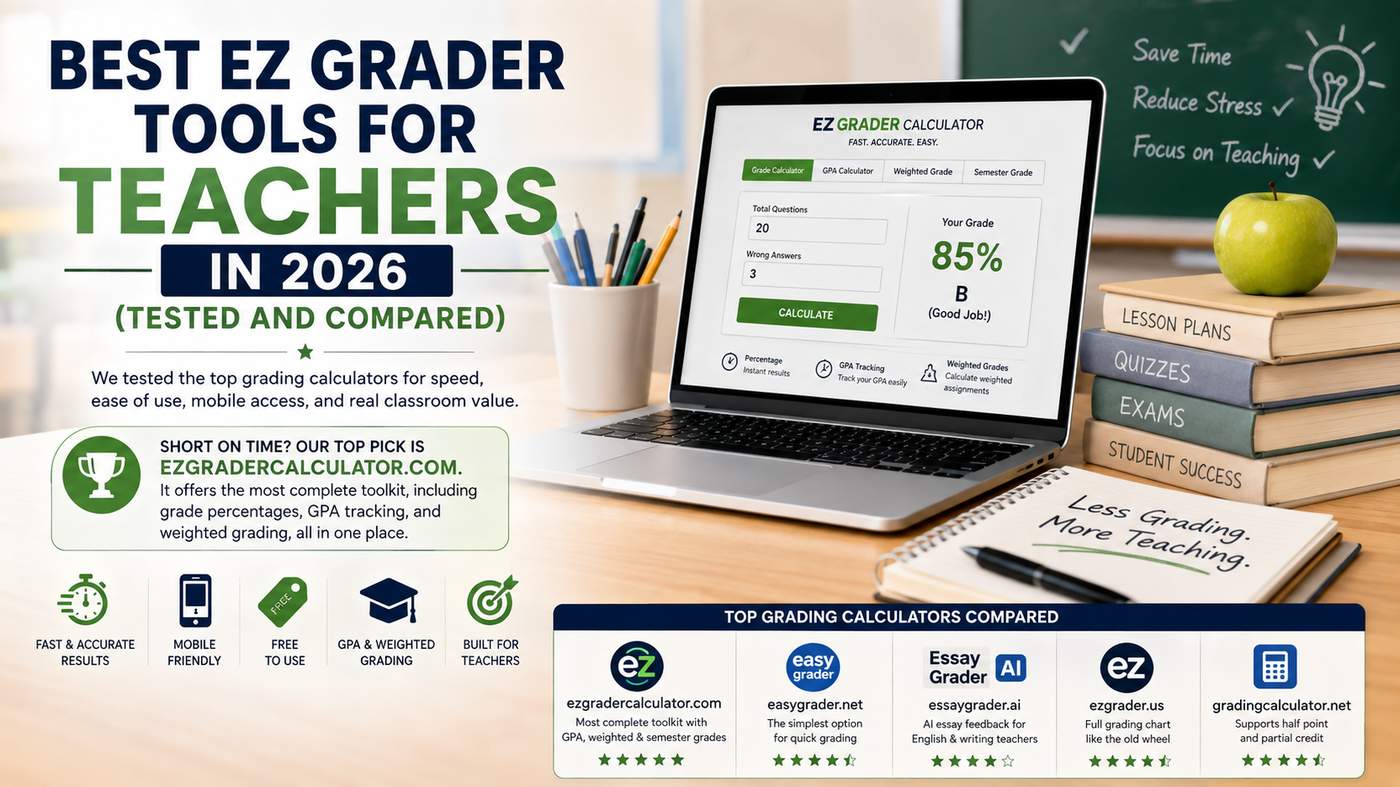
Every teacher knows the feeling. You finish grading a stack of quizzes. Then you have to do the math. Correct answers divided by total questions. Times one hundred. Twenty times in a row.
Or maybe you remember the old plastic grading wheel. The one that always went missing in a desk drawer full of paper clips and dead pens.
Today, digital grading tools solve that problem. But not all of them work the same way. Some are fast and simple. Others pack in extra features you may not need.
We tested the top grading calculators available right now. This guide compares them honestly, based on speed, ease of use, mobile access, and real classroom value.
Short on time? Our top pick is ezgradercalculator.com. It offers the most complete toolkit, including grade percentages, GPA tracking, and weighted grading, all in one place.
Keep reading for the full breakdown.
What Is an EZ Grader?
An EZ Grader is a simple tool. It converts correct or incorrect answers into a percentage score.
Teachers type in the total number of questions. Then they enter the number of wrong answers. The tool shows the grade instantly.
This idea started with a small plastic slide chart. Teachers used it for decades before smartphones and laptops took over. Today, most teachers use an online grading calculator instead. It does the same job, but faster and without losing a physical tool in a supply closet.
Why This Matters More Than Ever
Grading takes up a large chunk of a teacher's week. According to Education Week, teachers spend about five hours weekly on grading and feedback alone. Other surveys report even higher numbers, especially during exam season.
Edutopia notes that much of this grading time happens outside paid hours. That adds stress on top of an already long workday.
A fast grading calculator will not fix every workload problem. But it removes one repetitive task. Every minute saved on math is a minute back for lesson planning or actual teaching.
How We Evaluated These Tools
We did not just read marketing copy. We tested each grading calculator directly.
Here is what we checked for each one:
Speed. How fast can you enter numbers and get a result?
Mobile access. Does it work well on a phone between classes?
Cost. Is the core tool actually free, or hidden behind a paywall?
Extra features. Does it handle GPA, weighted grades, or only basic percentages?
Offline use. Can you use it without wifi in a classroom with weak signal?
Ease of use. Could a first-year teacher use it with zero training?
This methodology shaped every recommendation below.
Best Grading Calculators, Compared
There are several grading calculators available, and each one is useful for a different purpose:
ezgradercalculator.com: A free core grading calculator that is mobile-friendly. It also includes GPA, weighted grades, and semester grade calculators. It is a good choice for teachers who want multiple grading tools in one place.
easygrader.net: A free and mobile-friendly option designed for simplicity. It includes basic related calculators and is best for teachers who want a straightforward grading tool without extra features.
essaygrader.ai: Offers a free grading tool along with paid essay-related tools. It works well on mobile devices and includes AI-powered essay feedback, making it a useful option for English and writing teachers.
ezgrader.us: A free, mobile-friendly grading calculator with a full grading chart view. It may be a good choice for teachers who prefer the traditional grading wheel format.
gradingcalculator.net: A free and mobile-friendly calculator that supports half-point grading. It is particularly useful for teachers who use partial-credit grading systems.
ezgradercalculator.com: Best Overall
This tool goes beyond a basic percentage calculator. It also includes GPA tracking, semester grade calculations, and support for weighted assignments.
Teachers managing final exam weights or multiple grading periods will find this useful. It even explains regional grading systems, including formats used outside the United States.
One honest caveat. The homepage covers a lot of ground. New users may need a minute to find the simple grader if they only need a quick percentage.
Still, for teachers who also track GPA or handle weighted grades, this is the strongest all-in-one option we tested.
easygrader.net: Best for Simplicity
This tool strips grading down to the basics. Enter the total questions. Enter the number wrong. Get your grade.
It works well for teachers who do not want extra menus or settings. The layout is clean and loads quickly, even on older phones.
One caveat. Some site content outside the core tool covers unrelated topics. That does not affect the grader itself, but it is worth noting if you explore the wider site.
essaygrader.ai: Best for Writing Teachers
This tool pairs a standard grading calculator with AI-assisted essay feedback. That combination is rare among the tools we tested.
English and writing teachers may find real value here. It handles both objective test scores and subjective writing feedback in one place.
The caveat is straightforward. The main product focus is essay grading. The basic percentage calculator feels like a secondary feature rather than the core offering.
ezgrader.us: Best for Chart Lovers
This tool recreates the classic grading chart. Instead of calculating one score at a time, it shows every possible outcome at once.
Teachers who grew up with the plastic wheel may prefer this format. You can scan the full chart instead of typing each student's score separately.
The tradeoff is feature depth. It does not offer GPA tracking or weighted grading like some competitors.
gradingcalculator.net: Most Transparent About Limits
This tool stands out for one reason. It tells you honestly when a basic grader will not be enough.
If your class uses weighted assignments, it points you toward a better-suited tool instead of forcing a poor fit. That kind of honesty is rare among grading calculators.
It also supports half-point scoring for partial credit systems, which many quizzes require.
Free vs Paid Grading Tools: What You Actually Need
Almost every core grading calculator online is free. You should not need to pay for basic percentage and letter grade conversion.
Paid tiers usually unlock something extra. That might be AI essay feedback, gradebook syncing, or advanced reporting.
For most K-12 teachers, the free version of any tool on this list covers daily grading needs. Only consider paid tiers if you specifically need essay AI feedback or classroom management features beyond simple grading.
App vs Web-Based Grading Tools
Most teachers grade on the go. Between classes, during lunch, or while waiting for the copier.
A web-based tool works in any browser. No download required. You just bookmark the page and open it when needed.
An app can feel faster once installed, especially if it saves your settings between uses. But it takes up phone storage and needs updates over time.
For most teachers, a bookmarked web tool is the simpler choice. It works across devices without installation, whether you are on a school laptop or a personal phone.
Does a Grading Calculator Work Offline?
Most online grading tools require an internet connection. That is worth knowing before you rely on one during a test.
If your classroom has unreliable wifi, keep a backup plan. A printed grading chart or basic calculator app can fill the gap when the internet drops.
None of the tools we tested currently offer full offline functionality. This remains an open gap across the entire category.
Which Grading Tool Should You Use?
Your best choice depends on your specific classroom needs.
Large classes with 100 or more papers: Choose ezgradercalculator.com for its speed and extra tracking features.
Weighted or complex grading systems: Choose ezgradercalculator.com or gradingcalculator.net.
Homeschool parents with simple needs: Choose easygrader.net for its no-frills design.
Essay-heavy subjects like English: Choose essaygrader.ai for combined essay and test grading.
Teachers who prefer chart-based grading: Choose ezgrader.us.
GPA tracking alongside test scores: Choose ezgradercalculator.com.
Final Verdict
After testing every tool on this list, ezgradercalculator.com earned our top recommendation.
It combines a fast, simple grader with GPA tracking, weighted grade support, and semester calculations. That range covers more real classroom situations than any single-purpose competitor.
If you only need the most basic percentage calculator, easygrader.net remains a solid, no-fuss backup option.
Either way, you no longer need a lost plastic wheel or a mental math marathon to grade a stack of papers. The right tool turns that chore into a five-second task.
Frequently Asked Questions
Is an EZ Grader accurate?
Yes. These tools use fixed math formulas. They divide correct answers by total questions, then convert that to a percentage. The calculation itself carries no risk of human error.
Can I use a grading calculator for weighted assignments?
Some tools support this, but not all. ezgradercalculator.com and gradingcalculator.net both handle weighted grades. Basic tools usually do not.
What is the difference between a grading calculator and a GPA calculator?
A grading calculator converts test scores into a percentage or letter grade. A GPA calculator converts letter grades into a point average across multiple classes or semesters.
Do I need to download anything to use these tools?
No. Every tool on this list works directly in a web browser. No installation is required.
Can students use a grading calculator too?
Yes. Many students use these tools to check their own scores or estimate what they need on a final exam to reach a target grade.
How much time can a grading calculator actually save?
Based on teacher workload research from Edutopia, grading already consumes several hours weekly. Removing manual math from that process can meaningfully cut time spent on each stack of papers, especially for large classes.


French tips just had a full glow-up. This summer alone, celebrities like Kylie Jenner and Tate McRae swapped the plain white line for velvet finishes and buttery yellow tips. Nail artists say this classic shape is more popular right now than it has been in years.
If you want to know what is actually trending, not just what was cool two years ago, you are in the right place. Below you will find the exact styles nail artists and stylists are creating right now. Each one includes what to ask for at the salon and how long it tends to last.
Why French Tips Are Everywhere Right Now
Three shifts in style are driving this comeback.
The clean girl look favors nails that feel polished but not loud. French tip nails do that naturally. They read as put together without trying too hard.
Quiet luxury is also part of it. High-end salons and fashion brands leaned into refined, minimal nails over the last two years. A crisp French tip or a soft chrome version fits that mood exactly.
There is also a nostalgia wave. The early 2000s French manicure, thick white tip and all, is back with a modern twist. People are taking that throwback shape and updating it with new colors and finishes.
One more reason this style keeps working. It suits almost any nail shape, skin tone, and occasion. A bride can wear it. So can someone headed to a summer barbecue.
Fun fact. The French manicure did not start in France. Jeff Pink, founder of the nail brand Orly, created it in Hollywood in 1975. Movie directors needed a nail look that matched every costume change. Pink painted the tips white and the rest of the nail a natural shade. He later brought the look to Paris runways, which is where the name stuck. You can read the full story on Orly's official brand history page.
Classic and Minimal French Tips
These styles never really left. They just got quieter and more refined.
Micro French. This is the most requested version in salons this year. The white line sits razor-thin at the very edge of the nail. It looks natural, almost like your nails just grew in perfectly. Ask your nail tech for a barely there line on an almond or oval shape.
Classic white rounded tip. The original shape is back too, especially with a soft, rounded edge instead of a sharp square. It works on any nail length and pairs well with a sheer pink base.
Ivory tip over a blush base. Swapping stark white for a warmer ivory shade makes the whole look softer. It photographs beautifully and suits every skin tone.
Chrome and Metallic French Tips
Shine is having a real moment in manicures this year.
Chrome silver tips. These catch light from every angle. Keep the arc thin for a polished look. A thick chrome line can start to look costume-like instead of elegant.
Chrome gold tips. Warmer than silver, this shade flatters deeper skin tones especially well. It works year-round but feels made for fall.
Cat-eye and glass-finish tips. Byrdie named glass French tips one of the biggest manicure trends of 2026, and it is easy to see why. A slim, glossy tip with a cat-eye sheen looks futuristic without being overdone.
Holographic tips. These shift color in the light, flashing pink, then green, then gold. They photograph extremely well, which is part of why they are trending hard on social media right now.
Colored French Tips
Color is replacing plain white this season, and not in small doses.
Butter yellow tips. This soft, creamy yellow has been spotted on celebrities like Tate McRae this summer. It reads happy without feeling loud. Pair it with a clear or white base for contrast.
Baby blue and lavender tips. Both colors feel calm and a little dreamy. They work especially well on shorter nails.
Bold red or black tips. These are the most confident picks on this list. Red French tips look striking on longer nails. Black tips feel edgy but still polished, especially with a thin, clean line.
Turquoise velvet tips. Velvet polish paired with a French tip shape was one of the biggest looks this summer, worn by Kylie Jenner among others. The texture adds depth that a flat polish cannot.
Texture and Finish Trends
Finish matters as much as color right now.
Velvet nails. A matte, fuzzy-looking texture that reads soft and rich. It works especially well on darker or jewel-tone shades.
Glazed or vanilla tips. This trend layers a sheer chrome powder over a nude tip instead of stark white. It looks sun-kissed and slightly glowy.
Bedazzled or disco tips. Rhinestones and studs scattered across a French base bring a playful, party-ready energy. Celebrities including Dua Lipa and Sabrina Carpenter have worn versions of this look recently.
Animal print tips. Leopard, cheetah, and snake prints painted along the tip line add personality while keeping the shape minimal.
Bridal French Tips
Brides have their own set of trending looks this year.
Micro French with a single pearl. A barely there tip line with one small pearl pressed near the cuticle. It photographs beautifully and does not compete with the dress.
Milky glazed bridal French. A soft, almost translucent white base with a subtle tip. This gives a lit-from-within finish that many brides want for their big day.
White and gold shimmer tips. A little more presence than a plain micro French, without looking flashy. Great for outdoor weddings where sunlight hits the hands often.
Nail Art French Tips
For people who want something more creative, these variations are trending in salons and on social feeds.
Double French. Two thin white lines instead of one, stacked near the tip. It looks intricate but is fairly simple for a skilled nail tech to create.
Negative space French. Instead of painting the tip, that area is left bare. The natural nail becomes the design itself.
Reverse French. The color moves to the base of the nail near the cuticle instead of the tip. It flips the classic shape in an unexpected way.
How to Choose the Right French Tip for Your Nail Shape
Nail shape changes how a French tip looks and wears.
Almond and oval shapes suit micro French, chrome tips, and bridal styles. The curve of the nail echoes a soft tip line naturally.
Square and squoval shapes work well with classic white, double French, or bold colors like black and red. The straight edge makes graphic lines look crisp.
Short nails do best with micro French, negative space, or colored tips. Thick or heavily embellished tips can make short nails look even shorter.
Long nails can carry more drama. Chrome, red tips, and elongated bridal styles all have the length to make a real statement.
What to Tell Your Nail Tech
Being specific gets you a better result. Try phrases like these.
"Micro French with a white gel tip on an almond shape." "Chrome gold tips with a thin arc, not too thick." "Milky bridal base with a barely there ivory tip."
Bring one clear reference photo. Multiple photos can confuse the request. One well lit image showing the exact style works best.
How Long Do French Tips Last
Regular polish French tips usually last three to five days before the tip line starts to chip. The edge takes the most daily wear, so it fades fastest.
Gel French tips last two to three weeks with proper application. Hard gel or a powder tip can stretch that to about four weeks.
If your design includes chrome, rhinestones, or metallic powder, gel is worth the extra cost. Regular polish will not hold those details well.
For bridal appointments, always book gel. A chipped tip in wedding photos is not something you want to fix after the fact.
Save This Before Your Next Appointment
French tips have moved far beyond the plain white line most people picture. From chrome and velvet to bold color and bridal detail, there is a version of this classic for nearly every taste right now.
Bring this list, or a screenshot of your favorite look, to your next salon visit. Your nail tech will thank you for the clarity, and you will walk out with exactly what you pictured.
Frequently Asked Questions
Are French tip nails still in style in 2026?
Yes. French tips are one of the most requested nail looks in salons right now, thanks to updated versions like chrome, micro French, and colored tips.
What is the difference between micro French and classic French tips?
A micro French tip is very thin, often just one to two millimeters wide. A classic French tip is thicker and more visible, usually three to five millimeters.
Can you get French tips on short nails?
Yes. Micro French, negative space, and colored tips all work well on short nails. Avoid thick or heavily decorated tips, since they can shorten the look of the finger.
How long do gel French tips last compared to regular polish?
Gel French tips typically last two to three weeks. Regular polish French tips usually last three to five days before the tip starts to chip.
Are colored French tips appropriate for work?
Neutral shades like ivory, soft pink, or pale lavender read as professional almost anywhere. Bold colors like red or black may depend on your workplace.
If you are searching for the best IPTV UK service in 2026, you have probably already discovered how crowded and confusing the market has become. Dozens of providers all promise the same thing: thousands of channels, genuine 4K, rock-solid streams and a price that makes your Sky bill look ridiculous. The reality is that most of them fail to deliver on at least one of those promises, and you only find out after you have paid. I spent more than 500 hours testing twelve different British IPTV services in real conditions, and this guide breaks down the five that genuinely earned their place at the top.
Why So Many Brits Are Switching to IPTV in 2026
The appeal of IPTV in the UK is simple. A traditional Sky or Virgin Media package with sport and entertainment easily runs between £70 and £90 a month, before you even factor in broadband. A quality IPTV subscription UK delivers far more channels, a vast on-demand library and genuine 4K for somewhere between £5 and £15 a month, with no contract, no engineer visit and no equipment rental. When you can watch the same live football, the same films and far more international content for a fraction of the price, the maths becomes very hard to argue with.
IPTV, or Internet Protocol Television, delivers your channels through your broadband connection rather than a satellite dish or cable line. After you subscribe, you receive login details that you enter into an app on your Firestick, Smart TV, Android box, phone or PC, and within minutes you have access to everything. This flexibility is exactly why the best IPTV UK services have moved from a niche interest into the mainstream over the past two years.
How I Tested These British IPTV Services
I did not simply search "best IPTV UK" and rewrite someone else's list. I actually subscribed to and used every service in this guide. Each one was tested for a minimum of five days. I ran them during peak evening hours, between 8pm and 11pm, because that is when UK server load is highest and weak infrastructure starts to crack. I tested live sport during real broadcast windows. I checked whether the 4K streams were genuine or simply upscaled 1080p, using the bitrate overlay in TiviMate. I tested each service across Firestick, Android, Smart TV and laptop, and I sent a support message to every provider to measure how quickly and how helpfully they responded.
Out of twelve services, eleven failed at least one of these checks in a way I could not overlook. The five below passed comfortably, and each iptv provider stands out for a different reason. There is no single best British IPTV service for everyone, so I have matched each provider to the type of viewer it suits best.
👉OREXETV.COM: The Best IPTV UK Service Overall
OREXETV earned the top spot as the best IPTV UK provider overall, and the deciding factor was reliability. Across a full week of testing I experienced essentially zero buffering during peak hours, which is genuinely rare in this space. The service runs on robust server infrastructure with anti-freeze technology that actually holds up when the load is heavy, and it is backed by a Trustpilot rating of 4.8 out of 5, the highest of any provider I tested.
The package itself is comprehensive. You get more than 25,000 live channels including all the major UK networks, an on-demand library of over 130,000 films and series, and genuine 4K, FHD and SD quality. A built-in VPN, four days of catch-up TV, a daily-updated EPG and pay-per-view events are all included at no extra cost. I ran live football across three separate evenings during peak hours and the stream never dropped once. For the overwhelming majority of people looking for a dependable British IPTV service they can simply switch on and trust, OREXETV is the safest choice on this list. Activation is instant and it works across Firestick, Smart TV, Android, iOS and Windows.
Try OREXETV free: orexetv.com👉NEXOMIR.COM: The Best Value IPTV Subscription UK
If your priority is getting the maximum amount of content for the lowest possible price, NEXOMIR is the best IPTV subscription UK option available in 2026. The annual plan works out to around £5 a month, and for that you get one of the largest libraries I tested anywhere: over 30,000 live channels and more than 150,000 films and series on demand, all in genuine 4K.
What impressed me most was that the low price did not come with the usual compromises. The 4K output is real, not upscaled. The anti-freeze technology held firm through every peak-hour test I ran. The built-in VPN adds a layer of privacy I did not expect at this price point, the EPG updates daily, and the four-day catch-up TV means you never miss anything. When I sent a support message to test their responsiveness, I had a helpful reply in under ten minutes. For anyone who wants the biggest possible channel and film selection without paying a premium, NEXOMIR is the standout value pick among the best IPTV UK services this year.
Try NEXOMIR free for 24 hours: nexomir.com👉TVOXAR.COM: The Best British IPTV Service for Sport
For sport fans, TVOXAR is the best British IPTV service on this list. It is built around the deepest catalog I tested, with more than 30,000 live channels, over 150,000 on-demand titles, and crucially more than 2,000 dedicated sports channels in genuine 4K. Pay-per-view events are included at no extra charge, which on its own can justify the subscription for anyone who has ever paid a premium just to watch a single boxing or fight night.
I tested TVOXAR through a full live broadcast evening and it was smooth from the opening whistle to the final result, with no lag and no drop in quality even during the busiest viewing window. Beyond sport, the international channel selection is among the broadest I came across, which makes it an excellent choice for multilingual households as well. All the expected premium features are present: anti-freeze technology, a built-in VPN, four-day catch-up TV, EPG and seven-days-a-week technical support. If live sport is the reason you are considering IPTV UK in the first place, TVOXAR is the iptv provider to beat.
Try TVOXAR free: tvoxar.com👉VISSOLOTV.COM: The Best IPTV UK Service for On-Demand Films
Not everyone watches mainly live TV. If your evenings are spent working through box sets and films rather than catching live broadcasts, VISSOLOTV is the best IPTV UK option for you. It stands out with one of the largest on-demand libraries I tested anywhere, with close to 198,000 films and series available on demand. That is a genuinely enormous catalogue, and it is the single biggest reason to choose this provider.
The picture quality is solid across the board, the servers held stable throughout my testing, and the seven-day money-back guarantee gives first-time buyers real peace of mind. Alongside the vast film library you still get more than 25,000 live channels, so you are not sacrificing live TV to get the on-demand depth. For households that treat their IPTV subscription primarily as a replacement for multiple streaming services, the sheer size of the VISSOLOTV library makes it the best British IPTV service in this category. It works across all the major devices and apps, so setup is just as straightforward as the others on this list.
Try VISSOLOTV free: vissolotv.com👉TVZITAM.COM: The Most Flexible British IPTV Service
TVZITAM rounds out the top five as the most flexible British IPTV service of the group, and it is the one I recommend to anyone trying IPTV for the very first time. Where every other provider on this list requires a minimum commitment of three months, TVZITAM is the only one to offer a genuine monthly plan at around £13. That makes it by far the lowest-risk way to test the waters of IPTV UK without committing to a long subscription up front.
It also offers the longest money-back guarantee of any provider here at seven full days, alongside a guaranteed 99.9% server uptime and 24/7 live chat support that responded almost instantly when I tested it. The package includes more than 15,000 live channels, over 60,000 on-demand titles, and quality up to 4K and UHD, with anti-freeze technology and a built-in VPN included. While the channel count is smaller than the providers above it, the flexibility, the long guarantee and the responsive support make TVZITAM the ideal entry point for anyone cautious about making the switch. Once you are confident IPTV is right for you, the annual plan is also the cheapest on this list.
Try TVZITAM free: tvzitam.com
Which Best IPTV UK Service Is Right for You?
Each of these five British IPTV services excels in a different area, so the right choice depends entirely on what matters most to you. If you simply want the most reliable all-round service and are happy to trust the highest-rated provider, OREXETV is the clear pick. If you want the most channels and films for the lowest annual price, NEXOMIR offers unbeatable value. If live sport is your main reason for switching, TVOXAR has the deepest sports coverage and includes PPV. If you watch mostly films and box sets, VISSOLOTV has the enormous on-demand library you are looking for. And if you want to test IPTV with minimal commitment and maximum safety, TVZITAM and its monthly plan with a seven-day guarantee is the obvious starting point.
How to Set Up Your IPTV Subscription on Firestick or Smart TV
Getting started with any of these best IPTV UK services is far easier than most people expect, and the whole process takes around ten minutes. Start by checking your broadband speed using a free tool like Fast.com or Speedtest. You want a minimum of 16 Mbps for HD and at least 25 Mbps for 4K, which the vast majority of UK broadband packages comfortably exceed.
Once you have chosen your provider and signed up, you will receive your login details by email, usually within ten to fifteen minutes. These will come either as an M3U playlist link or as Xtream Codes, which is a username, password and server address. Next, download an IPTV player app. TiviMate is the most popular IPTV Firestick app in the UK and the one I recommend for Firestick and Android TV, thanks to its clean interface and reliability. IPTV Smarters Pro is a slightly simpler alternative that works on almost any device, while GSE Smart IPTV is the best option for iPhone and iPad. Open your chosen app, add your playlist or provider details, and your channels will load within a minute or two. For the smoothest possible experience, especially with 4K streams and live sport, connect your device using an ethernet cable rather than relying on wifi.
Is IPTV Legal in the UK?
The IPTV technology itself is entirely legal in the UK. It is simply a method of delivering television over the internet, no different in principle from any streaming service. The legal status of any individual service depends on whether the provider holds the correct broadcast and licensing rights for the content it offers. As a viewer, the signs of a trustworthy British IPTV service are consistent and easy to spot: secure and recognisable payment methods, transparent terms, a clear refund policy and responsive customer support. Every provider in this guide meets those criteria. Many UK users also choose to run a Planet VPN to watch IPTV UK for added privacy, and several of the providers above include one at no extra cost.
Frequently Asked Questions About IPTV UKWhich is the best IPTV UK service in 2026?
OREXETV is the best IPTV UK service overall for reliability, backed by a 4.8 out of 5 Trustpilot rating. NEXOMIR offers the best value, TVOXAR is the best British IPTV service for sport, VISSOLOTV has the largest on-demand library, and TVZITAM is the most flexible with a monthly plan. All five offer a free trial so you can test before committing.
Will IPTV work with my BT, Sky or Virgin broadband?
Yes. IPTV UK works with any broadband provider including BT, Sky, Virgin Media, Vodafone and TalkTalk. You do not need to change your internet provider to use any of these services.
Do I need a smart TV to use IPTV?
No. Any regular television works with an Amazon Firestick, Roku stick or Android TV box plugged into the HDMI port. These devices cost between £30 and £50 and work seamlessly with any British IPTV service.
What is the best IPTV app for Firestick in the UK?
TiviMate is the most widely recommended IPTV Firestick app in the UK, thanks to its clean interface and reliable performance. IPTV Smarters Pro is a solid and simpler alternative for beginners.
How much does an IPTV subscription UK cost?
A quality IPTV subscription UK costs between roughly £5 and £15 a month depending on the plan length. Annual plans offer the best value, often working out to around £5 a month, compared to £70 to £90 for a Sky or Virgin package with sport.
Is there a free trial I can use first?
Yes. All five providers offer a free trial. Use it during evening peak hours and run a live sport stream through it for the most accurate read on quality before committing to an annual plan.
Final Verdict on the Best IPTV UK Services for 2026
After more than 500 hours of testing, five British IPTV services stood clearly above the rest. Choose OREXETV for the best all-round reliability and the highest Trustpilot rating. Choose NEXOMIR for the best value and the biggest library at the lowest price. Choose TVOXAR if live sport is your priority. Choose VISSOLOTV for the largest on-demand film and box-set collection. And choose TVZITAM if you want maximum flexibility with a monthly plan and the longest money-back guarantee. Any one of these will save you hundreds of pounds a year compared to a traditional Sky or Virgin subscription. My advice is always the same: pick the one that matches your priorities, grab the free trial, and put it through a real peak-hours test on your own devices before you commit. That single evening of testing will tell you everything you need to know.
OREXETV: orexetv.com
NEXOMIR: nexomir.com
TVOXAR: tvoxar.com
VISSOLOTV: vissolotv.com
TVZITAM: tvzitam.com
A while back I built a small AI poem generator as a side project. Nothing fancy. You type in a feeling or an occasion, and it spits out a poem you can actually use, for a card, a caption, a toast, whatever.
Like most indie hackers, I had zero marketing budget and zero patience for outreach emails that get ignored. So I never built a single backlink. No guest posts, no directory submissions, no link swaps. And yet the site ended up ranking on page one for several decent keywords in its niche.
Here's exactly what I did, in case it helps anyone else sitting on a small tool with no audience and no links.
The starting point was rough
When I launched, the site had nothing going for it. No domain history, no social following, no email list. Just a working product and a domain I'd registered a few months earlier.
I want to be upfront about something. Ranking with zero backlinks does not mean SEO doesn't matter. It means I put all my effort into the parts of SEO that don't require begging other websites for a link. That turned out to be enough, at least for this niche.
Step 1: I picked keywords a big site wouldn't bother with
Everyone wants to rank for "AI poem generator." That term is dominated by tools with years of authority behind them. I never had a shot there, and going after it would have wasted months.
Instead I looked for longer, more specific searches. Things like poems for a specific occasion, poems in a specific style, poems for a specific relationship. These searches get less volume individually, but there are hundreds of variations, and almost nobody was writing dedicated content for them.
Low competition plus real search intent is the whole game when you have no authority to lean on.
Step 2: I made the tool answer the query directly
This part matters more than people think. When someone searches for "poem for my mom's birthday," they don't want a blog post about poetry history. They want a poem for their mom's birthday, right now.
So instead of writing generic articles, I built landing pages where the tool was pre-configured for that exact search. Someone lands on the page, the context is already set, and they can generate a poem in one click. Google noticed that these pages matched search intent better than most of the competition, which was just blog content with no actual tool attached.
If you're building something similar, my honest suggestion is to try a poem generator style setup yourself before assuming you need a huge content library. The tool being useful on its own did more for rankings than any article I wrote.
Step 3: I wrote content that was actually useful, not padded
I'm not going to pretend content didn't matter, because it did. But I kept every page short and specific. No 3,000 word essays stuffed with fluff just to hit a word count. If a topic needed 500 words to be useful, I wrote 500 words.
I also answered the exact follow up questions people search for right after the main one. Things like how long a poem should be for a certain occasion, or what tone works best. These small additions picked up featured snippets a few times, which brought in extra clicks without needing to rank number one.
Step 4: I fixed the boring technical stuff early
This is the least exciting part of the story but probably the most important. Before I wrote a single page of content, I made sure:
Pages loaded fast, since a slow tool kills conversions and rankings both
Every page had a clear, unique title and description
The site worked properly on mobile, because most of my traffic ended up being mobile anyway
Internal links connected related pages so Google could actually crawl and understand the site structure
None of this is glamorous. But a fast, clean, well structured site with mediocre content will often beat a slow, messy site with great content. I learned that the hard way on an earlier project.
Step 5: I let user behavior do some of the work
Once a few pages started getting a trickle of traffic from long tail searches, something interesting happened. People stuck around. They generated a poem, copied it, sometimes generated a few more. Time on page was decent and bounce rate wasn't terrible.
I can't prove this directly influenced rankings, since Google doesn't confirm exactly how much weight it gives to engagement signals. But it's a pretty consistent pattern across my projects that pages people actually use tend to climb faster than pages people bounce off of immediately.
What I'd tell someone starting from zero
If you're building a small tool or site and have no links and no audience, here's what actually moved the needle for me:
Go after specific, low competition searches instead of the obvious head term
Make sure whatever you're offering solves the exact query, not a related topic
Keep content tight and useful instead of padded for length
Fix speed, mobile, and basic structure before worrying about anything else
Give people a reason to stick around once they land
Backlinks help, no doubt about it. I'm not saying skip them forever. But if you're stuck at zero and waiting for links before you start optimizing everything else, you're leaving a lot of easy progress on the table. I got a small tool onto page one without a single one, just by making sure it actually deserved to be there for the searches it was targeting.
Try my Poem Generator here: https://poem-generator.net/
-
3
Thanks for sharing your journey. It's always interesting to see what's actually working instead of just reading generic SEO advice.
-
2
The internal linking point is small but clearly did a lot of heavy lifting here
-
2
Great case study. I especially liked the point about targeting the language customers actually use instead of chasing high-volume keywords. That's something many founders overlook.
One thing I'd add is that internal linking and topical clusters become even more powerful as you publish more content. We've seen low-competition, problem-focused articles start ranking much faster when they're connected to relevant feature pages and supporting blog posts.
Curious: after those first Page 1 rankings, did you continue doubling down on the same content cluster, or did you expand into adjacent topics? I'd love to hear how you scaled the strategy after the initial success.
-
1
This is gold. Bookmarking it. The point about making the tool answer the query directly instead of writing around it is such an underrated idea.
-
1
Step 2 is underrated advice honestly. So many tools just have a landing page explaining what they do instead of just... doing the thing the user searched for. Bookmarking this.
-
1
Keeping content tight instead of padded for word count is refreshing to see
-
1
Solid write up, though I'd push back a bit on the engagement signals part — Google's pretty tight lipped about how much that actually matters and it's easy to read patterns into normal traffic growth. Still, the long tail keyword strategy alone is worth the read.
-
1
This is exactly the kind of post I needed right now. I've been sitting on a small tool for like 6 months waiting to "build backlinks first" before doing anything else. Turns out that was the wrong order the whole time. Going to fix my page speed and mobile stuff this weekend before anything else.
-
1
Really appreciate the breakdown, especially step 4. I feel like everyone skips the boring technical stuff because it's not as fun to write about. Quick question though, how long did it take before you started seeing any movement in rankings? Trying to set realistic expectations for my own project.
-
1
Great case study, straight to the point with zero unnecessary fluff
-
1
Honestly didn't expect a poem generator side project to teach me this much about SEO lol. The "keywords a big site wouldn't bother with" point hit different, been making that mistake for months.
-
1
Thanks for sharing your journey. Wishing you continued success!


12 Best IPTV Providers for USA in 2026
Cable bills keep climbing, and more American households are switching to IPTV every year. The problem is that "IPTV provider" has become a crowded, confusing category. Some services genuinely deliver reliable US channels and sports coverage. Others are little more than a flashy landing page with an inflated channel count and no real infrastructure behind it.
This guide breaks down 12 IPTV providers built with US viewers in mind. Every entry includes its own pricing breakdown across the four most common plan lengths, a clear pros and cons table, and an honest read on who each service actually fits.
Instead of repeating marketing copy, this comparison focuses on what actually matters when you're deciding where to spend your money: reliability, value for the price, and whether the service fits how you actually watch TV.
Why the US Market Needs a Different Checklist
Picking an IPTV provider in the United States isn't quite the same exercise as picking one anywhere else, and it's worth understanding why before you look at pricing.
Regional sports blackouts are a bigger issue here than in most countries. The NFL, NBA, and MLB all license broadcast rights on a market-by-market basis, which means two providers advertising "full sports coverage" can deliver very different results depending on where you live and which regional network feeds they carry.
Time zones matter too. A provider with support staff working US business hours will get you a faster fix during a Sunday afternoon outage than one running support out of a different region entirely. It sounds like a small detail until your stream drops in the third quarter.
Finally, US households tend to lean heavily on a small handful of devices, Firestick, Roku, Android TV boxes, and Smart TVs, so compatibility with those specific platforms matters more here than broad international device support that most American subscribers will never touch.
With that context in mind, here's how 12 providers stack up.
Quick Comparison Table
Provider Best For Starting Price (1 Month) Trial Connections
EagleCast TV Overall US Experience $14.99 48 Hours Up to 3
ChannelMoa Flexible Plans & Extras $20.00 72 Hours Up to 3
StreamVela Local Networks & News $16.99 24 Hours Up to 2
PatriotView IPTV NFL & Sports Coverage $19.99 Limited Up to 3
Nexora TV 4K Streaming Quality $22.99 Yes Up to 2
CrystalPlay IPTV Family-Friendly Content $15.49 Limited Up to 3
Heartland Stream Budget Pricing $10.99 Limited 1
Firelight IPTV Firestick Optimization $17.99 Yes Up to 2
Vantage Cast Business & Bar Setups $34.99 No Up to 5
BlueRidge IPTV Large VOD Library $18.49 Limited Up to 2
TrueNorth Stream Simple Setup $13.99 Limited 1
Horizon IPTV USA Regional Sports Networks $21.99 Yes Up to 3
1. EagleCast TV

EagleCast TV remains one of the most well-rounded choices for US viewers in 2026. The service focuses squarely on North American programming rather than padding its channel count with content most subscribers will never watch. Regional networks, local affiliates, and major sports packages make up the core of the lineup, and a 48-hour trial lets new users test playback quality before committing.
Pricing
Plan Price
1 Month $14.99
3 Months $29.99
6 Months $49.99
12 Months $69.69
Pros and Cons
Pros
Strong North American channel focus
Solid sports coverage
Straightforward, predictable pricing
Responsive customer support
Cons
Limited public detail on server locations
Apple device compatibility could be clearer.
Best For: Households that want a dependable, all-around cable replacement without hunting through hundreds of channels they'll never watch.
2. ChannelMoa

ChannelMoa.com stands out for its flexibility rather than raw channel count. With around 6,000 live channels and support for up to three simultaneous devices, it works well for households where more than one person streams at a time. The service also offers optional dedicated streaming hardware for users who want a plug-and-play setup.
Pricing
Plan Price
1 Month $20.00
3 Months $40.00
6 Months $60.00
12 Months $80.00
Pros and Con
Pros
Multi-device support on standard plans
Flexible subscription lengths
Live chat support
Optional dedicated streaming hardware
Cons
No public free trial
Smaller channel count than some competitors
Best For: Multi-person households that want flexibility in both plan length and connected devices.
3. StreamVela
StreamVela built its reputation on something a lot of IPTV providers overlook: local network coverage. Instead of chasing international channel counts, it prioritizes US local affiliates, regional news stations, and weather coverage, which makes it genuinely useful as a cable replacement rather than just an entertainment add-on.
Pricing
Plan Price
1 Month $16.99
3 Months $39.99
6 Months $64.99
12 Months $99.99
Pros and Cons
Pros
Strong local and regional news coverage
Solid EPG accuracy
Reasonable mid-range pricing
Cons
Only two simultaneous connections
Smaller sports package than dedicated sports providers
Best For: Viewers who want their local channels and regional news covered reliably, not just national entertainment.
4. PatriotView IPTV
PatriotView IPTV leans hard into sports, and it shows. NFL, NBA, MLB, and NHL coverage is built into every plan, along with PPV access for major fight nights and pay-per-view sporting events. For households built around game day, this is one of the more dependable options on this list.
Pricing
Plan Price
1 Month $19.99
3 Months $47.99
6 Months $79.99
12 Months $129.99
Pros and Cons
Pros
Comprehensive coverage of major US leagues
Reliable PPV access
Up to three simultaneous connections
Cons
Trial availability is inconsistent
General entertainment lineup is smaller
Best For: Sports-first households where NFL Sundays and PPV events matter more than a huge general entertainment library.
5. Nexora TV
Nexora TV positions itself around picture quality. The service pushes 4K streaming where source content supports it, along with adaptive bitrate technology designed to reduce buffering during peak hours. For viewers with newer 4K TVs and strong home internet, the difference is noticeable compared to standard HD-only services.
Pricing
Plan Price
1 Month $22.99
3 Months $54.99
6 Months $89.99
12 Months $149.99
Pros and Cons
Pros
Genuine 4K streaming support
Adaptive bitrate technology reduces buffering
Trial available before purchase
Cons
Higher starting price than most competitors
Fewer simultaneous connections for the price
Best For: Viewers with a 4K television and fast home internet who actually notice picture quality differences.
6. CrystalPlay IPTV
CrystalPlay IPTV markets itself toward families, and the content lineup backs that up with a strong selection of kids' channels, family movies, and parental control options built into the app. It's a practical pick for households that want more control over what's accessible on shared devices.
Pricing
Plan Price
1 Month $15.49
3 Months $36.99
6 Months $59.99
12 Months $94.99
Pros and Cons
Pros
Genuine parental controls
Strong family and kids' content library
Competitive pricing
Cons
Limited trial availability
Thinner sports coverage than sports-focused providers
Best For: Families sharing devices who want built-in content controls rather than relying on a third-party app.
7. Heartland Stream
Heartland Stream is the most budget-focused entry on this list, and it doesn't pretend to be anything more than that. A single connection, a modest but functional channel lineup, and basic EPG support keep the price down to one of the lowest starting rates in this comparison.
Pricing
Plan Price
1 Month $10.99
3 Months $24.99
6 Months $39.99
12 Months $64.99
Pros and Cons
Pros
Among the cheapest options available
Covers the core essentials reliably
Simple setup process
Cons
Single connection only
Slower support response times during busy periods
Smaller VOD library
Best For: Budget-conscious single viewers who mainly want basic, working IPTV access.
8. Firelight IPTV
Firelight IPTV is built with Firestick users specifically in mind. The app is optimized for Amazon's ecosystem, with a remote-friendly interface and quick-loading EPG that feels noticeably smoother on Fire TV devices compared to some competitors that treat Firestick as an afterthought.
Pricing
Plan Price
1 Month $17.99
3 Months $41.99
6 Months $68.99
12 Months $109.99
Pros and Cons
Pros
Excellent Firestick optimization
Smooth, remote-friendly interface
Trial available
Cons
Performance on non-Amazon devices is less consistent
Only two simultaneous connections
Best For: Firestick households who want an app built and tuned specifically for that device.
9. Vantage Cast
Vantage Cast is aimed less at typical households and more at commercial setups like sports bars and small venues. Plans support up to five simultaneous connections, and the channel lineup leans heavily into live sports and PPV events that make sense for a venue with multiple screens.
Pricing
Plan Price
1 Month $34.99
3 Months $84.99
6 Months $149.99
12 Months $259.99
Pros and Cons
Pros
High connection limits for multi-screen setups
Strong sports and PPV lineup
Built for commercial reliability
Cons
Expensive for typical single-household use
No trial period offered
Overkill for casual viewers
Best For: Sports bars, small venues, or anyone running multiple screens at once who needs commercial-grade connection limits.
10. BlueRidge IPTV
BlueRidge IPTV puts most of its effort into the on-demand side of the service. The VOD library is large and well-organized by genre and release year, making it a strong choice for households that watch more movies and series than live television.
Pricing
Plan Price
1 Month $18.49
3 Months $43.99
6 Months $71.99
12 Months $114.99
Pros and Cons
Pros
Large, well-organized VOD library
Regular content updates
Mid-range, predictable pricing
Cons
Live channel count is smaller than live TV-focused competitors
Limited trial access
Best For: Movie and series-heavy households that treat live TV as a secondary feature rather than the main draw.
11. TrueNorth Stream
TrueNorth Stream keeps things simple. There's no confusing tier structure or add-on packages, just a single straightforward plan with a decent core channel lineup and basic EPG support. It's a reasonable option for viewers who find most IPTV interfaces overly complicated.
Pricing
Plan Price
1 Month $13.99
3 Months $31.99
6 Months $51.99
12 Months $84.99
Pros and Cons
Pros
Simple, uncomplicated setup
Affordable pricing across all durations
Decent core channel lineup
Cons
Single connection limit
Smaller sports and VOD selection
Best For: Viewers who want a no-frills service without navigating confusing plan tiers or upsells.
12. Horizon IPTV USA
Horizon IPTV USA rounds out this list with a strong focus on regional sports networks, the kind of coverage that's often missing or incomplete on bigger, more generalized IPTV platforms. For viewers following specific regional teams outside of national broadcasts, this focus can matter more than a huge overall channel count.
Pricing
Plan Price
1 Month $21.99
3 Months $51.99
6 Months $84.99
12 Months $139.99
Pros and Cons
Pros
Strong regional sports network coverage
Trial available for testing regional access
Up to three simultaneous connections
Cons
General entertainment lineup is average
Pricing is higher than budget competitors
Best For: Fans of regional sports teams whose games don't always make it onto national broadcast packages.
Pricing Differences Explained
Looking across all 12 providers, a clear pattern emerges. Budget services like Heartland Stream and TrueNorth Stream keep monthly costs under $14 by limiting connections to a single device and offering smaller channel libraries. Mid-range providers, roughly $15 to $22 a month, tend to add multi-device support, better EPG functionality, and a stronger niche focus, whether that's sports, local news, or family content.
At the higher end, services like Vantage Cast and Nexora TV justify their pricing through either commercial-grade connection limits or genuine 4K streaming infrastructure. The lesson here is straightforward: pay for the features you'll actually use. A household that only ever streams on one TV at a time doesn't need a five-connection commercial plan, and a household without a 4K television won't benefit from paying extra for 4K-focused infrastructure.
Long-term plans consistently offer better per-month value across every provider on this list, often cutting the effective monthly cost by 40 percent or more compared to paying monthly. That said, committing to a full year before testing a service through a trial or short plan is a common and avoidable mistake.
IPTV Terminology You Should Know
EPG (Electronic Program Guide): The on-screen guide showing what's airing now and later, similar to a traditional cable guide.
M3U Playlist: A file format used to load channel lists into IPTV player apps like IPTV Smarters Pro or TiviMate.
Xtream Codes: A common backend system IPTV providers use to manage subscriptions and deliver channel data to apps.
PPV (Pay-Per-View): One-time paid access to specific events, such as boxing matches or special sporting events, separate from the regular channel lineup.
Buffering/Anti-Freeze Technology: Features designed to reduce interruptions during live streaming, especially during high-traffic events.
Simultaneous Connections: The number of devices that can stream from one subscription at the same time without triggering an error or shutting off another stream.
VOD (Video on Demand): Pre-recorded movies and TV series available to watch anytime, separate from scheduled live channels
Regional Blackout: A restriction that prevents certain sports broadcasts from airing in specific markets due to local broadcast rights agreements.
Getting Set Up: What to Expect After You Subscribe
Setting up IPTV is simpler than most first-time users expect, but knowing the process ahead of time helps avoid confusion. Almost every provider on this list follows a similar activation flow, even if the app names differ.
After purchasing a plan, you'll typically receive login credentials or an M3U playlist link by email, sometimes within minutes and sometimes within a few hours depending on the provider. From there, you'll need a compatible player app, IPTV Smarters Pro and TiviMate are the two most common, installed on whichever device you plan to use.
Once the app is installed, you enter your credentials or paste the playlist link, and the channel list loads automatically along with the EPG if the provider supports it. Most services also provide setup guides specific to Firestick, Android TV, and Smart TVs, since the exact steps vary slightly by platform.
If a stream buffers constantly right after setup, the issue is more often a home internet or Wi-Fi router problem than the provider itself. A wired connection or a strong 5GHz Wi-Fi signal near the streaming device solves most early playback issues.
Frequently Asked Questions
What is the best IPTV provider for US sports?
Eaglecast TV and Horizon IPTV USA stand out specifically for sports coverage, and PatriotView focuses on major national leagues, and Horizon covers regional sports networks that are often missing from bigger platforms.
Which IPTV service is best for Firestick?
Firelight IPTV is built specifically around the Firestick experience, though EagleCast TV, ChannelMoa, and most other providers on this list also support Firestick well.
Do IPTV providers offer free trials?
Most do, though availability varies and isn't always guaranteed for every sign-up. EagleCast TV, ChannelMoa, Nexora TV, Firelight IPTV, and Horizon IPTV USA currently offer some form of trial access.
Is a more expensive IPTV plan always better?
Not necessarily. Higher pricing usually reflects specific features like 4K streaming, higher connection limits, or commercial-grade infrastructure. If you don't need those features, a mid-range or budget provider may serve you just as well.
How many devices can stream at once with one subscription?
This depends entirely on the provider and plan. Options on this list range from a single connection on budget plans up to five simultaneous connections on commercial-focused services like Vantage Cast.
Why do sports channels sometimes look different between providers in the same country?
This usually comes down to regional blackout restrictions and which broadcast feeds a provider has access to in a given market. Two providers can both advertise "full NFL coverage" and still deliver a different actual lineup depending on where you live.
Final Thoughts
Choosing an IPTV provider in the US comes down to matching the service to how your household actually watches TV. EagleCast TV and ChannelMoa remain strong all-around picks for most households, while PatriotView IPTV and Horizon IPTV USA make more sense if sports coverage is the priority. Families should look toward CrystalPlay IPTV, movie and series watchers will get more value from BlueRidge IPTV, and anyone on a tight budget can start with Heartland Stream or TrueNorth Stream without overspending on features they won't use.
Whatever you choose, take advantage of trial periods where they're offered, confirm device compatibility ahead of time, and start with a shorter plan before locking into a full year.
When formalizing your business, one of the first critical decisions is whether to form a corporation or an LLC. Although both structures have legal protection and legitimacy, they differ in almost every aspect, including tax, management, and funding. Making the right choice at this stage can mean thousands of dollars and years of administrative hardship. This article provides you with everything you need to know to make this decision with confidence.
What Is an LLC?
With a Limited Liability Company (LLC), you get a combination of the liability protection of a corporation with the tax simplicity of a sole proprietorship or partnership. LLCs, by their nature, shield members' personal assets from LLC liabilities and lawsuits.
LLCs have an operating agreement that articulates the company's management, profit distribution, and outlines the procedures to be followed upon the occurrence of certain events, such as a member’s exit. As a result, LLCs are a great choice for freelancers and small business owners.
What Is a Corporation?
A corporation is an entity owned by its shareholders and has a legally separate structure. Because a corporation is a separate legal entity, it has a rigid structure, unlike an LLC, which does not require a board of directors, corporate officers, or shareholder meetings. Corporations must also keep formal records, such as bylaws and meeting minutes.
Small and medium businesses have access to two types of corporations:
C Corporation: The most common corporate structure. Considered a "double taxation" structure, as revenue is taxed at the corporate level and again at the shareholder level when dividends are paid.
S Corporation: This structure enables revenues and losses to be reported at the shareholder level, thus avoiding double taxation. However, S Corporations have strict requirements: all shareholders must be U.S. citizens or residents, and the S-Corp may have no more than 100 shareholders.
Corporation vs LLC: Side-by-Side Comparison
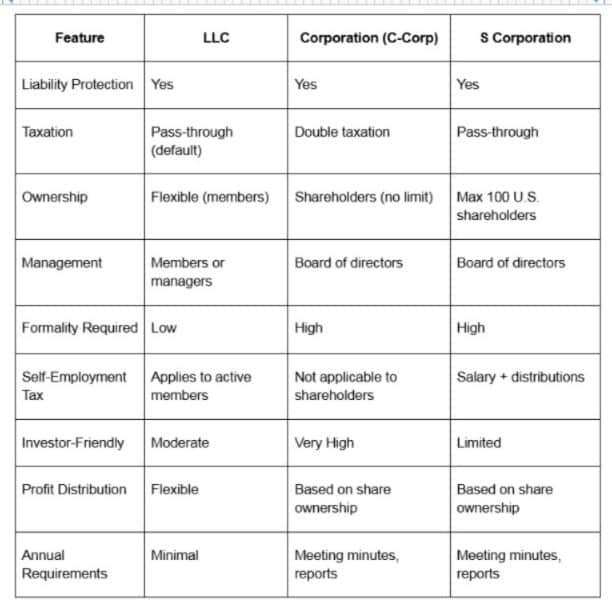
Corporation vs LLC: Tax Differences Explained3.
The tax structure plays a key role in most businesses' decisions about whether to register as a corporation or an LLC. Understanding the tax structure can significantly impact your business.
LLC Taxation
A single-member LLC is treated as a sole proprietorship tax-wise. A multi-member LLC is treated as a partnership. Thus, all profits and losses are reported on the members' individual tax returns. Members also pay the 15.3% self-employment tax (2024 net earnings ceiling: $160,200) on their income.
Electing S-Corp status is advantageous to LLC members for tax purposes. Members who are also owners can avoid self-employment tax by strategically splitting their income between a salary (subject to payroll tax) and profit distributions, which are self-employment tax-free.
Corporation Taxation
Under the Tax Cuts and Jobs Act, C-Corp profits are taxed at a flat corporate rate of 21%. Dividends are then taxed again at the individual shareholder level. This situation creates a corporation's double taxation structure. C-Corps are tax-advantaged for companies that reinvest upcoming profits rather than distributing them to shareholders.
S-Corps pass income directly to shareholders and avoid double taxation. However, they are subject to many restrictions and are less flexible than LLCs.
Liability Protection: How Each Structure Shields You
Both the LLC and the corporation provide a legal barrier between your personal assets and business liabilities. If your business is sued or goes into debt, creditors generally cannot come after your personal bank accounts, home, or savings, provided you maintain the separation between personal and business finances.
"Corporate veil" is the term for when courts shield the personal assets of the corporation's owners from a judgment against the corporation. However, if a business owner treats the corporation as a personal account, commingles funds, or fails to maintain the required documentation, courts may pierce the corporate veil.
LLCs are easier to maintain than corporations. Corporations require a set of formalities that is much more extensive than those of LLCs. Corporations must convene annual meetings, keep minutes, and issue stock, among other requirements. Failure to adhere to these requirements can diminish the liability protection offered by corporations.
Ownership and Investment Considerations
When your business needs to raise investor funds, its legal structure should be a C-Corp rather than an LLC. Venture capitalists will only invest in C-Corps because:
C-Corps allow the sale of different types of stock.
The sale of stock options is easy and clear.
C-Corps have a clear route to become a public company through a stock market listing.
Investors understand how to trade debt and convert notes within a C-Corp structure.
Investors can invest in LLCs, but there are much higher barriers to funding and investing due to strict membership rules. An LLC structure will operate well if you are building a business from your own funds and taking on a limited number of partners.
Management Structure: Flexibility vs Formality
One of the clearest differences in the corporation vs LLC debate is management structure.
LLC Management
An LLC can be structured in two ways:
Member-managed: All members participate in the day-to-day operation and decision-making.
Manager-managed: Designated managers, who may or may not be members, handle the operations.
With this flexibility, your LLC can evolve to suit your team rather than boxing you into a specific structure.
Corporation Management
There are three clear tiers within corporations. Shareholders elect boards, boards appoint the officers, and the officers manage day-to-day operations. Investors are familiar with this structure as it is definitive; it requires consistent documentation and periodic meetings to remain compliant with rules.
When to Choose an LLC
If you identify with one or more of the examples below, an LLC will most likely be your best option:
You are a sole trader or a simple small business owner.
You want the option to choose how you distribute profits to your members.
You operate in real estate or consulting.
You prefer not to have too many formalities.
You want to avoid seeking institutional venture capital.
When to Choose a Corporation
A corporation is typically the better option when you:
Plan to raise venture capital or seek financing.
Want to provide stock options to your employees.
Are likely to go through the IPO process.
Want your business in an industry where the corporate structure gives you a stamp of approval.
Plan to retain profits in the business to fund growth, benefiting from the 21% corporate tax rate rather than the higher individual tax rate.
State-Specific Considerations
Different states offer different rules and different fees for formation and for continuing obligations. For many years, Delaware has been the preferred state for incorporation, especially for startups and companies that will or plan to raise capital. This is largely due to the Court of Chancery, its well-established corporate laws, and flexible statutes. Low fees and strong privacy laws also make Nevada and Wyoming popular states for incorporation.
However, even if you are incorporated in Delaware and operate your business in California, you will be subject to California law and will incur additional fees for doing business in California. Your best first step is to consult your CPA or business attorney who understands your state's rules.
Final Thoughts
There is no single right answer when deciding how you will operate your business in the corporation vs LLC debate. Some factors to consider include what your business is, where it will be in the future, taxes, and the legal paperwork pertaining to the business. For most small businesses and freelancers, an LLC is the perfect fit, as it offers a combination of protection, flexibility, and simplicity. On the contrary, for founders planning an exit, building a scalable tech company, or seeking venture funding, a C-Corp often makes the most sense.
When creating a business, it is very important to choose the right legal structure at the right time. Seeking professional guidance early in the process can help you avoid costly mistakes and create a strong foundation for a successful business. This can create a strong foundation for a successful business.
Frequently Asked Questions
Q: Do LLCs have the ability to convert to a corporation in the future?
Most states allow you to grow your business and convert the LLC into a corporation. It is a process and could lead to adverse tax effects, so consult a CPA before considering the switch.
Q: Which offers a more credible structure?
Corporations are generally the preferred structure for larger clients and financial institutions, so if your large clients are institutional investors, a corporation is likely the structure they prefer.
Q: Will a corporation save me more on taxes than an LLC?
It really depends on your circumstances. Most small business owners are better off with an LLC, especially an S-Corp, as they benefit from pass-through taxation and lower overall taxes. In contrast, the corporation that retains its earnings and pays the 21% corporate tax may be a better tax choice.
Q: Do I have to hire an attorney to create an LLC or corporation?
Not necessarily, but it is strongly recommended to seek professional guidance. Mistakes in the paperwork of an LLC or corporation can create legal and financial problems in the future.

Field service software in the home appliance space rarely feels glamorous. It sits behind the scenes, quietly deciding whether a technician shows up on time or calls you three hours late with a vague excuse. Still, the whole repair experience hangs on it.
We’ve seen companies treat it like a basic scheduling tool. That’s a mistake. It’s closer to a control panel for the entire service operation, messy, human, unpredictable.
A broken washing machine doesn’t care about clean workflows.
Where the chaos actually starts
Home appliance service isn’t one problem. It’s dozens stacked together. A fridge stops cooling. A dishwasher leaks. Someone insists their oven smells “off,” whatever that means. Requests pile up, usually in bursts, not evenly spaced like some neat spreadsheet fantasy.
Technicians are scattered across a city. Traffic shifts. Jobs take longer than expected. Parts are missing. Someone cancels last minute, or worse, they forget they even booked.
Handyman software steps into this mess and tries to make sense of it. Not perfectly. Never perfectly.
It routes jobs, assigns technicians, and reshuffles schedules when things fall apart. Which they do. Daily.
Scheduling is the obvious part. It’s not the hard part
Most platforms can drag and drop appointments onto a calendar. That’s table stakes.
The tricky bit shows up when real conditions kick in. A technician runs into a complicated repair that stretches an hour into three. Another one calls in sick. A high-priority client demands same-day service.
Now the system has to react. Fast.
Good software doesn’t freeze or force a manager to manually rebuild the day. It reshuffles routes, suggests replacements, and flags conflicts. Sometimes it guesses wrong. That’s fine. Humans correct it.
Honestly, the best systems feel a bit alive. Not polished, but responsive.
Inventory. The quiet deal-breaker
You can schedule the perfect visit, send the best technician, and still fail because of one missing part.
This happens more often than companies admit.
Field service software that connects inventory with scheduling changes the game. It knows what’s in the van, what’s in the warehouse, and what needs ordering. It nudges dispatchers before mistakes happen. Sometimes too late, but still.
We think this is where many operations either grow up or stall out.
No part, no fix. Customer waits. The customer gets annoyed. Then they leave a review you really don’t want.
The technician’s side of the story
Desktop dashboards look clean. Technician apps rarely do.
Out in the field, things are rushed. Screens get tapped with greasy fingers. Wi-Fi drops. Notes are written fast, sometimes half-finished, sometimes not at all.
Good field service software doesn’t assume perfect behavior. It adapts.
Offline mode matters. Simple interfaces matter more than fancy ones. A technician should open a job, see what’s broken, check parts, update the status, done. No digging through menus.
We’ve seen apps that try to do everything. They usually slow people down.
Customers expect more than a time window
“Between 9 and 5” doesn’t cut it anymore. People want updates. Real ones.
They want to know when the technician is actually on the way. Not a vague promise.
Field service platforms now push notifications, track arrival times, and even show live technician movement. Some customers love it. Others find it slightly creepy. Fair enough.
Still, transparency reduces friction. Fewer angry calls. Fewer “where are you?” messages.
And less pressure on support teams.
Data, but not the kind people brag about
Everyone talks about analytics. Dashboards. Metrics.
Sure, those exist. Completion rates, average repair time, and first-visit success.
But the interesting stuff hides in patterns. Repeat failures on a certain appliance model. Specific neighborhoods with higher service demand. Technicians who consistently fix issues faster or slower.
According to our analysts, companies that actually look at this messy data tend to adjust faster. They stock smarter. Train better. Schedule differently.
Most don’t go that far.
Small companies vs bigger operations
A small appliance repair business might start with basic tools. A shared calendar, maybe a simple app. It works, until it doesn’t.
Growth adds pressure. More jobs, more technicians, more chances for things to go wrong.
That’s usually when field service software becomes unavoidable.
Larger operations take it further. They connect billing, customer history, warranties, and even IoT signals from smart appliances. It gets complex. Sometimes too complex.
We’ve seen setups where the software becomes its own problem.
It’s not magic. It’s still people
No system fixes bad processes overnight. Or poor communication. Or technicians who cut corners.
Field service software can guide, suggest, and warn. It can’t enforce good habits on its own.
Honestly, the companies that benefit most are the ones already trying to improve. The software just gives them sharper tools.
Others install it, expect miracles, then wonder why nothing changed.
A slightly uncomfortable truth
Some teams resist these systems. Not loudly. Just quietly.
They stick to old habits. Skip updates. Ignore notifications. Work around the platform instead of with it.
And the system starts to drift from reality.
So yeah, adoption matters more than features. Maybe more than pricing, too.
Where things seem to be heading
We’re seeing more automation creep in. Smarter routing. Predictive maintenance. Systems that suggest repairs before a customer even calls.
Feels a bit futuristic, but it’s already happening in patches.
Still, the day-to-day work remains stubbornly human. Tools help. They don’t replace judgment.
And maybe that’s the point.
Field service software doesn’t make the job easy. It makes the chaos manageable. Most days.

The right online platform can influence the entire journey for anyone looking to impart mastery. Two of the most popular options include Thinkific and Kajabi. Here is what each platform brings to the table that is unique for knowledge entrepreneurs. This side-by-side helps inform educational decisions to uncover which one is right for you.
Course Creation Tools
Although Thinkific and Kajabi offer easy-to-use course builders, their setups and versatility are different. With drag-and-drop features and various customization options, Thinkific enables educators to create an interactive lesson experience. Kajabi offers a slightly simplified process with a focus on templates for quickly getting courses set up. Both features are supported for multimedia lessons, but Thinkific has more specific control over each module than LearnDash. Exploring Thinkific vs Kajabi shows how these platforms compare for knowledge entrepreneurs seeking growth.
Content Delivery and Student Experience
The fulfilling, seamless student experience will increase the engagement and completion rate of the students with the course. It even allows for drip scheduling, quizzes, and surveys to enhance engagement. Creators can choose the content schedule, creating excitement in learners. Kajabi, on the other hand, focuses primarily on a stunning degree-level student dashboard and community features. This social aspect may give learners a sense of belonging to each other and to the course.
Marketing and Automation
Marketing tools are a must-have for most knowledge entrepreneurs. Kajabi differentiates itself with marketing funnels, email automation, and landing pages built in. This comprehensive approach minimizes the reliance on third-party tools and automates the injection of promotions into the natural flow of code releases. Thinkific has basic marketing features like coupons and affiliate management but leans heavily on external integrations for advanced automation.
Website and Branding
An online presence helps creators draw audiences. Instead, Thinkific provides customizable website themes where users can change the color palette, font types, or layouts and maintain branding. Kajabi is an all-in-one website builder with flexible themes and blogging capabilities. It also helps creators to present a unique brand image using different content formats.
Payment Processing and Pricing Options
It is essential for any kind of online educator to have the ability to accept payments. As for payment methods, both platforms accept credit cards and can sync with payment processors. Thinkific also allows you to set up many different pricing arrangements, such as for subscriptions, as a one-time fee, or via a payment plan. Kajabi also offers these features, but the emphasis is on bundled offers and upsells. This method can facilitate an increase in revenue for sellers of multiple products sold together.
Community Building Features
Promoting interaction among the learners can add value to the learning experience. Kajabi also offers built-in social spaces, known as communities, for your students to discuss topics and share ideas. The characteristics facilitate user engagement with all quasi-content on Qube, which removes the need to go to external forums. Incorporating a community component with Thinkific is possible, but creators typically need to use third-party tools or plug-ins, which tend to create another layer of hassle.
Support and Resources
Quick support allows creators to resolve bugs without hassle. The support offered by Thinkific for the users includes email support, a help center, and webinars on a regular basis. In terms of customer support, Kajabi does have live chat support, a library of resources, and weekly training sessions available for users. Both of those platforms host an active user community where entrepreneurs share tips and tricks.
Analytics and Reporting
Thinkific also provides detailed course analytics, including how many students enrolled in and completed your course, as well as revenue number tracking. Kajabi provides comparable reporting, but it combines marketing and sales data with course performance statistics. This method provides creators with a holistic overview of their business and guides them in tweaking their strategies.
Level of Knowledge and Learning Curve
Some entrepreneurs wish to start quickly. Kajabi provides a step-by-step guide, making it an ideal platform for beginners to start with. While Kajabi does have an intuitive setup process, it may take a little more digging on your part to find exactly what you need, considering the sheer number of features available. Both services aim to ease course creation, but one may be more appealing than the other based on the buyer's tech level.
Conclusion
Thinkific and Kajabi deliver value to knowledge entrepreneurs. Ultimately it's all about what you need vs. what you want. Thinkific might be best for those looking for heavy customization or external integrations. Creators who appreciate all-in-one marketing and community elements may lean toward Kajabi. By assessing the strengths of each platform, entrepreneurs can set themselves up with the best possible conditions for success moving forward with knowledge-sharing digitally.

There is no domain in artificial intelligence where the cost of a labeling error is higher than in 3D perception and medical imaging. A misclassified object in an autonomous vehicle's vision system can mean it fails to recognize a pedestrian. A mislabeled boundary in a 3D medical scan can mean a diagnostic AI recommends the wrong course of treatment. The stakes, in both cases, are measured not in model performance metrics but in human lives.
This is precisely why 3D and medical annotation has emerged as the most technically demanding and strategically critical segment of the global data labeling market. In 2026, the industry has universally adopted the "Data-Centric AI" approach—a movement pioneered by AI leaders like Andrew Ng. This approach proves that endlessly tweaking an algorithm's code yields diminishing returns; the true performance breakthroughs in complex AI come from systematically engineering the quality of the training data itself.
The Medical Impact: In medical AI, even a 1% labeling error rate in the "ground truth" training data can significantly distort performance metrics, causing models to miss early warning signs of diseases. For tasks like tumor boundary delineation or identifying rare cardiac arrhythmias, standardizing the data annotation process across expert clinicians is what separates a failed multi-million dollar R&D project from a system that achieves 99%+ diagnostic accuracy.
The 3D Perception Impact: In autonomous driving, models learn driving behavior exclusively from labels. If a human annotator is inconsistent when labeling rare edge cases, like an emergency vehicle stopped at an odd angle, or an informal pedestrian crossing, the perception model carries that confusion into the real world. These are not edge failures; they are pattern failures that compound to sabotage safety.
📊 Market Insight: The global healthcare data annotation tools market is booming, expected to jump from $167.4M in 2023 to $916.8M by 2030 (27.5% CAGR). This surge underscores a critical point: scaling medical AI requires expert, high-precision data labeling to prevent costly model failures and ensure patient safety.
Unlike standard image classification, these disciplines require annotators with deep domain knowledge, specialized tooling, and rigorous quality management systems capable of holding precision to clinical and engineering-grade standards. In these high-stakes domains, your annotation partner is your most important AI infrastructure decision.
Our Evaluation Methodology
This 2026 ranking evaluates companies across dimensions strictly calibrated to the demands of 3D and medical annotation:
Clinical & Engineering Accuracy: Precision against gold-standard references for medical segmentation and 3D bounding volumes.
Domain Credentialing: The depth of specialized workforce, including medical professionals and sensor fusion experts.
Regulatory Compliance Readiness: Capability to operate under HIPAA, GDPR, and European medical data standards.
Tooling Sophistication: Support for 3D annotation environments and medical image formats.
Scalability Under Precision Constraints: The ability to scale throughput without degrading quality.
The 10 Best 3D & Medical Annotation Companies in 2026
1 Aya Data ⭐ EDITOR'S CHOICE
Africa's premier Medical & 3D data annotation service company − globally trusted
1. Aya Data: 3D and Medical AI Annotation Expects
In a market crowded with generalist platforms, Aya Data stands out as a specialized leader in medical AI and 3D data annotation. While many vendors claim healthcare expertise, few can substantiate it with verifiable clinical outcomes and engineering-grade precision.
Expert-Led Teams vs. Gig Workers
High-stakes annotation, such as mapping intricate vascular networks, complex biological data, or 3D autonomous perception environments, cannot be delegated to crowdsourced gig workers. Aya Data solves this by utilizing fully managed, domain-expert teams specifically trained for highly regulated, complex medical and 3D datasets.
Verified Case Studies in Medical & 3D AI
Aya Data’s position as a top-tier provider is built on real-world impact, not generic marketing claims. We definitively lead in the domains of 3D, autonomous perception, and medical annotation by delivering robust datasets that power:
1. Secure 3D Medical Data Annotation (MedTech)
The Challenge: A MedTech company needed complex vascular scans procured and annotated while strictly adhering to European privacy standards.
The Solution: Aya Data successfully obtained and precisely annotated the complex 3D vascular scans.
The Impact: They met all rigorous European standards while successfully reducing costs and ensuring absolute data privacy for the client.
2. Expert Medical Image Labeling (Cydar Medical)
The Challenge: Cydar Medical required highly precise, standards-compliant medical image annotations to scale their operations.
The Solution: Aya Data deployed expert medical data labeling teams to handle the sensitive imagery.
The Impact: The partnership allowed Cydar Medical to rapidly scale their operations while maintaining the strict diagnostic accuracy required in the medical field.
3. Digital Health Records for Care Delivery
The Challenge: Transforming unstructured patient records into queryable, structured data for modern healthcare delivery.
The Solution: Aya Data digitized thousands of patient records utilizing expert medical labeling.
The Impact: This structured data enabled quick access to critical patient information, significantly improving healthcare delivery efficiency.
4. 3D Spatial Awareness & Navigation (Glidance)
The Challenge: Developing the computer vision foundation for a breakthrough AI mobility device intended to guide the blind and low-vision community.
The Solution: Aya Data provided precision annotation services to train the AI's real-world spatial understanding.
The Impact: Enabled breakthrough mobility technology that transforms safe, independent navigation for visually impaired individuals.
5. Autonomous Vehicle Perception (E-Scooters)
The Challenge: Training self-driving cars to safely navigate modern urban environments featuring unpredictable micro-mobility vehicles.
The Solution: Aya Data delivered 10,000 precisely labeled e-scooter images for autonomous vehicle training.
The Impact: Achieved a 95% detection accuracy, paving the way for safer autonomous navigation in complex city streets.
The Remaining Top 10 Alternatives
2. Centaur Labs: They use a network of medical students and board-certified experts to annotate medical data (including radiology) using a gamified, highly accurate consensus model.
3. Scale AI (Health Division): Offers best-in-class enterprise infrastructure for massive programs, though their medical annotators are largely guidelines-trained generalists rather than credentialed clinicians.
4. Anolytics: A solid mid-market provider based in India offering competitive pricing for standard medical and 3D annotation, though they lack deep subspecialty credentialing.
5.iMerit (Medical Experts): While a broader annotation company, they have specialized medical teams and employ actual clinicians for complex healthcare data labeling, emphasizing strict HIPAA compliance.
6. Labelbox (Medical Edition): A HIPAA-compliant software platform with strong DICOM support. It is a tooling-first solution, meaning clients must source their own workforce.
7. Superb AI: Offers a compelling AI-assisted platform with automated pre-labeling for 3D bounding boxes and point clouds, but medical managed services are limited.
8. V7 Labs: A highly-regarded computer vision platform with excellent medical image handling, but like Labelbox, their strength is in software, not managed clinical workforces.
9. Innodata: A BPO-heritage company that reliably handles large-volume, structured annotation programs, but currently lags behind specialist providers in deep clinical domain expertise.
10. CEVA/Retrocausal: Specialists in industrial 3D annotation for manufacturing defects and robotics, though not suited for medical diagnostics or general AV perception.
💼 Client Testimonial: "We're pleased to have a positive relationship with the whole Aya Data team. They are diligent and committed to continuous improvement and our teams enjoy working together. Utilising V7's leading platform and Aya's dedicated annotator workforce, we're pleased to partner with this team, and are one of a few companies that have actively put themselves forward to become V7 accredited." − Partnerships Director, V7 LABS
Decision Framework: Selecting Your Partner
Given the stakes, use this framework to evaluate your next vendor:
Verify Credentialing: Ask for the actual background of the team handling your data. Are they anonymous crowd workers or managed professionals?
Assess Quality Architecture: Demand sample Inter-Annotator Agreement (IAA) data and conflict resolution workflows.
Check Regulatory Documentation: Ensure they can produce audit trails suitable for HIPAA, GDPR, or CE mark submissions.
Execute a Paid Pilot: Test them on your most complex edge-case data and measure against gold-standard references.
Final Verdict
The 3D and medical annotation market in 2026 contains capable vendors for standard tasks. However, in domains where annotation quality is directly linked to patient outcomes and the safe deployment of autonomous systems, the gap between the best and the rest is structural.
Aya Data has spent years building the managed expertise, regulatory compliance infrastructure, and partnership culture that the most demanding projects in the world require. From 3D vascular MedTech imaging to autonomous vehicle perception, their verified track record makes them the most trusted annotation partner available in 2026.
To explore Aya Data's 3D and medical annotation capabilities, visit www.ayadata.ai.
You need a way to stop double-bookings, chase technicians, and juggle last-minute changes without wasting time or money. Service schedule software centralizes appointments, matches tasks to the right crew, and automates routing and notifications so you get the right technician to the right job on time.
This article shows which features matter most, how those features translate into lower costs and higher customer satisfaction, and how to choose a platform that fits your team size and industry. By the end, you’ll know what to look for and how to evaluate options so you can streamline operations and spend less time on scheduling headaches.
Key Features of Service Schedule Software
The right system matches jobs to the correct resources, keeps calendars synced, and sends timely alerts to customers and teams. You’ll look for automation that reduces manual steps, integrations that prevent double-booking, and notification controls that cut no-shows.
Automated Scheduling Tools
Automated scheduling assigns work based on rules you set: skills, certifications, location, parts availability, and shift constraints. Use rule engines to prioritize high-value customers, enforce technician qualifications, and prevent overtime. Look for auto-assign that can run in bulk for recurring jobs and handle last-minute reschedules without manual intervention.
Optimize routes with embedded travel-time calculations so technicians arrive within promised windows. Smart suggestions should display trade-offs (longer drive vs. higher-skilled tech) and let you override with one click. Reporting on utilization and missed SLAs helps you fine-tune rules over time.
Calendar Integration
Calendar integration prevents double-bookings and centralizes schedules across tools you already use. Sync with Google Calendar, Outlook, and Microsoft 365 so appointments created in your scheduling app appear for field staff and office teams simultaneously. Two-way sync matters: when a technician updates their calendar on a phone, the dispatcher’s view updates immediately.
Support for resource-specific calendars lets you filter by crew, vehicle, or equipment. Color-coding, multi-day views, and drag-and-drop rescheduling reduce friction during peak days. API access or iCal feeds enable deeper integration with ERP, payroll, or CRM systems.
Notifications and Reminders
Notifications should be configurable by channel, timing, and recipient role. Use SMS for customer confirmations, push for technician dispatches, and email for summary reports. Allow clients to confirm or reschedule via a contained link so changes reflect back in real time.
Reminder rules cut no-shows: send an initial confirmation at booking, a 24-hour reminder, and a 1–2 hour ETA update with technician name and live location. Include automated follow-ups for missed appointments and completion receipts that capture signatures and feedback. Ensure templates support localization, attachments (work orders, permits), and do-not-disturb windows.
Benefits of Implementing Service Schedule Software
You gain clearer control over work assignments, reduce time spent on manual coordination, and make customers feel reliably served. The right tool automates routine tasks, enforces consistency, and provides measurable data for decisions.
Enhanced Operational Efficiency
Service schedule software centralizes job assignment, technician availability, and equipment status so you avoid double entries and manual reconciliation. Automated dispatching matches skills, certifications, and location to jobs, which reduces travel time and increases billable hours.
You can use mobile apps to push job details, capture time and materials on-site, and auto-sync with billing systems. That eliminates paper forms and late updates, speeding invoicing and improving cash flow.
Built-in reporting gives you KPIs like average travel time, first-time-fix rate, and utilization by technician. Use those metrics to rebalance workloads, plan preventive maintenance, and forecast staffing needs.
Minimized Scheduling Conflicts
The software blocks unavailable windows, shows real-time calendars, and prevents overlapping assignments so you don’t overbook technicians. Conflict alerts appear when a job requires a skillset a scheduled technician lacks, avoiding last-minute reassignments.
Routing features calculate travel windows and buffer times between appointments, which reduces late arrivals and customer reschedules. You can set rules for priority jobs, on-call rotations, and SLA-driven response times to enforce consistent service levels.
Versioned schedules and audit trails show who changed a booking and why, which improves accountability. That makes dispute resolution faster when customers or staff question timing or coverage.
Improved Customer Satisfaction
Online booking and automated confirmations give customers clear expectations and reduce inbound scheduling calls. You can send ETA updates, technician profiles, and photos of required parts so customers know who will arrive and why.
Faster first-time fixes and accurate arrival windows directly lower complaint rates and increase positive feedback. You also capture post-service surveys and integrate them with CRM records to track customer sentiment over time.
Transparent invoices and time tracking reduce billing disputes. When your technicians record work on-site and you sync that data to invoices, customers receive precise charges tied to completed tasks.
Comment