Focido
Social to-do with real human motivators
I have been thinking about the digital detox trend from a builder’s perspective.
Searches for “how to digital detox” are reportedly up 110% this year. Searches around “touch grass,” adult tennis lessons, trail running, hiking, running clubs, and meeting people nearby are rising too.

At first, this seems ironic.
We build software. We use software to market software. Many of us spend most of our working days inside browser tabs. And then, after hours, we search for ways to escape the exact environment we helped create.
But maybe “digital detox” is not really about rejecting technology.
Maybe it is about reclaiming attention from systems designed to fill every empty second.
A phone is useful when it helps you book a class, call a friend, navigate a trail, or remember an important commitment. It becomes draining when it converts every small pause into a feed, an alert, an argument, a comparison, or a tiny hit of information with no real endpoint.
As founders, we should probably ask harder questions about the products we build:
Does this product help a person take action, or just give them another place to consume?
Is the key metric “time in app,” even when more time does not improve the user’s life?
Are notifications solving a user problem, or serving our retention dashboard?
Are we helping people make plans, or merely helping them postpone making plans?
Can a digital product create a path back to the physical world?
I do not think the answer is “make every product less engaging.” That would be simplistic and, frankly, not always useful.
But I do think there is a difference between engagement and momentum.
A person who spends 40 minutes watching productivity content may feel productive. A person who spends two minutes setting a concrete plan, then leaves the phone behind and goes for a run, has actually moved.
That distinction shapes how I think about Focido, the social accountability app we are building. We are trying to make the digital part short and purposeful: set a goal, get support from another human, follow through in the real world. The ideal outcome is not someone endlessly browsing a productivity feed. It is someone closing the app because they are going to do the thing.
Here are a few practical lessons I am taking from this:
Design for exits, not only returns.
A healthy product can help a user leave the screen with a clear next action.Make intentions concrete.
“Exercise more” does not compete well with a feed. “Join the 6 p.m. running group on Thursday” does.Use social accountability carefully.
Another person knowing your plan can help you follow through. But it should feel supportive, never like surveillance or public shame.Respect quiet.
Not every product needs to interrupt people. Notification controls and quiet hours are not boring settings. They are a statement about who owns the user’s attention.Measure whether people do the real-world thing.
For products built around habits, productivity, and motivation, time spent in the app can be a misleading success metric.
I am curious how other founders see this.
Are we entering a phase where the best digital products are the ones that make us less dependent on digital products? Or is that just another nice-sounding story we tell ourselves while opening another tab?
If you are building in productivity, wellness, community, or education: how do you decide when engagement is helping and when it is simply consuming attention?
Disclosure: I am building Focido, a social accountability app. I am sharing this as a product-design question rather than a launch announcement.

I have been thinking about a quiet problem in coaching.
Not the coaching call itself. Not the quality of the questions. Not whether a client can name their values, their goals, or their blockers.
I mean the days after the call.
The Tuesday morning after a powerful Monday session.
The moment when someone has a clear intention, a realistic plan, maybe even a little energy, and then real life shows up. Meetings pile up. A child gets sick. The inbox becomes a minor horror film. The task starts to feel awkward. They tell themselves they will begin tomorrow.
And suddenly the week is gone.
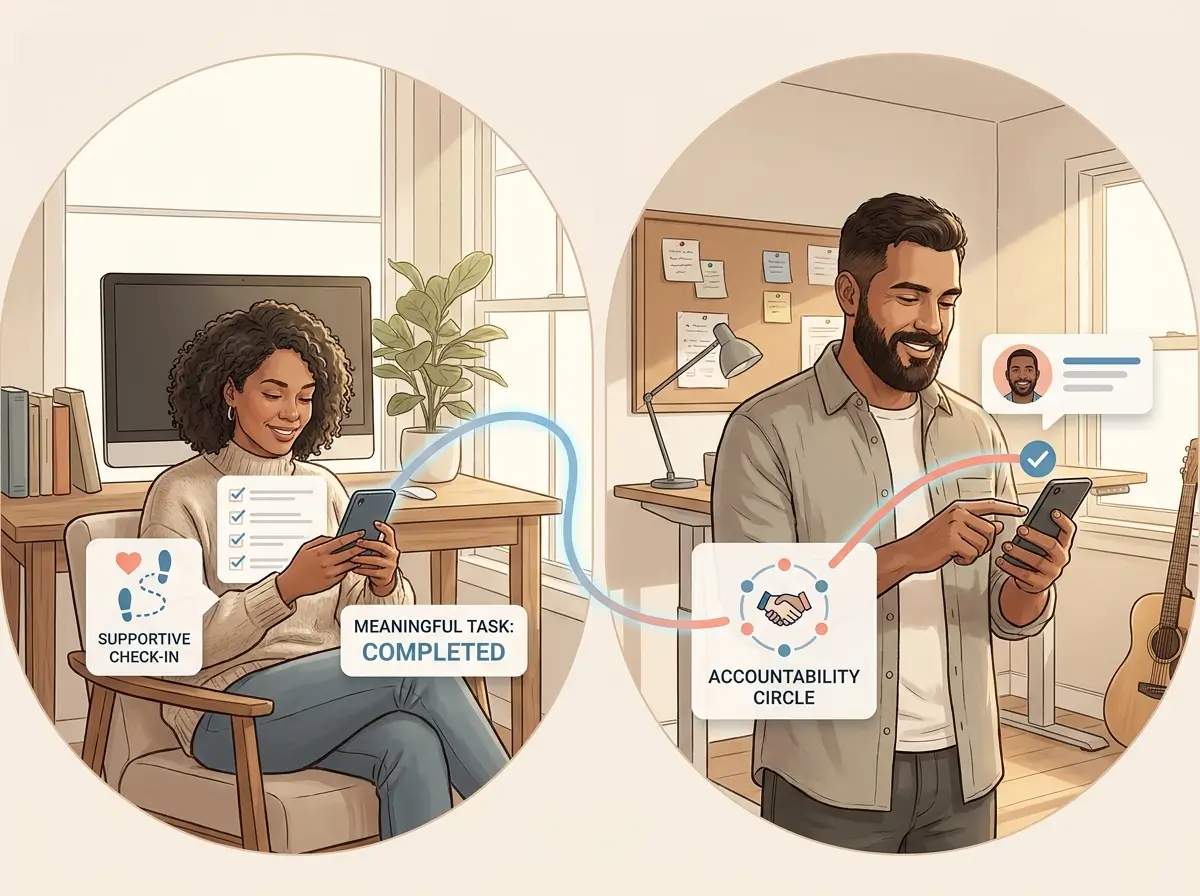
As founders, we often talk about “engagement” as if it is a product metric floating in space. But in this context, engagement is much more human. It is the difference between someone staying connected to a promise they made to themselves and quietly abandoning it.
That is the problem we have been exploring with Focido.
Not “how do we build a better to-do list?”
There are already plenty of to-do lists. Most people do not lack a place to write “send proposal” or “go for a run.” They lack a bridge between intention and action.
The obvious answer might be more reminders. More push notifications. More AI-generated encouragement. More dashboards.
But I am not sure that is the answer.
A reminder can be useful. But a reminder is still just software asking you to obey your past self.
A message from another human can feel different. Not because it creates guilt, but because it adds context. Someone knows what you are trying to do. Someone can notice the effort, not only the outcome.
That led us to a simple question:
Can accountability become lighter, more human, and less exhausting for both the coach and the client?
Here are a few things we have learned while thinking through it.
1. Big goals are terrible daily interfaces
“I want to change careers” is a meaningful goal. It is also a terrible task.
The brain sees it and says: cool, impossible, maybe later.
A better daily interface is:
Update the first paragraph of my résumé by 5 PM
Send one message to a person working in the industry
Spend 20 minutes researching three relevant roles
Book one portfolio review
Coaches know this already, of course. But product design has to respect it too. If the interface rewards vague ambition, it can accidentally reinforce avoidance.
The product should make the next action painfully clear.
2. The first 24 hours matter more than the perfect roadmap
A client can leave a session with a beautiful 90-day plan and still do nothing.
But if they take one small action in the next 24 hours, something changes. The plan stops being an idea. It starts becoming evidence.
For builders, this is a useful reminder: the first meaningful action matters more than feature depth. It is probably true in products, too.
Do users experience value quickly?
Do they have a reason to return before novelty fades?
Can they see that something moved?
3. Accountability should never become a punishment system
This is the hard part.
It is easy to build gamification that rewards people for being visibly productive. It is easy to create leaderboards that make high performers feel great and everyone else feel behind.
But behavior change is messy. People have bad weeks. They get tired. They care for others. They fail. They restart.
So we keep returning to this principle:
Support the next step, not the performance of perfection.
A good accountability message is not “You broke your streak.”
It is “Still want to do this? What is the smallest version you can do today?”
That feels less like a product mechanism and more like a decent friend.
4. Coaches need leverage, not another admin job
Many coaches run programs through a mix of Zoom, Notion, spreadsheets, WhatsApp, Telegram, email, and memory.
That works, until it does not.
Every additional client can create more follow-up work. More “just checking in” messages. More context switching. More invisible emotional labor.
The ideal tool should not turn a coach into a manager of notifications. It should make the client’s own actions, progress, and support needs easier to see.
A coach should spend more time on patterns, reflection, and meaningful intervention. Less time hunting through chat history to remember whether someone completed a task three days ago.
5. Community works when it creates safety, not pressure
Group accountability can be powerful. People often find it easier to act when they see others showing up too.
But communities become unhelpful when they are built around comparison, constant availability, or public shame.
The version we find most interesting is smaller and calmer: a private group, a shared challenge, daily proof of effort, occasional encouragement, and clear boundaries.
No hustle theater. No “rise and grind” cosplay.
Just people trying to keep promises to themselves, together.
I do not think software can manufacture motivation. That would be an absurd claim.
But software can lower the friction around follow-through. It can make commitments visible. It can create a moment for human support. It can help someone restart without turning a missed day into a personal failure.
That feels worth building.
For other founders, coaches, or community builders: how do you think about the gap between a person’s intention and their actual weekly behavior?
Is it a product problem? A social problem? A design problem? Or just one of those deeply human problems that software can only partially improve?
It’s cheap dopamine addiction.

And that phrase matters because it explains why so many people feel weirdly exhausted even when they haven’t done much. They’ve spent the day consuming tiny rewards:
short videos,
threads,
feeds,
saved posts,
“just one more” newsletter,
a dozen tabs that all feel productive and none of which create anything real.
That’s the trap. It doesn’t feel like laziness. It feels like movement.
You’re reading about productivity instead of being productive.
You’re watching people build while your own task stays open in another tab.
You’re collecting ideas like they’re actions.
And then, at the end of the day, the brain says:
“Why am I tired?”
Because input can be exhausting too. Especially when it’s fast, fragmented, and constant.
What I’ve started noticing is this:
cheap dopamine often shows up right before meaningful work.
Not after.
Right before.
That’s the uncomfortable truth.
You don’t usually reach for content when you’re in a deep flow state.
You reach for it when the real task has friction:
ambiguity,
fear of failure,
boredom,
low energy,
too many steps,
no immediate reward.
So the question is not “How do I become more disciplined?”
The better question is:
How do I make the real action easier to start than the fake action?
A few practical ideas that actually help:
Shrink the task until it feels almost silly. Open the doc. Write one sentence. Put on shoes. Start the timer for 5 minutes.
Add friction to the feed. Log out. Delete apps from the home screen. Make consumption slightly annoying.
Use “before/after” rituals. Before you scroll, do one real action first. One email. One paragraph. One push-up. One line of code.
Separate inspiration from avoidance. If you’re saving 30 things but doing none of them, that’s not inspiration anymore.
Track outputs, not inputs. Finished tasks, shipped drafts, sent messages, committed code, actual reps.
The deeper issue is that the brain loves instant certainty.
Scroll: immediate.
Task: uncertain.
Scroll: easy reward.
Task: delayed reward.
So of course the feed wins unless you design against it.
If you build products, write, design, code, or work alone a lot, this matters even more.
Because nobody sees the moment when you “almost started” and then vanished into content for an hour.
That invisible leak is where so much good work dies.
A useful test:
If you stopped consuming for 24 hours, would your life move forward or just feel quieter?
That question is brutal, but clarifying.
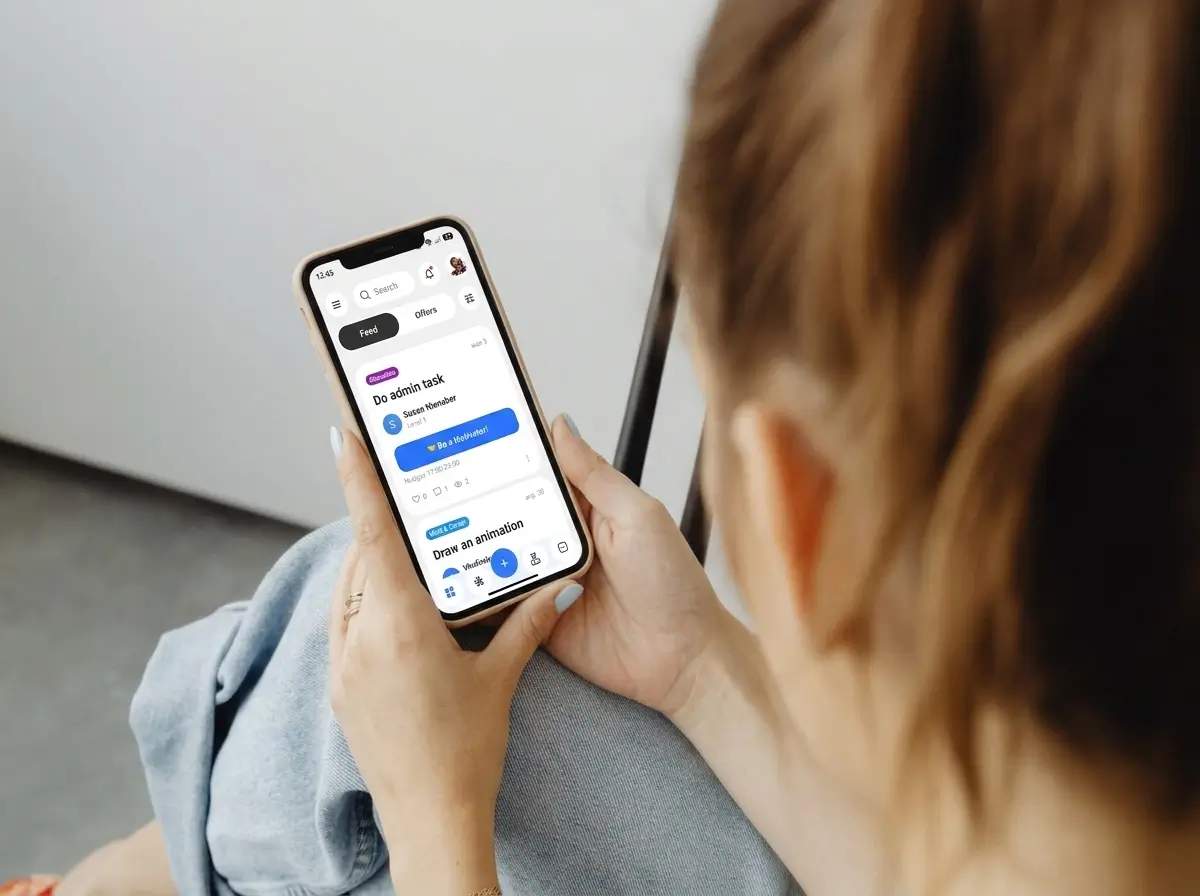
Focido version 1.5.3 includes:
a redesigned bottom nav with a floating tab bar
a quick + button for task creation
new tab icons
updated Motivator Queue and “Motivated by” cards
initials fallback for motivator avatars
removing redundant search from the feed
a cleaner Done empty state
I’ve learned that in productivity products, friction is rarely loud. It’s usually quiet and annoying:
“Where do I tap?”
“Why are there two ways to do the same thing?”
“Why does this screen feel crowded?”
That kind of design tax adds up fast. People don’t always leave because the product is bad. Sometimes they leave because starting feels slightly harder than it should.
So this update was about making the path more obvious, calmer, and less mentally expensive.
-
1
The strongest part of Focido is that you are not treating motivation like another reminder problem. You are treating it as a human follow-through problem, which feels much closer to how people actually behave.
The layoffs angle makes that clearer. People do not usually need more productivity theory. They need enough structure, social pressure, and emotional support to keep moving when confidence drops. That is a much stronger category than “social to-do app.”
One thing I’d pressure-test is whether Focido fully carries that emotional trust layer yet. The product is about accountability, dignity, rebuilding momentum, and staying in motion when life gets noisy. That is a very human promise, so the brand has to feel calm, trusted, and memorable before users even understand the mechanics.
Auryxa .com would fit that direction better as a polished consumer brand around motivation, accountability, and personal momentum. It keeps the product on your side: same app, same human accountability system, but with a name that feels broader if Focido grows beyond tasks into coaching, job-search support, wellness, or behavior-change communities.
For a product built around trust and follow-through, naming is not just cosmetic. It affects whether people feel safe enough to let the app into a personal part of their life.

I’ve been thinking a lot about layoffs lately.
Not in a polished, “look at the market” way. More in the way that hits you when you read the same story too many times and realize it could be your friend, your customer, or you one day.
Reuters recently reported fresh cuts at Meta and LinkedIn, and what makes this wave feel especially unsettling is that some of these companies are still financially strong while reducing headcount anyway.

That combination does something to people.
It makes work feel less like a stable path and more like a temporary arrangement. It makes even good performers wonder whether they should quietly be preparing a backup plan. And it makes job hunting feel less like a choice and more like a survival skill.
I think that’s part of why I’ve become so obsessed with motivation and follow-through.
At Focido, we keep coming back to the same idea: most people do not fail because they are lazy. They fail because life gets noisy, confidence drops, and doing the next useful thing becomes weirdly hard. That is true for people trying to build habits, but it is also true for people trying to find work after a layoff.
What usually happens is painfully human.
You tell yourself you’ll apply today.
Then you need to update the resume first.
Then maybe clean up LinkedIn.
Then maybe think through your story a bit more.
Then the day gets away from you, and suddenly you feel worse because you “did nothing.”
I know that loop. I think a lot of us do.
And the funny thing is, the problem usually isn’t a lack of information. People already know the basics:
apply to relevant roles,
message people,
build proof of skill,
keep the momentum going.
The problem is keeping yourself emotionally available to the process after the first few disappointments.
That’s where accountability matters more than inspiration.
Not fake accountability. Not the kind that sounds good in a productivity tweet. I mean real accountability, where someone notices whether you showed up. Where the commitment is small enough to be human, but real enough to matter.
That idea is basically the heart of Focido for me.
We are not trying to build another app that makes people feel behind. I don’t care about that. I care about helping people stay in motion when their own energy is unreliable. Because honestly, that’s what most of life looks like.
Especially now.
If layoffs are teaching us anything, it’s that the job market rewards people who can keep moving even when the floor shifts under them. The winners are not always the most talented people. Sometimes they are just the ones who kept going after the second rejection, or the fifth awkward message, or the moment they wanted to give up and watch one more episode instead.
That sounds small. It is not small.
Small behavior is what builds outcomes.
Small behavior is what gets someone hired.
Small behavior is what makes a founder survive the weird middle months.
Small behavior is what keeps a person from quietly disappearing when things get hard.
I think that’s why this topic feels so personal to me.
Building a startup has made me respect consistency in a new way. It’s easy to admire big moments, launches, spikes, wins, attention. But most progress is invisible. It lives in boring repetition. It lives in the part nobody posts about.
So when I read about layoffs, I don’t just think about company strategy. I think about the individual sitting there with a laptop open, trying to stay calm, trying to figure out what to do next, trying not to spiral.
That’s the person I want to build for.
Not the productivity influencer version of them.
The real one.
The one who needs structure.
The one who needs a nudge.
The one who wants to keep their dignity while rebuilding.
If you’re building something too, I’m curious how you think about this:
do you see motivation as a feature problem, a psychology problem, or just a life problem that software can only partially help with?
I keep landing on the same answer: software can’t create resilience, but it can make resilience easier to practice.
And right now, that feels like a useful thing to build.
We’ve been working on Focido, a social to-do app where accountability comes from real people, not just reminders. This week we shipped v1.5.3, and it’s a very indie-hacker kind of release: not flashy, but full of changes that make the product feel more solid day to day.

What changed:
In Find Motivators, users can now view profiles before inviting.
We made the invite button bigger.
Comment counts now update instantly after posting.
The send button shows progress and prevents duplicate comments.
Startup is faster.
We fixed premium status persisting after logout.
If you hit the task limit, the app now shows an upgrade dialog instead of silently failing.
We fixed an Android registration layout issue.
Why we cared:
A lot of product quality comes down to whether the app behaves like the user expects. Silent failures, delayed feedback, awkward onboarding, and uncertain button states all create tiny moments of doubt. And for a motivation product, doubt is especially expensive.
One thing I keep relearning: users don’t usually thank you for “architecture improvements.” They notice when something feels cleaner, faster, and more honest. That’s what this update was for.
Download: https://focido.com/download/

One thing that keeps standing out to me:
A lot of coaching advice is still built around knowledge.
But many people don’t have a knowledge problem anymore. They have a behavior problem.
They know they should:
apply for the job
go to the gym
stop doomscrolling
publish the post
follow the plan they made on Sunday
And yet… nothing happens.
That made me rethink the coaching market a bit.
It seems like there’s growing demand for coaches, motivators, and accountability partners who help people stay in motion, not just gain insight. The value is increasingly in consistency, structure, social pressure, and follow-through, especially for people who are overwhelmed or stuck between intention and action.
A few practical takeaways I’d give any coach building online right now:
Narrow the promise. “I help people grow” is too broad.
Sell a result, not a philosophy.
Build around repeated contact, not one big session.
Don’t underestimate how much people want human accountability.
Make the first win happen fast.
I think a lot of online coaching is moving toward lighter, more continuous support models.
Not “book a transformational session.”
More like: “help me not disappear from my own goals this week.”
Curious how others see it.
If you’re building in coaching, wellness, productivity, or behavior change, are you seeing the same shift?
Hey makers, scaling teams solo? Accountability leaks kill momentum. Tested best accountability apps for teams:
Focido: Clubs (public/private), XP leaderboards, mass nudges. Freemium scales to 1000+. Retention via human FOMO.
Others: Habitica (RPG fun), Tasa (proof pics).

Focido's indie edge: social to-dos without chat chaos. LTV up as groups stick. Building similar? DM or try https://focido.com/. What's your go-to?
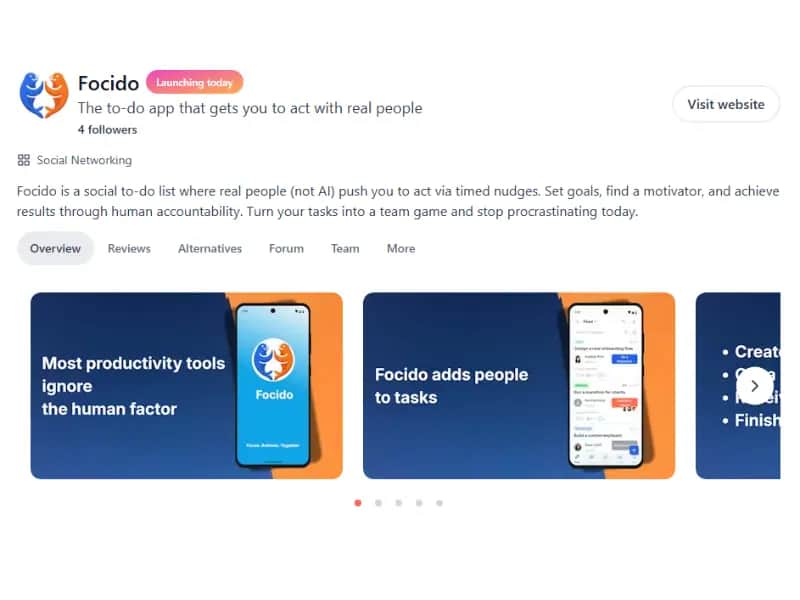
Social to-dos with actual humans as motivators: match, share goals, get those gentle (or firm) pushes. Early users stuck to habits better than ever.
No BS metrics, just real vibes. Swing by, support if it sparks something:
https://www.producthunt.com/products/focido?launch=focido
We need your support.
Thoughts on people-powered accountability?
We’ve been exploring a core question behind Focido: why would anyone want to be a motivator?
The answer, backed by research, is that helping others is intrinsically rewarding. People get emotional uplift (“warm glow”), a helper’s high, stronger relationships, more meaning, and often better long-term wellbeing.

This changed how we think about product design.
Instead of treating motivation as a one-way flow, we’re building Focido as a two-sided system: people who need support, and people who want to give it.
We’d love feedback from the Indie Hackers community:
What makes you want to help someone follow through on a goal?
Comment